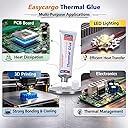
This review is for the Easycargo Thermal Glue ES910. My first application for this product was to attach a glass encapsulated axial lead thermistor (think of a 1N4148 diode for comparison) to the mounting base of a TO-3 transistor. The thermistor will monitor the temperature of the transistor and adjust the cooling fan air flow as needed. The tube of “glue” arrived in an ESD zip lock envelope with no instructions; either on the tube or in the envelope. The Amazon ad did have a small data sheet posted with some characteristics of the product. One aspect I noted was the 5-8 min set time which seemed about right given the contents listed. After removing from the zip lock envelope, I squeezed the tube back and forth for about 20 seconds to mix it before removing the cap to puncture the inner seal. Thankfully the metal-foil like tube didn't split open during the flexing. The first small (about 3mm diameter ball) of the “glue” I squeezed out was about 1/3 liquid. I tried to mix the material together with a toothpick on the transistor. Unfortunately, the “glue” was so runny I ended up taking a paper towel and wiping it all off to try again. I put the cap back on the tube and tried squeezing the contents around for another 30 seconds or so. I realize now that I probably should have used the toothpick and stirred inside the puncture hole. I then squeezed out another 3mm diameter ball of the “glue” onto the transistor. This time it was more like the consistency of RTV. Still not a very stiff mixture; but I figured I could work with it. I placed the thermistor on/in the dab of “glue” and then tried to hold it in place as best I could. It didn't take long to realize this “glue” was definitely not going to set in 5-8 minutes in this situation. I already had the connecting wires soldered onto the thermistor, and they added to the difficulty of keeping it in place. I tried using a heat gun to see if that would speed up the curing process. After one to two minutes at the lowest 200F setting, I could see what appeared to be singed areas on the thinner sections of the “glue”. So I bailed on the heat gun. I then decided to just stabilize the thermistor in the “glue” best I could and wait and see. Four to five hours later the thermistor still moved quite easily. After 24 hours, I could see the “glue” appeared to be drying some; but it was still fairly easy to move the thermistor. I checked again at 48 hours later – still not firm enough. Another 24 hours (3rd day now) and things were looking promising; but even minor handling of the wires resulted in the thermistor still moving too much. On the 4th day, the thermistor was reasonably secure and I was able to install the assembly successfully. I definitely would not call this product a “glue” (for this application – read on). I noted many sellers advertised their product as a “thermally conductive adhesive”. I think the word adhesive would have been a better choice. To me the term glue tends to indicate a more permanent and quick setting bond. Adhesive not so much. Many of these thermal adhesives appear to be marketed as a silicone grease alternative. The theory is you may not need the usual heat sink mounting hardware when using an adhesive. I'll still be using the usual mounting hardware for my heat sinks on TO-220, TO-3, etc, when I use this “glue” instead of silicone grease. For my first application of this product, it has an unbearably slow cure time. So, the negatives are no instructions and a very slow cure for exposed and/or thicker applications. On the positive side, my thermistor is still in place after several weeks now and there seems to be good thermal conductivity with the transistor. Comparison with my Fluke thermocouple on the transistor matches well with the thermistor output. My next application was a more traditional aluminum bga heatsink attachment to a copper plate for a home brew TO-220 heatsink. The glue was spread thin and evenly on the copper as I would do for a silicone grease heatsink application. Next I aligned the bga heatsink and applied pressure with both thumbs for a 60 second count. During the first 5-10 seconds I could move the heatsink around; but after 20 seconds things were setting up fast. When 60 seconds was up I removed my thumbs and placed a thick metal plate on top of the heatsink with a half pound weight on top that. I left the assembly for about 4 hours. When I came back the heatsink was nicely secured to the copper plate. I suspect I waited longer than necessary for the curing process but figured better safe than sorry. The data sheet indicates a W/m.k of > 0.975 (that's just over 1C/W according to web information); you can find other similar products with higher W/m.k values which should transfer heat better. If you need that aspect. The old silicone grease has a similar 1C/W rating to this product and I'm fine with that as I generally design conservatively. Since this “glue” added 3 days to my electronics project construction I don't think it's performance is that useful for surface, open style applications; but for it's intended use to attach heatsinks to electronic components it works very well. If you have an application similar to my first use of this product, I'd suggest looking for something different. But for use as a thin thermal adhesive for metal to metal and likely some other materials (such as full pack To-220 with insulated case) it does work quite well. Just be sure to get it thoroughly mixed before starting to use it. I couldn't convince myself to give the seller 5 stars as there was just insufficient information on use/application. Some instructions as well as any information regarding removal/cleanup would be very helpful.