Desertcart purchases this item on your behalf and handles shipping, customs, and support to KUWAIT.
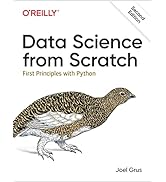
To really learn data science, you should not only master the tools―data science libraries, frameworks, modules, and toolkits―but also understand the ideas and principles underlying them. Updated for Python 3.6, this second edition of Data Science from Scratch shows you how these tools and algorithms work by implementing them from scratch. If you have an aptitude for mathematics and some programming skills, author Joel Grus will help you get comfortable with the math and statistics at the core of data science, and with the hacking skills you need to get started as a data scientist. Packed with new material on deep learning, statistics, and natural language processing, this updated book shows you how to find the gems in today’s messy glut of data. Get a crash course in Python Learn the basics of linear algebra, statistics, and probability―and how and when they’re used in data science Collect, explore, clean, munge, and manipulate data Dive into the fundamentals of machine learning Implement models such as k-nearest neighbors, Naïve Bayes, linear and logistic regression, decision trees, neural networks, and clustering Explore recommender systems, natural language processing, network analysis, MapReduce, and databases Review: The BEST book for learning how many data science functions work under the hood - START HERE! - Did you see something on the news about ChatGPT, Stable Diffusion, or some other big development that made you want to look into machine learning? Maybe you truly plan on entering data science as a field but don't know where to start? Or perhaps you've seen one of the author's brilliant/hilarious talks about why he doesn't like Jupyter Notebooks or how to answer the infamous "FizzBuzz" programming interview question using Tensorflow neural networks (seriously, look up Joel Grus on YouTube). If you know a little bit of Python, a little bit of relevant math, and want to go into any data science or machine learning path, then this book is a must-have. It certainly won't be the only resource you'll need, but it helps you get the most out of other content you'll likely look into later (like how to code up a machine learning pipeline, or maybe a large language model if you're really adventurous). Far too many machine learning lessons out there just tell you to import certain Python libraries (scikit-learn for example) and start using them without giving you any basic understanding of how those imported functions even work to begin with. Even to this day there are still college courses and coding bootcamps that ask you to download a Jupyter Notebook file and just hit "Shift + Enter" and look at the output. You're not going to learn how to code that way!!! Joel Grus does an excellent job of filling in this gap by teaching you more Python than what a statistics professional would usually know and more math than what a typical software developer would know. And that's key if you want to go into a field that relies on both. All the information for Python and math that you need to get started is here. It's 27 chapters that get you familiar with Python and how to use it, as well as the math used in data science and ML (linear algebra, probability and statistics, algorithms, etc). You eventually learn enough of both as you go through the chapters to start applying what you learn for some real-world usage. I've had this book for years and it's still as useful as when it first came out, but the only exception I've seen is that the Twitter API tutorial in the book no longer applies to the paid format that Twitter now uses to access that feature. The tutorial is still good for learning how API's get put to use. Once you've read this book and have gotten familiar with all it has to offer, your next step will probably involve looking into a book about how to actually use pre-built data science libraries (like what you find in the Anaconda distribution of Python). This book may turn out to be heavily responsible for my first startup, but that's a story for later. Review: Amazing introduction to Data Science - Let me start this review by explaining clearly who this book is for: anyone who has had some form of introduction (even if concise) to programming in Python, algebra, statistics, and probability will find this book a great introduction to Data Science. While the author does a great job at having a crash course on these topics (and I even learned a thing or two here and there), I can see the contents being a bit overwhelming if this is your first point of contact with these subjects. However, should you meet the requirements I mentioned above, you'll find this book a breeze! Joel does a good job at explaining the topics using his signature brand of humor, keeping the read entertaining even in the most advanced areas. I'd even say that this is a must read if you are considering going into machine learning, since it teaches you a thing or two in the topic as well. Please keep in mind that the book is monochrome. If that bothers you, consider viewing the electronic version. TLDR: If you're looking for a concise introduction to data science and have a bit of knowledge of basic Python, algebra, statistics and probability, look no further than this book! Otherwise, come back once you've picked up those tools and you'll feel right at home :)


| Best Sellers Rank | #86,265 in Books ( See Top 100 in Books ) #14 in Business Mathematics #18 in Data Modeling & Design (Books) #20 in Data Mining (Books) |
| Customer Reviews | 4.4 out of 5 stars 777 Reviews |
C**T
The BEST book for learning how many data science functions work under the hood - START HERE!
Did you see something on the news about ChatGPT, Stable Diffusion, or some other big development that made you want to look into machine learning? Maybe you truly plan on entering data science as a field but don't know where to start? Or perhaps you've seen one of the author's brilliant/hilarious talks about why he doesn't like Jupyter Notebooks or how to answer the infamous "FizzBuzz" programming interview question using Tensorflow neural networks (seriously, look up Joel Grus on YouTube). If you know a little bit of Python, a little bit of relevant math, and want to go into any data science or machine learning path, then this book is a must-have. It certainly won't be the only resource you'll need, but it helps you get the most out of other content you'll likely look into later (like how to code up a machine learning pipeline, or maybe a large language model if you're really adventurous). Far too many machine learning lessons out there just tell you to import certain Python libraries (scikit-learn for example) and start using them without giving you any basic understanding of how those imported functions even work to begin with. Even to this day there are still college courses and coding bootcamps that ask you to download a Jupyter Notebook file and just hit "Shift + Enter" and look at the output. You're not going to learn how to code that way!!! Joel Grus does an excellent job of filling in this gap by teaching you more Python than what a statistics professional would usually know and more math than what a typical software developer would know. And that's key if you want to go into a field that relies on both. All the information for Python and math that you need to get started is here. It's 27 chapters that get you familiar with Python and how to use it, as well as the math used in data science and ML (linear algebra, probability and statistics, algorithms, etc). You eventually learn enough of both as you go through the chapters to start applying what you learn for some real-world usage. I've had this book for years and it's still as useful as when it first came out, but the only exception I've seen is that the Twitter API tutorial in the book no longer applies to the paid format that Twitter now uses to access that feature. The tutorial is still good for learning how API's get put to use. Once you've read this book and have gotten familiar with all it has to offer, your next step will probably involve looking into a book about how to actually use pre-built data science libraries (like what you find in the Anaconda distribution of Python). This book may turn out to be heavily responsible for my first startup, but that's a story for later.
G**I
Amazing introduction to Data Science
Let me start this review by explaining clearly who this book is for: anyone who has had some form of introduction (even if concise) to programming in Python, algebra, statistics, and probability will find this book a great introduction to Data Science. While the author does a great job at having a crash course on these topics (and I even learned a thing or two here and there), I can see the contents being a bit overwhelming if this is your first point of contact with these subjects. However, should you meet the requirements I mentioned above, you'll find this book a breeze! Joel does a good job at explaining the topics using his signature brand of humor, keeping the read entertaining even in the most advanced areas. I'd even say that this is a must read if you are considering going into machine learning, since it teaches you a thing or two in the topic as well. Please keep in mind that the book is monochrome. If that bothers you, consider viewing the electronic version. TLDR: If you're looking for a concise introduction to data science and have a bit of knowledge of basic Python, algebra, statistics and probability, look no further than this book! Otherwise, come back once you've picked up those tools and you'll feel right at home :)
V**A
Good book for startes on AI/ML
Good book for someone starting on learning basics of AI/ML
A**R
Very very good book!
This book is suitable for people with basic python programming skills. It is very good for beginners and advanced users alike. The codes are very clear and without errors. This book teaches you the basics and introduce some expert level topics for you to explore further if keen. If you are a novice data analyst and some harder topics throw you off, you should probably revisit the topics after you have gain more knowledge on data science. I highly recommend this book as your first book into data science because the codes and thought processes are very clear. 70-80% of the book are data science foundation and basics for you to tackle harder topics later.
Y**K
Amazing book on Data Science
Great book when you want to get into the field of Data Science
A**A
Great book about the how of Data Science, but not the why.
In my personal opinion, this is a book to bridge the gap between an experienced mathematician/statician and practical machine learning. The book is more focused on describing how to implement mathematical formulas in Python than to actually explain the math behind it. I am a proficient Python Engineer and I can read the code and understand what is being done, but the author makes no effort to explain how it reached to that conclusion, or why it matters. The author does implement the mathematical formulas in Python skillfully, it misses the point of the book though. Another big problem with this book is that it assumes you can learn mathematics by just doing mathematics without understanding the why. It is frustrating to read and follow the author implement mathematical formulas without explaining why. I believe this is the case because the author DOES assume you have the required math to follow the book. I believe the author should add a section in the preface that list the prerequisites for this book: - Linear Algebra - Statistics - Probability - Vector Calculus - Continuous Optimization Above all, it is a good book if used as an index on where to start to understand Data Science, but it definitely doesn't fulfill the promise of being "from scratch". From scratch IMHO means you dive into the internals of Data Science algorithms. I had the expectation that this book was going to be more like "Designing Data-Intensive Applications" for Data Science where the "why" is as important as the "how". Data Science from scratch is a book about the how, with no effort to dive into the why. The book does provide the vocabulary for me to discuss Data Science with practitioners, but I didn't feel it got me any closer to becoming a practitioner myself. BTW, the fact that book is monochrome doesn't matter the font and figures are very clear and readable.
M**I
Great book, really means from scratch
This is a great book. Doing everything from scratch and not just using numpy, sklearn, etc is a great way to learn what's really going on underneath. I'm surprised how far he gets along this path. By the end, you will have implemented a keras-like deep learning setup. It won't be fast enough for production use since it's all using Lists underneath, but you'll be able to see how it all fits together. Also, coming from a more typed language background, I loved the type annotations.
T**
Good Coverage of the "Bare Metal" of basic Data Science
If you need a good broad brush to learn from, the second revision (in monochrome) is the book for you! Yes, there is numpy, pandas, and a host of other packages and frameworks available to perform many of the examples of what is explained in the book. But you need to broaden your knowledge with this material that touches the "bare metal" of Data Science. Excellent use is made of clear, concise verbiage to make things "black and white". (save the color images and other crutches for the board room stakeholders!).
B**.
Buen producto llego bien, solo no brilla mucho
Buen producto llego bien
J**I
Highly recommended
A must-read in this era.
H**H
Start with this book right now!
Joel's method of explaining is both entertaining and very useful
D**I
Not bad, but not good either
The book is useful to grasp the basic concept behind data science. However it gets pretty messy as the topics become more complex, especially when the python code is shown without too much of explanations. If you need a book to learn python for data science, there are many other alternatives.
V**T
Very good ground up approach to the subject
It’s definitely from the ground up - I found it useful to revisit the maths as well as seeing the code - well with the price of the book
Trustpilot
2 weeks ago
1 month ago