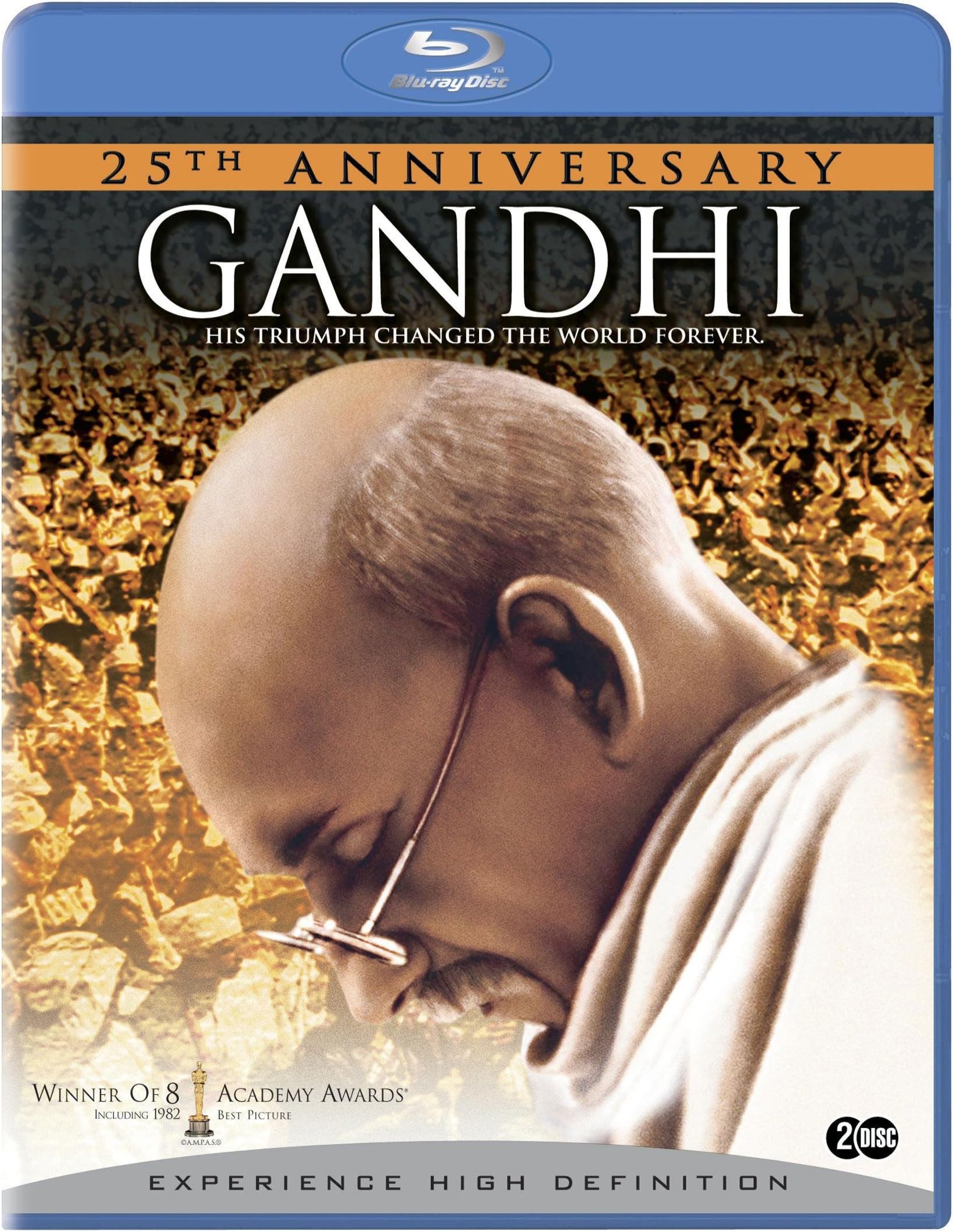
Gandhi
Product ID: 12066805
Details
- FormatSubtitled
- GenreAward Winning
- LanguageEnglish
- Runtime3 hours and 8
Desertcart purchases this item on your behalf and handles shipping, customs, and support to KUWAIT.
Sir Richard Attenborough's sweeping biography of Mohandas Gandhi, who rose from simple lawyer to worldwide symbol of peace and understanding. Gandhi earned eight Academy Awards® including Best Picture, Best Director and Best Actor. Review: "We must be the change we wish to see." - "Gandhi" is a brilliant encapsulation of the life of the man who must be counted among the greatest, most admirable figures in the history of humankind. Starring Ben Kingsley, Martin Sheen, Candice Bergen, Rohini Hattangady, Roshan Seth, John Gielgud, and Trevor Howard, and directed by Richard Attenborough, this 1982 film is a stunning achievement - without doubt one of the finest biographical epics ever made. It garnered six Academy Awards, including Best Picture; Best Actor (Kingsley); and Best Director (Attenborough). This film beautifully fulfills the goals set out in the film's preface: "...to be faithful in spirit to the record and try to find one's way to the heart of the man..." As this film demonstrates, Mohandas K. Gandhi, always faithful to his principles of equality, justice, and peace, uses non-violent civil disobedience as a means to gain equality for his nation's oppressed. his weapon. He is repeatedly assaulted by police and is imprisoned - usually on trumped up charges - several times because of his political beliefs and activism. Yet this always gentle and humble gentle man never loses sight of his main goal: helping his people achieve political and economic equality. Although only marginally successful, Gandhi becomes famous throughout the world for his work in South Africa and India. In this masterfully produced, directed, written, and acted film, the life of Mohandas K. Gandhi is painted against the backdrop of some of the most momentous events in twentieth century Indian history. "Gandhi" shows how the Mahatma (Great Soul) leads a nation of 350 million people to freedom from British colonial rule using non-violent means. We see Gandhi at the outset, making speeches in his low-key style, but even then espousing his clearly defined doctrine of peaceful non-cooperation against a repressive British colonial rule. Contrary to many public perceptions of the man, this film shows that Gandhi was not just a simple, humble man in a loincloth. He was a shrewd, pragmatic man who knew the value of good press in the furtherance of his cause. He knew how to confront his political enemies in ways that got his point across while garnering from his foes a grudging respect. Throughout all these tumultuous events, Gandhi never wavers from his belief in non-violent civil resistance as a means of achieving justice, equality, and freedom for the Indian nation. January 30, 1948: a supreme irony: Mohandas K. Gandhi - the man of peace who consistently espouses the dignity of all people; the proponent of non-violence, equality, justice, and peace - is violently gunned down by an assassin working for a fanatic Hindu group. There are simply not enough superlatives to do adequate justice to "Gandhi." Every aspect of this film is masterfully done! Ben Kingsley's portrayal of Gandhi is one of those singular performances that is so good that it defies description. His meticulous preparation for this part is readily evident in every scene in which he appears. His physical resemblance to the real Gandhi, and the way he mimicked Gandhi's mannerisms, is so realistic as to be positively eerie. Kingsley's performance is always sensitive, even slightly understated. Yet there is always present a powerful intensity that conveys the deep spirituality and integrity of the man he so lovingly portrays. Other performances, although nowhere near as wide-ranging, are no less outstanding. Among them: John Gielgud as the slighly addled, pompous British viceroy, Lord Irwin; Trevor Howard as the British judge whose respect for defendant Gandhi leads him to rise from his seat in deference to the man he is about to sentence to prison; Roshan Seth as Pandit Jawaharlal Nehru, the staunchly loyal disciple and future Indian Prime Minister; and Rohini Hattangady as Gandhi's loving wife. A NOTE ABOUT THE DVD: "Gandhi," a 20-year old film, was only released on DVD for the first time in October 2001. This a truly magnificent restoration and remastering of this great film! It's the first time that "Gandhi" appears on recorded media in its original 2.35:1 widescreen format. Video and audio quality are both simply outstanding! There are plenty of "extras" included on the DVD, including a "Making of Gandhi" photo montage and several newsreel clips showing Gandhi at several important points in his life. "Gandhi" is a film that belongs in every movie lover's DVD collection Review: Gandhi film review - Gandhi provided a refreshing, informative narration of Mohandas Gandhi’s life and accomplishments. Many of the events and occurrences during the film, as well as Gandhi’s life, I was completely unaware of. The film surprisingly begins with the tragic, inevitable ending to Gandhi’s life, which was his assassination. The audience then begins their journey following Gandhi’s defining movements and successes, as well as his many struggles. Gandhi, as a younger, naïve man, is shown traveling to South Africa on a train, which he is abruptly ejected from solely based upon his ethnicity and for sitting in first-class. Gandhi realized how biased the prejudiced laws towards Indian minorities were and began a campaign towards achieving these basic rights. Gandhi adamantly spoke to his fellow Indians regarding their non-violent stance, even in the face of physical harm. Throughout several demonstrations, Gandhi and many followers, including a large number of Indian miners, were arrested. It was following unflattering global media coverage that Gandhi and the South African Indian population were awarded several equal concessions. After his release from the South African prison camp, following this victory, Gandhi returns to India with warm greeting from the populace. After some persuasion, Gandhi agrees to assist with the fight for independence from British rule in India. Gandhi speaks at several rallies and outlines his goal for non-violent, non-cooperation against the British. There were many marches and demonstrations held by the Indian general public, much to the British’s dismay. Indians were even encouraged to cease their purchase of British-made clothes and burn any existing British clothing they may have. The fight for independence was extremely difficult and faced many challenges, including the murder of innocent men, women and children by the British soldiers during a peaceful demonstration. Gandhi was even imprisoned on several occasions for a range of supposed infractions. Some of the demonstrators grew wary of the violence and would strike back in kind. In return, Gandhi vowed to fast, even if he died as a result, until the protestor violence had ended, which it did for a time. Gandhi organized a march to the sea to signify Indians’ rights to their own natural salt resources, without British taxation. Many Indians joined Gandhi’s lead by selling and purchasing Indian salt, in lieu of the British options. Gandhi and his wife were yet again imprisoned for their demonstrations and speeches, but unfortunately his wife did not survive the last imprisonment. After successfully gaining the world’s attention, once again, there were discussions to facilitate India’s independence from British rule. Eventually it was decided to split India into two countries, due to Muslim and Hindu violence. Even this decision held its own rebuffs, as fighting erupted between the two groups at the borders. Gandhi vowed to fast until death or until the violence was completely eradicated amongst the groups. Violence did eventually cease and Gandhi began planning a risky visit to Pakistan. Unfortunately, as we know from history and the beginning of the film, Gandhi was assassinated shortly after ending his fast. The assassination was coordinated by those opposed to Gandhi’s multi-faith inclusion and perceived “Muslim tolerance.” According to Invitation to World Religions Gandhi was a Hindu follower yet denounced certain of its beliefs and practices (p. 126). He was firmly opposed to the Hindu caste system and campaigned for the “untouchables” to be referred to as the “Children of God.” Gandhi diligently worked against these caste stereotypes to gain further respect for these individuals. He was also a proponent of women’s rights and their improved status. Gandhi believed in the “universality and truth of all religions and sought throughout his life to reconcile Hinduism and Islam” (Invitation to World Religions, p. 126). Unfortunately, his executioner was a Hindu nationalist that disagreed with these views. Overall this movie was extremely informative and worth the view. It is astonishing to see one man’s determination, kindness and fortitude change the face of the world for the better.
| Contributor | Ben Kingsley, Candice Bergen, Columbia Pictures; Filmcrest & National Film, Edward Fox, John Gielgud, John Mills, Martin Sheen, Richard Attenborough, Trevor Howard Contributor Ben Kingsley, Candice Bergen, Columbia Pictures; Filmcrest & National Film, Edward Fox, John Gielgud, John Mills, Martin Sheen, Richard Attenborough, Trevor Howard See more |
| Customer Reviews | 4.7 out of 5 stars 4,726 Reviews |
| Format | Subtitled |
| Genre | Award Winning, Biography, Drama |
| Language | English |
| Runtime | 3 hours and 8 minutes |
M**S
"We must be the change we wish to see."
"Gandhi" is a brilliant encapsulation of the life of the man who must be counted among the greatest, most admirable figures in the history of humankind. Starring Ben Kingsley, Martin Sheen, Candice Bergen, Rohini Hattangady, Roshan Seth, John Gielgud, and Trevor Howard, and directed by Richard Attenborough, this 1982 film is a stunning achievement - without doubt one of the finest biographical epics ever made. It garnered six Academy Awards, including Best Picture; Best Actor (Kingsley); and Best Director (Attenborough). This film beautifully fulfills the goals set out in the film's preface: "...to be faithful in spirit to the record and try to find one's way to the heart of the man..." As this film demonstrates, Mohandas K. Gandhi, always faithful to his principles of equality, justice, and peace, uses non-violent civil disobedience as a means to gain equality for his nation's oppressed. his weapon. He is repeatedly assaulted by police and is imprisoned - usually on trumped up charges - several times because of his political beliefs and activism. Yet this always gentle and humble gentle man never loses sight of his main goal: helping his people achieve political and economic equality. Although only marginally successful, Gandhi becomes famous throughout the world for his work in South Africa and India. In this masterfully produced, directed, written, and acted film, the life of Mohandas K. Gandhi is painted against the backdrop of some of the most momentous events in twentieth century Indian history. "Gandhi" shows how the Mahatma (Great Soul) leads a nation of 350 million people to freedom from British colonial rule using non-violent means. We see Gandhi at the outset, making speeches in his low-key style, but even then espousing his clearly defined doctrine of peaceful non-cooperation against a repressive British colonial rule. Contrary to many public perceptions of the man, this film shows that Gandhi was not just a simple, humble man in a loincloth. He was a shrewd, pragmatic man who knew the value of good press in the furtherance of his cause. He knew how to confront his political enemies in ways that got his point across while garnering from his foes a grudging respect. Throughout all these tumultuous events, Gandhi never wavers from his belief in non-violent civil resistance as a means of achieving justice, equality, and freedom for the Indian nation. January 30, 1948: a supreme irony: Mohandas K. Gandhi - the man of peace who consistently espouses the dignity of all people; the proponent of non-violence, equality, justice, and peace - is violently gunned down by an assassin working for a fanatic Hindu group. There are simply not enough superlatives to do adequate justice to "Gandhi." Every aspect of this film is masterfully done! Ben Kingsley's portrayal of Gandhi is one of those singular performances that is so good that it defies description. His meticulous preparation for this part is readily evident in every scene in which he appears. His physical resemblance to the real Gandhi, and the way he mimicked Gandhi's mannerisms, is so realistic as to be positively eerie. Kingsley's performance is always sensitive, even slightly understated. Yet there is always present a powerful intensity that conveys the deep spirituality and integrity of the man he so lovingly portrays. Other performances, although nowhere near as wide-ranging, are no less outstanding. Among them: John Gielgud as the slighly addled, pompous British viceroy, Lord Irwin; Trevor Howard as the British judge whose respect for defendant Gandhi leads him to rise from his seat in deference to the man he is about to sentence to prison; Roshan Seth as Pandit Jawaharlal Nehru, the staunchly loyal disciple and future Indian Prime Minister; and Rohini Hattangady as Gandhi's loving wife. A NOTE ABOUT THE DVD: "Gandhi," a 20-year old film, was only released on DVD for the first time in October 2001. This a truly magnificent restoration and remastering of this great film! It's the first time that "Gandhi" appears on recorded media in its original 2.35:1 widescreen format. Video and audio quality are both simply outstanding! There are plenty of "extras" included on the DVD, including a "Making of Gandhi" photo montage and several newsreel clips showing Gandhi at several important points in his life. "Gandhi" is a film that belongs in every movie lover's DVD collection
J**N
Gandhi film review
Gandhi provided a refreshing, informative narration of Mohandas Gandhi’s life and accomplishments. Many of the events and occurrences during the film, as well as Gandhi’s life, I was completely unaware of. The film surprisingly begins with the tragic, inevitable ending to Gandhi’s life, which was his assassination. The audience then begins their journey following Gandhi’s defining movements and successes, as well as his many struggles. Gandhi, as a younger, naïve man, is shown traveling to South Africa on a train, which he is abruptly ejected from solely based upon his ethnicity and for sitting in first-class. Gandhi realized how biased the prejudiced laws towards Indian minorities were and began a campaign towards achieving these basic rights. Gandhi adamantly spoke to his fellow Indians regarding their non-violent stance, even in the face of physical harm. Throughout several demonstrations, Gandhi and many followers, including a large number of Indian miners, were arrested. It was following unflattering global media coverage that Gandhi and the South African Indian population were awarded several equal concessions. After his release from the South African prison camp, following this victory, Gandhi returns to India with warm greeting from the populace. After some persuasion, Gandhi agrees to assist with the fight for independence from British rule in India. Gandhi speaks at several rallies and outlines his goal for non-violent, non-cooperation against the British. There were many marches and demonstrations held by the Indian general public, much to the British’s dismay. Indians were even encouraged to cease their purchase of British-made clothes and burn any existing British clothing they may have. The fight for independence was extremely difficult and faced many challenges, including the murder of innocent men, women and children by the British soldiers during a peaceful demonstration. Gandhi was even imprisoned on several occasions for a range of supposed infractions. Some of the demonstrators grew wary of the violence and would strike back in kind. In return, Gandhi vowed to fast, even if he died as a result, until the protestor violence had ended, which it did for a time. Gandhi organized a march to the sea to signify Indians’ rights to their own natural salt resources, without British taxation. Many Indians joined Gandhi’s lead by selling and purchasing Indian salt, in lieu of the British options. Gandhi and his wife were yet again imprisoned for their demonstrations and speeches, but unfortunately his wife did not survive the last imprisonment. After successfully gaining the world’s attention, once again, there were discussions to facilitate India’s independence from British rule. Eventually it was decided to split India into two countries, due to Muslim and Hindu violence. Even this decision held its own rebuffs, as fighting erupted between the two groups at the borders. Gandhi vowed to fast until death or until the violence was completely eradicated amongst the groups. Violence did eventually cease and Gandhi began planning a risky visit to Pakistan. Unfortunately, as we know from history and the beginning of the film, Gandhi was assassinated shortly after ending his fast. The assassination was coordinated by those opposed to Gandhi’s multi-faith inclusion and perceived “Muslim tolerance.” According to Invitation to World Religions Gandhi was a Hindu follower yet denounced certain of its beliefs and practices (p. 126). He was firmly opposed to the Hindu caste system and campaigned for the “untouchables” to be referred to as the “Children of God.” Gandhi diligently worked against these caste stereotypes to gain further respect for these individuals. He was also a proponent of women’s rights and their improved status. Gandhi believed in the “universality and truth of all religions and sought throughout his life to reconcile Hinduism and Islam” (Invitation to World Religions, p. 126). Unfortunately, his executioner was a Hindu nationalist that disagreed with these views. Overall this movie was extremely informative and worth the view. It is astonishing to see one man’s determination, kindness and fortitude change the face of the world for the better.
P**O
Always open you package right away, just in case it's empty inside.
Good quality of the product, but it was a replacement order. The first time I received a sealed, empty envelope.
A**9
Inspirational!!
This was an extremely inspirational movie! It was amazing to see how much strength and courage in one person could cause so much change for so many people. The movie began with Gandhi's assassination in 1948 and the funeral service and then goes back in time to when he was an attorney in South Africa in 1893. During this time he realizes how bad Indian people are being treated in South Africa due to racial discrimination and begins his non-violent protests to gain some rights for the Indian people in Africa. After his success there he returns to India where he continues his non-violent, non-cooperation campaign there against the British Empire. The British government controls everything and the Indian people are treated very poorly in their own land. Millions of Indian people follow Gandhi's campaign against the British, but problems begin to occur such as protestors being killed. Gandhi eventually tries to stop the campaign by fasting until everyone stops protesting so no one else will be killed. Gandhi spends time in jail and protesting eventually begins again. The British is eventually pushed to the point that they grant India independence. Unfortunately after all of his work gaining rights for Indians in South Africa and being such a leader in gaining India's independence from the British things were still unsettled in India. The end of the movie was about the war between religions. The Muslims and the Hindus began fighting and killing each other. Gandhi again refuses to eat until the fighting stops. Eventually it does, but India becomes separated into two nations: India and Pakistan. He spends his last days continually trying to bring peace between the two nations and religions. In the end the movie comes around to the beginning where he is shot and killed by one of his own. This movie relates to world religions by showing what religious tensions can cause. Gandhi went through all those struggles to bring his people out of the pain and suffering they were experiencing under other governments due to racial inequality, oppression, etc. Then they turn on each other because they believed in religious inequality. We see this all over the world in all nations just maybe not to this extreme. Gandhi's belief was that all people can live together regardless of our race, gender, religion, caste, etc. Instead of people wasting so much time being prejudice and hating they need to take the time to learn about others and their way of life. This is a wonderful movie. It could be a great learning tool and inspiration to all.
H**I
Gandhi makes mountains move
Gandhi stirs the hearts and minds of people from around the world. First the people in South Africa, then to his homeland of India, then to the world. Gandhi finds himself and his fellow Indians being discriminated against in South Africa, treated like second class citizens or really last class citizens. He starts out a lawyer and ends up a leader. An unlikely leader, a passive man, a nonviolent man that united people to his cause. People united that seemed unlikely partners, Hindus, Muslims, Christians and others came together to help put an end to discrimination in South Africa. It seemed like an impossible task that became a reality. Once returning to his homeland of India, he thought about pursuing his lawyer career once again, but realized that he was called for a greater purpose. People around him wanted to attack the problems of his people with violence, while he persuaded them to attack the British rule with nonviolence and non compliance. The goal was to free India of British rule, but this was not an easy task and did not happen overnight. Gandhi hoped to unite all religions together in a peaceful, nonviolent coexistence. He became a symbol of unity to his countryman, a symbol of peace and change. His leadership came in the form of poverty, of humbleness and of perseverance. He often ended up in jail for civil disobedience along with his followers. He called upon all Hindus and Muslims to unite in an effort to bring independence to India. Through the course of time and through a massacre and thousands of arrests for a peaceful, nonviolent change, change did happen. Changed happened at a high cost though. The country was divided into Pakistan and India, separating Muslim and Hindu. Muslims and Hindus reared up against each other in violence and there was a great hatred that arose between the two religions. Gandhi went on yet another fast and prayer in hopes of uniting the countryman once again. After much violence, the people made vows of peace. Millions revered Gandhi as a national spiritual leader and followed his peaceful nonviolent ways and brought about Indian Independence from Britain and a coexistence with Muslim and Hindu alike.
J**I
“The Story of My Experiments with Truth”…
I read Gandhi’s autobiography, with the subject title, precisely half a century ago, when I was traveling through India the hard way, cheaply, not realizing at the time that I would be fulfilling Professor Gokhale's dictum to Gandhi. I purchased my copy in the country, very cheaply also, a shoddily produced product, though the words were the same as in the slick versions published in the West. Gandhi had a few eccentricities, for sure. Listing them would tend to discredit him. This movie of his life wisely never mentions them, though there are the slight allusions. The movie concentrated on the essential, well, truth of the matter: one very stubborn man took on the most powerful empire in the world and gained political independence for a third of a billion people. The question has been asked before, as it was in the movie: Would his tactics and actions have worked against Hitler, Stalin or Mao? We suspect not, though the question will always be hypothetical. Gandhi’s ideas and actions were based on the historical circumstances that were presented to him. And it is to the credit of the British people that they did work. Sir Richard Attenborough directed this movie which was released in 1982. Ben Kingsley brilliantly plays Gandhi. My current doctor started life in the Punjab. I told him I had just watched the movie. His first comment, indeed, the comment of many is how much Kingsley looks like Gandhi. I agree. And Kingsley plays the part so well, stealing the stage. Oh, and my doc said: “I really need to have my (American) kids watch that.” Good advice for all of us, no matter where we started life. The movie fittingly opens on January 30, 1948, showing Gandhi’s assassination less than half a year after the independence of India that he was largely responsible for. No, it was not by a fanatical Englishman distraught over the loss of his cushy home. Nor a Muslim, upset about the deaths of so many of his co-religionists during The Partition. He was killed by a fellow Hindu, a hard-right nationalist, who thought Gandhi had given too much away to “the other side.” A lesson for our own troubled times, as we have recently witnessed. Those who wrap themselves in the flag may be the first to injure our institutions and leaders. There are numerous rich, beautifully filmed scenes that provides insights into the essence of the man. Gandhi was a lawyer! Freshly minted from University College, London, he went to South Africa and would wear a proper lawyerly three-piece suit. His dignity was a bit ruffled when he was unceremoniously thrown off the train in Pietermaritzburg for being “colored.” He spent a number of years rallying the local Indian community (the British imported Indians to many of their colonies, from Trinidad to Burma and Fiji). There’s a good scene of Gandhi winning a fight with one of South Africa’s giants: Jan Christian Smuts. Gandhi is back in his native India in 1915. Professor Gokhale admonishes Gandhi: “See the real India, then you will know what to write. India is 700,000 villages, not a few hundred lawyers in Delhi and Bombay.” And so he does, tossing that three-piece suit into the dust-bin of history, thereafter dressing in homespun. Gandhi’s wife tells him that there are two forms of slavery in India: one for “untouchables,” the other for women. He wants to rid India of its evils and backwardness, without “importing the unhappiness of the West.” “Poverty”, Gandhi states, “…is the worst form of violence”. The movie shows the British having their “Hitler/Stalin” moments when General Dyer commanded his troops to open fire on unarmed civilians at Amritsar, killing 1600. There is a great scene of one of my favorite metaphors, in which Attenborough literally films “the big boys" (the British leadership) with their cigars and brandy befuddled as to what to do with “this man,” (which is a polite formulation of what Churchill would call him). Candace Bergen plays the delightful Margaret Bourke-White, taking the pictures by which most of us now visualize him. Surely someone out there must object, but Alyque Padamsee brilliantly plays Mohammed Ali Jinnah, the father of modern day Pakistan. Padamsee just exudes “evil.” And indeed, in real life this womanizing hard-drinking, slick, Western-educated man was such an unlikely Muslim champion. Oh… the what if’s of history, as in, if this one man was more like Gandhi, might India never have been partitioned? Peter Harlowe plays Lord Louis Mountbatten who peacefully lowers the British flag in 1947, recognizing Indian independence. In the tangled webs department, he himself would be assassinated by Irish extremists off Sligo, Ireland in 1979. A great movie about a great man playing an outsized role in the sweeping drama of human history. 5-stars, plus.
K**I
"You must be the change you wish to see in the world"---Gandhi
GANDHI is Sir Richard Attenborough's magnificent film biography of the incomparable Mohandas Karamchand Gandhi who led India to independence in the first half of the twentieth century by employing Satyagraha ("truth-force") against the entrenched British colonial administration. Attenborough worked for twenty years to create this wonderful labor of love, which is David Lean-esque in scope and storyline and cinematography. Lean himself was inspired to craft several scenes of A PASSAGE TO INDIA, his 1984 swan song, upon Attenborough's work. If imitation is the sincerest form of flattery, it is hard to say which director flatters which. GANDHI is so painfully close to being perfect that its imperfections loom larger than they are. By and large, these imperfections come about because of the vast sweep of this more than three hour film. Gandhi's entire adult life, from his time as a young, undistinguished barrister in South Africa to his death at the hands of Hindu extremists in his 79th year, is the subject of this film. As a result of embracing nearly six decades in some 200 minutes, the film tends toward the episodic. Many important personages and occurrences in the Mahatma's life are glimpsed in passing and are not deeply explored. For example, his very close lifelong friend and unswerving supporter, Hermann Kallenbach, a German Jew who later became a Zionist and a supporter of rapproachment between Jews and Arabs, appears in a few cameo scenes with only limited, largely meaningless dialogue. Gandhi's philosophy, an important element since it was so central to the man, his worldview, and his accomplishments, is spoon fed to us piecemeal and incompletely. We do, however, watch Gandhi evolving from a dapper, young, easily offended, even explosive, barrister to a wise elder who chose to live plainly in honor of the ideas he served. The nature of "non-violence" is such that no language has an independent term for it. The Hindi term "ahimsa" means "(a) not (himsa) harming." It is always defined in the negative, an indication of how rarified the concept is. There have been many nonviolent movements throughout history. Gandhi's was the first modern one, able to benefit from recording media and journalistic coverage. Martin Sheen plays "Walker" a composite character who reports on Gandhi over the years. The "Extras" disc has several historical newsreels of Gandhi addressing himself to the issues of his day. Also extremely interesting is Attenborough's Director's Commentary, which exposes the underpinnings of this project and Gandhi's profound effect on the man who made this picture. The irony of Nonviolence, of course, is that the targets of Nonviolence often respond violently---even to the point of irrationality---to its application, as the British often did. Daniel Day-Lewis in his first role, plays a South African street tough who threatens Gandhi. Edward Fox portrays General Dyer, who committed the terrible Amritsar Massacre upon a group of Indians peaceably listening to a Gandhian speaker. Dyer's intent, "to inflict a lesson that would be felt across the length and breadth of India" did just that; it ultimately turned Gandhi from a supporter of Home Rule into a supporter of Independence. Ben Kingsley (in his first major role) is nothing short of spectacular in the part of the Mahatma, slowly evolving his philosophy of non-violent non-cooperation with evil over decades, and bringing this incredible moral power to bear not only against the British, but against those Hindus and Muslims who would see India riven into two. Gandhi's campaign of nonviolence and fasting is well-known, but less well-known is his failed attempt to keep "Mother India" united in an atmosphere of universal respect. This is a Himalayan film about a truly Himalayan human being. This world would be far more sane if we all could adopt even a modicum of Gandhi's way.
R**T
Gandhi
Thanks! Beautiful movie.
A**A
Excellent film à voir avec petits et grands!
J'ai été vraiment transportée par ce film, alors que je connais un peu Gandhi par ailleurs. Seul bémol: l'acteur qui joue le Gandhi de la jeunesse ne lui ressemble pas du tout, si bien que j'ai mis un peu de temps à entrer dans le film. Mes filles ont eu exactement la même impression, c'est donc bien que cela saute aux yeux. Ce que j'ai adoré: les répliques, les détails qui rendent le film parfaitement crédible et nous en apprennent sur ce grand homme. Le film est truffé de citations, de phrases-clés, qu'on pourrait méditer pendant des heures. En voici quelques exemples pour ne citer que celles prononcées par Gandhi: "Quand on lutte pour une juste cause, les gens jaillissent des trottoirs." "C'est notre souffrance qui leur fera comprendre leur injustice." Cette phrase est probablement ma favorite, tant l'histoire de Gandhi, sa vie ne fait que l'illustrer. Il a fait plusieurs grèves de la faim, a été en prison sans jamais renier sa cause, en assumant les conséquences de ses actes. Cette force morale est absolument consternante. En s'adressant au gouvernement britannique: "Vous êtes obligés de nous humilier pour nous contrôler." "Pour gagner l'indépendance, il faut montrer que nous en sommes dignes." "Oeil pour oeil est une règle qui finira par rendre le peuple aveugle." "La voie de la vérité et de l'amour a toujours triomphé dans ce monde." "Peu importe les livres sacrés à condition que Dieu soit aimé": Gandhi a toujours refusé la partition. Il voulait absolument qu'Hindous et Musulmans vivent ensemble. Malheureusement, encore aujourd'hui, certains semblent avoir oublié son enseignement. "Le sel de l'Inde appartient à l'Inde." (sous-entendu et non aux Britanniques) "L'indépendance va bientôt tomber d'un arbre comme une pomme mûre." "La pauvreté est la pire forme de violence." "Les tyrans et les assassins peuvent nous paraitre invincibles, mais à la fin, ils tombent toujours." A ces phrases-clés qui nourrissent l'esprit et le coeur de chacun s'ajoutent les images sublimes, la lumière qui se dégage du film. Après l'avoir visionné, on croirait avoir passé un grand moment avec cet homme, l'avoir mieux connu, avoir souffert et lutté avec lui. On l'aime encore davantage. J'ai adoré également l'explication, sous forme de parabole, racontée par Gandhi à un Hindou qui vient se plaindre des horreurs de la guerre. Je vous la laisse découvrir... Un très bel hommage à cet acteur, cet exemple de la non-violence! Mes enfants de 8 et 11 ans ont été transportés aussi. Un film également à la portée de tous...sur la justice et l'importance de se battre corps et âme pour la faire régner, sans tuer. Peu d'hommes évidemment sont capables d'une telle grandeur morale, mais il en existe quand même. Un récit encore d'actualité et à ne pas oublier si on ne veut pas encore que le monde sombre dans l'horreur.
M**I
MUST Have in you Movie Collection
I must have watched this so many times, every time I watch this I get goosebumps. One the person himself and then there is the way the movie has been taken. Build up of events and how it all culminates to the where the move starts from. Had ordered this movie so that my 10 year old daughter can relate to what she is reading in her textbooks. We had a great time watching this together and trying to answer her queries and clarification was really fun. I hope the move has left a lasting impression on her and more clarity on Indian Independence struggle. For a quite a lot of us, Ben Kingsley is probably how Gandhi looked. I am sure he must have lived that role to play it so well. Great movie and must have in your collection and all more if you have school going kids and want them to learn Indian Independence history, please go ahead and order this movie and you will not regret this.
G**S
Aankoop Gandhi Blu-ray
100 % OK Goede verzending en besteld item beantwoorde volledig aan de beschrijving van de verkoper ( uiterst tevreden ) :-):-):-)
S**R
Es gibt wenig Filme mit einer solchen Botschaft !!!!
Gerechtigkeit und Freiheit lassen sich nicht unterdrücken! NIE! Um es gleich an dieser Stelle zu erwähnen - wer seichte Unterhaltung sucht, wird hier nicht fündig werden - der Film ist eigentlich kein Film - es ist eine fotografierte Botschaft und die gilt es innerhalb der 183 Minuten zu ergründen! Ghandi wurde vielfach beschrieben, d.h. man hat oft versucht diesen Menschen zu beschreiben - in Geschichtsbüchern, Biographien etc. - dieser Film selbst ist ebenfalls nur ein kleiner, wenn auch extrem beeindruckender, Beitrag, Ghandi und seine Lehren ins Gedächtnis zu rufen. Bevor Sie diesen Film anschauen sollten Sie irgendwo im Internet, oder einem Lexikon nach einem Foto von Ghandi suchen - spätestens dann können Sie nachvollziehen, wieso NUR Ben Kingsley für die Rolle des Ghandi in Frage kam! Wie beschreibt man das Leben eines Menschen, eines zunächst unscheinbaren Mannes, dessen leise Stimme zum Sprachrohr einer riesigen Nation wurde? Dem Interesse und dem damit verbundenen Ehrgeiz Richard Attenboroughs ist es zu verdanken, dass dieser Film entstehen konnte. Das der DVD beiliegende "Begleitheftchen" zeigt auf welchen Weg man zurücklegen musste, bis dieser Film enstehen konnte... Beeindruckende Massenszenen vor großartigem Hintergrund - bewegende Musik - hohe Schauspielkunst. Diese DVD trumpft unter anderem mit dem umfangreichen Zusatzmaterial - wie z.B. "The Making of Gandhi...", "Original Filmaufnahmen" und und und - auch nach den 183 Minuten Film bereitet es Freude, sich mit dieser DVD zu beschäftigen. Ghandi - Mensch mit Ziel vor Augen, dem großen Traum von Freiheit im Herzen - bereit diesen Traum zu verwirklichen - auf friedlichem Wege, was will man dazu noch großartig schreiben? Nur eines noch - wer diesen Film gesehen hat, wird verstehen können, was Albert Einstein einst meinte, als er sagte: "Zukünftige Generationen werden kaum glauben können, dass ein Mensch wie Er wirklich auf dieser Erde gewandelt ist!"
A**X
Epic showcase for blu-ray
This is the review I would have liked before buying this blu-ray title. I was put off by the "Blu-ray/Upscale Comparison" review but wanted the disk so much I took the risk. I do not understand how that reviewer could detect "little difference" between the blu-ray and DVD versions. Upscaling cannot produce detail which is not in the video signal, only interpolate to make the picture smoother. Ghandi benefits from high definition detail in a variety of types of scene: 1) Close-ups of actors faces when delivering great performances. This movie is an epic and was a phenomenon in its time. Its 8 oscars are an indication that it wasn't just because of its historical importance - there are some great performances. High definition really brings this to life: you see every strand of hair and skin pore. The eyes and muscle tone in the face make performances utterly engaging. For example, the tension in the debriefing scene with Edward Fox after the massacre is positively palpable. 2) Wide vistas (sumptuous, colonial interiors and sweeping, panoramic exteriors) with characters in the distance. Blu-ray enables you to see the actors' performance while on DVD you just know they are there and hear them talking. 3) Complex scenes, such as the opening funeral with a crowd of 400,000 people (how do you upscale that from 720x480?), lavishly ornate colonial interiors and exteriors, and lush Indian landscapes and panoramas. I was concerned about the age of the film. The opening scene was grainy and my heart sank. However, it was shot in low-light and there's only a handful of shots in the whole 3-hour epic that suffer in this way, a record which is substantially better than films many years younger than Ghandi. Colour is superb, with the sets, costumes and beautiful use of light by Attenborough making Ghandi a visual feast. This is a wonderful movie and a stunning demonstration of what blu-ray can do. I commend it whole-heartedly to anyone with a blu-ray player.
Trustpilot
2 weeks ago
2 weeks ago