We remain fully operational. Our teams are working around the clock to ensure your deliveries continue safely.

قم بتنزيل التطبيق


معلومات عنا
حقوق الطبع والنشر © 2024 Desertcart Holdings Limited
قم بتنزيل التطبيق
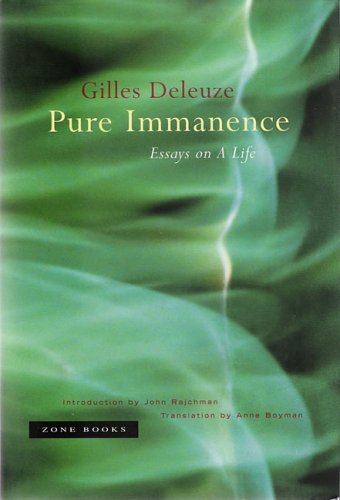
Pure Immanence: Essays on a Life (Mit Press) [Deleuze, Gilles, Boyman, Anne, Rajchman, John] on desertcart.com. *FREE* shipping on qualifying offers. Pure Immanence: Essays on a Life (Mit Press) Review: From Dickens to Nietzsche - Charles Dickens captures the essence of the philosophical nature of reality according to Deluze. Ellen Berry notes that "three brief essays make up Pure Immanence -- one on Hume, one on Nietzsche, and one -- "Immanence: A Life" -- that functions as a Deleuzian last testament of sorts, written as it was "in a strange interval [immediately] before his death" as John Rajchman informs us in his very useful introduction to the volume. In this essay, which appears first in the book, Deleuze defines what he calls a "transcendental empiricism," as a-subjective, impersonal, wild and powerful state, existing "in contrast to everything that makes up the world of the subject and the object". Unlike a notion of the transcendent, the plane of the transcendental is an absolute immanence, complete in itself, neither "in something" nor belonging to someone (say some notion of a universal subject). "It is only when immanence is no longer immanence to anything other than itself that we can speak of a plane of immanence". Pure or absolute immanence is what Deleuze calls "A LIFE," defined as a paradoxical experience/duration in which individuality fades and becomes "a singular essence," an empty time of singularities or virtualities existing in between what we take to be the defining moments of an individual's life. A LIFE unfolds according to a different logic than the life of an individual. It can never be grasped fully; it is always yet "in the making," in potentia, and flashes into conscious existence only occasionally. Deleuze gives two striking examples to illustrate this enigmatic state/space/time, the first from Dickens's Our Mutual Friend : "A disreputable man, a rogue, held in contempt by everyone, is found as he lies dying. Suddenly, those taking care of him manifest an eagerness, respect, even love, for his slightest sign of life. Everybody bustles about to save him, to the point where, in his deepest coma, this wicked man himself senses something soft and sweet penetrating him. But to the degree that he comes back to life, his saviors turn colder, and he becomes once again mean and crude. Between his life and his death, there is a moment that is only that of a life playing with death." In another example, Deleuze calls attention to very small children, as yet unformed as individuals, who all tend to resemble one another except in their singularities -- a smile, a gesture. "Through all their sufferings and weakness, [they] are infused with an immanent life that is pure power and even bliss". As Rajchman points out, one would need a new conception of society in order to understand Deleuze's notion of a life. It would be one in which we recognize that what we share is our singularities and not our individualities, that "what is common is impersonal and what is impersonal is common" (14). From this perspective, society is viewed not as a social contract between individuals but as an experiment with what in life precedes both individuals and collectivities. Relations with others would be based not in identification or recognition but in encounter and new compositions formed by saying "yes" to what is singular yet impersonal in living. Berry notes that "This all too brief summary cannot do justice to what is a complex set of musings. While Pure Immanence is not the place to start if one is unfamiliar with Deleuze's thought, it is a rich, rewarding, and not inaccessible read." ---------------------------------------------------------------------------- Chapter Three is a brilliant summary of Nietzsche's project: Nietzsche's Thus Spoke Zarathustra outlines three metamorphoses of the spirit 1) The camel which carries the weight of established values such as education, morality and culture 2)The lion which destroys and is the critique of all established values, and finally 3) the child of innocence carrying a mirror which reveals our monsterousness, who creates new values and new principles of evaluation. An example of the creation of a new value is by observing that while illness is an evaluation of health, out of one's excessive well being, health can become the evaluation of illness through affirmation, even in the face of the illness--such is the "reversal," the "shift in perspective" that Nietzsche saw as crucial in the transmutation of values. It is this easy shift in perspectives from health to sickness and from sickness to health, this lightness of movement that signifies "great health." "All interpretations determine the meaning of a phenomenon." Meaning consists of a relation of forces the active ones being valid (conquest and subjugation) and others being invalid and reactive (adaptation and regulation). Will is the relation of force to Force, but this doesn't mean that the will wants power or domination which becomes dependent on established values. The will to power consists not in coveting or even inn taking but in creating and giving. The power of will in not in having what we want but in our having the will to want. Active forces affirm, and affirm in their difference (affirmation), while reactive forces principally negate, oppose, and limit the other (nihilism). While interpretation finds meaning in forces, evaluation finds values in the will to power. The history of man and of nature has been the triumph of reactive forces, of negation, of adaptation (e.g., natural selection) and regulation. Slaves triumph in their subtracting and limiting others while "masters are slaves that have triumphed in a universal becoming-slave: European man, domesticated man, the buffon." When nihilism triumphs, the will to power stops meaning to create, and leads to want to dominate, to take on "established values: money, honors, power." The typology, stages moving beyond the triumph of nihilism: 1) Resentment against everything that is active. Projection of blame--"It's your fault." 2) Bad Conscience. Introjection of blame--"It's my fault." 3) The ascetic ideal--Life, salvation is judged according to values that are said to be superior to life--lead to nothingness. The ascetic are carriers (donkey, buffoon) of the weight of responsibility to higher values, rather than the creative lightness of the dancer. 4) The death of God. The negation of the higher values are replaced by human values ("morals replace religion; utility, progress, even history replace divine values"). This is the higher man who claim to embrace all of reality, but are still carriers, burdened by human values (the Yes of the donkey). 5) The last man and the man who wants to die. The Last Man says all is vain, "better a nothingness of the will than a will to nothingness." Here is the "will to deny reactive life itself, and inspires in man the wish to actively destroy himself, a readiness for transmutation by "an active becoming of forces, a triumph of [the aggressivity that belongs to] affirmation in the will to power," like the "lightening that announces the thunder that follows, what is affirmed." "Joy emerges as the sole motive for philosophizing. Stages of transmutation: 1) Multiplicity and becoming as objects of affirmation. "Joy [of the diverse, the multiple] emerges as the sole motive for philosophizing. 2) Becoming is no longer opposed to Being (the Being of becoming), the One is said of the multiple as multiple (the One of multiplicity). One affirms the necessity of chance, the player rolls the dice in affirmation. 3) The Eternal Return, not of the Same, but repetition of what can be affirmed beyond negation, the liberating. "I `must' want it in sucha a way that I also want its eternal return." 4) The Overman--the gathering of all that can be affirmed, the superior form of what is--Dionysus.
| Best Sellers Rank | #363,885 in Books ( See Top 100 in Books ) #765 in Philosophy Movements (Books) |
| Customer Reviews | 5.0 5.0 out of 5 stars (18) |
| Dimensions | 6 x 0.5 x 8.75 inches |
| Edition | 2nd |
| ISBN-10 | 1890951250 |
| ISBN-13 | 978-1890951252 |
| Item Weight | 6.4 ounces |
| Language | English |
| Print length | 104 pages |
| Publication date | March 22, 2005 |
| Publisher | Zone Books |
W**E
From Dickens to Nietzsche
Charles Dickens captures the essence of the philosophical nature of reality according to Deluze. Ellen Berry notes that "three brief essays make up Pure Immanence -- one on Hume, one on Nietzsche, and one -- "Immanence: A Life" -- that functions as a Deleuzian last testament of sorts, written as it was "in a strange interval [immediately] before his death" as John Rajchman informs us in his very useful introduction to the volume. In this essay, which appears first in the book, Deleuze defines what he calls a "transcendental empiricism," as a-subjective, impersonal, wild and powerful state, existing "in contrast to everything that makes up the world of the subject and the object". Unlike a notion of the transcendent, the plane of the transcendental is an absolute immanence, complete in itself, neither "in something" nor belonging to someone (say some notion of a universal subject). "It is only when immanence is no longer immanence to anything other than itself that we can speak of a plane of immanence". Pure or absolute immanence is what Deleuze calls "A LIFE," defined as a paradoxical experience/duration in which individuality fades and becomes "a singular essence," an empty time of singularities or virtualities existing in between what we take to be the defining moments of an individual's life. A LIFE unfolds according to a different logic than the life of an individual. It can never be grasped fully; it is always yet "in the making," in potentia, and flashes into conscious existence only occasionally. Deleuze gives two striking examples to illustrate this enigmatic state/space/time, the first from Dickens's Our Mutual Friend : "A disreputable man, a rogue, held in contempt by everyone, is found as he lies dying. Suddenly, those taking care of him manifest an eagerness, respect, even love, for his slightest sign of life. Everybody bustles about to save him, to the point where, in his deepest coma, this wicked man himself senses something soft and sweet penetrating him. But to the degree that he comes back to life, his saviors turn colder, and he becomes once again mean and crude. Between his life and his death, there is a moment that is only that of a life playing with death." In another example, Deleuze calls attention to very small children, as yet unformed as individuals, who all tend to resemble one another except in their singularities -- a smile, a gesture. "Through all their sufferings and weakness, [they] are infused with an immanent life that is pure power and even bliss". As Rajchman points out, one would need a new conception of society in order to understand Deleuze's notion of a life. It would be one in which we recognize that what we share is our singularities and not our individualities, that "what is common is impersonal and what is impersonal is common" (14). From this perspective, society is viewed not as a social contract between individuals but as an experiment with what in life precedes both individuals and collectivities. Relations with others would be based not in identification or recognition but in encounter and new compositions formed by saying "yes" to what is singular yet impersonal in living. Berry notes that "This all too brief summary cannot do justice to what is a complex set of musings. While Pure Immanence is not the place to start if one is unfamiliar with Deleuze's thought, it is a rich, rewarding, and not inaccessible read." ---------------------------------------------------------------------------- Chapter Three is a brilliant summary of Nietzsche's project: Nietzsche's Thus Spoke Zarathustra outlines three metamorphoses of the spirit 1) The camel which carries the weight of established values such as education, morality and culture 2)The lion which destroys and is the critique of all established values, and finally 3) the child of innocence carrying a mirror which reveals our monsterousness, who creates new values and new principles of evaluation. An example of the creation of a new value is by observing that while illness is an evaluation of health, out of one's excessive well being, health can become the evaluation of illness through affirmation, even in the face of the illness--such is the "reversal," the "shift in perspective" that Nietzsche saw as crucial in the transmutation of values. It is this easy shift in perspectives from health to sickness and from sickness to health, this lightness of movement that signifies "great health." "All interpretations determine the meaning of a phenomenon." Meaning consists of a relation of forces the active ones being valid (conquest and subjugation) and others being invalid and reactive (adaptation and regulation). Will is the relation of force to Force, but this doesn't mean that the will wants power or domination which becomes dependent on established values. The will to power consists not in coveting or even inn taking but in creating and giving. The power of will in not in having what we want but in our having the will to want. Active forces affirm, and affirm in their difference (affirmation), while reactive forces principally negate, oppose, and limit the other (nihilism). While interpretation finds meaning in forces, evaluation finds values in the will to power. The history of man and of nature has been the triumph of reactive forces, of negation, of adaptation (e.g., natural selection) and regulation. Slaves triumph in their subtracting and limiting others while "masters are slaves that have triumphed in a universal becoming-slave: European man, domesticated man, the buffon." When nihilism triumphs, the will to power stops meaning to create, and leads to want to dominate, to take on "established values: money, honors, power." The typology, stages moving beyond the triumph of nihilism: 1) Resentment against everything that is active. Projection of blame--"It's your fault." 2) Bad Conscience. Introjection of blame--"It's my fault." 3) The ascetic ideal--Life, salvation is judged according to values that are said to be superior to life--lead to nothingness. The ascetic are carriers (donkey, buffoon) of the weight of responsibility to higher values, rather than the creative lightness of the dancer. 4) The death of God. The negation of the higher values are replaced by human values ("morals replace religion; utility, progress, even history replace divine values"). This is the higher man who claim to embrace all of reality, but are still carriers, burdened by human values (the Yes of the donkey). 5) The last man and the man who wants to die. The Last Man says all is vain, "better a nothingness of the will than a will to nothingness." Here is the "will to deny reactive life itself, and inspires in man the wish to actively destroy himself, a readiness for transmutation by "an active becoming of forces, a triumph of [the aggressivity that belongs to] affirmation in the will to power," like the "lightening that announces the thunder that follows, what is affirmed." "Joy emerges as the sole motive for philosophizing. Stages of transmutation: 1) Multiplicity and becoming as objects of affirmation. "Joy [of the diverse, the multiple] emerges as the sole motive for philosophizing. 2) Becoming is no longer opposed to Being (the Being of becoming), the One is said of the multiple as multiple (the One of multiplicity). One affirms the necessity of chance, the player rolls the dice in affirmation. 3) The Eternal Return, not of the Same, but repetition of what can be affirmed beyond negation, the liberating. "I `must' want it in sucha a way that I also want its eternal return." 4) The Overman--the gathering of all that can be affirmed, the superior form of what is--Dionysus.
ترست بايلوت
منذ شهر
منذ 3 أسابيع