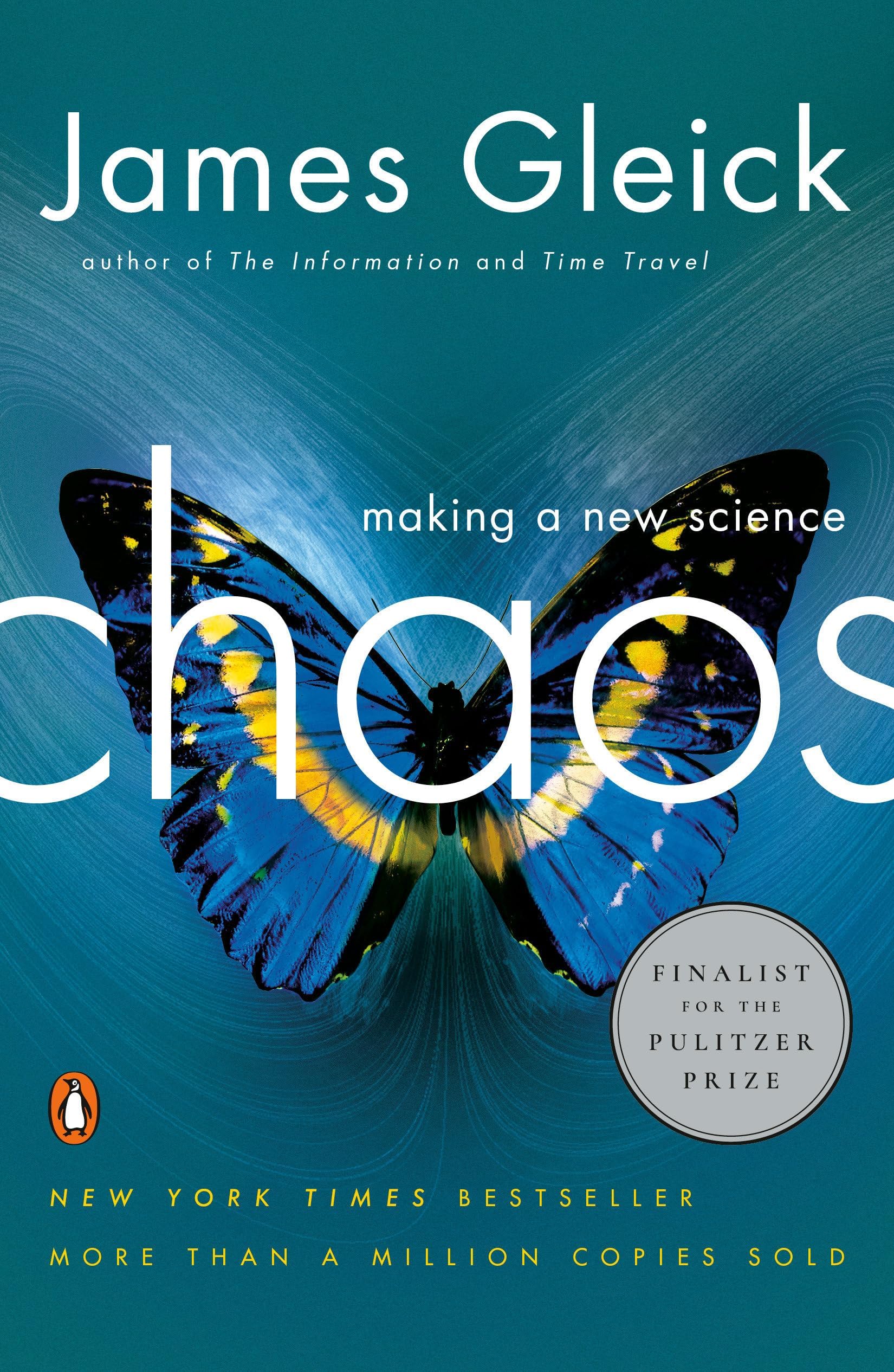
Chaos: Making a New Science
Product ID: 1585682
🌌Explores chaos theory
📚Engaging narrative
🔬Innovative concepts
Desertcart purchases this item on your behalf and handles shipping, customs, and support to KUWAIT.
🌟 Embrace the Chaos: Transform your understanding of the universe!
Chaos: Making a New Science by Penguin Books is a revolutionary exploration of chaos theory, presenting complex scientific concepts in an engaging narrative that appeals to both professionals and curious minds alike. This book invites readers to rethink traditional notions of order and disorder, making it a must-read for anyone interested in the cutting-edge of science.


| ASIN | 0143113453 |
| Best Sellers Rank | #48,668 in Books ( See Top 100 in Books ) #2 in Chaos Theory #7 in Fractal Mathematics #80 in History & Philosophy of Science (Books) |
| Customer Reviews | 4.5 4.5 out of 5 stars (3,224) |
| Dimensions | 1.3 x 5.5 x 8.4 inches |
| Edition | Anniversary,Reprint |
| ISBN-10 | 9780143113454 |
| ISBN-13 | 978-0143113454 |
| Item Weight | 2.31 pounds |
| Language | English |
| Print length | 384 pages |
| Publication date | August 26, 2008 |
| Publisher | Penguin Books |
L**R
Entropy's Stepchild.
Chaos, like String Theory, is a purely Mathematical Construct with applications for several different scientific disciplines. Fortunately the reader doesn't have to be math-wiz to enjoy this amazing book (although the author does sneak a few equations here and there). Basically Chaos Theory studies the behavior of complex systems that are sensitive to their starting conditions; small changes can have a large effect on the outcome. (It's a little more complicated than that but also beyond the scope of this review). Journalist and science writer James Gleick has put it all together in this highly readable "biography" of the theory. The roots of Chaos go back to the early 20th century with some hints as far back as the late 19th century. Gleick traces the turbulent history of this new science and the people that made it happen. For as long as we've had Mathematicians and Physicist the two sciences have been butting heads and neither side wanted anything to do with Meteorology in general. Yet it was in an obscure Meteorological journal in the 1950s that we find one of the first papers that reference this chaotic side to Nature. For me, parts of this book were a tough read with some sections that were hard to get through. On the other hand there were other parts that went very fast, but whatever effort you put into reading this book is well worth it. While exploring Chaos's history the author introduces the reader to some unfamiliar concepts like: Strange Attractors, Nonlinear Fluid Dynamics and Phase Transitions. It turns out that Chaos has strong ties to Biology, Astronomy, Geology and, yes, even Meteorology. As a matter of fact just about any science you can think of that has a complex or nonlinear problem can be studied with Chaos applications. Some of the scientist mentioned in the text may be familiar to you while others are somewhat more obscure. One that stood out for me was Benoit Mandelbrot and his study of Fractals. The book has many illustrations of fractals, some of which are in full color. It's not just science that benefits from Chaos Theory but everyday life has elements to which the math can be applied; the stock market, population dynamics, medical research, wherever there are transitions from stability to chaotic conditions. When you watch a pot of water on the stove, there is a point where it changes from orderly to turbulent and in that instant when it goes from just hot to boiling something strange is going on, something chaotic but understandable if you take the time to look a little deeper and just work it out. Chaos helps us see the hidden turmoil that lurks in the universe around us. The Second Law of Thermodynamics tells us the everything tends toward disorder, we call it Entropy. But is there an underlying order to that Chaos? How do we recognize it's calling card and once recognized, what do we do with it? Even today the research goes on and our understanding of many issues can change overnight. So hang on tight "It's gonna be a bumpy ride". I'm not sure how much I got out of this book but I did come away with plenty of food for thought. I had no technical or formatting problems with this Kindle edition. Last Ranger
J**Y
More technical information, please
My background is electrical engineering, and I really liked this book. It presented a very good history of chaos theory and its development from quirky art into a legitimate branch of science. It also gave interesting personal backgrounds of the pioneers in the field. However, I would have preferred if were written more like a textbook and illustrated with practical examples. The book is a very good introduction to chaos theory for non-technical readers. It's well-written and easy to read. But it doesn't offer enough detailed information for those of us who really want to delve into this subject and learn more than just superficial facts. I would have given the book five stars if it had presented a bit less historical background and offered more technical information, especially pertaining to the most recent developments in the field. On the positive side, the author was very good at pointing out that chaos is a natural and very necessary feature of our universe. As an engineer, I was taught almost nothing about chaos, other than it is very bad when it appears in electrical system, and so we were trained to eliminate it at all costs. This book shed a whole new positive light on it.
C**N
A Fascinating Journey into Chaos and Revolutionary Science
"Chaos: Making a New Science" is a book that captivated me from the very first page. James Gleick takes us on a fascinating journey through chaos, exploring a science that challenges our conventional perceptions. Gleick demonstrates his mastery by making complex scientific concepts accessible to the average reader. His skill in interweaving human stories with scientific discoveries creates a compelling narrative. As you progress through the pages, you are immersed in the fascinating history of the emergence of chaos theory. From the engaging accounts of key figures to the clear explanation of concepts like sensitivity to initial conditions, Gleick manages to maintain interest without sacrificing scientific rigor. What makes this book stand out even more is its timeless relevance. Although written in the 1980s, the ideas and principles presented remain foundational in modern science. In summary, "Chaos" not only provides a masterful exploration of chaos and the new science that emerged from it but also invites the reader to question and redefine their understanding of the world around us. Highly recommended for those seeking an engaging and enriching read in the realm of science.
W**B
If you're into physics, math, stem, etc. you need to read this.
Superb book. If you're into physics, math, stem, etc. you need to read this. Very well written by top science author, interesting story, good explanation for one of the most surprising discoveries ever in math and physics
N**T
The book is as chaotic as its subject
Gleick has done excellent research into an interesting subject, though I gather that it's now considered dated, like me. There's no deep math and the concentration is more on researchers' progress paths. However, I didn't care for the organization of the first half of the book. Take Lorenz, depicted, possibly incorrectly, as the originator of Chaos Theory. Maybe half of his work on chaos is described at the beginning. Then, as later researchers from other backgrounds discovered him, new aspects of his work were revealed in great detail. By the time I'd finished absorbing these new items, I'd almost forgotten why the later researchers were interested. This book needn't have been so difficult to read. BTW, I'm not entirely an ignoramus. I have solid qualifications in Engineering, so how this book became a best-seller is beyond me.
A**E
Un clavado a los orígenes de la teoría del caos, y de sus fundadores !!!
M**S
This was the first book I ever read about chaos theory so many years ago and I fell in love with. Lost it in a move and I bought it again. From Amazon 2nd hand in pristine conditions, a very good deal!
C**N
Classique sur ce sujet. Très bonne lecture pour découvrir un peu l'histoire de cette science.
P**D
Gave the book to a friend who is interested in the subject. Excellent history of chaos theory.
X**E
I like this book very much. Actually it answered quite a few questions which bothered me before. Thanks
Trustpilot
3 weeks ago
2 weeks ago