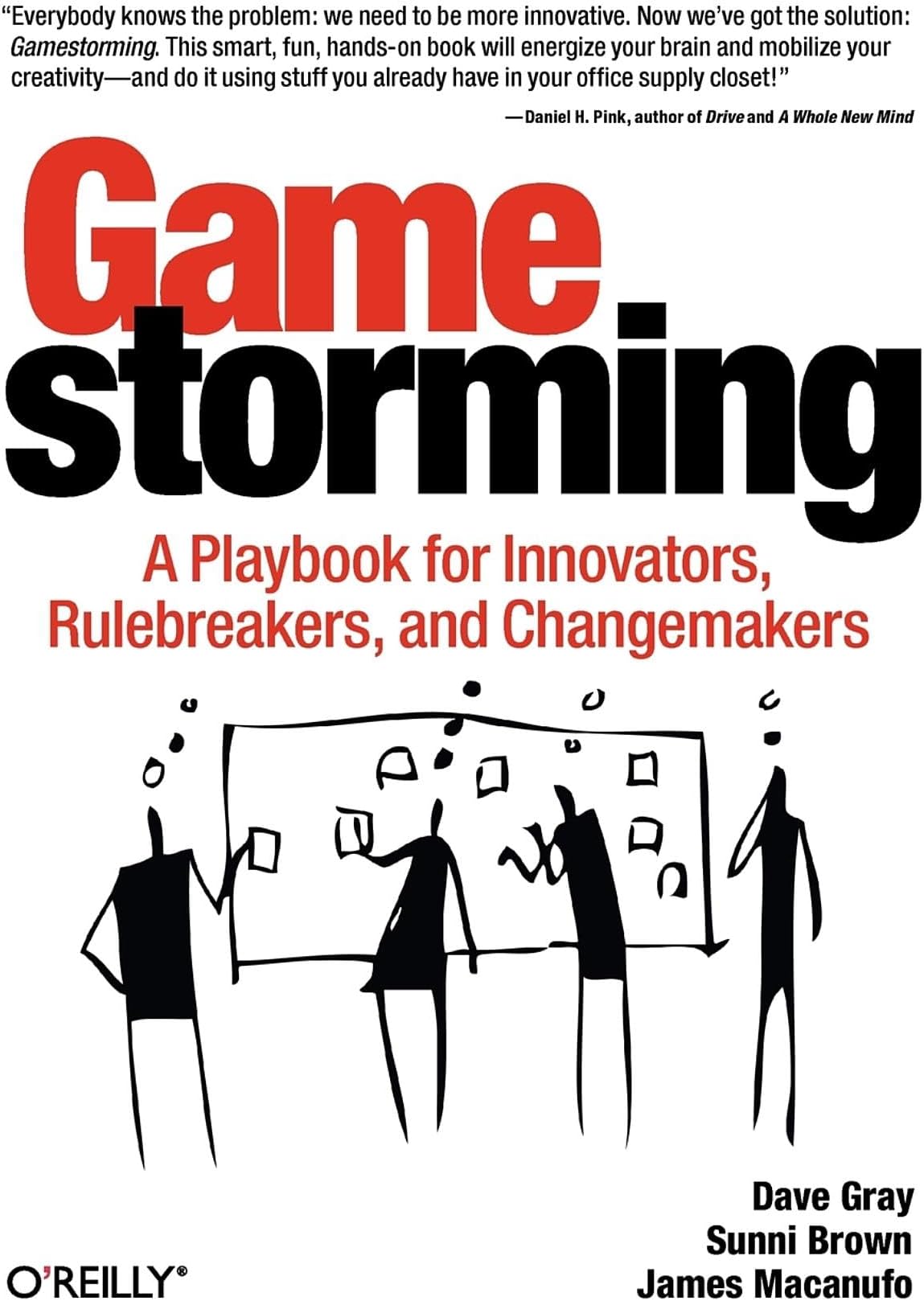
Gamestorming: A Playbook for Innovators, Rulebreakers, and Changemakers
Product ID: 1703841
Buy anything from 5,000+ international stores. One checkout price. No surprise fees. Join 2M+ shoppers on Desertcart.
Desertcart purchases this item on your behalf and handles shipping, customs, and support to KUWAIT.
Gamestorming: A Playbook for Innovators, Rulebreakers, and Changemakers [Gray, Dave, Brown, Sunni, Macanufo, James] on desertcart.com. *FREE* shipping on qualifying offers. Gamestorming: A Playbook for Innovators, Rulebreakers, and Changemakers Review: Must have and a gift from authors - Update: i had a chance to practice some of the ideas in the book in two scenarios. First was a strategy improvement workshop for a country business unit. The other was with a product development team and the sales person. Both heavily relied on ideas from this book, and also from the CONCEPTS that are in the first part. Both workshops where a success. So I am keeping my original 5 star rating and the claim the book should cost $5000, but I now only say it half-jokingly. Your BIGGEST HURDLE to get the most of this book is you need to understand all games (and thus go over about 100 methods), and the use this knowledge to build workshops. Sore, you can pick 1 methods and try a scenario where it would work. But the $5000 remark comes from reading and having in your mind 100 methods and the right context to actually create a very engaging, highly productive and collaborative workshop (or meeting) experience. Which also requires a bit of imagination as to where people minds will be at any point, and how each game output connects with which output. If the authors ever update it, I would like to see a better index the games (Kindle version really fails), possibly a table which lists all games and a very short description. Besides a better TOC of games, I'd add a new section of "game storming examples". Instead of the very brief ending of one example, I'd provide 8 to 15 short examples of full game storming sessions with the agenda, for typical use cases that are the lifeblood of planning, strategy and other frequently occurring meetings. These should depict the agenda visually if possible (how things connect). -- I read books in bursts, when I call on others wisdon to move myself ahead in a particular direction. This time, my new role involves innovation, marketing and strategy. This book should cost $5000, come signed and with a return envelope to thank the authords. It's value lies in providing a very sharp color palette and tools to collaborate in the seams betweek group knolege, teams and business challenges. As an economist, marketing person and researcher (analytic thinker) I can essily see why, when and how to apply many of the games in real life scenarios. The instructions are very well balanced, with enough detail to make them work, ut not more than it becomes too fixed or rigid (or boring). The goal is to USE these. And it is exhausting to go over all the posibilities. So you could try some if doing a quick read of the entire book exhausts you too much. But Inchose to force. I opted to read all of it first and think scenarios where I could use the methods. It have already started to create different kinds of workshops in my mind as I do this. Additionally, just reading the methods, some of which you may be familiar with, retriggers things you knew and forgot. In some other cases the instructions are so sound you'll note you where doing something wrong in the past. It shows they have practiced, and the variarions and short advice will make so much sense especially when you have sern some of the Methods in action, and know there's 20% that you'll need to deviate little or bend some rules-and to make sure you manage expectations, calm, clarify or less people lose the stress (eg. no wrong way here). This book is a gift from the authors. It's hugely dense by its very own nature, and may overwhelm if you want to read from A to Z. Jt And there lies its strength: a solid palette, a good initial framework, and very sound advice, instructions and, did I say the best compilation of ideas on the topic ever? Review: Wow, was I positively surprised! - For me, the word "gamestorming" sounds a lot like "brainstorming". So when I came across Gamestorming, I thought it was a book describing yet another technique to generate ideas. As such, Gamestorming didn't seem that interesting to me. Some months later I discovered that (co-author) Dave was teaching "Gamestorming" at a conferences I was planning to attend. I thought a workshop would be a much better way to teach me how to use this new technique (rather than reading a whole book about the topic), so I signed up. And then, thinking it could be a little advantageous to actually read the book beforehand, ended up buying the book as well. Wow, was I positively surprised when I got the book and quickly browsed the pages. I realized that Gamestorming was a reference guide of various workshop techniques, many of which I've known and used for years. Affinity map, card sorting, dot voting, post-up, storybord, brainstorming and poster session are all "games" I have taught or "played" with various clients and colleagues. I just thought of them as techniques or tools, although it makes sense to call them games. After all, using gamestorming in workshops and meetings is fun. And the exiting part: Now I have a whole book full of new games to try out! (Hopefully, there will be even more games added in future editions.) Btw, I quite liked the first three chapters of the book, the ones that summarizes the game world evolution, the essentials for using gamestorming and the core gamestorming skills. It made me realize there are several ways to improve the outcome and usefulness of playing the games, even the ones I've known for years. P.S. Gamestorming was so enjoyable that I ended up reading most of it before attending the workshop. Still, the hands-on workshop was of great value, especially the part covering the visual language and the bodystorming session. And I did get Dave to sign my copy, a nice little workshop memory.



























| Best Sellers Rank | #93,642 in Books ( See Top 100 in Books ) #22 in Business Image & Etiquette #57 in Running Meetings & Presentations (Books) #266 in Communication Skills |
| Customer Reviews | 4.4 4.4 out of 5 stars (854) |
| Dimensions | 7 x 0.6 x 9.19 inches |
| Edition | 1st |
| ISBN-10 | 0596804172 |
| ISBN-13 | 978-0596804176 |
| Item Weight | 2.31 pounds |
| Language | English |
| Print length | 286 pages |
| Publication date | August 31, 2010 |
| Publisher | O'Reilly Media |
F**S
Must have and a gift from authors
Update: i had a chance to practice some of the ideas in the book in two scenarios. First was a strategy improvement workshop for a country business unit. The other was with a product development team and the sales person. Both heavily relied on ideas from this book, and also from the CONCEPTS that are in the first part. Both workshops where a success. So I am keeping my original 5 star rating and the claim the book should cost $5000, but I now only say it half-jokingly. Your BIGGEST HURDLE to get the most of this book is you need to understand all games (and thus go over about 100 methods), and the use this knowledge to build workshops. Sore, you can pick 1 methods and try a scenario where it would work. But the $5000 remark comes from reading and having in your mind 100 methods and the right context to actually create a very engaging, highly productive and collaborative workshop (or meeting) experience. Which also requires a bit of imagination as to where people minds will be at any point, and how each game output connects with which output. If the authors ever update it, I would like to see a better index the games (Kindle version really fails), possibly a table which lists all games and a very short description. Besides a better TOC of games, I'd add a new section of "game storming examples". Instead of the very brief ending of one example, I'd provide 8 to 15 short examples of full game storming sessions with the agenda, for typical use cases that are the lifeblood of planning, strategy and other frequently occurring meetings. These should depict the agenda visually if possible (how things connect). -- I read books in bursts, when I call on others wisdon to move myself ahead in a particular direction. This time, my new role involves innovation, marketing and strategy. This book should cost $5000, come signed and with a return envelope to thank the authords. It's value lies in providing a very sharp color palette and tools to collaborate in the seams betweek group knolege, teams and business challenges. As an economist, marketing person and researcher (analytic thinker) I can essily see why, when and how to apply many of the games in real life scenarios. The instructions are very well balanced, with enough detail to make them work, ut not more than it becomes too fixed or rigid (or boring). The goal is to USE these. And it is exhausting to go over all the posibilities. So you could try some if doing a quick read of the entire book exhausts you too much. But Inchose to force. I opted to read all of it first and think scenarios where I could use the methods. It have already started to create different kinds of workshops in my mind as I do this. Additionally, just reading the methods, some of which you may be familiar with, retriggers things you knew and forgot. In some other cases the instructions are so sound you'll note you where doing something wrong in the past. It shows they have practiced, and the variarions and short advice will make so much sense especially when you have sern some of the Methods in action, and know there's 20% that you'll need to deviate little or bend some rules-and to make sure you manage expectations, calm, clarify or less people lose the stress (eg. no wrong way here). This book is a gift from the authors. It's hugely dense by its very own nature, and may overwhelm if you want to read from A to Z. Jt And there lies its strength: a solid palette, a good initial framework, and very sound advice, instructions and, did I say the best compilation of ideas on the topic ever?
V**E
Wow, was I positively surprised!
For me, the word "gamestorming" sounds a lot like "brainstorming". So when I came across Gamestorming, I thought it was a book describing yet another technique to generate ideas. As such, Gamestorming didn't seem that interesting to me. Some months later I discovered that (co-author) Dave was teaching "Gamestorming" at a conferences I was planning to attend. I thought a workshop would be a much better way to teach me how to use this new technique (rather than reading a whole book about the topic), so I signed up. And then, thinking it could be a little advantageous to actually read the book beforehand, ended up buying the book as well. Wow, was I positively surprised when I got the book and quickly browsed the pages. I realized that Gamestorming was a reference guide of various workshop techniques, many of which I've known and used for years. Affinity map, card sorting, dot voting, post-up, storybord, brainstorming and poster session are all "games" I have taught or "played" with various clients and colleagues. I just thought of them as techniques or tools, although it makes sense to call them games. After all, using gamestorming in workshops and meetings is fun. And the exiting part: Now I have a whole book full of new games to try out! (Hopefully, there will be even more games added in future editions.) Btw, I quite liked the first three chapters of the book, the ones that summarizes the game world evolution, the essentials for using gamestorming and the core gamestorming skills. It made me realize there are several ways to improve the outcome and usefulness of playing the games, even the ones I've known for years. P.S. Gamestorming was so enjoyable that I ended up reading most of it before attending the workshop. Still, the hands-on workshop was of great value, especially the part covering the visual language and the bodystorming session. And I did get Dave to sign my copy, a nice little workshop memory.
B**N
Solid concept with many good examples (though often too similar)
The book starts with a solid introduction outlining a strong and clear definition of a game as an exploratory space with specific rules and players. It really helps you imagine the rich possibilities in developing helpful games as small journeys to find effective and practical solutions for all kinds of tasks. The examples of games are abundant. However, too many of the examples seem too similar, almost as if they are included to provide a deceptive feeling of abundance. It makes you want to apply Affinity Mapping approach to many of these games to outline the similarities as the core concept for groups of games and just add some notes on possible variations. Overall, it's s a helpful handbook with ever-useful practices.
A**O
muy bueno y util
B**Y
The book is perfect to use it as an inspiration for workshop, what kind of activities to do. Many, many different games for the appropriate situation. Depends on the subject you work on, there more or less games you can pick from. I participated on workshops before, so I knew what it is about. For newbee, there are not enough examples from real life. Perfect for inspiration
D**E
I have seem dozens of design books about group work and this is the one that summarized it best. It's first part also summarizes the creation process in a super simple way. Recommended to anyone who creates in order to try different creative idea process. It has been working really well for me since it's release. Lots of fun to try out the methods
A**P
Sono sempre alla ricerca di suggerimenti per esercitazioni o giochi da inserire in attività di formazione, in questo libro ne ho trovati tanti, descritti bene e facilmente adattabili a vari contesti. Alcuni li ho già rielaborati e utilizzati, i partecipanti li hanno trovati utili e stimolanti. La prima parte del libro fornisce un inquadramento teorico che aiuta capire come utilizzare meglio e rielaborare i giochi. Il libro è pensato per chi voglia autonomamente migliorare i processi creativi nel proprio gruppo di lavoro; è una lettura poco accademica e molto divulgativa, quindi adattissimo anche a chi non si occupa specificamente di formazione.
G**M
Love the content and ideas from this book I’m designing learning workshops.
Trustpilot
1 month ago
3 weeks ago