We remain fully operational. Our teams are working around the clock to ensure your deliveries continue safely.

قم بتنزيل التطبيق


معلومات عنا
حقوق الطبع والنشر © 2024 Desertcart Holdings Limited
قم بتنزيل التطبيق
Buy anything from 5,000+ international stores. One checkout price. No surprise fees. Join 2M+ shoppers on Desertcart.
Desertcart purchases this item on your behalf and handles shipping, customs, and support to KUWAIT.
🎵 Unleash fat bass grooves anywhere — your secret weapon for instant sonic swagger!
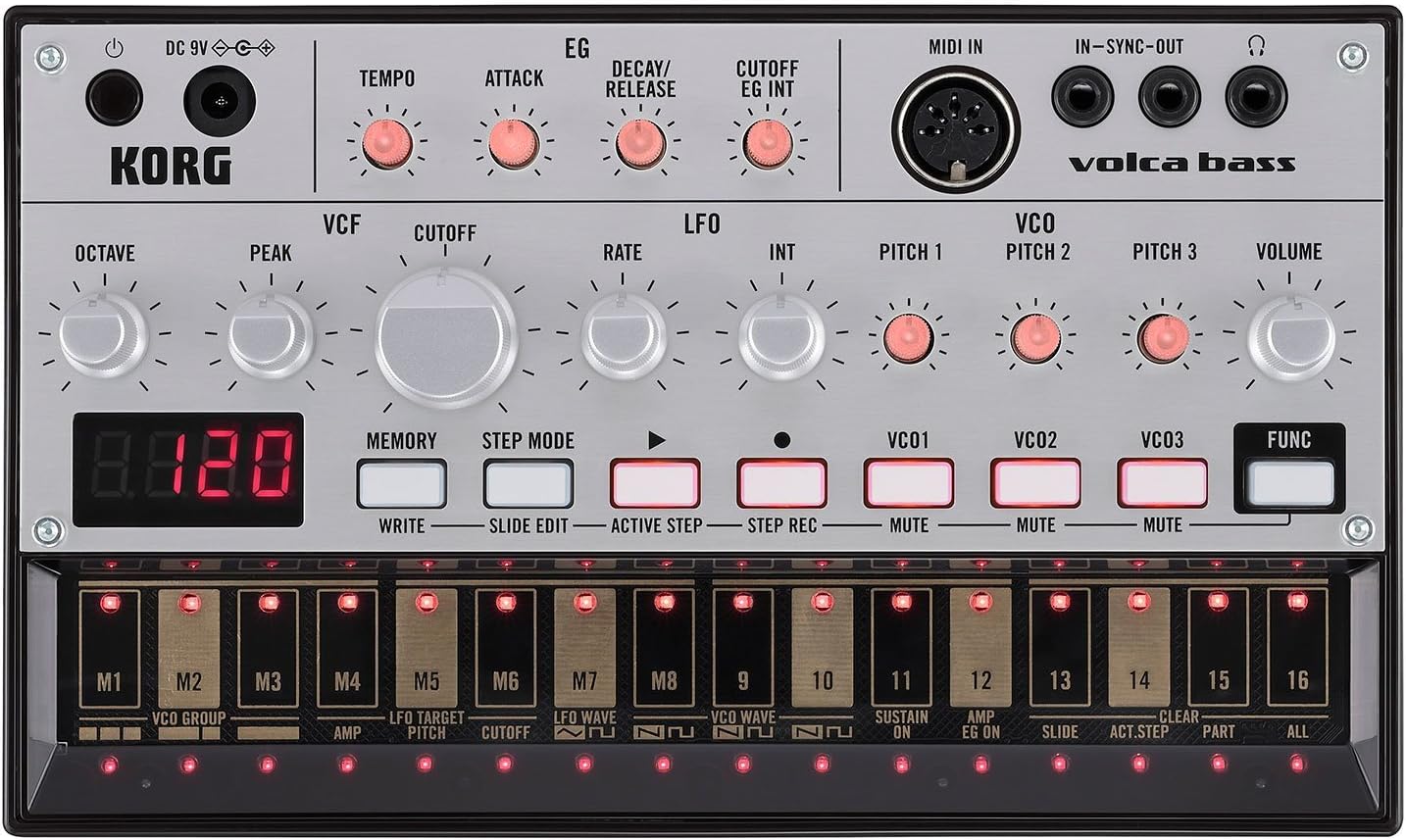
The Korg Volca Bass is a compact analog synthesizer featuring three stable oscillators and a 16-step Electribe-inspired sequencer. Designed for powerful, punchy bass sounds with classic acid house slide and filter effects, it offers portability with battery power and a built-in speaker. Its intuitive controls and MIDI sync capabilities make it ideal for both studio production and live performance, delivering professional-grade bass tones in a pocket-sized powerhouse.


| ASIN | B00CAKQCHS |
| Best Sellers Rank | #1,075 in Musical Instruments ( See Top 100 in Musical Instruments ) #7 in Tabletop Synthesizers |
| Body Material | Bass Wood |
| Brand | KORG |
| Brand Name | KORG |
| Color | White |
| Connector Type | 3.5mm Jack, USB |
| Customer Reviews | 4.6 out of 5 stars 660 Reviews |
| Finish Type | Polished |
| Global Trade Identification Number | 04959112108691 |
| Included Components | Instruction Manual |
| Item Dimensions | 8 x 5 x 2 inches |
| Item Type Name | Sound Module |
| Item Weight | 16 ounces |
| Item dimensions L x W x H | 8 x 5 x 2 inches |
| Manufacturer | Korg |
| Material | White |
| Model Name | VOLCABASS |
| Model Number | VOLCABASS |
| Part Number | KRVOLCABASS |
| Sound Profile | Bass-heavy |
| Unit Count | 1.0 Count |
| Warranty Description | 1 year manufacturer warranty. |
J**.
The Little Bass Synth I Didn't Know I Needed
This was an impulse buy on Amazon Warehouse (AW) on a bitterly cold night in early February, an evening when I had had a few too many glasses of wine. I was vaguely aware of the Korg Volca series, in that I had seen a few negative or neutral comments about them on various music forums, but I hadn't listened to any audio demos or watched any YouTube demonstration videos. Honestly, these tiny boxes had never appealed, as I like my synths with keys or something I can put in a rack and MIDI up to my rig. So when this popped up on AW in a "Used-Acceptable condition for what seemed to be nearly 50% off the retail price, I thought, well, if I don't like it, I can sell it on for a profit. I'm glad I did. I love this little box, and it looked absolutely brand new in the box when it arrived. Go figure. I like it more than my Pro-1 monosynth -- I think the Volca Bass sounds better than most of my keyboards, with the exception of my Korg Radias. I mean to say, the Volca Bass is fat sounding, and oh!!! it has that distorted squeal that is very similar to a Roland TB-303 (or the Behringer clone). The filter resonance (peak knob) on this wee thing self-oscillates, so if you're looking to do a bit of Daft Punk or Chemical Brothers-style late 90s and early 00s techno work, this little guy can do it, and do it very nicely. Let's get the cons out of the way: The speaker is rubbish. I get why Korg put it there, but the speaker doesn't have the range to actually hear what all the glorious goodness this synth can make. Tip: Use headphones if you're going portable with this. Otherwise, hook it up to your mixer / monitoring system / amp. The MIDI implementation is good, but you can't modulate the filter via MIDI. What???!!! Why not, Korg? What are you thinking? Sigh... So, you must use the Volca Bass's filter knob in real-time. Also, no MIDI out, but it is possible to modify the unit so that it can do MIDI out, so at least there's that option for the hardcore modders. Pattern storage is limited to 8 memory slots. You will use those up quickly, and then you'll have to decide on which patterns to get rid of for later sessions. Also, there is no pattern chaining, so you must manually change patterns in real time, and you will need to do that in perfect sync as there is also no "wait to change pattern" functionality. If you're sequencing a pattern, know that the filter knob adjustments do not get recorded. The octave knob's movements will be recorded, however. On the other hand, it is possible to create 24 patterns when in individual three-osc mode, and with a bit of clever muting, you can probably do quite a bit with that. The smaller, clear knobs ... it's sometimes difficult to see what their positions are. Also, when I reach for the tempo or the EG attack knobs at the top center/left of the unit, I often accidentally brush the big filter knob. No noise oscillator... that's a shame. But not a deal breaker... So them's me cons. On the the pros: Three very stable analog VCOs (digitally tuned for stability, but these bad boys are definitely analog oscillators), any of which can be a Saw or Square wave. You have the options of three independent VCOs, two stacked together, or all three stacked together. There is also a tuning knob for each VCO, so you're able to create a very thick and fat super saw sound. Note range can be adjusted per voice but only if you are sequencing a pattern. Otherwise, all three VCOs will change depending on where the octave knob is set. The playing surface (ribbon?) is really responsive to touch and it's fun to play and slide around on it, but it is important to note that the playing surface is not velocity sensitive. The Volca Bass responds to velocity when connected to MIDI controller, though. Keep that in mind if you want to get the most you can out of this tiny box of joy. It took me a few minutes to work out what the deal was with the black and gold "keys." Tip: The gold keys are the black keys on a keyboard. The rest are the white keys. The lowest note on the surface is an "A". Maybe an "E" would have been better, which is the lowest note on a bass guitar, but from keyboard perspective I suppose it makes sense (an 88-key keyboard's first note is an A.) The filter on this insanely good. I read somewhere that it's based on a Korg 700s filter. I dunno if it is or not. And I don't care. I really like a lot. The envelope seems limited, but it actually has two modes and it is perfectly serviceable. One mode with no sustain segment, just an attack and delay, which is superb for punchy bass tones, and the second mode is with a sustain feature, which is great for more synthy sounds and self-oscillating the filter rez. These modes are switched by holding down the function button and pressing the number 11 key marked Sustain. Pattern sequencing is quick, if not a bit imprecise when doing it in real time. There is some sort of quantization going on, which can be distressing if your timing is off. I much prefer to sequence a pattern in Step Rec mode. Speaking of modes, the Active Step mode is useful and fun. At the moment, I tend to use a Beat Step Pro to sequence more complex patterns. Other times, I will set up a zone on my workstation to play the Volca Bass via MIDI in real time. I'll even swipe at the playing surface from time to time when playing other synths. You'll definitely want to put some effects in the signal chain, such as pedals or some other multi-fx unit, as the dry sound may be a bit in your face. But even dry, it can sit in a mix at low volumes. All in all, I'm really impressed by the sound of the Volca Bass. I had no idea that I was missing this in my life, and I'm glad I bought it. I'm now considering selling my Pro-1, as I have had that turned off since the beginning of February when the Volca arrived and I don't need two monosynths which cover the same sonic terrority. For its size, it's a little powerhouse in a tiny, tiny box. Could the UI (knobs), memory storage and MIDI implementation be improved? Sure, those could be better, but if you can snag one of these for $100 or less, it's definitely worth it.
H**L
Fun, powerful, and portable little machines
Korg's Volca series is great, but it would probably be helpful to know what you're getting into ahead of time before purchasing. While there's a lot of videos on YouTube, and some busy topics on Reddit discussing the merits of these machines, I think I fit pretty accurately the target audience for the series to help speak on whether or not they might be right for you: I’m an amateur to synthesis and have minimal space for gear, a low budget, and an affinity for low-fi sounds. That being said, I started with the Bass about a year and a half ago and admittedly didn't really understand the thing, or how to use it in my workflow that at the time was primarily just clicking around in the DAW. After jumping over that hurdle and learning the various functions and controls, the thing really opened up. While it's certainly got a tinny/metallic sound to it and is by no means your classic acid machine, the thing really screams and can make some great sounds. Granted, I don't have years of experience with higher-end synthesizers to compare against, but that leads into my next point, which is that these machines are just fun, especially for someone starting out working with hardware. I've seen complaints about them being 'toys', or limited in what you can do with them, and while I won't argue the merits of that based on some folks' perspectives, the small, portable nature of them makes them a non-invasive addition to a small space and perfect for picking up and messing around outside of the desk or studio environment. The price tag encourages buying them over time, and since getting the Bass, I've added the Beats, FM, and Keys to the mix. They each have their own quirks and limitations that encourage creativity. As well, they're powerful enough to be useful, and rather than being overwhelming machines (a bit like the Microbrute is for me as still-an-amature), they're in most respects easy to learn. The FM's a bit of it's own story though, as FM synthesis is complicated by nature. I'm hesitant to purchase the Sample, simply due to the lack of an audio in. Maybe the iOS app is convenient and easy to use, but it still adds an extra layer to getting sounds on the machine. Which brings me to another point: if you're considering either the Beats or the Sample, you might look first for a used ES-1 or ER-1. They're roughly the same price, but a bit more versatile (although bigger), and at least in comparing the ER-1 to the Beats, sound considerably better (the Beats snare issue is annoying, but not a total deal breaker if the other pros outweigh that con). In summary, I think these are really great, affordable little machines. Without the hassle of buying old buggy hardware, you get some new portable things with a lot of potential. If you’re looking for machines with ‘recordability’, though, these probably fall more in the jam-box or accent-to-other-machines category. Have fun!
R**P
Volca bass analog synth
Well, first things first..I'm 30 years old, from sothern California. My dad is a old school Dj that still performs at weddings & other events, but he started out in 1981 Dj'ing at "bobby mcgee restaurant & nightclub". After growing up around a whole family that revolves around music since I can remember, These devices bring back those memory's from the beginning for me! The way they even look & sound is almost a perfect mirror reflection of what I've experience from the past. This review is for the "korg volca bass" so I'll tell you how it sounds to me. The volca bass sounds pretty much like the korg monotribe as far as quality goes, it's simple & great. The operation & programming is why I love this unit the most! I'm a "real-time" performer, meaning when I play live or even in studio I prefer to pretty much keep the beat going simply put..I do not like sitting for longs periods of time editing music. For me I like to be in a "live event" type state of mind, I find i work better under pressure when there is always that "what if I mess up, ect" going on in my brain I just give all I got at that point. So this Volca bass & the other 2 units are great for someone that likes the process of creating, making,mixing,editing layers on layers of an infinite amount of variations music in front of people, these are made for you! I'm not going in-depth with operation because I'm good at 95% of what these babies can really do so if you have any questions fill free to contact me. I don't know much about the "write" functions but everything els I'm good with. Basically I got all three at once because they make up the basics of music. Somtimes I find myself building a drum pattern first, then I work on the bass line, then I use the volca keys (or what I call it volca-synth) for many different things. What's nice is just making a few cords on the (flux) setting, making is record realtime without quantization all the patter of music. Meaning on flux mode it will not correct or off tones ect..but this allows for a more complex pattern to be recorded:) so after making a nice chord you can play on top of it or whatever you want. The thing they don't tell you about all three of these unites especially the "keys" is that you under the right light condition, you can see right through these things! So in the middle of a mix you look down & it's pretty dang trippy some times! you can see the red led lights inside from parts of the sequencer actually blinking from the inside out while on the outside most the knobs blink/flash strobe, to show the movement that was recorded while playing in memory mode. Also I say "most" because there are a few knobs like "peak knob " if I remember right, that do not light up & they are not suppose to light up. So it's not broken or anything if your not seeing certain a knob/light not flash. Some bad things, hard to use with my big hands but very doable.. Had to go to GC & buy like 70$ worth of korg A/c power supply's for them all still not bad..also I'd be willing to pay more if the had more functions & a little better built, I'm not complaining trust me. So that's all I have time for now. Thanks
A**.
Simple analog goodness
This is my first real analog synth, as my others are all really either FM or sample based. Very different approach. A patch for this is literally a pic of where you have the knobs set lol. Much more old school. Loving the wide variety of sounds and textures, and the possibilities for deep booming sounds and drones so far especially. Easily worth the price.
A**.
Great would be better if it was designed to easily write midi to a DAW.
It has a great sound and pretty easy to get started with. It would be improved if it had an app or companion plugin but that’s what I would want, not necessarily what you might want. It arrived quickly and was intact. Only minus is it ships without an electric plug. It runs on either battery or plug but comes with batteries. I’d prefer it cane with the plug and I buy my own batteries.
J**H
Dive into analog
I'm a musician, primarily guitarist, who has recently gotten interested in analog synths. There are plenty of software synths available, including some that mimic some of the classics (e.g., Mini Moog) but there's something about creating sounds from scratch by physically turning knobs that isn't there with the software synths. I read the considerable hype about the Volca line and decided, for the price, it was worth taking a chance. For my needs, I settled on the Volca Bass. I am blown away by this little synth. Don't let the small size fool you. It is not a toy but a real instrument that will be hard to put down once you get the hang of it. Plus, since it works (a long time!) on batteries, or with an adapter, it's something you can put in your backpack and take with you just about anywhere. If it didn't look like I was starting to hoard musical instruments (and the fact I really don't need them) I'd get the other two Volca units as well.
M**T
Very analog. The sync does not work correctly.
This is my first Volca. Coming from digital music making world, this analog instrument feels limiting at first. The fact that you can’t really save the actual tone and only a pattern made using it is an “aha” moment. Yet the sound this instrument generates is worth the trade off. It is juicy, deep, rich and super analog in its roundness. Often unpredictable too, in a good way. This Volca is beautifully designed: just look at the red digits of the display and internal reflections around them. It’s such a pleasure using it, it’s a kind of item that is cool to have sitting on your desk. You can power it on and come up with interesting sounds and patterns. It feels timeless. Unfortunately, the sync feature works very poorly. When connected to other Volcas it skips some notes and does not hold the sync. It's a well known issue with all the Volcas, based on the suggestions found online it's likely due to signal of the synth bleeding into the sync track and causing wrong sync triggers. It really is a shame as otherwise it's a great little device.
K**N
Phat Analog Module
After 6 months of owning this little beast, I would say to look at it more like a moog sub phatty module than a 303 and you'll be thrilled. Get a keystep, a $40 fx pedal and start a band. Schools should teach music on the volca series IMO. Either way this is a great analog synthesizer that swings far above its class and a wonderful place to discover analog filter addiction.
ترست بايلوت
منذ شهرين
منذ يومين