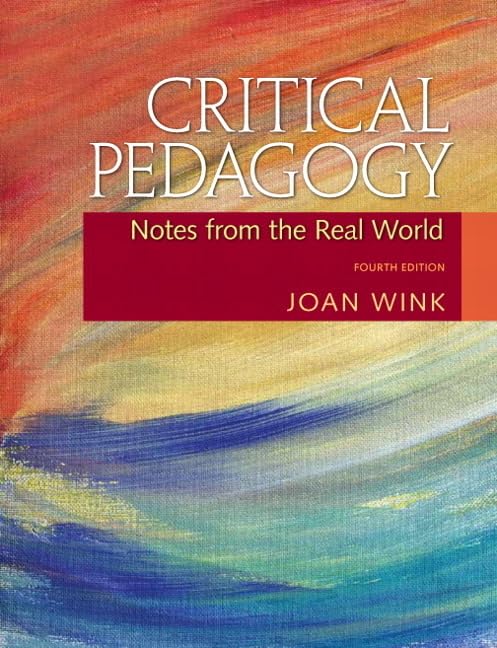
Critical Pedagogy: Notes from the Real World
M**S
Pedagogy at it's best!
Review by: Melissa CreesCritical Pedagogy: Notes from the Real World 4th EditionJoan WinkThis text discusses real life situations that utilize pedagogy as a way of teaching and learning. Throughout the text there are helpful lessons and resources that the reader can utilize in realistic contexts. Much of this text is based on the ideas of Plato, Socrates, and Aristotle. In addition, The three perspectives of pedagogy; Transmission models, generative model, and transformative model are elaborated on which is a necessary foundation of knowledge to truly teach and learn reflectively.I enjoyed reading this text because of the personal touch that it has. To read about Dr. Wink's personal experiences allows us to see into her world. This is beneficial because her world consists of years of trial and error with teaching and learning. In addition, this text has many models that help the reader to really see what Dr. Wink is talking about. These models will be helpful as an educator because I can refer back to them in the future.My favorite chapter in this book is chapter three. This chapter really digs deep into where critical pedagogy came from and how it has evolved over time. I think this is an important thing to look at because it shows us that teaching and learning is always evolving and we should always strive to make it better. Socrates, Plato, and Aristotle are mentioned in this chapter because of their influence on pedagogy. I enjoyed seeing how each of these ideas shaped what pedagogy is today. Foe example, The Socratic dialogue was a huge step in critical pedagogy. To further thinking while drawing more and more out of a students mind is the oldest trick in the book. But it works! I Vygotsky is also mentioned in this chapter which makes sense because of the connections he made between dialetical learning (which is great) and collective learning (also great!) Put them together, and we have some seriously wonderful pedagogy going on.I enjoyed reading this text and how it continued to build upon each idea. I found this text to be a comfortable read that touched on some wonderful ideas. As a student of Dr. Wink, I appreciate her attention to detail throughout this book and it is clear that she has her readers in mind. She includes activities that we can utilize in our classroom that will make it easy for us to embrace diversity and to think outside of the box. Thank you Dr. Wink!
S**A
Critical Pedagogy
Critical Pedagogy Notes from the Real World Fourth Edition by Joan Wink 2011 is a book dedicated to the hope of teachers becoming more than methodologists making a difference. “Critical pedagogy enables us to understand that we also are professionals and intellectuals who have the power to take part actively in self- and social transformation. Critical pedagogy makes us keep on keeping on.” (Wink 2011 p. 148). Taking those words to heart as a current student of Dr. Winks’, who has struggled a great amount with the principals and premise of this assignment aka review, I find myself reeling in what she would describe as the whirlwind. She brings to light the need to continue learning, unlearning and keeping on through continued self- and social transformation. I will write this review because I must, much like I must give state and nationally required assessments to my students. It doesn’t mean that I have to agree with it or like it. It simply means that I must do what is asked in order to meet the requirements and expectations. The book itself is an easy read as you follow Dr. Wink through her own learning and unlearning and relearning. Her learning is expressed in stories and experiences which she happily shares with her readers, even the stories that make you grimace as you read them and hurt for the people who lived them. “Learning can be very challenging, but the problem is that it always leads to relearning, which is more challenging. I think that relearning often involves a shift in methodology.” (Wink 2011 p. 37) To me this is the point she wants all of her readers to gain from this book. That pedagogy alone isn’t enough. As educators it is our responsibility to become critical thinkers and doers in a hope to make the changes needed for our students and us. Dr. Wink’s style is to begin the chapters with questions that make the reader begin to think critically about them. How does it pertain to me? Does it pertain to me? Have I experienced it? I do think these questions taking the place of chapter titles are very relevant and necessary to this book. Chapter one addresses why in the world critical pedagogy matters. Chapter two goes on to question what critical pedagogy is. In chapter 3 the reader is taken down a historical track to learn where critical pedagogy arrived. And probably most important are chapters four and five in which the reader is provided with ideas, examples and experiences that teach how to do critical pedagogy and where to go from here forward. I would recommend all teachers and especially those teachers who are left with little to no guidance in their school systems have a copy of this book. Critical Pedagogy is full of resources and data supporting the use of them as well as supporting the end to many long time teaching practices. I do appreciate all of the references to pioneers in the field of education who have stepped out into the transformative thinking to lead the way for upcoming transformative teaches. Dr. Wink gives credit to the likes of Krashen, Cummins Vygotsky, Freire and Alma Flor Ada to name a few. I didn’t find this book to be an easy read because of the amount of material and depth within its pages, but having that depth to reference and fall back on is well worth the great amount of text. I strongly suggest that as a reader you take the time to review the notes and the reflective questions Dr. Wink provides at the end of each chapter. In my opinion that is truly her goal—creating critical thinkers of critical pedagogy.
ترست بايلوت
منذ أسبوعين
منذ أسبوعين