We remain fully operational. Our teams are working around the clock to ensure your deliveries continue safely.

قم بتنزيل التطبيق


معلومات عنا
حقوق الطبع والنشر © 2024 Desertcart Holdings Limited
قم بتنزيل التطبيق





Buy anything from 5,000+ international stores. One checkout price. No surprise fees. Join 2M+ shoppers on Desertcart.
Desertcart purchases this item on your behalf and handles shipping, customs, and support to KUWAIT.
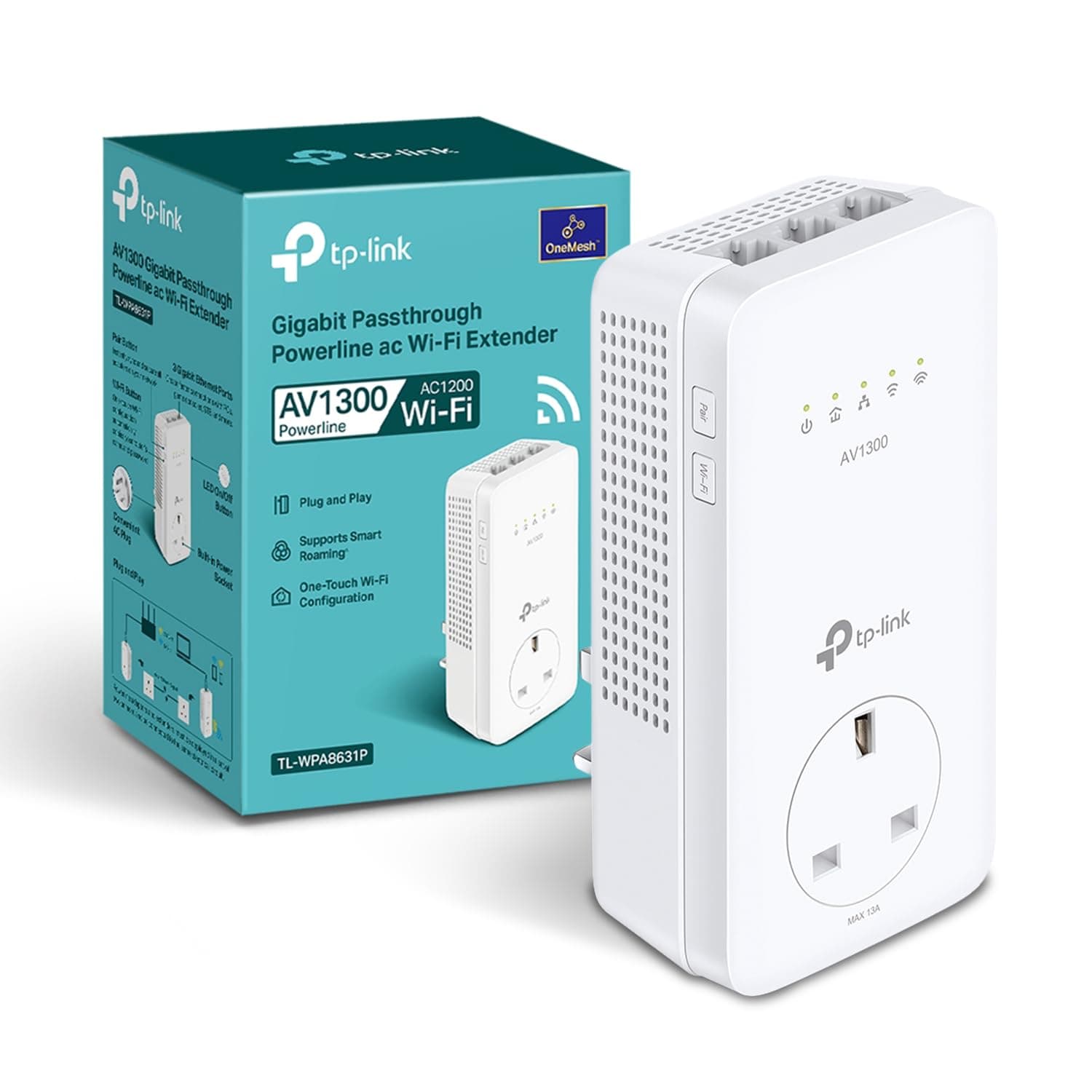
🚀 Power up your home network with lightning-fast, seamless WiFi everywhere!
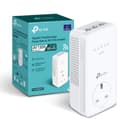
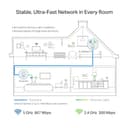
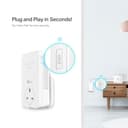
The TP-Link TL-WPA8631P is a high-performance AV1300 powerline WiFi extender featuring dual-band speeds up to 867 Mbps on 5 GHz and 300 Mbps on 2.4 GHz. It includes 3 gigabit Ethernet ports for reliable wired connections and supports OneMesh for a unified, seamless network experience. With plug & play setup, integrated power socket, and 2x2 MIMO beamforming, it ensures stable, wide-range coverage ideal for streaming, gaming, and smart home devices.


| ASIN | B08LX61KDL |
| Best Sellers Rank | 1,404 in Computers & Accessories ( See Top 100 in Computers & Accessories ) 9 in Powerline Network Adapters |
| Box Contents | TL-WPA8631P |
| Brand Name | TP-Link |
| Color | White |
| Compatible Devices | Desktop, Desktop Computer, Game Consoles, Laptop, NAS, Printer, Smart TVs, Smartphone, Tablet |
| Country of Origin | China |
| Customer Reviews | 4.2 4.2 out of 5 stars (340) |
| Data Link Protocol | Gigabit Ethernet |
| Data Transfer Rate | 1300 Megabits Per Second |
| Hardware Interface | Ethernet |
| Item Dimensions L x W x H | 15.2L x 7.7W x 7.5H centimetres |
| Manufacturer | TP-Link |
| Manufacturer Part Number | TL-WPA8631P |
| Model Number | TL-WPA8631P |
| Product Warranty | 3 year manufacture |
S**T
Brilliant devices
We stream TV, game and video conference using these. Very easy to configure, just press the pair buttons; more detailed configuration (which many might not need and there is a detailed user manual you can download from tp-link) using the web interface is self explanatory but I have more IT experience than is typical; you should bear this in mind if you are less experienced. The web interface offers great flexibility, crucially it offers the all important MAC address white listing (I won't entertain any WiFi without this capability), for fun you can even schedule when the LEDs turn off at night which is actually useful in a bedroom. Find the web interface at the private IP address your broadband router assigns it, most likely starting '192.168', or download the tpPLC utility from tp-link and access your device's web interface via tpPLC by clicking on the little globe which pops out to the right of your device (give tpPLC a few minutes to sort itself out, then hover over your device and watch the globe pop out). Clicking the globe will open a browser at the appropriate IP address, the first time in you'll need to set a device access password (this isn't the SSID WiFi password). Each WiFi capable tp-link device will have a different IP address. The default device IP is provided by your router's DHCP server but you can statically configure. The TL-WPA8631P also provides a DHCP server with configurable address range (you can disable it). The WiFi has WPA/WPA2/WPA3 security, 3 power levels, a guest network off by default, parental controls for specified MACs, 2.4GHz and/or 5GHz can be switched off. There's facility to backup/restore settings, some settings can be synchronized (or not) across devices, you can list connected clients. I downloaded the user manual from tp-link to check it had the features I needed, it's comprehensive and runs to about 45 pages. My house has brick internal walls dating from mid 20th century and covers an area large enough to make WiFi difficult. The house wiring is approximately 15 years old, I have no ethernet cables between rooms, I rely on powerline data transmission using the house ring circuits. I find no problem running powerline devices on simple inexpensive extension leads (without power filtering) and somewhat surprisingly find these devices work between ring circuits; I don't understand why this is but it's likely because I don't understand my house wiring well enough (it was rewired before I moved in). The takeaway is that in my house the powerline works very well everywhere, even in the 'garden office' which has its own ring circuit and is 60ft from the house, but it might not follow you will get the same performance; from what I read your house electrical wiring is critical to your experience. I currently have four AV1000 (max 1000Mbps over powerline and with 1Gbps wired ethernet) and two AV1300 (max 1300Mbps over powerline with dual band wifi and 1Gbps wired ethernet). I downloaded the tpPLC utility from tp-link and run it on Windows 11; it shows the powerline speed being achieved between the various devices in my house is more or less half the max theoretical speed of the slowest device. Thus AV1300 to AV1300 is typically ~700Mbps, AV1300 to AV1000 is typically 400/500Mbps and AV1000 to AV1000 is also 400/500Mbps. The tpPLC utility shows these numbers vary over time over a small range. Whether these speeds are a realisable data rate for connected devices I don't know, I assume there are loses and actual connection speeds for equipment will be slower. The broadband speed to my house over fibre is 130Mbps. Speed tests from computers to the internet using ethernet cable connected to the 1Gbps ports show me achieving 120/134Mbps so powerline isn't causing a bottleneck and I'm seeing my full broadband speed. When I increase my broadband speed to 264Mbps it will be interesting to see if I see this greater speed over powerline. The AV1300 TL-WPA8631P offer 2.4GHz & 5GHz wifi. At 5Ghz I also achieve 120/134Mbps, at 2.4GHz this speed seems to drop sometimes to 100+Mbps; I was surprised by this because the TL-WPA8631P is rated at 300Mbps for the 2.4Ghz wifi. Otherwise horses for courses, 2.4GHz penetrates brick walls much better than the 5GHz and I switch off whichever wifi frequency works less well in the environment it is being used, typically using 5GHz only within a room and 2.4GHz between rooms through brick walls; it stops connected wireless devices sometimes choosing the less strong/fast signal; that's a typical wifi issue not limited to these devices. The wifi TL-WPA8631P have excellent configuration options when using their web interfaces, including MAC white listing which I use extensively, and one can restrict a MAC (eg a child's smartphone) so it can't access WiFi at night. Being able to restrict MACs on a school night is essential, they learn soon enough not to use up their 4G phone data. I have not tried using OneMesh, my broadband router doesn't support it and I don't find the need for Mesh WiFi. Rather than have all network names (SSID) the same and experience the commonplace wifi issue of a computer hanging on too long to a weak signal from a distant access point and not knowing which access point you are connected to, all SSID names are different and we know where we are connected; that is fine for us. If you walk around your house while in a video conference your mileage might be different and need Mesh wifi. Overall I have found these powerline devices amazing; for my purposes these devices beat dragging ethernet cables around the house. If you have Gigabit broadband and want to see it in distant parts of your property then wired ethernet might be the way to go (though I note powerline equipment with speeds faster than AV1300 are available which I have not tested) but for more modest speeds, like my 130Mbps broadband, and good house wiring, this might be all you need. I have not tried mixing different vendors, all our devices are tp-link. I've updated the firmware on both of the TL-WPA8631P, because it was there not because I needed to, I used the web interface but the downloaded tpPLC utility also has the facility to do this.
K**N
Well known brand, good support, solid products
Just had the broadband upgraded to FTTP by BT, so wanted to take advantage of higher speeds in my study, which is on a different floor of the house. Previously used a pair of rather ancient powerline adapters, also TP-link products and was interested in this item because I thought it would be faster for large bandwidth transfers, which I do regularly and also incorporates a WiFi repeater. As we have masonry walls in the house, the WiFi from downstairs is badly attenuated. First thing to note: the box contains just 1 PLA, so either order 2, or another that is compatible, probably without the WiFi function. Installation is as simple as plugging in, hitting first the pair button on both ends and then the WPS function to synch the WiFi. 5 minute job. Unfortunately in my case, the wiring in my house has meant that I couldn't get any faster bandwidth (achieves approx 85 Mbps transfer on Speedtest on a 1Gb optical fibre throttled to 150Mbs)> I also found that the WiFi speed is also attenuated. It's worth downloading the app as well as it provides many extra security and usage functions - like turning off certain devices when it's time for the kids to go to bed. UPSHOT: So, although the product is no good for me and has been returned to amazon for credit, it is a brilliant bit of kit an no doubt it will work fine in a house with solid walls, especially if you can located the 2 PLAs on the same ring main.
T**Y
Solved remote access
Needed a wifi connection in my workshop set at the end of the garden. Luckily I had a hard wired gigabit connection near the same house electric circuit to the workshop so the base unit could be plugged in and onto the main network relatively simply. (An absolute requirement for the system- it won't work off two different electrical circuits). Signals now run up the armoured cable out to the shed and to the wifi unit. It's not the fastest of connections giving me adequate performance that end, but allows a wifi cctv camera to work well enough and serve the equipment in the workshop.
ترست بايلوت
منذ أسبوعين
منذ شهرين