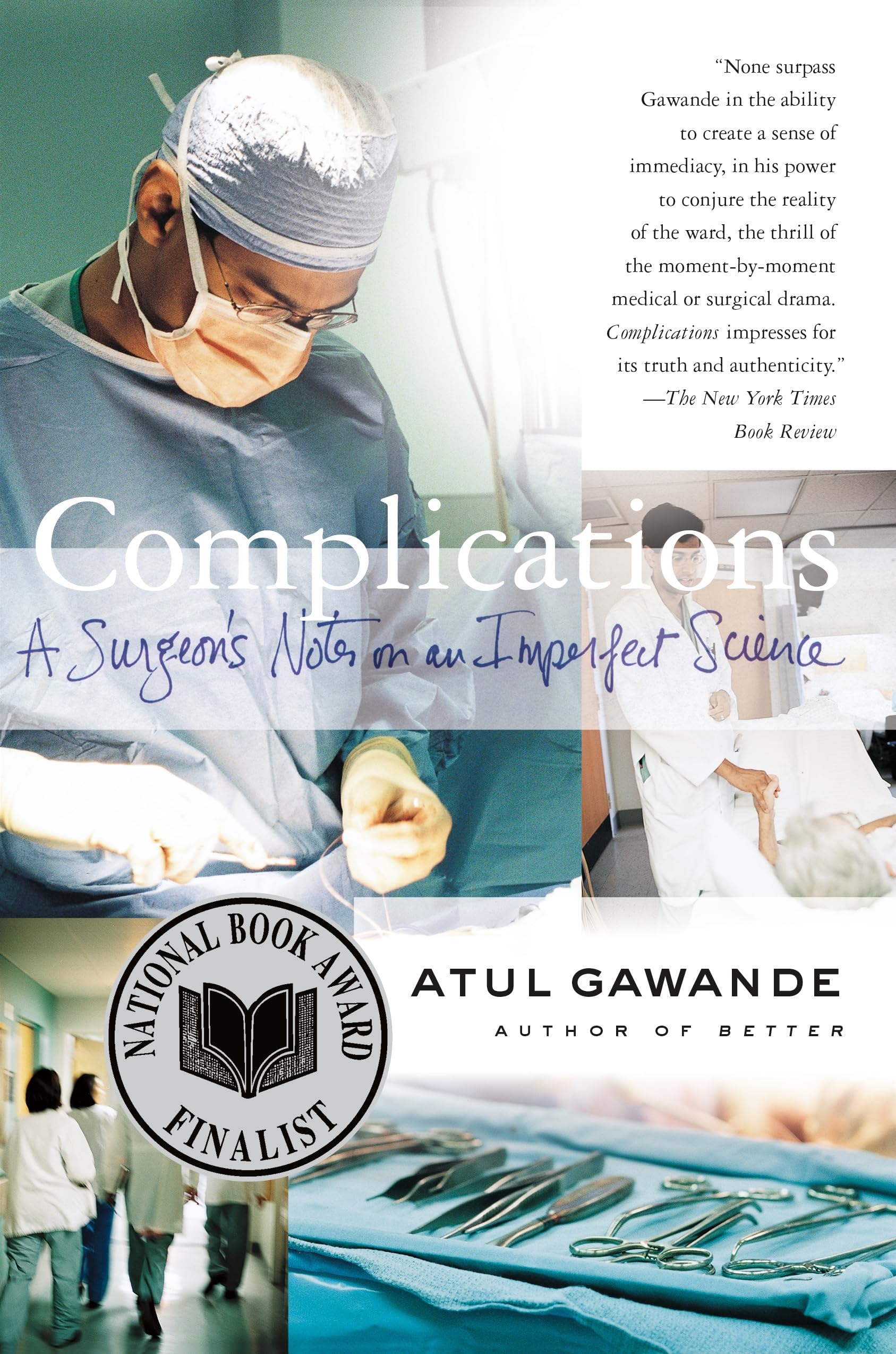


Buy Complications: A Surgeon's Notes on an Imperfect Science by Gawande, Atul online on desertcart.ae at best prices. ✓ Fast and free shipping ✓ free returns ✓ cash on delivery available on eligible purchase. Review: Un libro molto interessante da leggere se masticate l'inglese. Drammatico e comico allo stesso momento. Lo scrittore ha avuto un grandissimo successo con vari libri basati sulla sua esperienza da neurochirurgo che ho immediatamente ordinato poco dopo. A me è piaciuto molto e l'ho finito in meno di due settimane. Review: This book was a fascinating look into the modern doctors world. It is a job more defined by statistics than in the past, but personality and experience still play a great part. I really enjoyed reading this doctor/author's book book on Checklists and their usage in medicine so I was not disappointed with his more random thoughts on doctoring in general. Some of it is quite unsettling as in the case of surgery and interns learning. You hate to be a learning experience when your life is at stake, but how else do interns learn? Still...most doctors insist that their loved ones, are not part of this experience. Doesn't seem really fair; does it? Doctors like everyone else do better with practice, and this is well demonstrated with these specialized practices that only do Hernia operations. It also makes it possible for robots and computers to be quite effective at simple procedures. However that gives me pause. Here the blue screen of death might have greater implications than a reboot. I liked the fact where he dealt with some of his mistakes and diagnoses of patients and how there was a struggle of procedure and how to approach things. One person was nearly harmed by a minor oversight and another person was saved with a hunch. Given that both of these areas (oversights and hunches) are in the gray areas of human cognition it shows how much luck plays a factor, or a sixth sense, that doctors with experience start to develop. A quick synopsis of what this book includes: INTRODUCTION FALLABILITY *Education of a knife: How interns are trained in surgery. Odds are, you are their training. *The computer and the hernia factory: Repetition = perfection and efficiency *When doctors make mistakes: How mistakes happen. Like all of us they are human, but unlike all of us the ramifications are greater. *Nine Thousand Surgeons: Conferences provide an opportunity to compare notes and keep up to date. *When Good doctors go Bad: Peer review is necessary but whistle blowing on a colleague is rare. Not surprising there are remediation schools, but few and far between. Important note, if some doctors push you away from others...take note. MYSTERY Full Moon/Friday the 13th: Is there any truth to this. Statistically no, but the jury is still out. The pain perplex: Pain stumps most doctors as how and why it exists is not clear cut.There is no test for pain. A queasy feeling: Nausea is not one symptom, nor does it have a single cause and can be very difficult to treat. Crimson tide: Blushing, for some it undermines their confidence, but is it only cosmetic? The man who couldn't stop eating: Overeating is a life altering issue and surgery to address this is gaining ground as in the case of the morbidly obese, it works. UNCERTAINTY *Final Cut: Autopsy is not done as much any more unless there is a mystery surrounding the death. However, it helps educate doctors as to the accuracy of their diagnoses. Unfortunately to many it is a violation of the dead, who will gain nothing in return. *The dead baby mystery: Sometimes the answers are obvious *Whose body is is anyway: Doctors these days advise, not dictate and patients struggle to make the right choices. *Doctors have to let patients make bad choices despite their objections. *The case of the red leg: Gut feeling are sometimes all you have and often they are dead on. In the absence of this all that is left is statistics. SUMMARY This book was interesting, as it was a mix of topics. Some associated with specific symptoms like pain, blushing and nausea. Others associated with medical errors, bad doctors, cases that were swayed by errors and hunches. If you have any interest in medicine, but not the background, these are great books to read, as you get the human side of it, rather than the scientific.


| Best Sellers Rank | #161,127 in Books ( See Top 100 in Books ) #15 in Surgery #222 in Medical Reference #1,201 in Diseases & Physical Ailments |
| Customer reviews | 4.7 4.7 out of 5 stars (1,764) |
| Dimensions | 13.84 x 1.78 x 20.83 cm |
| Edition | First Edition |
| ISBN-10 | 0312421702 |
| ISBN-13 | 978-0312421700 |
| Item weight | 1.05 Kilograms |
| Language | English |
| Print length | 288 pages |
| Publication date | 1 April 2003 |
| Publisher | Picador USA |
C**N
Un libro molto interessante da leggere se masticate l'inglese. Drammatico e comico allo stesso momento. Lo scrittore ha avuto un grandissimo successo con vari libri basati sulla sua esperienza da neurochirurgo che ho immediatamente ordinato poco dopo. A me è piaciuto molto e l'ho finito in meno di due settimane.
A**J
This book was a fascinating look into the modern doctors world. It is a job more defined by statistics than in the past, but personality and experience still play a great part. I really enjoyed reading this doctor/author's book book on Checklists and their usage in medicine so I was not disappointed with his more random thoughts on doctoring in general. Some of it is quite unsettling as in the case of surgery and interns learning. You hate to be a learning experience when your life is at stake, but how else do interns learn? Still...most doctors insist that their loved ones, are not part of this experience. Doesn't seem really fair; does it? Doctors like everyone else do better with practice, and this is well demonstrated with these specialized practices that only do Hernia operations. It also makes it possible for robots and computers to be quite effective at simple procedures. However that gives me pause. Here the blue screen of death might have greater implications than a reboot. I liked the fact where he dealt with some of his mistakes and diagnoses of patients and how there was a struggle of procedure and how to approach things. One person was nearly harmed by a minor oversight and another person was saved with a hunch. Given that both of these areas (oversights and hunches) are in the gray areas of human cognition it shows how much luck plays a factor, or a sixth sense, that doctors with experience start to develop. A quick synopsis of what this book includes: INTRODUCTION FALLABILITY *Education of a knife: How interns are trained in surgery. Odds are, you are their training. *The computer and the hernia factory: Repetition = perfection and efficiency *When doctors make mistakes: How mistakes happen. Like all of us they are human, but unlike all of us the ramifications are greater. *Nine Thousand Surgeons: Conferences provide an opportunity to compare notes and keep up to date. *When Good doctors go Bad: Peer review is necessary but whistle blowing on a colleague is rare. Not surprising there are remediation schools, but few and far between. Important note, if some doctors push you away from others...take note. MYSTERY Full Moon/Friday the 13th: Is there any truth to this. Statistically no, but the jury is still out. The pain perplex: Pain stumps most doctors as how and why it exists is not clear cut.There is no test for pain. A queasy feeling: Nausea is not one symptom, nor does it have a single cause and can be very difficult to treat. Crimson tide: Blushing, for some it undermines their confidence, but is it only cosmetic? The man who couldn't stop eating: Overeating is a life altering issue and surgery to address this is gaining ground as in the case of the morbidly obese, it works. UNCERTAINTY *Final Cut: Autopsy is not done as much any more unless there is a mystery surrounding the death. However, it helps educate doctors as to the accuracy of their diagnoses. Unfortunately to many it is a violation of the dead, who will gain nothing in return. *The dead baby mystery: Sometimes the answers are obvious *Whose body is is anyway: Doctors these days advise, not dictate and patients struggle to make the right choices. *Doctors have to let patients make bad choices despite their objections. *The case of the red leg: Gut feeling are sometimes all you have and often they are dead on. In the absence of this all that is left is statistics. SUMMARY This book was interesting, as it was a mix of topics. Some associated with specific symptoms like pain, blushing and nausea. Others associated with medical errors, bad doctors, cases that were swayed by errors and hunches. If you have any interest in medicine, but not the background, these are great books to read, as you get the human side of it, rather than the scientific.
R**L
Lucid, well-researched
F**N
One of the most thrilling books I read in a long time. It is picked with real-life experiences, interrupted by insights and thought experiements that keep you thinking. Highly recommended for everyone interested even slightly in medicine.
M**O
医療は人を救うというプロパガンダのヒーローストーリーでもなく、病院の闇を暴露するだけの本でもない。ただし、怖い現実はタップリと書いてある。 医学は未知の領域が多い不完全なものという根本だけではなく、治療する医師が「人間」であるという事から更にComplicationを生む。具体的にはどういうことなのか。 それは・・・ 一般の業界でも仕事の経験を積むことでスキルを上げていくが、医師の場合にはスキルを上げる唯一の方法が患者を練習台にして学ぶというスタイルである事実。 医療関係者は研修医に家族が病気になった時もお産をする時も、研修医には担当させることは無いという身もふたもない事情。 評判の良かった医者が、いつの間にか訴訟また訴訟という医療ミス連発のヤブ医者になってしまう話。そして、同僚の医師が止まらないミスに気付いても、アクションを起こすことが難しい現実。 医学が不確かである事以上に、持っている知識を正しく使えていない状況が問題である事。 Complicationsを読むと、医療に不確かさはつきものである事実に納得と理解を深めることができると同時に、患者サイドとして「医師や病院を常に吟味しなくてはいけない」と読んで危機感を新たにすることになると思う。
ترست بايلوت
منذ شهرين
منذ 4 أيام