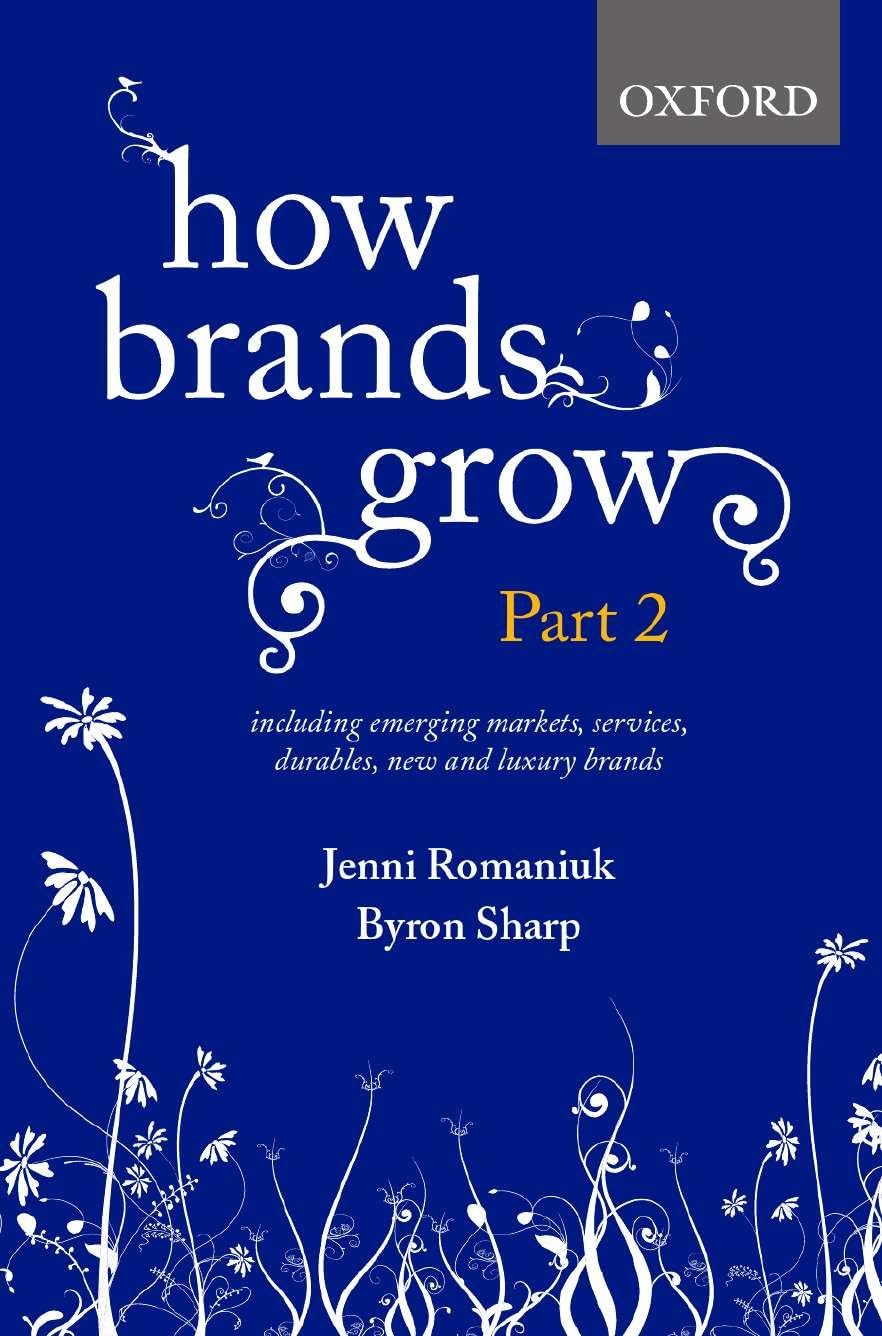

desertcart.com: How Brands Grow: Part 2: Emerging Markets, Services, Durables, New and Luxury Brands: 9780195596267: Romaniuk, Jenni, Sharp, Byron: Books Review: Romaniuk & Sharp move to more practical application, it's an excellent foundation on key topics in marketing & advertising. - Both of the "How Brands Grow" books are must reads for any modern marketer. They are filled with solid examples showing what works and how brands exist and interact with the consumer. Even better, the examples span the world comparing a wide range of established and emerging markets. Most important, the chapters reveal the flaws many of the enthusiastic theories of brand growth. Marketing is far too often caught up in a fad - like brand love or consumer engagement. And while marketers get promoted for telling their superiors they've embraced the fads, the companies they work for suffer damage. The reader should also be ready. My experience had already shown me common sense support for what the book reveals. But for others, perhaps more steeped in the fads, the book may be challenging and irritating. I have friends it so thoroughly surprised it took them time to embrace what is said. There is also care required in reading this book. It is all about brand - and heavily salted with examples from consumables (like soft drinks) and services (like banking). There are few hard product examples (a couple of automotive and technology), but not many. But getting into the details of these weaknesses too much would undermine the absolute about this book - that it's an ABSOLUTE MUST READ for any marketer. Review: What marketing is about - How Brands Grow part 2 is a must read for all those interested in understanding what makes the difference between big, successful brands and small brands. This new book brings all the insights of 'How Brands Grow - what marketers don't know' to the next level, providing practical examples on how to measure mental availability, distinctive assets and physical availability. Additionally it also provides plenty of data points on emerging markets - very useful and relevant to demonstrate that the laws of growth hold true also in less developed, often fast growing markets. I found 'how brands grow - part 2' as inspiring as the former and possibly even better in providing guidance about implementing the laws of growth in real business life.
| Best Sellers Rank | #1,912,020 in Books ( See Top 100 in Books ) #546 in Business Marketing #950 in Marketing & Consumer Behavior #5,856 in Marketing (Books) |
| Customer Reviews | 4.6 4.6 out of 5 stars (148) |
| Dimensions | 9.1 x 6.1 x 0.9 inches |
| Edition | Illustrated |
| ISBN-10 | 0195596269 |
| ISBN-13 | 978-0195596267 |
| Item Weight | 1.15 pounds |
| Language | English |
| Print length | 192 pages |
| Publication date | November 19, 2015 |
| Publisher | Oxford University Press |
D**T
Romaniuk & Sharp move to more practical application, it's an excellent foundation on key topics in marketing & advertising.
Both of the "How Brands Grow" books are must reads for any modern marketer. They are filled with solid examples showing what works and how brands exist and interact with the consumer. Even better, the examples span the world comparing a wide range of established and emerging markets. Most important, the chapters reveal the flaws many of the enthusiastic theories of brand growth. Marketing is far too often caught up in a fad - like brand love or consumer engagement. And while marketers get promoted for telling their superiors they've embraced the fads, the companies they work for suffer damage. The reader should also be ready. My experience had already shown me common sense support for what the book reveals. But for others, perhaps more steeped in the fads, the book may be challenging and irritating. I have friends it so thoroughly surprised it took them time to embrace what is said. There is also care required in reading this book. It is all about brand - and heavily salted with examples from consumables (like soft drinks) and services (like banking). There are few hard product examples (a couple of automotive and technology), but not many. But getting into the details of these weaknesses too much would undermine the absolute about this book - that it's an ABSOLUTE MUST READ for any marketer.
V**O
What marketing is about
How Brands Grow part 2 is a must read for all those interested in understanding what makes the difference between big, successful brands and small brands. This new book brings all the insights of 'How Brands Grow - what marketers don't know' to the next level, providing practical examples on how to measure mental availability, distinctive assets and physical availability. Additionally it also provides plenty of data points on emerging markets - very useful and relevant to demonstrate that the laws of growth hold true also in less developed, often fast growing markets. I found 'how brands grow - part 2' as inspiring as the former and possibly even better in providing guidance about implementing the laws of growth in real business life.
J**E
Best Marketing book you will ever buy.
I was very skeptical about the recommendation I got on the first book. I thought after 30 year of marketing with companies like P & G, Kraft, T-Mobile and Mars I knew enough about marketing. I was wrong. I found it to be the best clear headed marketing book I have have read in years. THere is so much baloney that passes for marketing today. This book and the first book by Sharp approach marketing from a much more realistic basis. The book explains how many platitudes about marketing are just not true. If you are serious about your craft, I suggest you read these two books.
N**K
More like Part 1.5
The first book was marvelous. This book felt more like Part 1.5. It rehashes a lot of old ideas, and then goes into a semi-useful set of heuristics around brand marketing. To its credit, some of it feels more actionable than the first book.
M**O
Every marketer should read this book
I am very grateful for this book. It finally answered many questions I had and helped me to deal with my projects.
E**A
All is good
I am so happy I have this book! The condition and delivery very good.
P**Y
How Brands Grow Part 1 was a brilliant, milestone publication that changed how many of us ...
How Brands Grow Part 1 was a brilliant, milestone publication that changed how many of us look at marketing. Treating consumer buying behavior as probabilistic rather than deterministic, and looking at marketing using data based analysis, backed by underlying fundamental theory, has been both highly influential and very useful. I therefore had very high expectations for this follow up. However, I was ultimately just a little disappointed. There is nothing wrong with the book per se, and if you haven't read the first one, I would jump straight to this edition, as it covers most of the key insights, and expands on important topics such as mental and physical availability. But I thought it could, and should have have expanded on those original ideas to a greater degree. I felt that it also badly missed examples of how strategically applying these principles delivers results in market. From a technical perspective, the section on mental availability does start to dig into the science of memory, but I thought it could have gone much deeper. For example, I would have liked to see more discussion around how the practical bottleneck in memory lies in retrieval rather than in encoding - Humans have plenty of space for memory encoding, but for the practical purposes of 'mental availability', the challenge is to have those memories activate at the time and place when they are relevant to our brands. Acknowledge that, it opens up all sorts of opportunities to tap into the science of memory, especially leveraging context, priming, co-encoding, and cuing to create mental availability at the time and place where it really counts. I would also liked to have seen more around how mental availability is impacted by competitive marketing, as what memories spring to mind first are very dependent on how competitors are soaking the market. Along with memory, I think there was room for a lot more discussion around prototype theory, which can have a big impact on how memories are encoded, categorized and retrieved. At a practical level, I would also liked to have seen more discussion around some common debates the first book triggered around potentialy atypical categories. For example, how closed networks, habits, and situations where switching costs are high (learning curves, accessories, lock and key, personal branding) impact sequential repeat buying. I was pleased to see luxury brands discussed, but it was only very briefly, at the end of the book. This doesn't in any way detract from the value and impact of the original book, which I would give a heartfelt 5 stars for it's insights into fundamental probabilistic buying behavior. But for me, that created very high expectations, especially with respect to tapping into psychology related science to uncover rules or laws that can be applied to marketing. This book does move the proverbial peanut down the road a little, but not as much as I'd hoped.
R**6
One of the best books you'll read on building a brand!
Order it. Read it. Implement it.
J**A
Thanks to Byron Sharp and his team, marketing science has finally arrived! A bit expensive to buy from Brazil, but it is worth every penny! Strongly recommend it!
T**Y
Both this and the first book in this series helped me realize a lot of the errors in the modern "digital marketing" business that are leading to both SMB and large enterprises to lose massive amounts of money chasing bad marketing ideas down bad roads. This is a quick and easy read and is worth 100s of most of the other marketing dreck out there.
H**M
Hier wird tatsächlich mit 'Viel Data' den vielen schicken 'Gesetzen' der Markenführung der empirische Spiegel vorgehalten. Hier wird echtes menschliches Verhalten nachgewiesen, statt den rosaroten Vorstellungen, wie Menschen und Marken angeblich zusammenspielen sollen. Das Tolle an diesem zweiten Band ist, dass die echten Mechanismen nun auch in Schwellenländern und digitalen Märkten gezeigt werden können! Wir sehen also, dass menschliches Verhalten weltweit stark von unserer entwicklungsgeschichtlichen Herkunft getrieben ist. Deshalb die gleichen Verhaltenstendenzen in Industrie- und Schwellenländern. Überall zeigt sich, dass die wichtigsten Faktoren für das Markenwachstum in der physikalischen und mentalen Verfügbarkeit der Marke liegen. Und dass sich die Marken in einer Kategorie ihre Käufer teilen! Soviel zu den Hoffnungen, dass man eigene treue Kunden entwickeln kann. Wenn man diese Grunderkenntnisse akzeptiert hat man zwar immer noch kein einfaches Rezept für die Markenführung - aber man kann sich auf die wirklich wirksamen Aufgaben konzentrieren und dafür geben die Autoren viele Hinweise. Wenn Sie nur ein Marketingbuch dieses Jahr lesen, dann bitte dieses. Es lohnt sich
M**E
Good read in general but not as good.as.vol 1. Has too many concepts / ideas given for granted with no proof. Has a significant amount of editorial poofs... erroneous references and grammatical errors.
M**I
Not very convinced, also i found it ti heavy to read so took me ages.also too much repetition vs rhe very first version
ترست بايلوت
منذ 3 أسابيع
منذ 5 أيام