
Desertcart purchases this item on your behalf and handles shipping, customs, and support to KUWAIT.
📖 Dive into the memoir shaping America’s conversation—don’t get left behind!
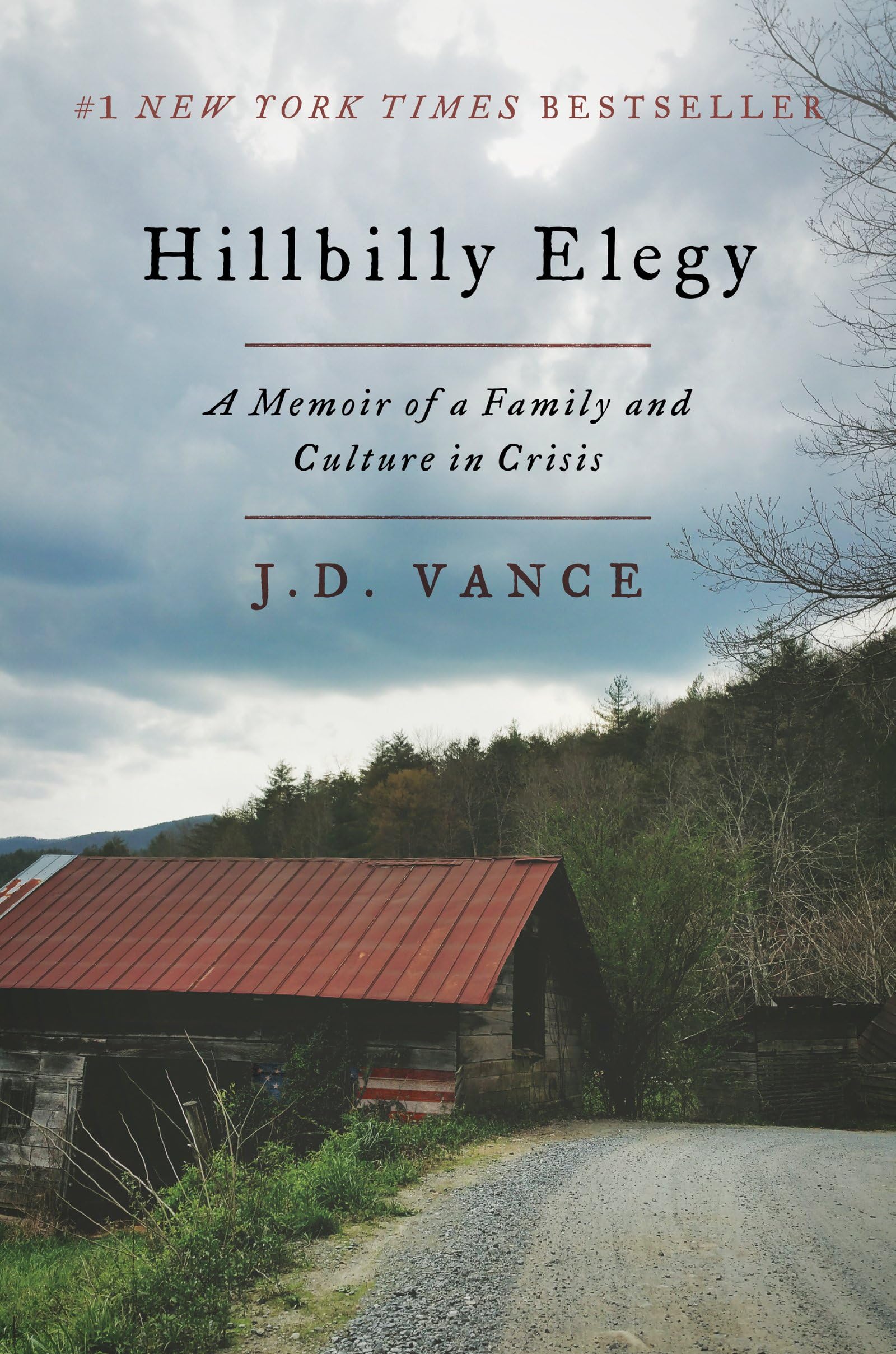
Hillbilly Elegy is the #1 New York Times bestselling memoir by J.D. Vance, a former Marine and Yale Law graduate, offering a raw, personal account of growing up in Appalachia’s white working-class Rust Belt. Praised for its searing honesty and cultural insight, the book explores themes of poverty, addiction, family trauma, and social mobility. Soon to be adapted into a major motion picture directed by Ron Howard, it remains a must-read for understanding the socio-political dynamics shaping modern America.




| Best Sellers Rank | #18,104 in Books ( See Top 100 in Books ) #23 in Political Leader Biographies #66 in Memoirs (Books) #91 in Women's Biographies |
| Customer Reviews | 4.4 out of 5 stars 125,026 Reviews |
X**O
A wonderful Book That I Highly Recommend!
Hillbilly Elegy: A Memoir of a Family and Culture in Crisis is a deeply personal, thought-provoking, and remarkably honest memoir that resonates strongly with anyone familiar with the culture, values, struggles, and resilience of Appalachian families and Eastern Kentucky heritage. As someone with roots and family connections tied closely to the Appalachian region, I found this book especially meaningful because it captures many of the realities that people from the region understand firsthand — the pride, loyalty, hardship, work ethic, family complexity, and generational challenges that are often misunderstood or overlooked by outsiders. J.D. Vance writes with authenticity and emotional depth while balancing personal storytelling with broader observations about family dynamics, economic struggle, cultural identity, addiction, opportunity, and social mobility. The memoir does not attempt to romanticize hardship, nor does it dismiss the strength and character found throughout Appalachian communities. Instead, it presents a nuanced and human portrayal of life within that culture. One of the strongest aspects of the book is its honesty. The stories feel genuine, personal, and at times difficult, yet they are also filled with resilience, humor, sacrifice, and determination. Many readers from Eastern Kentucky, Ohio Valley communities, and Appalachian backgrounds will likely recognize familiar experiences, attitudes, and family dynamics within its pages. The writing itself is engaging, intelligent, and accessible. The memoir moves naturally between personal history and larger social commentary without losing emotional connection to the people and places at the center of the story. It encourages reflection not only about Appalachian culture, but also about family responsibility, identity, opportunity, and perseverance. Whether one agrees with every perspective presented or not, Hillbilly Elegy remains an important and impactful memoir that contributes meaningfully to conversations about Appalachian America and working-class family life. It is a compelling, respectful, and emotionally powerful read that will resonate strongly with many readers who share similar roots and experiences.
J**R
More questions than answers
J.D. Vance chronicles his "upwardly mobile" journey from a dirt-poor boy in the backwoods of Kentucky, to a Yale-educated lawyer in Washington D.C. It is quite a journey, to be sure. J.D.'s story is one of family ties, bad choices, cyclical dysfunction, and in some cases, redemption. "Hillbilly Elegy" first landed on my reading list due to an article in my newsfeed that listed Vance's memoir as potential insight into the group that supposedly swung this year's election in favor of Donald Trump - poor, working-class whites in the country's rust belt. We do indeed get an insider's glimpse into the mindset and lifestyle of the poor, white communities in Appalachia and surrounding regions. Yet politics and analysis is minimal, so any link between the group in question and our president is left mostly as an exercise for the reader. The book is fascinating on many levels, the least of which was the dichotomy between the strong family ties upon which the hillbillies draw their strength and honor, and the dysfunction, cheating, brawling, and deep-seated anger present in their everyday lives. Blood is indeed, thicker than water. To me, the real question is just how we break the cycle of poverty and bad choices. One particular story Vance relays typifies the scenario played out over and over in his community. A young man with a pregnant girlfriend landed a decent job in a tile warehouse. This man was chronically late, missed work at least once a week, and took hour-long bathroom breaks. Though warned repeatedly, his behavior did not change. Yet when he was finally fired, he lashed out at the manager for being inconsiderate of his difficult home situation (which, of course, he created in the first place!). This mindset of blaming others is very prevalent throughout the book. The author, however, places some of the blame at the foot of the conservative rhetoric - instead of pushing the poor to engage their issues, "the message of the right is increasingly: It’s not your fault that you’re a loser; it’s the government’s fault." I think this is a bit of a cop out, and to be honest, struck me as pandering to liberal elite that runs most of the media in this country. I would suggest that the creation of our massive welfare state, and the dependence of the poor on government handouts with little to no accountability is much more responsible for the poor's inability to truly confront their station in life. Similarly, Vance takes some time to disparage evangelical theology as taught by the church his dad attended. To be sure, there is often much to disparage. In fact, the suspicion of science and government held by his dad's church mirrors the attitude of many of my fellow evangelical brothers and sisters. Yet, the irony that his dad's home life was one of the few peaceful and stable families in his entire existence is not lost on Vance. In fact, he admits, "Dad embodied a phenomenon social scientists have observed for decades: Religious folks are much happier. Regular church attendees commit fewer crimes, are in better health, live longer, make more money, drop out of high school less frequently, and finish college more frequently than those who don’t attend church at all." Sometimes I think society at large wants the results of what they find in the church and organized religion, yet chafe at the thought of being told what to do, and what behavior is acceptable and what is not. The fact that possibly you can't get one without the other is a possibility our "enlightened" minds simply do not want to consider. And what is it, exactly, that these church-going people find at church? It's not a "phenomenon," as Vance categorizes it, but the power of Jesus Christ. I feel I would be remiss, as well, at this point not to push back against a sentiment Vance conveys as popular truth - evangelical churches are shedding members at an alarming rate. As a proof-point, he references an article from the Huffington Post that makes the tired claim that evangelicalism is being rejected by the current generation. Huffington Post, the darling child of hipsters and liberals everywhere, has never been a friend of evangelicals, and I would hope other, more balanced studies would be considered. The book, "Christians are Hate-Filled Hypocrites...And Other Lies You've Been Told" is a good place to start. Using strong scientific and statistical analysis, it directly refutes some of the very studies mentioned in the HP article. Anyway, I digress. Admittedly, conservative politics and the supposed failure of evangelicalism are overall a smaller focus in the book. For the most part, Vance simply recounts the story of his life, and that of his closest relatives. It is fascinating, heart-breaking, and often akin to watching the proverbial train wreck. In fact, I wonder if that is one reason the book has been so popular. For most of us, we can read about the dysfunction so prevalent in Vance's upbringing and pat ourselves on the back - we're not perfect, but at least we're not as bad as that Vance clan! Only near the end of the book, in Chapter 14, does Vance attempt some deeper analysis and retrospective thinking. And I would hope we would do the same. The situation surrounding poor, working-class whites in the Midwest, similar to that surrounding African Americans in urban settings, is complex and difficult, with no easy answers. But that doesn't mean we should't still be tackling these inconvenient issues. Everything from how we respond to the poor, to how we treat our spouse, is on the table. I appreciate Vance airing out his dirty laundry. I doubt many of us would want our family's deepest and darkest secrets to be exposed in a book for all to read. But in doing so, he gives us the opportunity to participate in the plight of an entire segment of our population that, until the last year, was rarely spoken of. --------------- I noticed Amazon and Goodreads have a slightly different meanings to their 5-point scale. I thought it was odd to have a different rating for the same book on two different sites, so I came up with my own scale below. For the record, it is fairly close to Amazon's scale, but allows me to be consistent between both sites. 5 - Fantastic. Life-altering. Maybe only 25 in a lifetime. 4 - Very good. 3 - Worth your time. 2 - Not very good. 1 - Atrocious
R**Z
To the Bright and Shining Sun, Again
It may be that the most interesting thing about this book is its resonance. A coming-of-age blue collar memoir, it sits (nearly) atop the bestseller list and has drawn over 7,000 Amazon reviews. While it appears to focus on a singular phenomenon its impact has been generalized by the author and now touches tens of thousands of readers. The phenomenon is the migration of job-seeking Scots-Irish Appalachians to southwestern Ohio. I know this process intimately. My own parents were from Kentucky and settled in Cincinnati. We lived in what may be the epicenter of such migrations, a town called Norwood that is surrounded by Cincinnati. I described my experiences there in a memoir entitled THE BIGGEST CITY IN AMERICA (1999). Norwood was once home to a plethora of manufacturers, a few of which remain. U.S. Playing Card, Allis-Chalmers, American Laundry, the Fisher Body Plant (making Camaros), et al. drew workers from Appalachia who often held jobs there during the week and returned to Kentucky on the weekends. They huddled together in single homes; in Cincinnati poker parlance, a full house is a ‘full Norwood’. Now, Norwood has lost one third of its population; two of its three Catholic churches have closed and its manufacturing base has largely disappeared. What happens to people under such circumstances? Some survive, Charles Murray suggests, by maintaining social capital and making sound choices. They complete school, hold off on procreating until they are married, take a role in their community’s civic life and practice their religion. J.D. Vance lives betwixt and between. He knows the experience of the dysfunctional and he exemplifies the possibilities of escape and success. Throughout his book, but particularly in its second half, he reflects on the manner in which some choose drugs, promiscuity and dependency, while others sustain the foundational elements of life which protect them and their families. Another way to think about this (along with the decline of manufacturing and the reduction of blue-collar opportunities) is that the 1960’s offered freedom, but part of that freedom (drugs, free love) turned out to be cataclysmic for those who allowed themselves to be set adrift. The decline of job opportunities exacerbated that situation. So too, perhaps, did the expansion of the opportunities for government dependency. Working as a clerk bagging groceries, e.g., Vance reflects on those who work the food stamp system while others invest the labor that pays for it. This particular migration story is a powerful one. My Mizzou Chancellor, Brady Deaton, wrote his Wisconsin doctoral dissertation on it and our distinguished graduate, James Lee Burke, wrote a wonderful novel on the subject (TO THE BRIGHT AND SHINING SUN). Vance’s take on it succeeds for a number of reasons. First, the book is beautifully written and personally compelling. He offers us a privileged look into the strengths and dysfunctionalities of his own family. While the migration issue is susceptible to significant economic analysis, Vance puts living flesh on the bones of theory. He brings the story home to the reader as he explores the human hearts and souls which populate his narrative. We see real people, speaking real words and bleeding real blood. (I wish that he had included illustrations, but if you check out his Megyn Kelly interview clips you will see his beloved grandmother and sister and even catch a glimpse of his troubled mother.) He is honest with regard to his own experience. Four years in the Marine Corps help to stabilize his life and enable him to utilize his GI Bill benefits to attend Ohio State. An old Army friend of mine once said that his most gratifying work as a company commander was helping people who had never really belonged to anything actually do so. When he moves on from Ohio State to Yale law school he reveals his cultural naivete; he never really realized, e.g., that belts and shoes are supposed to match and when he was offered Sauvignon Blanc or Chardonnay at a recruitment dinner he chose the one that was easiest to pronounce. The book succeeds in part because it is a wonderful redemption story, but it is more complex than that. James Ellroy asked Dick Contino if he could write a novella about his life. What’s it about? Contino asked. “Heavily-compromised redemption,” Ellroy responded and Contino agreed. J.D. Vance’s redemption is not heavily-compromised, but it reveals the knife edge that he walked and the dangers that remain on the dark side, a side still inhabited by those he knows and loves. This may be the surprise hit of the year; the Harper editors who agreed to publish it were very shrewd to do so. The story gives heart to all and helps many find a voice that speaks for them.
W**L
Inspiring
I read The Hillbilly Elegy by J.D. Vance because it is on my daughter’s reading list this summer and reading what she reads allows me to connect with her through our life long love of books. The Hillbilly Elegy is the best book I’ve read in a long time. The last book I read on my daughter’s list was Ayn Rand’s Anthem, and the classical rhetorical laced with her “I” agenda made me graze pages like a fat cow eager for slaughter. Kill me, please! No offense to Rand, she has her merits, but I wanted a story. I am a big tootsie pop (sucker) for good stories. Now several key ingredients make up a well-constructed story beginning with a Shakespearean understanding of the human condition. 1. Vance understands the human condition. The human condition are the characteristics, essential events, and particular events which evolve around birth, growth, and inner and outer conflict. “Mamaw could spew venom like a Marine Corps drill instructor, but what she saw in our community didn’t just piss her off. It broke her heart.” Vance understands what motivates the anger behind his Mamaw’s words, and it cuts at the core of the human condition. Vance’s book is loaded with this understanding, not just Mamaw, but his father and the reason he gave him up in the first place, his mother and her continuous struggle with drugs and men, his Aunt Wee, and his sister Lindsay, and finally his own human condition revealed in the monster dream at the end. 2. Themes of forgiveness bathed in hope and the strength to overcome adversity. Vance came from dirt poor and turned Ivy League Yale graduate now living the American dream. He didn’t make that journey with the human feelings of anger and resentment that often blames others for their circumstances; He made it with love, forgiveness and understanding. “For me understanding my past and knowing I wasn’t doomed gave me the hope and fortitude to deal with the demons of my youth.” 3. Humility: Vance credits his success hugely to his mamaw and papaw. “Few of even my closest friends understood how utterly hopeless my life would have been without Mamaw and Papaw. So maybe I just wanted to give credit where credit is due.” He doesn’t only credit Mamaw and Papaw, but a whole slew of blue-collar workers who helped him to achieve his Ivy League dream. These people include his sister, his cousin Gail, his Aunt Wee and even his mother, despite her many problems, instilled in him a lifelong love of education. Vance says, “Remove any of these people from the equation and I’m probably screwed.” 4. Accessibility: The Hemingway/Shrunk in White style of writing has a conversational syntax that can be grasped by anyone. Vance may be Ivy League now, but he still has the heart of his hillbilly ancestors and he knows how to speak to them and for them. 5. Humor: This book will make you laugh out loud despite some of the horrific circumstances in Vance’s childhood, the laughter was the hope as conveyed in many of Mamaw’s speeches, especially this particular one on bullying. “And she said something I will never forget: ‘Sometimes, honey, you have to fight, even when you’re not defending yourself. Sometimes it’s just the right thing to do.’ Then she taught me a move, a swift hard (make sure to turn your hips) punch right to the gut.” 6. Solutions: Glass Castle by Jeanette Walls is similar to Vance’s Hillbilly Elegy because it shows a tough upbringing turned successful; however, as good as that story was, Walls did not offer any solutions for the homeless. Now, I’m not saying Vance offers great solutions for the problems with poverty in our country, but he does offer simple solutions, ones involving self-examination and our role in society. Recently, someone told me to read Black Rednecks and White Liberals by Thomas Sowell (the title made me hesitate reminding me of a book Tom Buchanan liked in The Great Gatsby), now while this book probably offers great solutions; It was not what I looked for with Vance’s book. In Vance’s book I looked for a story about a poor boy who went Ivy. Vance’s book is a memoir and the parallel to Sowell’s non-fiction book just doesn’t work here. I recommend Vance’s book to all of those people who still believe in the American Dream and the hope and love where good family support fuels the dream. Vance’s tone is so optimistic for those wanting to follow a similar path, and even more so to everyone who wants stability, a home, a family and love.
P**I
A moving personal story AND a specious analysis of 'a culture' that would not pass muster in a high school term paper.
Congratulations to J.D. Vance for overcoming some truly appalling childhood circumstances. As a memoir, the book is a compelling personal tale of triumph set against a portrait of a region helpless to help itself. I grew up in a rural area a few miles outside of Middletown and my father was from Jackson Ky, so when I heard about this book, I simply had to read it. In age, I am contemporary with Mr. Vance's mother, and the area was suffering economically when I left Ohio for good, well over 30 years ago. The book is at its strongest in relating personal history and reactions--this is a very inspiring journey. It falls very short in its attempts to be illuminate larger truths without the scholarship or broader insights it would take to support such message. And at times it seems like that message is a self-proclaimed hillbilly giving the hometown lazy Lil Abner mattress testers the much needed kick in the drop seat of their straw covered union suits he thinks they so richly deserve. It purports to have special insight into the 'hillbilly' culture. Beyond relating the (obviously exaggerated) colorful exploits of Mamaw's family and some sort of peculiar pop-culture inspired of tales of blood feuds fought by the coarse-mouthed and belligerent, this book is exclusively rooted in greater Middletown. Middletown is so generically described it could be any blue collar region anywhere in the country that has lost its economic engine, leading to entrenched systemic poverty and the ills that go with it. The sad outcomes of those who migrate from rural poverty to urban poverty is a universal story: as true in Lima, Peru as in Lima, OH. Given the title, one might have expected to learn more about the 'briar hoppers' who migrated to the factories away from the land that had shaped many of those families who settled on Frozen Creek more than 200 years ago. As a note, I can not recall ever hearing anyone from Breathitt County refer to themselves as a hillbilly. As for being the 'ah ha' book that explains current political climate, it's too mired in a self-serving worldview to accomplish much. The Middletown portrayed by Vance is an echo chamber of ignorance, hopelessness and despair, and while I haven't looked up the statistics, it seems as if the drug culture has gotten significantly worse. Yes, it's like that: I well remember anger as the default emotion and the ease with which it can stoked to reaction. I remember the sweeping condemnations of people desperate to be better than someone, anyone. And it saddened me to see that Mr. Vance has yet to leave those attitudes behind, and worse, uses them to justify heap scorn on a region that has been punished more than enough. Mr. Vance has a very selective understanding of "the thumb on the scale". Vance's ticket out of Middletown was a long standing US Government funded institution--the Marines. Public assistance puts money in to the community, enabling a grocer to employ a teenaged cashier fortunate enough to have a strong work ethic and ambition to better his circumstances. For someone determined to turn over the rocks of his hometown, the treatment of racism and xenophobia was curiously tepid and understated. The implication that Ohio legislators are out-of-touch do-gooders for trying to limit predation on the poor because they don't understand how convenient payday loans can be was simply astonishing. Vance didn't go to OU right out of high school because he couldn't figure out the financial aid form? Really? This Marine Corp Veteran with a public affairs background is so intolerant of the views of others that he rushes to complete his college degree? Honestly? The post high-school part of the book didn't really add up. Highly successful people from and in the Miami Valley are not as rare as hen's teeth, as Mr. Vance so often implies. Vance is a very young man, still raw with the traumas of his childhood. The most genuine parts of this memoir reveal a man struggling with his pain and searching for peace and an idenity and the ability to forgive the parents who failed him. I wish him well in that, and wish that his time at Yale had taught him the value of critical thought.
F**U
A Fine Piece of Writing From an Engaging Author
This is an exceptional memoir, particularly from an author so young. JD Vance's account of growing up among the Appalachian transplants in Ohio is loving and respectful as much as it is critical of the self-defeating lives he's seen so many lead. Vance writes from a conservative viewpoint, but his tale is filled with compassion and a sophisticated understanding of people and institutions. Vance’s grit, his personal honesty and the way he gives credit to others - his grandparents, his sister, the US Marines - made me like and admire him from the beginning. On the other hand, I think he too often downplays the fact that social forces, not just lack of individual and family will, have crushed the spirit of many Appalachian people. While Vance was able, with lots of help, to pull himself up and out, I don't think his story is representative of those of many poor Appalachian families. For instance, his grandma, "Mamaw," has enough resources to put Vance's mother through extensive in-patient drug rehab. Is that possible for most drug-addled Appalachian and Rustbelt families? Have you priced in-patient rehab lately? Vance is at his best when he's describing his initiation to the rare air of Yale Law and the recruiting marathon for postgrad jobs with top firms. While his take on life as a tourist in the upper crust is hilarious, his acceptance of that lifestyle as a key to a better life is a little cynical. He's essentially saying, "It's superficial and snobbish, but kids, you've gotta roll with it to make something of yourself!" These are chippy criticisms of a fine piece of writing from an engaging young author. JD Vance has a lot to say. Hillbilly Elegy is particularly relevant on the crest of the Trump Revolution, supported by many of the folks Vance so lovingly and critically describes. I'm recommending this book to all my friends. This is an exceptional memoir, particularly from an author so young. JD Vance's account of growing up among the Appalachian transplants in Ohio is loving and respectful as much as it is critical of the self-defeating lives he's seen so many lead. Vance writes from a conservative viewpoint, but his tale is filled with compassion and a sophisticated understanding of people and institutions. Vance’s grit, his personal honesty and the way he gives credit to others - his grandparents, his sister, the US Marines - made me like and admire him from the beginning. On the other hand, I think he too often downplays the fact that social forces, not just lack of individual and family will, have crushed the spirit of many Appalachian people. While Vance was able, with lots of help, to pull himself up and out, I don't think his story is representative of those of many poor Appalachian families. For instance, his grandma, "Mamaw," has enough resources to put Vance's mother through extensive in-patient drug rehab. Is that possible for most drug-addled Appalachian and Rustbelt families? Have you priced in-patient rehab lately? Vance is at his best when he's describing his initiation to the rare air of Yale Law and the recruiting marathon for postgrad jobs with top firms. While his take on life as a tourist in the upper crust is hilarious, his acceptance of that lifestyle as a key to a better life is a little cynical. "It's superficial and snobbish, but kids, you've gotta roll with it to make something of yourself!" These are chippy criticisms of a fine piece of writing from an engaging young author. JD Vance has a lot to say. It's particularly relevant on the crest of the Trump Revolution, supported by many of the folks Vance so lovingly and critically describes. I'm recommending this book to all my friends. This is an exceptional memoir, particularly from an author so young. JD Vance's account of growing up among the Appalachian transplants in Ohio is loving and respectful as much as it is critical of the self-defeating lives he's seen so many lead. Vance writes from a conservative viewpoint, but his tale is filled with compassion and a sophisticated understanding of people and institutions. Vance’s grit, his personal honesty and the way he gives credit to others - his grandparents, his sister, the US Marines - made me like and admire him from the beginning. On the other hand, I think he too often downplays the fact that social forces, not just lack of individual and family will, have crushed the spirit of many Appalachian people. While Vance was able, with lots of help, to pull himself up and out, I don't think his story is representative of those of many poor Appalachian families. For instance, his grandma, "Mamaw," has enough resources to put Vance's mother through extensive in-patient drug rehab. Is that possible for most drug-addled Appalachian and Rustbelt families? Have you priced in-patient rehab lately? Vance is at his best when he's describing his initiation to the rare air of Yale Law and the recruiting marathon for postgrad jobs with top firms. While his take on life as a tourist in the upper crust is hilarious, his acceptance of that lifestyle as a key to a better life is a little cynical. "It's superficial and snobbish, but kids, you've gotta roll with it to make something of yourself!" These are chippy criticisms of a fine piece of writing from an engaging young author. JD Vance has a lot to say. It's particularly relevant on the crest of the Trump Revolution, supported by many of the folks Vance so lovingly and critically describes. I'm recommending this book to all my friends. , ,
R**H
A fascinating insight into another world
This is an engaging and insightful book about what it is like to inherit and experience the Scots-Irish culture of Appalachia, even though Vance grew up in Middletown Ohio, the grandson of grandparents who migrated to Ohio in the late 1940s from Kentucky in search of a better life. The grandparents (Mamaw & Papaw) found that better life economically, but struggled with dysfunction in their family lives. The dysfunction carried over from their culture of origin, in combination with some poor choices (Papaw became an alcoholic and a womanizer), such that family dysfunction was perpetuated to the children. JD’s mom was pregnant out of high school, then a single mom with multiple boyfriends and husbands as JD was growing up, and became addicted to pain killers. Much of the story of the book is about how JD navigated these difficult circumstances, but the takeaway is really about what it took for him to escape the usually miserable consequences of that kind of existence, ultimately graduating from Yale law school into a lucrative career. First, the good. a) The anecdotal features of this memoir makes the book hard to put down. b) JD is clearly driven by the desire to understand the sociological and other issues that lie at the root of the dysfunction of his own and many other families of a similar cultural heritage. He has clearly done some study on this, and quotes from a sprinkling of academic studies to bolster his first hand observations. This is not, however, a handbook on policy, and JD is not afraid to confess his limitations. c) In spite of the shortcomings of Mamaw and Papaw, they are clearly the heroes of the book, stepping in to raise JD in the absence of motherly responsibility. JD says they were the best thing that happened to him. They showed him the value of love and stability, believed in the value of hard work, and did their best to ensure that he had his shot at the American dream. d) JD is brutally honest in his evaluation of his family and his cultural heritage, and does not pull any punches. In spite of this, it is clear that he loves his family and their heritage. Indeed, this drives his desire to understand why they are the way they are, as a precursor to finding solutions to those characteristics that are so socially devastating. e) A clear message that emerges from this book is the dominant impact on children of what is taught within a family. Beyond the impact of poor job availability and opportunity, and beyond the impact of sub-par school education, though both of those are important, the attitudes that kids grow up to adopt are often those learned and observed within the family. And these attitudes can either trump or compound those other disadvantages. For example, attitudes to learning in school determine whether school is of benefit. Attitudes to work determine whether people can advance their careers. Next, the not-so-good: a) Those looking for answers that can shape policy may not find much to bite on. This is not really a fair criticism because the book is memoir and not a political treatise. Beyond that, JD (and his family) oscillate between thinking that the government is not doing enough to help the economic depression in Middletown (& Appalachia), and on the other hand deploring the dependence of so many of their neighbors on the dole. Finally, some reflections on how Christian faith might speak into the above considerations. a) JD is clearly appreciative of how strong church communities can positively impact a society, calling as he does for churches to teach kids lessons of Christian love, family & purpose. He himself was the beneficiary of that, for the short time that he was in his father’s church. His father was himself an example of the transformative power of Christ in a person’s life, having gone from being deserter of his young family to being a family man in a stable second marriage, and regular churchgoer. JD’s Mamaw too had a deep Christian faith, but despised organized religion. She taught JD that to coast through life was to squander his God-given talent, that Christian duty demanded that he take care of his family, that he needed to forgive, and that God had a plan. b) While his father’s church had a deep impact on JD, he was subsequently to reject his faith because of aspects of evangelical theology, and doubts about the compatibility of faith and science. This speaks to how damaging it can be to the faith of young people when their church derives positions on science and faith that may be long-held but are based on poorly-grounded views of scripture. The prime example of this is the evolution/creation controversy of past centuries, but which persists today in some church cultures, especially in the USA. Somebody needs to reassure young people that they can believe in evolution and still be good Christians with a proper view of the bible. Fortunately there are signs in the book that JD has subsequently been reconsidering his rejection of the faith. c) Even though Christian faith can result in behavioral transformation that is beneficial to the individual and to society, such transformation is merely the fruit of that faith. The origin of that faith cannot and does not lie in policy. Through the lens of faith we understand the origin of anti-social behavior to be the sin nature that we all share. Legislation has no impact on that problem. Knowing this, we may be tempted as believers to disdain efforts to help the disadvantaged and the dysfunctional among us. This would, however, not conform to the example of Jesus who was the friend of sinners and defender of the weak. It would put us more into the mold of the Pharisee who thanked God that he was not like the common riff-raff sinner. Jesus strongly condemned the superior attitude of the Pharisee. It behooves us, therefore, to be engaged with doing what we can to bring hope to the hopeless, not just of a spiritual nature but also of the physical, social, and political nature. JD testifies that he owes his rescue to a handful of loving people that rescued him. Rescue is what we should be all about, being ourselves rescued by God.
T**T
Masterful.
In “Hillbilly Elegy,” J.D. Vance, the current U.S. Vice President, gives voice to the struggling middle class in America’s Rust Belt. Penning his coming-of-age story against a backdrop of addiction, parental neglect, and abject family dysfunction, the author edifies as much as he entertains. “Hillbilly Elegy” includes both a family sitcom, though perhaps more pathos than parody, and a life story. Vance finds an attentive audience for his writing despite, not because of, his political celebrity, possibly because his storytelling feels so raw, so real, and readers want to know how the story ends. Though he possesses an Ivy League law degree and has achieved success in venture capital and politics, it is clear that J.D. Vance still carries the emotional baggage of a difficult upbringing. In "Hillbilly Elegy," the reader is along for the ride in Vance’s catharsis as he relates anecdotes of his troubled family life replete with a drug-abusing, husband-hopping mother, and a pistol-toting grandmother who can curse “like a Marine drill sergeant.” He seeks to understand the “adverse childhood experiences,” or traumatic events of his youth, first in Jackson, Kentucky, then in Middletown, Ohio, that triggered a fight-or-flight response. As he readily attests in “Hillbilly Elegy,” had it not been for his maternal grandparents, an empathetic aunt, and a mature-beyond-her-years sister, J.D. would likely have spiraled down along with many of his Middletown, Ohio, contemporaries. Instead, he emerges acutely aware of the problems plaguing Rust Belt families, particularly children, innocently caught in a cycle of abuse, neglect, and other troubling circumstances. They experience at a tender age the effects of a confluence of adult struggles that, sadly, prevent them from avoiding the same plight and living the American dream. Ultimately, this book is about a bright young man trying to make sense of social and cultural phenomena unfolding before his eyes. For instance, he observes decay in the Rust Belt, resulting from “a decline in manufacturing, joblessness, addiction, and broken homes.” Faced with his mother’s appalling neglect, which of course he experiences firsthand, Vance evinces a “learned helplessness” amid Middletown’s “world of small expectations.” If it is the reader's pity he seeks as he recounts his experiences, he scores on every level. Thankfully, with humor and refreshing honesty, he accomplishes much more with “Hillbilly Elegy.” Indeed, the author offers commentary on the byproducts of industrial decline, most notably, shuttered factories and stubborn unemployment. Middle-class families in the Rust Belt today are reeling from displaced fathers and single mothers forced to accept minimum wage positions to make ends meet. J.D. saves his most penetrating observations for how working-class white Americans become mired in hopelessness. Regarding why those in the industrial Midwest become disillusioned with America, he writes, “It’s obvious why: If you believe that hard work pays off, then you work hard; if you think it’s hard to get ahead even when you try, then why try at all?” To his credit, Vance does not stop at defining the problem. He offers solutions but admits to the challenges “Hillbillies” face in their new middle-class existence in terms of “social, regional, and class decline.” Upon moving to parts of the country offering higher-paying factory jobs, they “never fully [escape] the legacy of abuse, alcoholism, poverty, and trauma” so characteristic of what they experienced in Appalachia. “Hillbilly Elegy” occasionally takes a detour into pointlessness, for instance, when the author decries “Internet conspiracy theories that rule the digital world.” While admittedly, such nonsense as “Obamacare legislation requiring microchip implantation” is unhelpful towards inspiring patriotism and trust in U.S. government institutions, is he giving the middle class enough credit? Should we not expect Americans at every socioeconomic level and in every age demographic, except perhaps those under 18, to be capable of separating fact from fiction? More to the point, none of Vance’s criticism will dissuade profiteers, propagandists, and Elmer Gantry-esque phonies from littering the Internet with misinformation. One of his benefactors, aside from the aforementioned family members who took an interest in him, clearly was the U.S. Marine Corps. His experience as an enlisted Marine taught him that “there’s something powerful about realizing that you’ve undersold yourself – that somehow your mind confused lack of effort for inability.” J.D. goes on to write, “That is why, whenever people ask me what I’d most like to change about the white working class, I say, ‘The feeling that our choices don’t matter.’ The Marine Corps excised that feeling like a surgeon does a tumor.” Besides teaching him what he is capable of, his military service, including a tour in Iraq, crystallized his thinking regarding his future and what he could achieve. It also instilled in him motivation and self-discipline. After a troubled boyhood spent shuttling from one relative or father figure to another and facing a future of “resentment at forces beyond his control,” Vance, one of the lucky ones, escapes a dead-end trajectory and enjoys a rebirth of sorts in “Hillbilly Elegy.” Adults, including a girlfriend from a nurturing, loving family, eventually to become his wife, finally believe in him and show him what he can accomplish. Discovering that he has agency in his life is the most crucial lesson J.D. Vance learns as he grows into adulthood. Above all, it leads him to believe that he can aspire to an Ivy League education and a career in politics. In “Hillbilly Elegy,” a frightened little boy, no longer fearing abandonment, experiences a metamorphosis. Then, grasping that first rung, a man finds a way up the ladder of social mobility. In his own words, J.D. now leads a life "that was the stuff of fantasy during [his] childhood." Vice President of the United States of America? Who knew? Masterful.
相**介
Wonderful Read with Confident Consistency.
From the opening till the end, the author has calmly and objectively relived his own history. Very insightful, and though not all facts are so merry, the entire tone of the book remained somehow positive and upbeat. Excellent read.
F**R
Great book
Great book.
B**N
Buy this book. It is simply a must read !
I was hovering between 4 & 5 stars for this book, but, what I can say is that it is the sort of book you can't seem to put down. It was a real eye-opener into the world of hillbilly America. The story was raw to say the least, yet JD Vance rose above all the obstacles of his early life and family history to reach be the second-in-command to the President of the United States of America. I honestly believe and hope that one day he will be President. There are many similarities between JD Vance's story and that of our own Jacinta Price, raised in remote Aboriginal communities, and now making her mark in Australian politics. Who knows what the future holds for these two battler survivors.
M**A
Un'America poco conosciuta
Un libro che partendo dalla storia autobiografica dell'autore descrive e analizza una realtà che raramente emerge quando si parla di Stati Uniti, quella dell'America bianca del Midwest, con i suoi problemi economici e sociali dovuti alla delocalizzazione, al dilagare degli oppiacei, alla disgregazione delle famiglie, all'erogazione di sussidi che invece di aiutare a riemergere dalle difficoltà spesso spingono a rimanerci. La parte finale è un po' scontata ma rimane comunque un libro interessante.
G**N
Infrecuente relato de la clase trabajadora blanca norteamericana
Hay un momento donde el autor, hillbilly confeso, pero graduado en Yale, relata como los estudios sobre el mal desempeño de los hijos de clases desfavorecidas en los EEUU son como clones de su infancia pero todos ellos se refieren a afroamericanos e hispanos. Es decir, la pobreza blanca de origen escocés-irlandés no entra dentro de los cánones mayoritarios e incluso académicos de los problemas de un nucleo de población que se concentra en los Apalaches. El exceso de violencia y desestructuración familiar, concluye el autor, no es un problema únicamente de las políticas públicas, de hecho señala sus limitaciones y problemas y hasta donde pueden llegar, sino de una subcultura donde el amor familiar y la autoestima están destruidos. Lectura cómoda, interesante, sorprendente en muchos momentos.
Trustpilot
2 weeks ago
1 month ago