
قم بتنزيل التطبيق


معلومات عنا
حقوق الطبع والنشر © 2024 Desertcart Holdings Limited
قم بتنزيل التطبيق
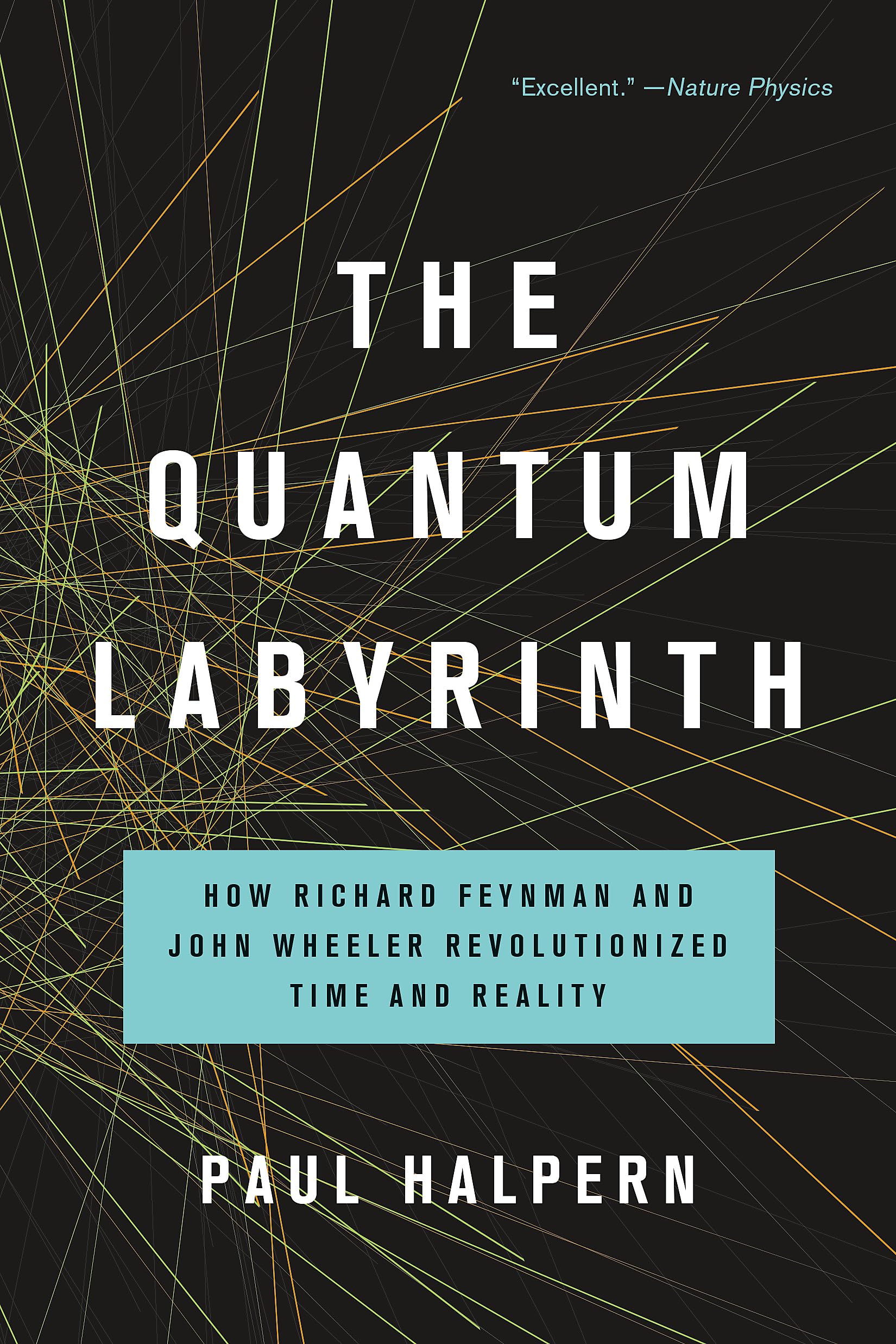
Buy The Quantum Labyrinth: How Richard Feynman and John Wheeler Revolutionized Time and Reality by Halpern, Paul online on desertcart.ae at best prices. ✓ Fast and free shipping ✓ free returns ✓ cash on delivery available on eligible purchase. Review: Le cheminement des idées du temps de la relativité et bien sûr de la mécanique quantique pour édifier une grande théorie unifiée. Les efforts couronnés de succès de deux acteurs (Feynman et Wheeler) leur parcours dans le long fleuve de l'Histoire et l'exposition claire de leurs idées qui ont révolutionnés les sciences. Un travail collectif représentatif de ce que des hommes doués ont réalisés au cours d'un siècle riche en rebondissement. Un ouvrage de référence qui constituent un témoignage sur la route d'individus ayant eu une influence considérable et dont les recherches ont fourni le matériaux de base au théories actuelles. Je recommande ce livre pour la clarté de l'exposé et pour la qualité des références historiques que le lecteur y trouvera. Review: I am not a physicist. I wouldn’t know a Higgs field from Wrigley Field. But after a college course in the history of science, I became fascinated with the subject. As a result, I have read a lot of books written by scientists who have made an effort to explain complex scientific theories – particularly in physics -- in layman’s terms. What those books often leave out, however, is the human element. Scientific discoveries are made by people, obviously, and the people who make them seldom do so in cold, clinical, ivory tower isolation. Rather, they do so in a sometimes collaborative, often competitive environment with other scientists -- not only their colleagues down the hall, but others halfway around the world. They also make these discoveries in the course of living their own lives, pursuing friendships and romances, having families, struggling with political, financial and health issues, and otherwise contending with the messy stuff of life. And these breakthroughs do not come easy – these scientists find their way to them only after many false starts and much time and effort in blind alleys, often while enduring much criticism from colleagues and competitors. Scientific biographies, on the other hand, often tend to focus on the lives of their subjects while making little effort to describe and explain the details of their scientific ideas and discoveries. This is, I suppose, to be expected, since such biographies are seldom written by physicists who fully understand, and thus can effectively convey, those highly complex ideas to non-scientist readers. A happy medium, for me, would be a book that explores both the personal and the scientific dimensions of these breakthroughs in the realm of physics. And here is where The Quantum Labyrinth shines. The author, Paul Halpern, is a physicist. Happily, he has a gift for explaining complex, often purely mathematical concepts in physics – including the bizarre and non-intuitive behavior of matter at the sub-atomic scale described by the theory of quantum mechanics -- in a way which is engaging and, at least in my case, somewhat understandable. But he presents those explanations in both their historical context, as well as in the context of the personal lives and relationships of the people who developed them. His primary subjects are two of the greatest minds of 20th century physics – Richard Feynman and John Archibald Wheeler – whose friendship began when Feynman began his graduate work at Princeton and was assigned to be Wheeler’s teaching assistant. The book explores their unique personalities as well as the development of their scientific ideas -- and their friendship – over the course of many eventful decades. But it doesn’t stop with Feynman and Wheeler; it includes many fascinating glimpses into their collaborations -- and their conflicts -- with other great physicists of their time, and shows how the newly emerging understanding of quantum mechanics – as well as many other breakthroughs – developed along many different pathways through the 20th century as a result of these collaborations. Familiar names from that era of science – Einstein (of course), Bohr, Dirac, Shroedinger, Heisenberg, Oppenheimer, and many others – all make an appearance, and Halpern makes an effort to show us who they were as people, not just as scientific icons. Particularly fascinating to me was the way their scientific breakthroughs ultimately became critical in the struggle to defeat the Axis powers in World War II, and how these scientists coped with being “drafted” into the war effort. In sum, I heartily recommend this book for those interested in the history of science generally, the development of 20th century physics particularly, and in the fascinating lives of those whose extraordinary work gave us the world we live in today.
| Best Sellers Rank | #97,912 in Books ( See Top 100 in Books ) #414 in History of the Americas #565 in Physics #37,574 in Textbooks & Study Guides |
| Customer reviews | 4.6 4.6 out of 5 stars (89) |
| Dimensions | 13.84 x 2.92 x 20.83 cm |
| Edition | Reprint |
| ISBN-10 | 1541672984 |
| ISBN-13 | 978-1541672987 |
| Item weight | 286 g |
| Language | English |
| Print length | 336 pages |
| Publication date | 29 November 2018 |
| Publisher | Basic Books |
C**N
Le cheminement des idées du temps de la relativité et bien sûr de la mécanique quantique pour édifier une grande théorie unifiée. Les efforts couronnés de succès de deux acteurs (Feynman et Wheeler) leur parcours dans le long fleuve de l'Histoire et l'exposition claire de leurs idées qui ont révolutionnés les sciences. Un travail collectif représentatif de ce que des hommes doués ont réalisés au cours d'un siècle riche en rebondissement. Un ouvrage de référence qui constituent un témoignage sur la route d'individus ayant eu une influence considérable et dont les recherches ont fourni le matériaux de base au théories actuelles. Je recommande ce livre pour la clarté de l'exposé et pour la qualité des références historiques que le lecteur y trouvera.
R**R
I am not a physicist. I wouldn’t know a Higgs field from Wrigley Field. But after a college course in the history of science, I became fascinated with the subject. As a result, I have read a lot of books written by scientists who have made an effort to explain complex scientific theories – particularly in physics -- in layman’s terms. What those books often leave out, however, is the human element. Scientific discoveries are made by people, obviously, and the people who make them seldom do so in cold, clinical, ivory tower isolation. Rather, they do so in a sometimes collaborative, often competitive environment with other scientists -- not only their colleagues down the hall, but others halfway around the world. They also make these discoveries in the course of living their own lives, pursuing friendships and romances, having families, struggling with political, financial and health issues, and otherwise contending with the messy stuff of life. And these breakthroughs do not come easy – these scientists find their way to them only after many false starts and much time and effort in blind alleys, often while enduring much criticism from colleagues and competitors. Scientific biographies, on the other hand, often tend to focus on the lives of their subjects while making little effort to describe and explain the details of their scientific ideas and discoveries. This is, I suppose, to be expected, since such biographies are seldom written by physicists who fully understand, and thus can effectively convey, those highly complex ideas to non-scientist readers. A happy medium, for me, would be a book that explores both the personal and the scientific dimensions of these breakthroughs in the realm of physics. And here is where The Quantum Labyrinth shines. The author, Paul Halpern, is a physicist. Happily, he has a gift for explaining complex, often purely mathematical concepts in physics – including the bizarre and non-intuitive behavior of matter at the sub-atomic scale described by the theory of quantum mechanics -- in a way which is engaging and, at least in my case, somewhat understandable. But he presents those explanations in both their historical context, as well as in the context of the personal lives and relationships of the people who developed them. His primary subjects are two of the greatest minds of 20th century physics – Richard Feynman and John Archibald Wheeler – whose friendship began when Feynman began his graduate work at Princeton and was assigned to be Wheeler’s teaching assistant. The book explores their unique personalities as well as the development of their scientific ideas -- and their friendship – over the course of many eventful decades. But it doesn’t stop with Feynman and Wheeler; it includes many fascinating glimpses into their collaborations -- and their conflicts -- with other great physicists of their time, and shows how the newly emerging understanding of quantum mechanics – as well as many other breakthroughs – developed along many different pathways through the 20th century as a result of these collaborations. Familiar names from that era of science – Einstein (of course), Bohr, Dirac, Shroedinger, Heisenberg, Oppenheimer, and many others – all make an appearance, and Halpern makes an effort to show us who they were as people, not just as scientific icons. Particularly fascinating to me was the way their scientific breakthroughs ultimately became critical in the struggle to defeat the Axis powers in World War II, and how these scientists coped with being “drafted” into the war effort. In sum, I heartily recommend this book for those interested in the history of science generally, the development of 20th century physics particularly, and in the fascinating lives of those whose extraordinary work gave us the world we live in today.
M**S
Feynmanについてはいろいろなところで書かれているから,それほど新しい情報というものはない しかし,Wheelerの周辺にはDeWit, Weber, Kip Thorn, MisnerなどBig nameが連なっている.Wheelerの空想力というのは本当に奇想天外である.worm holeが一般相対性理論と矛盾なく作れるということとか,Everettのような量子論の新解釈も生む.物理学が,数学をがっつり使うのに自由な発想を許容している魅力のあるが学問であるというのがすごくよくわかる. 理論は物事を説明するものではなく,descriptするものだという格言が印象的だった
D**.
Richard Feynman wechselte, nach einem mit Bravour absolvierten undergraduate Physikstudium, 1939 vom MIT an die Universität Princeton, um unter Anleitung von Eugene Wigner zu promovieren, aber die Administration ordnet Feynman kurzfristig John Wheeler als Assistent zu – eine Entscheidung, die beide später als eine der glücklichsten Fügungen ihres Lebens bezeichnen. Paul Halpern, promovierter theoretischer Physiker und Autor einer Reihe populärwissenschaftlichen Bücher, berichtet in seinem neuen Werk vom außergewöhnlich inspirierenden Zusammenwirken dieser beiden herausragenden Physiker; beide gaben sich mit Lehrbuch Erklärungen nie zufrieden und gingen physikalische Probleme oft auf ihre eigene Art und Weise an. Bereits ihre erste Arbeit beinhaltet eine Reformulierung der klassischen Elektrodynamik, die die Felder, zu Gunsten einer Fernwirkungs- Formulierung, zu eliminieren versucht, man hoffte damit der Selbstwechselwirkung vom geladenen Teilchen Herr zu werden, die für eine der Unendlichkeiten in Diracs QED verantwortlich ist. Feynman nimmt die Zeitumkehrbarkeit der Elektrodynamik ernst, und verendet gleichberechtigt retardierte und avancierte Potentiale. Aus Wheelers Bestreben, diese Ergebnisse auf eine Quantentheorie zu übertragen – etwas, was ihm nie gelang – resultiert Feynmans Formulierung der Quantenmechanik in Lagrangescher Form auf Basis eines Wirkungsprinzips, das er in seiner Dissertation diskutiert (1942) -- und ihn schließlich zu seinem Pfadintegral Ansatz führt, mit dessen Hilfe er (1949-50) zu einer QED mit endlichen Resultaten gelangte, für die er später den Nobelpreis erhält, gemeinsam mit Schwinger und Tomonaga. Wenn Feynman auch als der genialere der beiden gilt, dessen Methoden ganz neue Wege zur Quantenfeldtheorie eröffneten, so ist Wheeler eine nie versiegender Quelle ungewöhnlicher Ideen und 'verrückter' Einfälle. So rief er eines Tags Feynman an, und berichtet ihm, dass er womöglich den Grund gefunden hätte, weswegen alle Elektronen im Universum identisch seien – sie sind einfach alle ein und das selbe Elektron , das sich ständig in der Zeit vorwärts und rückwärts bewegt, wobei rückwärts bewegte Elektronen als Positronen in Erscheinung treten. Obwohl sich diese Idee nicht halten ließ, ging die Erkenntnis, dass Positronen äquivalent zu zeitlich reversen Elektronen sind, in die Formulierung von Teilchenprozessen mittels Feynman Diagrammen ein. Später wandte sich Wheeler der Relativitätstheorie und der Quantisierung der Gravitation zu, er entwickelte die Vorstellung, dass Quantenfluktuationen die Raumzeit auf der Planck- Ebene in eine Art Schaum verwandeln, der mit Miniatur Wurmlöchern durchsetzt sein könnte; er adaptierte dazu Feynman Methode als Summe über alle mögliche Geschichten (sum over histories). Diese Kombination von ART und QM führten ihn und Bryce deWitt zu ihrer berühmten Gleichung der Quantengravitation. Immer wieder kreisen diese Ideen um das wundersame Wesen der Zeit, die Kopenhagener Standard Interpretation der Quantenmechanik kennt gleich zwei Modi der Zeit. Solange das System sich selbst überlassen ist, entwickelt sich seine Wellenfunktion deterministisch gemäß der Schrödinger Gleichung, während dessen ist Entwicklung reversible – die Zeit zyklisch; sobald das System aber beobachtet wird, kollabiert die Wellenfunktion zu einem Eigenzustand, dieser Vorgang ist irreversible – ihm entspricht eine lineare Zeit. Wheelers und Feynman eröffneten nun eine dritte Sicht, die der labyrinthischen Zeit, wobei Wheeler Vorstellung seines Schülers Hugh Everett aufgreift. Im Alter widmete sich Wheeler in zunehmenden Maße mit grundlegenden Fragen: wie kommt 'Existenz' zustande, oder warum gibt es Quanten. Ihm erging es aber ähnlich Moses, der einen Blick auf gelobte Land werfen durfte, es aber nicht mehr erreichte... Der Autor verschmilzt auf interessante Weise, allgemein verständliche Darstellung physikalischer Ideen mit biographischen Schilderung aus dem Leben und Wirken seiner Protagonisten. Er verwendet dabei intensiv autobiographisches Material wie Feynmans 'Surely You're Joking, Mr. Feynman', 'What Do Yuo Care What Other People Think' (nach Aufzeichnung von R. Leighton) und Wheelers 'Geons, Black Holes and Quantum Foam' (mit K, Ford). Auch wenn ihm inhaltlich kleinere Fehler unterlaufen sind (etwa: die Paritäts- Verletzung der schwachen Wechselwirkungen wurde für den Beta- Zerfall von Yang und Lee 1956 vorhergesagt, und von Wu 1957 bei Experimenten mit Co-60 Isotopen bestätigt – neutrale K- Mesonen dienten hingegen Cronin und Fitch zum Nachweis der CP- Verletzung), ist dem Autor eine faszinierende Synthese gelungen, die es schafft, den Leser, in einem angenehmen erzählerischen Stil, mit der Entstehung moderner Kozepte der theoretischen Physik bekannt zu machen.
P**6
Wonderful book, I already knew quite alot about Richard Feynman and less so about John Wheeler. After reading this very insightful story on two giants of physics I feel the need to know more about the gentleman of physics John Wheeler, his first meeting with his new student Richard Feynman is amusing and the subsequent relationship between them is fascinating, two great minds that wanted nothing more than to understand the world around them and how it works defines both of their careers. Often moving but always fascinating, great read and highly recommended. Paul Halpern has done an excellent job here, an interweaving relationship of two of the greatest minds of the 20th century brought together in one wonderful book. 5/5
ترست بايلوت
منذ 3 أسابيع
منذ أسبوع