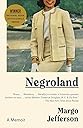
Negroland: A Memoir
Product ID: 32613857
Desertcart purchases this item on your behalf and handles shipping, customs, and support to KUWAIT.
Negroland: A Memoir [Jefferson, Margo] on desertcart.com. *FREE* shipping on qualifying offers. Negroland: A Memoir Review: Great Read!!! - Negroland was an engaging and thought-provoking read. As part of my journey of exploring books on middle-class Black American life, I found myself connecting more deeply with Jefferson’s perspective than with many others I’ve read. Her voice is sharp, honest, and layered, making the book not just a memoir but also a cultural critique. Margo Jefferson has certainly gained a new reader in me, and I look forward to exploring more of her work. Review: Another Profound but Disturbing Book about Blacks in America - First, an admission. I attended college with Margo Jefferson. I considered her somewhere between an acquaintance and a friend. I make this admission not because I am biased for or against the book, but because I have been doing a great deal of reading about Black America lately, and with every page I realize that despite my good intentions and all that goes with them, I know so little about the Black experience and am consequently an "other" when reading about it. With that as prologue, I found this book extremely well written, profound and disturbing, and all the more disturbing because of knowing her so many years ago. Margo (as I knew her) was (and, I'm sure, still is) a bright and vivacious woman and was always a pleasure to be with and talk to. The Margo Jefferson who wrote this book may be all those things and more, but there is an "otherness" quality about her that confirms how alien the Black experience is to me and how she may have viewed me and my background. And I suspect I was even more clueless about it then, as a sheltered white kid from the burbs, than I am now (even though I'm still a sheltered white man from the burbs). There's a part of me that wants to apologize for being clueless or possibly even for being white, but it's too little and way too late; besides, I'm not sure there's anything really to apologize for except being what I was, which I couldn't have helped in any case. I gave this book four stars for two reasons: first, because there's a stretch about Margo's thoughts on suicide, which I just have difficulty accepting even though I have no doubt that she felt what she says she felt. And second because there's a stretch about where Margo fits herself into the characters in "Little Women", which I've never read and for which I have no affinity. However, it's a five-star (or more) book in spite of these "deficiencies". Margo, if you ever see this, I'm proud to know you, even if my naiveté and innocence may have been unforgivable.
| Best Sellers Rank | #516,922 in Books ( See Top 100 in Books ) #545 in African American Demographic Studies (Books) #1,307 in Black & African American Biographies #3,031 in Sociology Reference |
| Customer Reviews | 4.0 out of 5 stars 1,111 Reviews |
D**E
Great Read!!!
Negroland was an engaging and thought-provoking read. As part of my journey of exploring books on middle-class Black American life, I found myself connecting more deeply with Jefferson’s perspective than with many others I’ve read. Her voice is sharp, honest, and layered, making the book not just a memoir but also a cultural critique. Margo Jefferson has certainly gained a new reader in me, and I look forward to exploring more of her work.
R**M
Another Profound but Disturbing Book about Blacks in America
First, an admission. I attended college with Margo Jefferson. I considered her somewhere between an acquaintance and a friend. I make this admission not because I am biased for or against the book, but because I have been doing a great deal of reading about Black America lately, and with every page I realize that despite my good intentions and all that goes with them, I know so little about the Black experience and am consequently an "other" when reading about it. With that as prologue, I found this book extremely well written, profound and disturbing, and all the more disturbing because of knowing her so many years ago. Margo (as I knew her) was (and, I'm sure, still is) a bright and vivacious woman and was always a pleasure to be with and talk to. The Margo Jefferson who wrote this book may be all those things and more, but there is an "otherness" quality about her that confirms how alien the Black experience is to me and how she may have viewed me and my background. And I suspect I was even more clueless about it then, as a sheltered white kid from the burbs, than I am now (even though I'm still a sheltered white man from the burbs). There's a part of me that wants to apologize for being clueless or possibly even for being white, but it's too little and way too late; besides, I'm not sure there's anything really to apologize for except being what I was, which I couldn't have helped in any case. I gave this book four stars for two reasons: first, because there's a stretch about Margo's thoughts on suicide, which I just have difficulty accepting even though I have no doubt that she felt what she says she felt. And second because there's a stretch about where Margo fits herself into the characters in "Little Women", which I've never read and for which I have no affinity. However, it's a five-star (or more) book in spite of these "deficiencies". Margo, if you ever see this, I'm proud to know you, even if my naiveté and innocence may have been unforgivable.
R**E
An Attempt at Exploring Her Life in Full
Margo Jefferson’s world is a world of pictures, sounds, and smells. So, I don’t get a true sense of what actually happened in her life. Her memoir often reads as several essays instead of chapters, many of which you cannot tell where her voice is. Many plays, books, movies, and major works of art are shared which allows her to reflect herself in them. She is not able to do it on her own. And, I find it puzzling that neither her father’s nor her own childhood pictures match their skin colors as adults. She speaks of hair perms, hair dying, and skin bleaching, but does not tell us if she has used any of those things. There are only clues. Hard to tell, but her Negroland, past and present, is a place where no Negroes are actually allowed unless they embrace Eurocentric values. These values are shown in good and bad ways while truly curly hair (referred to as nappy/kinky), wide noses, full lips, large backsides, and all ways of being Black, down to ways of laughing, etc. are only referred to in a negative light. Jefferson does not seem to be trying to fix anything and present the right values or embrace Blackness. Jefferson wrote this book to exonerate herself. This book is the beginning of some kind of recovery from all she experiences growing up. You get glimpses of her childhood, glimpses of herself as an older adult, and all that lie in between is referred to very quickly as suicidal. Her tangents leave me without a story I can easily share although I now have plenty of references to other books and poems she so often quotes to reflect her mental state. I can see a soul there, but it’s hiding behind so many images that she was pretty much forced to use in order to define herself growing up. She says she at times (or maybe all the time, this is unclear) has problems having “plural relations” with all Negroes—an ‘us’ or a ‘we’—I think because she must believe in the stereotypes and thinks she and her upbringing is a rarity. She seems to be saying that few Blacks in America, let alone any cultures from any African countries, could possibly have the great characteristics she touts, which are mostly aligned, in this book, to White people as a whole. Black people as a whole? Hmmm, she’s clearly not so fond of that. There are just way too many voices coming from Jefferson in this book and by the end I really have no idea which one she wants to be hers. She is conflicted. The description of her family is given only here and there, in contradictory pictures, in a few moments of dialogue, and in the last 20 pages of her book. I enjoyed some parts, but as a whole, realize that she was very afraid to write this book.
A**S
A Memoir That Won't Be Forgotten
Margo Jefferson's "Negroland" is a fascinating book that works on several levels -- social history, current politics, and the evolution of one person's identity over time. Often, two or even all three of these levels are in operation at once. That interplay gives the book a haunting resonance, and draws the reader in (this reader, anyway) as one would be drawn into a novel. Moreover, I thought the book was beautifully written. The writing is exquisitely precise at times, impressionistic and seemingly diffuse at others. Taken as a whole, however, the book adds up to a compelling exploration of an extraordinary woman's experience. The first thing this book does is to look at how people lived in a narrow subset of American society at a particular time: the black upper middle class in the 1950's and 1960's. Perhaps a particular place should be added - Chicago - but what's most clearly drawn are class and race differences. These people were top layer of an ethnic group that was at the low end of the American social scale, and held on to that positions with an extraordinary amount of discipline. It was far more "comfortable" to grow up as Margo Jefferson than as most other African American children in the period, but it was not necessarily any easier. She shows this in a multitude of ways, some very funny, some heart-breaking. The next thing that happens, of course, is that time moves on, throwing Ms. Jefferson into the racial and gender turmoil of the 1960's and 1970's. All of a sudden, her careful, successful "Negroland" background was judged by many of her peers to be inauthentic, adopted, "not black enough". It was difficult enough to be a young white woman in the period, when lots of things you'd be brought up to believe turned out not to be so at all. Being a young black woman, Ms. Jefferson makes clear, was a whole lot harder. Even feminism, which was important to her, would be judged by others on the basis of race. And through the whole social/political progression runs the memoir of an individual. Race is an inescapable part of that, since race necessarily affects so much that she experiences. But race affects different people in different ways. For example, Ta-Nehisi Coates and Ms. Jefferson both suffered from racism, but they are wildly different people, and write about race in wildly different ways. Ms. Jefferson's book is less dramatic, and less incendiary. For me, however, it was just as compelling an experience of seeing the world through someone else's eyes.
S**M
was one of the stars) thinks she is hard to love. She gets that wrong
Margo Jefferson's book was, she says, hard to write. and perhaps for that reason she makes the entrance to the book difficult - even rebarbative - for the reader. I urge you to perservere, even if you have to skip the first 38 pages and return to them later. What follows is a magnificent work which achieves what very few writers of autobiographies can do: locate the subject in public history as well as in the story of herself and her family. Margo (who was very kind to me as a freshman in HS when I was trying to prepare myself, Stanislavski-style, for the role of The Newsboy in "Our Town," in which she, a senior, was one of the stars) thinks she is hard to love. She gets that wrong, but what she gets right is everything else, and adds to the history of black and white America a profound and intimate view of life in the 1950s and 60s free of caricature and retroactive adjustment to what is currently chic. I'm going to be living with this book tells for a long time.
Y**Y
Uncomfortably Insightful
I always admired the liberal community where Margo Jefferson grew up. Why can't there be more schools like the University of Chicago's Lab School, deliberately integrated and progressive, I wondered. After reading Negroland, I can see that this was not a multicultural paradise if you were, as Ms. Jefferson says, a Negro. Despite being one of two daughters of a doctor with a respectable, charming mother, Margo learned from a young age that she was an outsider. But she was a privileged outsider, from an affluent, intact family—rich by black standards and upper middle class by white ones. There is an arch tone of irony in much of this memoir which may put some readers off, but as I became comfortable with it, I began to see the author's world as she does. At Michigan's Interlochen Arts Camp where she goes in the summer as a girl, there is more freedom, but similar racial patterns emerge. She writes, she acts—all competently—but as she later confesses, her need to be friendly and accepted always interferes with boldly asserting herself She carries this with her to college at Brandeis University, where she continued her education. After adoring Louisa May Alcott's novels, she reads James Baldwin's criticism of the author and rethinks not only Little Women but Alcott's other novels. And later, she moves to New York City, where she works at Newsweek and later the New York Times, where she won a Pulitzer for criticism.Still, all her accomplishments don't deliver the satisfaction that eludes her. At one point, she is plagued by suicidal impulses, which she pushes off as unearned. She concludes by embracing second wave feminism as interpreted by Flo Kennedy, a sidekick of Gloria Steinem (which Jefferson does not mention.) Feminism is the best of white culture, she argues, and it has been a part of her life as a single professional woman with a gift for friendship. I gave this book four stars rather than five because I felt it was uneven and the pieces didn't completely knit together, but I recommend it strongly. It's through understanding the cracks in our facade of equality that we can become whole. Certainly, Margo Jefferson illuminates them.
E**H
precise, exquisite, profoundly important reflection on race, gender, and the construction of identity
Mind-blowingly good. The dry crispness of the voice that greets the reader in the first pages doesn’t warm, but burns and glows and illuminates in exquisitely precise dissection and analysis of the culture she has witnessed, received, studied, and plumbed. So personal, so political, and ultimately universal. Gob-smacked.
M**J
Hmmmmmmmmm……
This book is not for your average everyday reader. This book is above my vocabulary grade (btw I’m a college grad). It's quite hard to follow at certain points. I don’t know if it’s due to the author’s poetic style of writing or the overwhelming use of extravagant vocabulary throughout. I’m finding it difficult to finish this book, but I refuse to put it down. I follow the basic premise. I get it. But the style and vocabulary throws me. I’m not finish yet and I hope that at some point I find it enjoyable. However, I must say,,,,,,,,,I don’t know if that was the author’s intent or objective. If you decide to buy this book, make sure you have a dictionary on hand and good luck finishing it.
Trustpilot
4 days ago
2 weeks ago