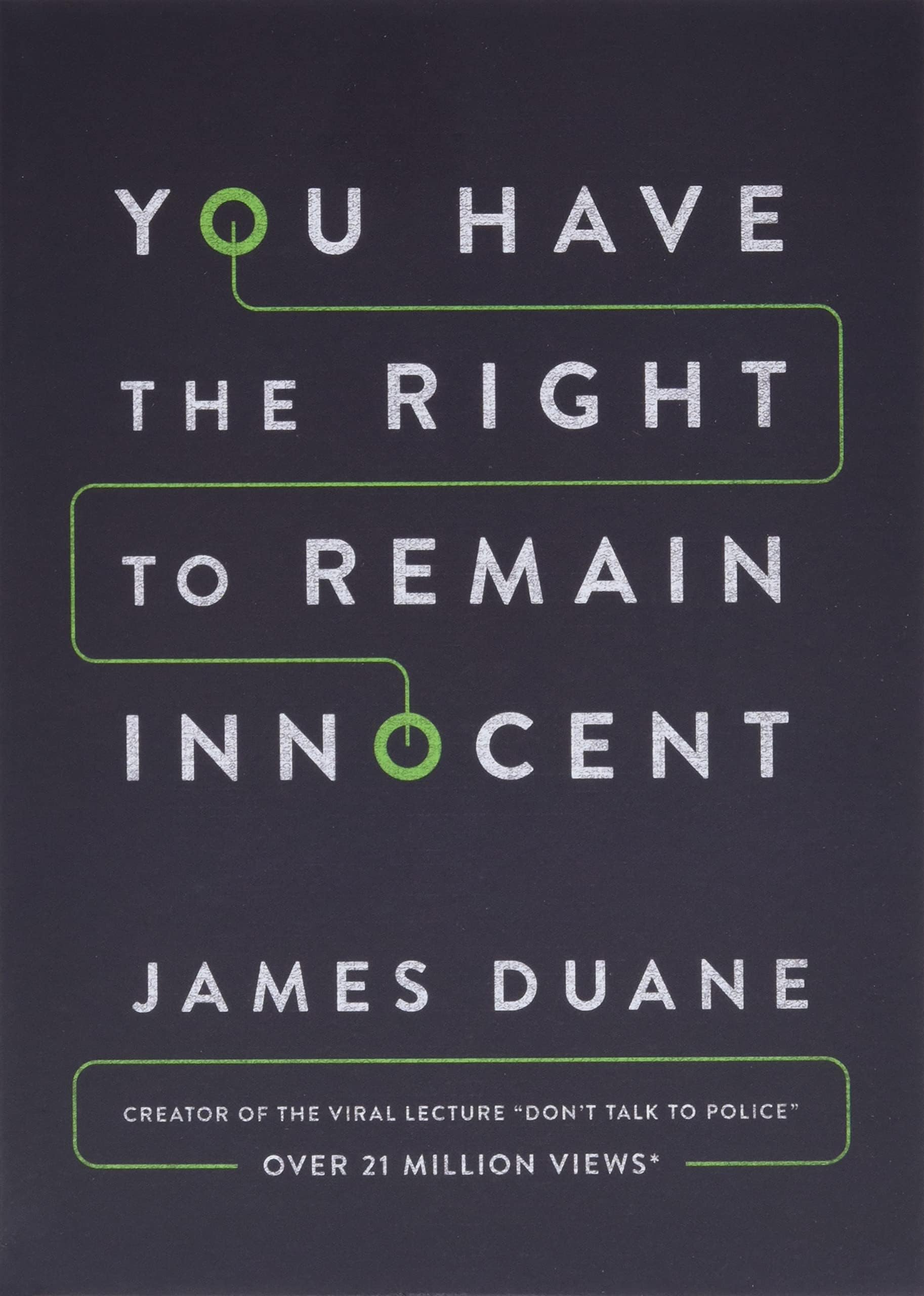
You Have the Right to Remain Innocent
Product ID: 33511972
Buy anything from 5,000+ international stores. One checkout price. No surprise fees. Join 2M+ shoppers on Desertcart.
Desertcart purchases this item on your behalf and handles shipping, customs, and support to KUWAIT.
You Have the Right to Remain Innocent [Duane, James] on desertcart.com. *FREE* shipping on qualifying offers. You Have the Right to Remain Innocent Review: An excellent book even if you've seen the video. - The book is a short, easy read which is well written, and I think valuable for anyone living in America. I found it a valuable read even after watching the video Duane became famous for, and strongly recommend it. Since the basic thesis of the book is stated in its title, which is also a reasonably summary of the book's actionable advice, it is reasonable to ask what is in the book which justifies opening the book to look at its pages. There's actually a lot. The book does starts with some caveats, perhaps most notably that he clarifies he's talking about speaking with the police when they come to you, unsolicited, to ask you questions about the past. It is both a legal requirement and good sense to readily comply with the request to identify yourself and explain what you are doing in the moment, where you currently are. One of his examples is if you are breaking into your own house because you locked yourself out and a policeman asks you what you are doing, do tell him that this is your house and you don't have your key. He mentions some other cases when you must talk with the police. The other very notable caveat is that he takes some pains to point out that every member of society owes a great debt to the men and women who serve as police, who take personal risk to do a difficult job that keeps us safe. Throughout the book, he makes it clear that he isn't talking about bad people, but (in the main) good people in a bad situation, which is the present criminal legal system in the United States. It is a system which sometimes convicts innocent people along with guilty people, and for reasons he makes clear throughout the book, his primary concern is giving innocent people the tools needed to avoid the pitfalls of this dangerous system. Good people make mistakes, and the mistake of a police officer or a prosecutor or a judge can cost an innocent person decades in prison. (He uses more than a few cases where the person convicted was later conclusively proved innocent by DNA evidence (often decades later) to show how wrong things can go for innocent people.) The book has more than a few interesting insights into problems with the criminal justice system—perhaps most notably being the way that no living person has any idea even how many crimes are defined by the law, let alone what they all are—but I think its greatest value lies in the examination of particular cases where he goes on to show how even very trivial statements, which are true, can become damning evidence in light of other things which a person may not know and has no control over. The case where a man admitted to having dated a woman some time before the crime he was convicted of happened, in the neighborhood where that crime happened, helped to send a man later exonerated by DNA evidence to prison. Coincidences happen, but not all juries believe that they do. And it is this sort of thing which is the main value of reading the entire book, I think. It is so very easy to slip into the mindset of wanting to give into the urge to cooperate, to be helpful, to be willing to answer any question which is not directly incriminating (and if I'm innocent, how could any question be directly incriminating?) which takes more than a little beating down by seeing over and over again how even minor admissions of completely true and innocent things can be disastrous. The book presents information, but I think equally reading it constitutes training. If one were ever to face a police interview it would be a very stressful situation, and when stressed we tend to forget what we know and fall back on our habitual reactions. Only through training ourselves by seeing many situations we could all too easily be in is it likely that we will remember to do what we should. The final two chapters of the book, which are much shorter than the first, deal with the specifics of how to go about exercising one's right to remain innocent in a practical sense. He covers many instances of how people have accidentally incriminated themselves when invoking their fifth amendment right, as well as how people have accidentally failed at refusing to talk to the police and asking for a lawyer. And again, it's not so much knowing what to do that's the real benefit of reading this book, but learning what not to do, and why not to do it. Review: Well worth the read. - Quick easy read, advice is gold!
| Best Sellers Rank | #59,132 in Books ( See Top 100 in Books ) #13 in Civil Rights Law (Books) #14 in Law Enforcement Politics #23 in Law Enforcement (Books) |
| Customer Reviews | 4.7 4.7 out of 5 stars (3,467) |
| Dimensions | 5 x 1 x 7 inches |
| ISBN-10 | 1503933393 |
| ISBN-13 | 978-1503933392 |
| Item Weight | 2.31 pounds |
| Language | English |
| Print length | 152 pages |
| Publication date | September 20, 2016 |
| Publisher | Little A |
C**N
An excellent book even if you've seen the video.
The book is a short, easy read which is well written, and I think valuable for anyone living in America. I found it a valuable read even after watching the video Duane became famous for, and strongly recommend it. Since the basic thesis of the book is stated in its title, which is also a reasonably summary of the book's actionable advice, it is reasonable to ask what is in the book which justifies opening the book to look at its pages. There's actually a lot. The book does starts with some caveats, perhaps most notably that he clarifies he's talking about speaking with the police when they come to you, unsolicited, to ask you questions about the past. It is both a legal requirement and good sense to readily comply with the request to identify yourself and explain what you are doing in the moment, where you currently are. One of his examples is if you are breaking into your own house because you locked yourself out and a policeman asks you what you are doing, do tell him that this is your house and you don't have your key. He mentions some other cases when you must talk with the police. The other very notable caveat is that he takes some pains to point out that every member of society owes a great debt to the men and women who serve as police, who take personal risk to do a difficult job that keeps us safe. Throughout the book, he makes it clear that he isn't talking about bad people, but (in the main) good people in a bad situation, which is the present criminal legal system in the United States. It is a system which sometimes convicts innocent people along with guilty people, and for reasons he makes clear throughout the book, his primary concern is giving innocent people the tools needed to avoid the pitfalls of this dangerous system. Good people make mistakes, and the mistake of a police officer or a prosecutor or a judge can cost an innocent person decades in prison. (He uses more than a few cases where the person convicted was later conclusively proved innocent by DNA evidence (often decades later) to show how wrong things can go for innocent people.) The book has more than a few interesting insights into problems with the criminal justice system—perhaps most notably being the way that no living person has any idea even how many crimes are defined by the law, let alone what they all are—but I think its greatest value lies in the examination of particular cases where he goes on to show how even very trivial statements, which are true, can become damning evidence in light of other things which a person may not know and has no control over. The case where a man admitted to having dated a woman some time before the crime he was convicted of happened, in the neighborhood where that crime happened, helped to send a man later exonerated by DNA evidence to prison. Coincidences happen, but not all juries believe that they do. And it is this sort of thing which is the main value of reading the entire book, I think. It is so very easy to slip into the mindset of wanting to give into the urge to cooperate, to be helpful, to be willing to answer any question which is not directly incriminating (and if I'm innocent, how could any question be directly incriminating?) which takes more than a little beating down by seeing over and over again how even minor admissions of completely true and innocent things can be disastrous. The book presents information, but I think equally reading it constitutes training. If one were ever to face a police interview it would be a very stressful situation, and when stressed we tend to forget what we know and fall back on our habitual reactions. Only through training ourselves by seeing many situations we could all too easily be in is it likely that we will remember to do what we should. The final two chapters of the book, which are much shorter than the first, deal with the specifics of how to go about exercising one's right to remain innocent in a practical sense. He covers many instances of how people have accidentally incriminated themselves when invoking their fifth amendment right, as well as how people have accidentally failed at refusing to talk to the police and asking for a lawyer. And again, it's not so much knowing what to do that's the real benefit of reading this book, but learning what not to do, and why not to do it.
R**S
Well worth the read.
Quick easy read, advice is gold!
E**E
A Must Read, Five Stars!!!!! 🌟🌟🌟🌟🌟
Book Review Written November 10, 2019 You Have the Right to Remain Innocent, By James Duane Kindle Edition (154 Pages) Attorney and witter James Duane offers the most important legal advice the reader will ever receive, and you should pay close attention. Why, well failure to heed his words will likely result in loss of your personnel wealth and/or freedom. That advise is that he next time a police officer or a government agent asks you whether you are willing to answer a few questions about where you have been and what you have been doing, you must respectfully but very firmly decline and mention your Sixth Amendment right to a lawyer, and tell the police that you want a lawyer. He is quick to point out that if you have an encounter with the police authorities you should act in a polite manner, treating the officer with the respect due their position, and provide your name with proof of identity as required by law. Further, you should respond to questions regarding why you are at the present location. However, the moment that questions regarding where you were at in the past or what your future plans are this is your signal to ask politely for a lawyer. I was surprised to discover that he also recommends that never mention the Fifth Amendment privilege or tell the poli that you wish to exercise your right to avoid incriminating yourself. He states that there is too great a danger that the police and the prosecutor might later persuade the judge to use that statement against you as evidence of your guilt. In spite of this the protections afforded by the Fifth Amendment are more precious than ever before. In this modern age, there are many uniformed people who believe that our government is deserving of our loyal cooperation and support, and that every good patriot with an innocent conscience should be glad to answer any questions from government agents. That is simply not true, maybe it was true a century ago, but not now. Why? The author provides ample evidence of the fact that the United States (US) Criminal Justice System has lost any legitimate claim to the loyal cooperation of American citizens. The US Criminal Codes contain tens of thousands of criminal statutes, including many touching upon conduct that is neither immoral nor dangerous, written as broadly as you can imagine, scattered throughout the thousands of pages. How can you then expect decent law-abiding, unsuspecting citizens to cooperate with an investigation into whether they might have violated some law they have never even heard about? The remainder of this book contains well written, easy to understand, fact based arguments, complete with numerous legal cases in support of his advice. Clearly, anyone who is familiar with how the criminal justice system operates in America would never advise their loved ones to waive the right to remain silent in the face of a criminal investigation. What ever your thoughts are regarding the American legal system, this book provides the most important information you will ever receive. I encourage everyone to read it and make up your own mind.
C**N
Mr Duane is fighting the good fight to make Americans understand how rigged the legal system is against normal citizens. Providing numerous case histories, he works hard to convince the reader how necessary it is to act counter-intuitively when questioned by the police. Highly recommended to anyone who still believes that their innocence will always triumph in the end.
R**S
Excellent book!! short, concise very easy to read, very useful, very important information. Great book 5/5 would recommend everyone to read even outside the US.
J**K
Highly recommended! It’s a great learning experience to understand the faults of human mind and regardless of how smart you think you are, you better be silent! Guilty or Not! Get a Lawyer!
M**L
As a Brit who is only curious I love it as it's so short and powerful. The author questions your common sense before your faith in the American system. It's an interesting way to explore lots of ideas that feed into justice; ethics, the limits of the police, how evidence should be handled, the psychology of memory applied to witnesses... Reading this and watching James Duane on Youtube and all the responses to his book and videos has been really fascinating. The book does not disappoint.
S**N
Excellent book that details, and offers great examples of, just how broken the legal/judicial system is. I couldn't agree more with the central tenet of this book, which is to keep your big mouth shut and don't answer questions when having interactions with the police. If I had my way, this book would become required reading in each and every high school in the country. Well done Mr. Duane.
Trustpilot
4 days ago
3 weeks ago