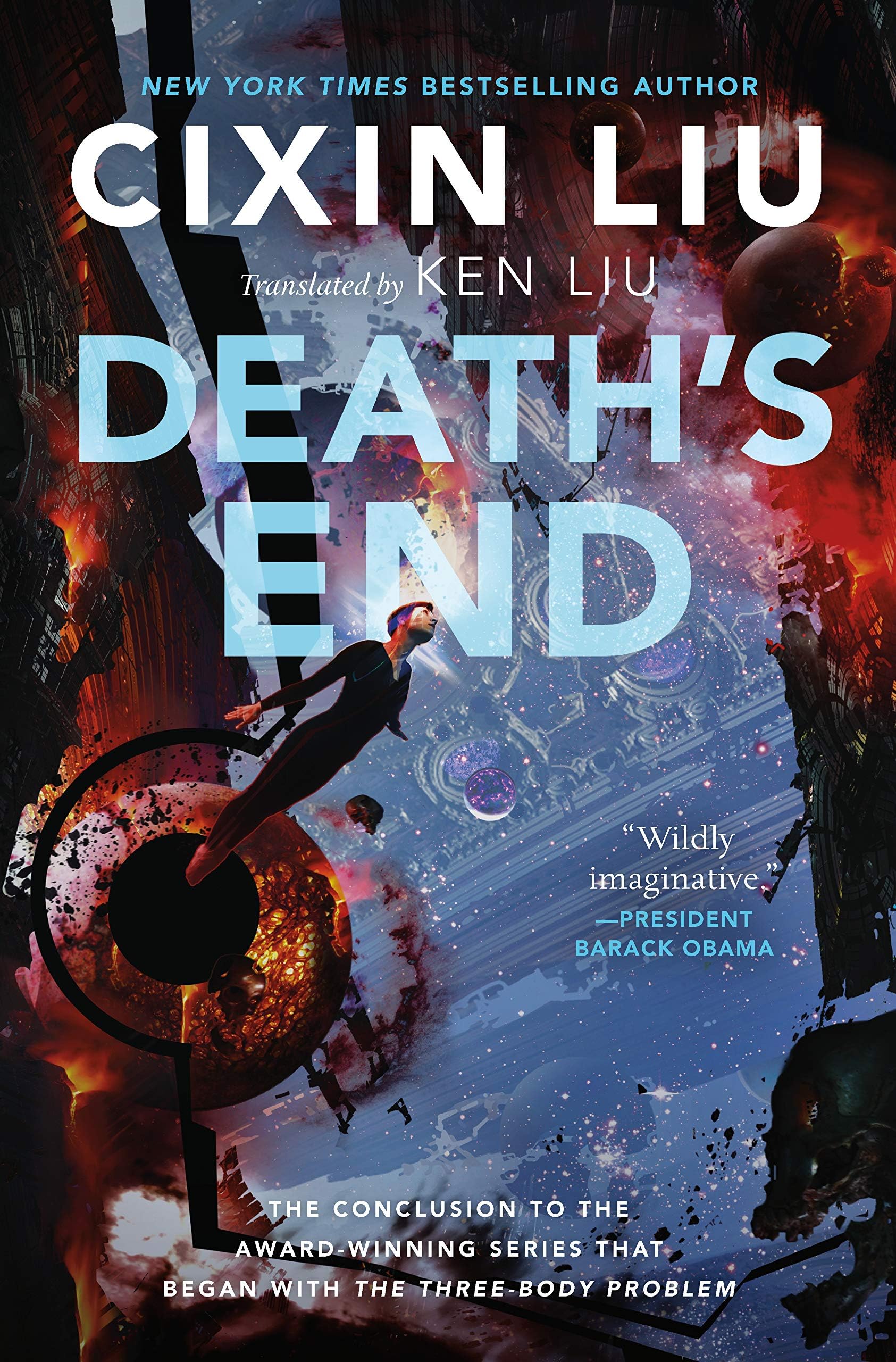
Death's End (The Three-Body Problem Series, 3)
Product ID: 34953984
Desertcart purchases this item on your behalf and handles shipping, customs, and support to KUWAIT.
The inspiration for the Netflix series 3 Body Problem ! Over 1 million copies of the Three-Body Problem series sold in North America PRAISE FOR THE THREE-BODY PROBLEM SERIES: “A mind-bending epic.” ― The New York Times • “ War of the Worlds for the 21st century.” ― The Wall Street Journal • “Fascinating.” ― TIME • “Extraordinary.” ― The New Yorker • “Wildly imaginative.” ―Barack Obama • “Provocative.” ― Slate • “A breakthrough book.” ―George R. R. Martin • “Impossible to put down.” ― GQ • “Absolutely mind-unfolding.” ― NPR • “You should be reading Liu Cixin.” ― The Washington Post The New York Times bestselling conclusion to the groundbreaking, Hugo Award-winning series from China's most beloved science fiction author, Cixin Liu. Half a century after the Doomsday Battle, the uneasy balance of Dark Forest Deterrence keeps the Trisolaran invaders at bay. Earth enjoys unprecedented prosperity due to the infusion of Trisolaran knowledge. With human science advancing daily and the Trisolarans adopting Earth culture, it seems that the two civilizations will soon be able to co-exist peacefully as equals without the terrible threat of mutually assured annihilation. But the peace has also made humanity complacent. Cheng Xin, an aerospace engineer from the early twenty-first century, awakens from hibernation in this new age. She brings with her knowledge of a long-forgotten program dating from the beginning of the Trisolar Crisis, and her very presence may upset the delicate balance between two worlds. Will humanity reach for the stars or die in its cradle? The Three-Body Problem Series The Three-Body Problem The Dark Forest Death's End Other Books by Cixin Liu Ball Lightning Supernova Era To Hold Up the Sky The Wandering Earth A View from the Stars Review: wonderful, full of ideas - DEATH'S END brings popular Chinese science fiction author's Remembrance of Earth's Past trilogy (begun with Hugo winner THE THREE BODY PROBLEM) to a rousing, fulfilling, and moving conclusion. It is a story that spans millions of years and multiple universes. It is strange, wonderful, full of ideas, and thought provoking. It is grand in scope and despite that, personal in nature. It is quite possibly the best science fiction book of 2016, which was full of science fiction novels that could claim that title, as this year's Best Novel Hugo finalist list attests to. It deserves all those superlatives and more. A summary of the plot of DEATH'S END is somewhat difficult, although the story itself is told in a somewhat straightforward (I was tempted to put the phrase "sometimes meandering" after straightforward, but that just didn't seem like the right thing to do) sequential manner. The story starts, in essence, where THE DARK FOREST left off. The people of Earth and the Trisolarans are at a standstill. Luo Ji, the one Wallfacer that actually did his job properly, found a way to hold off the Trisolaran attack via the Dark Forest defense. Luo Ji became what was called The Swordholder. The Swordholder was tasked with the responsibility of broadcasting the location of Trisolaris if the Trisolarans should head to earth to attack. The drawback is that broadcasting the location of Trisolaris would also give away the location of Earth, thus dooming both planets to attack from another malevolent civilization out there in the cosmos. The story, then is how humanity moves forward in the face of impending disaster. Unlike both THE THREE BODY PROBLEM and THE DARK FOREST, which have enough central characters to keep track of to make George R.R. Martin look like a rookie (okay, maybe not many, but you get the idea), DEATH'S END does have one central character, Cheng Xin. She is the character that ties all the sections of the book together as well as the character upon which the fate of humanity hinges. Time and again, Cheng Xin is called upon to make critical decisions. The most important decision comes not long after she is elected by the Earth's population to become the next Swordholder after it is time for Luo Ji to step down from that post. We all know that every decision has a consequence that leads to another decision point, and Cheng Xin finds herself in the middle of every monumental decision that is made in the book (granted, the nature of storytelling is to put the protagonist front and center and let him or her sort it out). And every decision is more monumental than the previous, leading up to the final decision at the end of the book. While the threat of the Trisolarans is present throughout the novel, there is a point at which the focus changes from fear of attack from the Trisolarans (for reasons which I will not go into here) to that of protecting and saving humanity over the long haul. That's not to say the Trisolarans didn't have their moment in the sun (sorry about that) in the story, but they nearly became an afterthought as humanity switch its goal from defending itself against the Trisolarans to defending itself against the universe. One more item about the structure of the novel before I move on to other things. The story is broken up into eras, which are listed in the front of the book and cover from the present all the way through 18906416 (In the timeline of Universe 647 - there, did that whet your appetite? If not, I have more coming.), although in reality (and I'm not sure which reality I'm talking about at this point) the story doesn't actually end in that year. The framework is a memoir entitled "A Past Out of Time", from which excerpts are presented from time to time. It proved to be, at least for me, an effective way to move the story along and provide perspective to what exactly was happening. This book is a lot of things, but one thing it isn't is a traditional story where there's a hero and a villain and a battle at the end to decide the victor (although that kind of story seems to be slowly disappearing from view). Sure, there's a protagonist in Cheng Xin, but she's really there to tie up all the eras (by going into hibernation which enables her to span those eras) and be there from beginning to end to provide a familiar thread while Cixin Liu does what he really wants to do: blow our minds. It's a story of the survival of humanity, a story of moral decisions, a story of love - of one person for another as well as one person for the entire human race - and a story of frenzied, mind blowing concepts and ideas that has the reader's head constantly spinning. Just when you get your head around a particular idea that Cixin Liu is presenting, he throws it away in favor of another equally mind blowing idea that is just as relevant to the situation at hand. I'll just list a few here: firearms that shoot bullets which contain a mini-black hole inside of them; the attainment of lightspeed by a method called curvature space propulsion, which has the potentially nasty side effect of reducing the speed of light in its wake to a point so slow that those trapped within its field can't get out, and thus are stuck there forever in something called a Black Domain; the concept of a weapon that can destroy its intended target by transforming the area of space from three dimensions to two dimensions; and just how do you file an insurance claim on the death of someone who fell into a mini black hole when in their frame of reference they've fallen through the event horizon but in our frame of reference it will take so long for them to fall through the event horizon that the claim will never be able to be made? Along with the flood of ideas comes its companion, the flood of exposition, or infodumps, if you will. It seems inevitable that with each complex idea there is an accompanying firehose worth of information regarding that idea. Sometimes it comes in the form of "As you know, Bob...", and sometimes it comes in the form of the author simply - well, I don't think there's anything simple about any of the ideas - telling the reader about it with large amounts of exposition, which sometimes lasts for several pages. If there's anything that could slow this book down and be a bit problematic, it's the infodumps. One could argue that at 600+ pages the book could use some editing, but it could also be argued that in order for Cixin Liu to get his ideas across those infodumps are necessary. In the long run, they didn't ruin my enjoyment of the novel, but I can see where they could be a problem for some readers. With regard to the narrator, P.J. Ochlan, it should be said that he did a wonderful job creating different voices for the characters and seamless changing between them when called upon to do so. His narration never took me out of the story, and he truly did the best he could with the aforementioned long and involved infodumps. I enjoyed listening to him and would be interested in listening to other books for which he is the narrator. I feel as if his style supplemented and augmented the tone that Cixin Liu was looking for in the novel, and if I ever find time I would be interested in going back and listening to his narration of DARK FOREST. He did not narrate THE THREE BODY PROBLEM. With regard to Ken Liu's translating job, once again, since I don't know Chinese I cannot say how much his translation represented what Cixin Liu was trying to tell the reader. I did enjoy the text of the story, and it felt well written. There's not much else I can say about it. It's no secret that I'm a sucker for cosmic, mind blowing ideas. I fall for the grand scope of a story that spans millions of years and multiple parallel universes, including the old message in a bottle trope. Yeah, I just love all that stuff. DEATH'S END is the book I've been waiting to read for several decades. A book like it may never come along again. Review: Simply Magnificent Science Fiction Trilogy - Death’s End is the concluding volume of Cixin Liu’s Remembrance of Earth’s Past trilogy. If you haven’t read the first two books, don’t begin here. But definitely begin, because this is the most magnificent science fiction work I have ever read, and I have read almost all of them. The first book in the trilogy, The Three Body Problem, was a very nice work, but ultimately the least engaging of the three. The Dark Forest was the best book I’ve ever read, of any genre. It contained elements of anthropology, sociology, philosophy and outstanding hard science fiction concepts and scenarios. It was simply magnificent, and ended in such a manner that a third book was not necessarily required. Well, Death’s End picks up where Dark Forest leaves off, in fact with a little overlap in order to introduce the main protagonist in the final work. For three hundred pages, Death’s End was every bit the equal of Dark Forest, but then there occurs a roughly 100 page segment that is so dumb, so contrived and so out of character with the other 1500 pages of the trilogy that it made me question who had written it and why it was there. It is not really a spoiler to reveal that the referenced 100 pages involve a rather silly fairy tale (for some reason they refer to three tales, though there is really only one, split into three chapters). The fairy tale is part of an inter-stellar conversation between two of the book’s main characters in which one is trying to convey a message through the use of metaphor. The Trisolarans have allowed and even initiated the conversation, but under very strict guidelines that limit information that can be conveyed, under penalty of death. Then, they allow a 50 page fairy tale to be conveyed, and memorized word for word by one of the characters. Sure, that makes sense. I guess the incredibly advanced Trisolarans don’t understand the concept of metaphor and think telling a 50 page fairy tale would be normal conversation under the circumstances. There follows another 50 pages in which the Earth Federation goes about deciphering the fairy tale in such a way that is even dumber and even more senseless than the fact that the fairy tale was conveyed in the first place. SPOILER: In one of the most incredibly stupid moments of any book I’ve ever read, the experts are stumped by a particular place name in the fairy tale. Luckily for them, one of the analysts talks in his sleep. After muttering the mysterious place name in his sleep, he is informed by his live-in girlfriend that the name is actually a combination of two place names in Norway, and not just any place names; names that have not been used for centuries. Luckily for him, his Norwegian girlfriend is a scholar in ancient Norwegian place names. Lucky humans, what are the chances. Then, like nothing ever happened, the novel returns to absolute excellence for the final 300 pages. It is the damndest thing; like listening to a two hour concert featuring the works of Mozart that is interrupted for ten minutes by a cacophonous din of meaningless music, and completely unnecessary as the author could have easily gotten where he needed to go without such a bizarre detour. For such a magnificent work to be marred in such a way is a shame, because one of the strengths of the trilogy is its believability and rock solid hard science fiction. Character actions and plot lines flow so smoothly because they are imminently believable and flawlessly crafted. In any event, it is the best science fiction series I’ve experienced; far more complex and engaging than the Foundation works and so much more approachable and enjoyable than the Dune novels. If a 20 year old asked me where to start in reading science fiction, I would direct him to Foundation and other Asimov works. If a 40 year old, who had sampled much of the genre asked the same question, I would insist that he read this trilogy. Afterwards, he would thank me for the suggestion but ask, “What was up with that stupid fairy tale.”
| Best Sellers Rank | #103,871 in Books ( See Top 100 in Books ) #55 in Hard Science Fiction (Books) #58 in Alien Invasion Science Fiction #71 in First Contact Science Fiction (Books) |
| Customer Reviews | 4.6 out of 5 stars 24,892 Reviews |
J**Z
wonderful, full of ideas
DEATH'S END brings popular Chinese science fiction author's Remembrance of Earth's Past trilogy (begun with Hugo winner THE THREE BODY PROBLEM) to a rousing, fulfilling, and moving conclusion. It is a story that spans millions of years and multiple universes. It is strange, wonderful, full of ideas, and thought provoking. It is grand in scope and despite that, personal in nature. It is quite possibly the best science fiction book of 2016, which was full of science fiction novels that could claim that title, as this year's Best Novel Hugo finalist list attests to. It deserves all those superlatives and more. A summary of the plot of DEATH'S END is somewhat difficult, although the story itself is told in a somewhat straightforward (I was tempted to put the phrase "sometimes meandering" after straightforward, but that just didn't seem like the right thing to do) sequential manner. The story starts, in essence, where THE DARK FOREST left off. The people of Earth and the Trisolarans are at a standstill. Luo Ji, the one Wallfacer that actually did his job properly, found a way to hold off the Trisolaran attack via the Dark Forest defense. Luo Ji became what was called The Swordholder. The Swordholder was tasked with the responsibility of broadcasting the location of Trisolaris if the Trisolarans should head to earth to attack. The drawback is that broadcasting the location of Trisolaris would also give away the location of Earth, thus dooming both planets to attack from another malevolent civilization out there in the cosmos. The story, then is how humanity moves forward in the face of impending disaster. Unlike both THE THREE BODY PROBLEM and THE DARK FOREST, which have enough central characters to keep track of to make George R.R. Martin look like a rookie (okay, maybe not many, but you get the idea), DEATH'S END does have one central character, Cheng Xin. She is the character that ties all the sections of the book together as well as the character upon which the fate of humanity hinges. Time and again, Cheng Xin is called upon to make critical decisions. The most important decision comes not long after she is elected by the Earth's population to become the next Swordholder after it is time for Luo Ji to step down from that post. We all know that every decision has a consequence that leads to another decision point, and Cheng Xin finds herself in the middle of every monumental decision that is made in the book (granted, the nature of storytelling is to put the protagonist front and center and let him or her sort it out). And every decision is more monumental than the previous, leading up to the final decision at the end of the book. While the threat of the Trisolarans is present throughout the novel, there is a point at which the focus changes from fear of attack from the Trisolarans (for reasons which I will not go into here) to that of protecting and saving humanity over the long haul. That's not to say the Trisolarans didn't have their moment in the sun (sorry about that) in the story, but they nearly became an afterthought as humanity switch its goal from defending itself against the Trisolarans to defending itself against the universe. One more item about the structure of the novel before I move on to other things. The story is broken up into eras, which are listed in the front of the book and cover from the present all the way through 18906416 (In the timeline of Universe 647 - there, did that whet your appetite? If not, I have more coming.), although in reality (and I'm not sure which reality I'm talking about at this point) the story doesn't actually end in that year. The framework is a memoir entitled "A Past Out of Time", from which excerpts are presented from time to time. It proved to be, at least for me, an effective way to move the story along and provide perspective to what exactly was happening. This book is a lot of things, but one thing it isn't is a traditional story where there's a hero and a villain and a battle at the end to decide the victor (although that kind of story seems to be slowly disappearing from view). Sure, there's a protagonist in Cheng Xin, but she's really there to tie up all the eras (by going into hibernation which enables her to span those eras) and be there from beginning to end to provide a familiar thread while Cixin Liu does what he really wants to do: blow our minds. It's a story of the survival of humanity, a story of moral decisions, a story of love - of one person for another as well as one person for the entire human race - and a story of frenzied, mind blowing concepts and ideas that has the reader's head constantly spinning. Just when you get your head around a particular idea that Cixin Liu is presenting, he throws it away in favor of another equally mind blowing idea that is just as relevant to the situation at hand. I'll just list a few here: firearms that shoot bullets which contain a mini-black hole inside of them; the attainment of lightspeed by a method called curvature space propulsion, which has the potentially nasty side effect of reducing the speed of light in its wake to a point so slow that those trapped within its field can't get out, and thus are stuck there forever in something called a Black Domain; the concept of a weapon that can destroy its intended target by transforming the area of space from three dimensions to two dimensions; and just how do you file an insurance claim on the death of someone who fell into a mini black hole when in their frame of reference they've fallen through the event horizon but in our frame of reference it will take so long for them to fall through the event horizon that the claim will never be able to be made? Along with the flood of ideas comes its companion, the flood of exposition, or infodumps, if you will. It seems inevitable that with each complex idea there is an accompanying firehose worth of information regarding that idea. Sometimes it comes in the form of "As you know, Bob...", and sometimes it comes in the form of the author simply - well, I don't think there's anything simple about any of the ideas - telling the reader about it with large amounts of exposition, which sometimes lasts for several pages. If there's anything that could slow this book down and be a bit problematic, it's the infodumps. One could argue that at 600+ pages the book could use some editing, but it could also be argued that in order for Cixin Liu to get his ideas across those infodumps are necessary. In the long run, they didn't ruin my enjoyment of the novel, but I can see where they could be a problem for some readers. With regard to the narrator, P.J. Ochlan, it should be said that he did a wonderful job creating different voices for the characters and seamless changing between them when called upon to do so. His narration never took me out of the story, and he truly did the best he could with the aforementioned long and involved infodumps. I enjoyed listening to him and would be interested in listening to other books for which he is the narrator. I feel as if his style supplemented and augmented the tone that Cixin Liu was looking for in the novel, and if I ever find time I would be interested in going back and listening to his narration of DARK FOREST. He did not narrate THE THREE BODY PROBLEM. With regard to Ken Liu's translating job, once again, since I don't know Chinese I cannot say how much his translation represented what Cixin Liu was trying to tell the reader. I did enjoy the text of the story, and it felt well written. There's not much else I can say about it. It's no secret that I'm a sucker for cosmic, mind blowing ideas. I fall for the grand scope of a story that spans millions of years and multiple parallel universes, including the old message in a bottle trope. Yeah, I just love all that stuff. DEATH'S END is the book I've been waiting to read for several decades. A book like it may never come along again.
S**Y
Simply Magnificent Science Fiction Trilogy
Death’s End is the concluding volume of Cixin Liu’s Remembrance of Earth’s Past trilogy. If you haven’t read the first two books, don’t begin here. But definitely begin, because this is the most magnificent science fiction work I have ever read, and I have read almost all of them. The first book in the trilogy, The Three Body Problem, was a very nice work, but ultimately the least engaging of the three. The Dark Forest was the best book I’ve ever read, of any genre. It contained elements of anthropology, sociology, philosophy and outstanding hard science fiction concepts and scenarios. It was simply magnificent, and ended in such a manner that a third book was not necessarily required. Well, Death’s End picks up where Dark Forest leaves off, in fact with a little overlap in order to introduce the main protagonist in the final work. For three hundred pages, Death’s End was every bit the equal of Dark Forest, but then there occurs a roughly 100 page segment that is so dumb, so contrived and so out of character with the other 1500 pages of the trilogy that it made me question who had written it and why it was there. It is not really a spoiler to reveal that the referenced 100 pages involve a rather silly fairy tale (for some reason they refer to three tales, though there is really only one, split into three chapters). The fairy tale is part of an inter-stellar conversation between two of the book’s main characters in which one is trying to convey a message through the use of metaphor. The Trisolarans have allowed and even initiated the conversation, but under very strict guidelines that limit information that can be conveyed, under penalty of death. Then, they allow a 50 page fairy tale to be conveyed, and memorized word for word by one of the characters. Sure, that makes sense. I guess the incredibly advanced Trisolarans don’t understand the concept of metaphor and think telling a 50 page fairy tale would be normal conversation under the circumstances. There follows another 50 pages in which the Earth Federation goes about deciphering the fairy tale in such a way that is even dumber and even more senseless than the fact that the fairy tale was conveyed in the first place. SPOILER: In one of the most incredibly stupid moments of any book I’ve ever read, the experts are stumped by a particular place name in the fairy tale. Luckily for them, one of the analysts talks in his sleep. After muttering the mysterious place name in his sleep, he is informed by his live-in girlfriend that the name is actually a combination of two place names in Norway, and not just any place names; names that have not been used for centuries. Luckily for him, his Norwegian girlfriend is a scholar in ancient Norwegian place names. Lucky humans, what are the chances. Then, like nothing ever happened, the novel returns to absolute excellence for the final 300 pages. It is the damndest thing; like listening to a two hour concert featuring the works of Mozart that is interrupted for ten minutes by a cacophonous din of meaningless music, and completely unnecessary as the author could have easily gotten where he needed to go without such a bizarre detour. For such a magnificent work to be marred in such a way is a shame, because one of the strengths of the trilogy is its believability and rock solid hard science fiction. Character actions and plot lines flow so smoothly because they are imminently believable and flawlessly crafted. In any event, it is the best science fiction series I’ve experienced; far more complex and engaging than the Foundation works and so much more approachable and enjoyable than the Dune novels. If a 20 year old asked me where to start in reading science fiction, I would direct him to Foundation and other Asimov works. If a 40 year old, who had sampled much of the genre asked the same question, I would insist that he read this trilogy. Afterwards, he would thank me for the suggestion but ask, “What was up with that stupid fairy tale.”
I**I
My favorite in the series - the best by far. Overly ambitious ending is its biggest flaw.
If Three Body Problem was a 2/5 because of horribly flat and emotionless characters, very poor pacing, and mediocre dialog... and the Dark Forest for a 3/5 because of similarly horrible pacing, overly drawn out world-building sections with little interest or plot development, and artificially forced segments to force a plot twist, but it gets another star for much better character arcs and a gorgeous beginning and ending... Death's End is a 4/5 because he finally gets it all right and his prose, the plot structure, and the characters are all absolutely amazing. It was the only book in the series that I actually thoroughly enjoyed reading and was continually astounded at how good it was. The only weakness of this book is the incompleteness and overly ambitious ending, which was not satisfying for me. For the "end" of a series, it opened far too many questions instead of closing them like previous novels did. On the merits of Three Body and Dark Forest alone, I cannot understand the widely acclaimed success of this series. The flaws of the first two books are so obvious it makes the reading deeply unenjoyable, at least for a scientifically and philosophically informed reader that expects some depth of character. But Death's End made it come together for me. If the previous two books could be rewritten with the same quality as Death's End, this would be close to a masterpiece series in my view, even with the occasional flaw here and there. It falls VERY far from that designation however, because of the depth of the flaws in the earlier two books, but I'm very glad to see he hit his stride with this book. This book was absolutely incredible, and it shows Cixin Liu's genius that was really just latent and hinted at in the first two books. But even this being the case, he left WAY too many loose ends open and didn't resolve or answer way too many questions he opened. I wish HE did a sequel to this and tied up lose ends. He did not, and the next book's style is so different (different author) that I'm reluctant to read it. This again is yet another flaw in an incredible uneven and flawed series that is always teetering on the edge of being a masterpiece, but not quite making it.
H**.
Guys, it’s time for some Dark Forest deterrence game theory.
With its completion with Death’s End, I can now say that the Remembrance of Earth’s Past is my all-time favorite science fiction series (says the noob of a sci fi fan). It opens just like you would expect the final volume of an insanely ambitious hard science fiction series to open, with a magician offering to help the emperor prevent the Fall of Constantinople in 1453. Wait, what? This has never been a series interested in hewing to convention. And so we get a story spanning a few million years (specifically, 1453 – 18906416). “Once, ancient Romans had whistled in their grand, magnificent baths, thinking that their empire, like the granite that made up the walls of the pools in which they floated, would last forever. No banquet was eternal. Everything had an end. Everything.” (SPOILERS for the first two books in the Remembrance of Earth’s Past series below.) Did I say that Death’s End is insanely ambitious? It purports to encompass most of the history of humanity, and of the universe, within its scope. And, indeed, all things must end. But nor is “life . . . nothing but a fragile, thin, soft shell clinging to the surface of this planet.” As another work of science fiction put it, “Life finds a way.” After a prologue that is bizarre and kind of awesome and strictly not necessary, and a brief interlude with Yang Dong shortly before she commits suicide, the story proper opens shortly after the Trisolaris invasion fleet becomes public knowledge (the Crisis Era). Yun Tianming is a sad sack, a loner, an entirely undistinguished scientist. But the thread of his life has the chance to play a greater role in the pattern of human history when it comes back into contact with his college crush, Cheng Xin. Yun Tianming is a bit of a head fake. Cheng Xin is not only Death’s End protagonist, but is far more central to the story, heck, to the entire series, than any of the characters from the first two books. Cheng Xin is, in at least one way, the best protagonist in the series. That is, she is the most memorable. Not the best, but she is the easiest to keep distinct in your mind as a character. Or at least that was my experience. She is no Luo Ji, though. The Trisolarans are right—Luo Ji is a mighty warrior. We do see Luo Ji again, but Cheng Xin’s story dominates the book in a way that Wang Miao and Luo Ji never did. The Wallfacer project isn’t the UN’s only response to the Trisolarans. Cheng Xin becomes a part of the parallel Staircase Program. The Staircase Program ultimately settles on a truly science fictional idea—using nuclear pulse propulsion to send a frozen brain light years through space. “At the same time, in Russia and China, Topol and Deongfeng missiles were also rising in the sky. The scene resembled a doomsday scenario, but Cheng Xin could tell by the curvature of the rocket trails that these were orbital launches instead of intercontinental strikes. These devices, which could have killed billions, would never return to the surface of the Earth. They would pool their enormous power to accelerate a feather to 1 percent of the speed of light.” We’re not going to spend the entire book stuck back in the Crisis Era, though. The same hibernation Luo Ji took advantage of in The Dark Forest is available to Cheng Xin, and she makes good use of it. When she first reawakens, Luo Ji singlehandedly holds the Trisolarans at bay as Swordholder. He wields Dark Forest deterrence. Ok, now this is REALLY SPOILER territory for The Dark Forest. In The Dark Forest, humans discovered why the universe is so quiet. Given an infinite number of stars, there are infinite habitable planets, infinite civilizations, infinite supercivilizations, and infinite supercivilizations that view any intelligent life as a potential threat. And if you’re a supercivilization, you don’t need to build a system the size of a small moon to destroy a planet. “‘Dark forest attacks all share two qualities: one, they’re casual, two they’re economical.’ ‘Elaborate, please.’ ‘These attacks are not part of some interstellar war, but a matter of conveniently eliminating possible threats. By “casual,” what I mean is that the only basis for the attack is the exposure of the target’s location. There will be no reconnaissance or exploration conducted against the target beforehand. For a supercivilization, such exploration is more expensive than a blind strike. By “economical,” what I mean is that the attack will employ the least expensive method: using a small, worthless projectile to trigger the destructive potential already present in the target star system.’” At least now we know what happened to the Moon in Seveneves. If that doesn’t sound bad enough, things get worse. Death’s End continues and expands on the best aspect of The Dark Forest—balls-to-the-wall crazy science, and lots of it. There are gigantic space cities. “[A] regular cylinder that stimulated gravity with the centrifugal force generated by spinning. With a length of seven kilometers, its useable interior surface area was 659 square kilometers, about half the sizes of ancient Beijing. Once, about twenty million inhabitants had lived here.” There are a few dozen more, like that or not. There is light speed travel. Well, near-light speed travel—“If there really were a Creator, the only thing he welded shut in all Creation was the speed of light.” And then there are antimatter weapons, artificial black holes, multiple dimensions, a circumsolar particle accelerator, and, for lack of a better word, vacuoles. But the Remembrance of Earth’s Past series has always been science fiction with a capital SCIENCE. Not only does Death’s End have a more relatable protagonist. It has, by a fair margin, the best writing of the series, especially the pacing and plotting. Liu (The Lius?) can throw out a hell of a wham line. “Tianming, did you know that the euthanasia law was passed specifically for you?” By the way, the Trisolarans make great villains (I’m not so sure they qualify as antagonists; the antagonist is more often physics and humanity’s current understanding of it.) They aren’t wantonly cruel, but they give as little thought to humanity’s pain as the wolf gives that of the sheep. One trend in modern villainy I’ve really come to find annoying is the bad guy going out of his way to show just how EVUL he is. Think Alan Rickman’s Sheriff of Nottingham killing Guy of Gisbourne for little to no reason. In reality, even despots need allies. Apropos, I just finished reading a biography of King John. He had a distinct tendency toward cruelty, and it made him a weak king. Tywin Lannister wouldn’t have been the most feared man in England, he would have been the most hated, and it would have cost him power. One of the high marks for Amazon’s Sneaky Pete is that the bad guy played by Bryan Cranston is so rational, which doesn’t stop him from being evil but does make him a much more dangerous foe. Ok, digression over. The Remembrance of Earth’s Past has always been chock full of social commentary, albeit rarely of the Anvilicious sort (perhaps aided by the language and cultural barriers). He sees environment as having an enormous influence on human society, and humans also as being prone to cyclical thinking reacting against the past as much as the environment. Thus humanity vacillates wildly: “The repressive militaristic uniformity of the Great Ravine; the optimism and romanticism of the latter half of the Crisis Era; the hedonistic freedom and indolence of the Deterrence Era.” Like Joe Haldeman in The Forever War, Liu touches on the idea of a trend toward feminization. Men in the Deterrence Era are so feminine that Cheng Xin initially doesn’t realize that they are men. Liu seems to tie this directly to a “half century of peace and ease brought about by the Deterrence Era [that] accelerated the trend.” When things get hard again later, the trend reverses. I’m not so sure. It is perhaps no accident that Haldeman and Liu are both men. If you don’t think “masculinity, as traditionally defined, [i]s considered an ideal,” just pick up a romance novel. Any era that makes Mike Rowe a sex symbol still puts a premium on masculinity. I find Death’s End, and the series in general, most fascinating, though, as a product of atheism. Not just a work influenced by atheism, or the product of an atheist (I have no idea if Cixin Liu is or isn’t), but a work that is the product of an atheistic society. And not just in the more direct ways it addresses religion (“The discovery of the dark forest state of the universe was a giant blow to most major religions, especially Christianity”). Or even Cheng Xin repeatedly playing the role of either Eve or Messiah (“I want to tell all those who believe in God that I am not the Chosen One. I also want to tell all the atheists that I am not a history-maker. I am but an ordinary person.”) I distinguish between a work written by an atheist and the product of an atheistic society because works written by Western atheists, especially American atheists, are still working from essentially a Judeo-Christian perspective. Even if they are reacting against it, their work can still be defined in relation to it. The typical nihilism in modern storytelling, then, is an act of rebellion that we can try to rationalize away—for there to be a rebellion, there must be a dominant order. The nihilism of Death’s End, on the other hand, is pervasive, and thus terrifying. Other books are dark in a way that makes you happy you can set them aside and return to normal life after you’re done reading. The darkness of Death’s End is fundamental, and reaches beyond the four corners of the book. The Trisolaran threat, the threat of a Dark Forest strike, the mindboggling timescale, space itself, all serve to reinforce that underlying nihilism. After all, is there anything more frightening than space to the atheist? They look up and see not the glory of God’s creation but instead an infinite emptiness creating ever more oppressive loneliness. Liu returns to it, again and again. “Death is the only lighthouse that is always lit.” “The child that was human civilization had opened the door to her home and glanced outside. The endless night terrified her so much that she shuddered against the expansive and profound darkness, and shut the door firmly.” “She finally understood how she was but a mote of dust in a grand wind, a small leaf drifting over a broad river.” But because I could not so easily dismiss it, I was left wondering as I read the book, and am left wondering still today weeks after finishing it, whether it meant as hopeful. Keynes was right. “In the long run we are all dead.” Toggle the end date for your book far enough and you’ll get there. Even the Bible ends with Revelation. Humanity escapes catastrophe miraculously, but it’s going to get us all eventually. And so we return to the opaque allegory of Cheng Xin, our Eve and Messiah. Is she savior of bringer of destruction? Is her weakness a damnation of us or merely of herself? Is it even really weakness at all?
S**I
A harrowing epic
Plenty has been written about the extraordinary imaginativeness and story-telling prowess of Liu Cixin in this thought-provoking book. Having just finished the trilogy after just over a week of obsessive reading, I’ll share a few thoughts as a means of decompressing from this harrowing epic. I read the first two volumes in Chinese and the third in English, mainly because it became too labored an effort to read the transliterated foreign proper nouns and technical words in Chinese (for me, anyway), and I can attest to the quality of the translation and its loyalty to the original. It felt as if I read all three books seamlessly in the same language. Although certain things are inevitably lost in translation, Ken Liu, as an accomplished writer himself, certainly compensated for the loss with innovations of his own. My only complaint has to do with certain word choices. For example, pinnace and dinghy are perhaps neither familiar to most readers nor appropriate terms for astronautic vehicles, and at times certain passages are unnecessarily grandiloquent while at others overly casual when exploring scientific and philosophical concepts. I was especially dismayed that the end of a fairy tale in the story opted for a word-for-word translation instead of “and they lived happily ever after,” despite that’s exactly what the source material means, and it was the only moment that I felt like I was reading a translation. It is important to point out that although the three books complete the same story arc in a mostly chronological order, they involve very different scale, scope, and more importantly, themes. Emotionally, each book is fully resolved at the end. In this regard, the first book, though a thorough page turner and winner of the Hugo Award, perhaps has the least depth of the three. One major theme of the first book is certainly the existential crisis that can arise out of either failure to grasp reality or loss of faith in humanity, and the second book inverts that theme to become the humanity’s shifting beliefs in reality and faith when faced with a crisis of existence. Death’s End, on the other hand, annihilates any notion that we may have of both crisis and existence. Romantic love evolves along with the installments. The Three Body Problem has a cynical notion of love, and the stories of various marriages are marked by betrayal, indifference, and lovelessness. In Dark Forest, love is an ideal that ultimately proves to be an illusion. In Death’s End, love is concrete with cosmic consequences, yet at the same times becomes the most elusive and utterly devastating. The narrative structure of Death’s End is also different compared to the previous two books. It doesn’t have the air of mystery of The Three Body Problem that is imposed by an unknown entity, or the intentional concealment of Dark Forest that plays smoothly into the Wallfacer Project. Instead, the story unfolds in a straightforward manner, but every decision made has far reaching consequences that you may not see for hundreds of pages, which in turn are foretold by minute details before they are revealed. There is one subtle but brilliant point a third into the book where the Trisolaran emissary sadistically admonishes the forlorn protagonist that the universe is not a fairy tale. It may seem like a mundane cliché by a cartoonish villain, but this point ties together the entire trilogy. The last installment, like the previous two, pays ample homage to other works of science fiction, sometimes covertly. It is interesting, however, that Liu also subverts elements from his prior stories in the trilogy. Similarly, Ball Lightening, of which a weaponized version is mentioned repeatedly in the second book, is an earlier eponymous novel of his. Three short stories come to mind: The Wandering Earth, The Rural Teacher, and a third one that may reveal too much plot by its title alone. The Wandering Earth tells the story of a human society that tries to escape the Sun that is shifting out of main sequence unexpectedly early by making Earth itself into a giant spaceship in order to fly to, ironically, Alpha Centauri, the Trisolaran home world. A specific object that appeared in The Wandering Earth is mentioned twice in Death's End, and becomes a powerful symbol at the very end of the novel. The Rural Teacher also deals with a fertile universe and the destruction of stellar systems, but unlike the Dark Forest, that universe is much more benevolent toward civilizations. Given the limited scope of the first book and the impeded scientific progress in the second, Death’s End is the only part of the trilogy to expansively explore frontier scientific ideas. The scientific foundations of the book are mostly solid and airtight, even when it feels dubious as observed by characters. Artistic licenses are only taken when it involves speculations far beyond even the frontiers of our current scientific understanding. However, one problematic aspect has to do with traveling and manipulating objects in four-dimensional space, as the novel implies that distance in 3D space can be shortened by traveling in the fourth dimension, which is incompatible with orthogonality of dimensions in the Euclidean part of space-time, and there is no metric shortening of the lower-dimensional distance by traveling in any direction in the higher-dimensional space. Of course, it is certainly possible that the local geometry of said fictional space is non-Euclidean. The author does a superb job confounding the philosophical center of the books with a very comprehensive treatment of the different beliefs in science, society, politics, religion, gender, human nature, life, etc., both through an interspersed objective omniscient narrator and through the subjective thoughts of opaque characters. Indeed, there is no true villainy in the trilogy, even when we’re dealing with genocidal alien invaders and mundicidal star destroyers. However, there remains a palpable degree of ethnocentrism and, more problematically, androcentrism that belies the author's ambitious big picture of cosmic proportions. Though the male gaze is prevalent in the first and second books, it nonetheless reflects the inner worlds of the male protagonists, if not the author himself, from an exceedingly patriarchal society. Yet what Liu perceives to be the difference between “masculine” and “feminine” values cannot be reconciled even at cosmic scales, despite the author’s clear intention to absolve and diminish all sins, aggression and weakness alike, in the grand schemes of the Dark Forest universe. It is disappointing, but forgivable. Many critics think that Death’s End is the best of the trilogy, including the translator. I disagree. Liu has written three entirely unique books out of the same story, one may even argue that they’re written in three different genres, and each succeeds and excels on its own equal footing. Nonetheless, Death’s End is the grandest, and it will blow your mind.
J**E
In which the series ends as it lived: complex, thoughtful, epic and intimate at once
It's hard to know where to begin talking about The Three-Body Problem trilogy (officially known as the Remembrance of Earth's Past series), a truly staggering piece of science-fiction written by Chinese author Cixin Liu and translated to English by Ken Liu and Joel Martinsen (Liu did books 1 and 3, while Martinsen did 2). A trilogy that spans literally thousands of years, deals with quantum physics, game theory, sociology, religion, space exploration, space colonization, and more, all driven by the nature of first contact with alien intelligence - there's a lot going on in this series, and that's before you start realizing just how much Cixin (reminder: Chinese names are traditionally written with the family name first and the given name second) truly takes on the advanced science of his ideas. And yet, when you finish it, you realize that you've read something truly incredible - a piece of hard science-fiction whose ambition, scope, richness, and ideas are impossible not to find yourself thinking about for days afterward. Death's End, the series' final volume, feels like yet another shift in the series, just as The Dark Forest was a shift from The Three-Body Problem. Because if the first two volumes were about how we come to terms with the fact that we're not alone in the universe, the final volume is about what it's like to realize that you - and every other civilization that's ever lived - are limited in your time, and might one day have no choice but to end? Once again using the previous book as a launching point, Death's End takes on the uneasy stalemate we were left with, but watches as things shift quickly out of control in the exact way the end of The Dark Forest feared they might. Just like the others, Death's End is undeniably the final part of this saga, but it feels like its own book, giving us another new central character and a very different tone, one that finds itself wondering which is more important: survival or morality? And as usual, Cixin doesn't believe in easy answers. Spanning even more time than the other books, Death's End unfolds on an epic scale, as humanity tries to find a way to prevent itself from being viewed as a threat by the rest of the galaxy. But is the sacrifice worth it - in other words, is safety so important that we should cripple ourselves as a race? Do we escape and leave our planet behind, setting out as nomads across the galaxy? Or do we try to intimidate others, showing that we're not to be messed with? Death's End deals with these questions as it has in the other novels, diving into the science, the game theory, and the objections, and giving readers the sense that sometimes, there are no easy answers to be given. Indeed, what's so compelling about Death's End is the main character, who takes choices that so often feel like the wrong ones for a situation - I often found myself almost screaming at her for being wrong...and yet, you understand why she's doing them, and can almost agree. Where do we draw the line between survival and being a monster? What's acceptable to do in order to save ourselves? And does it truly matter, on a large enough time scale? Over the course of Death's End, Cixin draws all of the series' various threads into focus thematically, making it clear that this is a series about recontextualizing our place in the universe and how we would react to that. But he's done so, once again, by focusing on a small group of characters, advanced and thoughtful explorations of science and philosophy, and a story that's engrossing on both the macro and micro level. And while the series comes to an appropriately complex, epic ending, I love how even to the end, Cixin makes it equally about the larger questions and about these characters and the choices they have to make - and their own emotional stakes as well. To explain this series is a difficult challenge, to put it mildly. This is a series that spans a huge amount of time, deals with advanced scientific concepts in complex terms, grapples with rich philosophical and political ideas, debates questions without easy answers, and gives you a scope that can be daunting. It's a story of alien invasions, yes, but one in which the action sequences we're so used to are replaced with existential dread, a rethinking of our own lives, and a fear of the unknown that's hard to quantify. It's also the story of people caught up in these times, trying to give themselves a good life while never forgetting the larger questions of their era, and juggling their own fears with fears for humanity. In other words, it's what hard science-fiction is great at - thoughtful questions, big ideas, and speculation, all of which change the way you think about the world. This series is a truly incredible achievement, one that honestly left me a bit staggered and reeling as I attempt to think about it all, but one that I love all the more for what it accomplishes. If you're a hard science-fiction fan, or simply someone who loves dealing with the complex ramifications of common ideas, this is a must read series. I've never read anything like it in my life, and I'm a richer person for the ideas it's inspired me to think about.
A**5
I Can't Believe I Read All Three
*Spoilers* Just warning anyone there may be some *spoilers*. And yes, I kind of can't believe I read all three "Three Body" books. To be honest the first one was my favorite, next I preferred the second one. I Loved the "gaming" sequences in the first book and was quite disappointed when they ended. I felt they added - another dimension or fantasy, but in a real way. They were exciting, and a mystery to try and solve. Who were the characters in "real life"? or Which characters were they from the story? I enjoyed the cop character. He added some earthiness and grit, and intelligence. He also disappeared from the third book. And yes, the third book introduces a totally new female lead. I'll throw a few questions in here that puzzled me in particular - What does the opening sequence regarding the brain in Medieval era have to do with it?? And I would have Liked if we learned more about the character with the brain after he left the solar system. Also, I would have liked to learn more about the scientifically advanced civilization that threw the "paper" thing to earth. I lay in bed at night wondering about these things!! As for Cheng Xin the female lead character, I notice everyone puts their own thoughts and feelings and interpretations into reviews and they can wildly differ. That goes for all books in general. One person saw the religious symbolism. I saw - well I was actually happy that the author didn't make her the feminist superhero that every character has to be now a days it seems to me. He actually had the (bleeps!) to indulge us with the old-fashioned notion that women may hesitate more before taking aggressive, destructive action (please don't see this Disney). And in the end, she Did take Nobel action that may help in a small way to save "the universe". I think I'd give it a 4 1/2 stars if there were the option. Maybe because even though there were things I thought were - way out there or not easily understood, it made me think and wonder a lot. And it did hold my attention; I looked forward to reading every night. I Love good sci fi!!
S**Y
Magnificent end to a magnificent trilogy!
Death’s End by Cixin Liu is a magnificent end to a magnificent trilogy. And it’s long, much longer than the other two books, but it does not drag and caps the tale with a ending that is unexpected and ultimately satisfying. In place of a western mad-dash of action and heroism. Death’s End is contemplative, thoughtful and exciting in it’s own quite way. The book starts off with a most unconventional love story; but don’t let that fool you, Death’s End is, as with the other books, packed full of bad-ass science and twisting waves of crisis and joy. The Dark Forest hangs heavy over the Earth and forces humanity to make hard choices. Things go wrong, thing go right, but as time goes by, the possibility of a Dark Forest attack grows. The people of earth make sacrifices, and more often than not, sacrifice the wrong things. Victories come and go, but as with the defeats, they are short lived and death lurks in the darkened depths of the universe. For all our history and power and brains, the people of earth are but babes in the woods, flailing and making to much noise, unaware of the monsters that live among the distant trees. Having read the trilogy straight through, I find the Ken Liu translations are my favorite, and I was surprised how different the voice was between the two translators. I think they should’ve asked Ken Liu to translate all three. But I am sure Ken had projects and deadlines of his own. Cixin Liu is a excellent story teller. And this book, much as the other books, had politics and philosophy at its heart; and like the other books, Mr. Liu leaves the answers up for debate. It was also about responsibility. Responsibility, to ones self, to ones fellow man and to the universe at large. But most of all, the book was about love. And that was the most unexpected peace of all. Behind all the science and aliens and disasters, love flowed through the pages. In some cases, it was a love that killed, and by killing saved others. In some cases, it was a love that saved, but ended up destroying. In some cases, it was a love that denied the consequences of it action and paid the price. Buy most of all, for me at least, it was the love life and it fragility that struck home. In a month or so, I may have to read the trilogy again; there is more there, I can feel it. If you read the first book, and were put of by the second, power through, because Death’s end is worth our time.
G**N
Stretching your mind, your imagination, and your belief as far as billions light years
The Three-Body Problem Trilogy is one of the very few books that way exceeded my expectations. It’s a real epic tour not just down the rabbit hole but worm holes, black holes, interdimensional portals, parallel universes, time tunnels, in multitude ways that defy the known laws of physics, but at the same time never loses sight of the human elements. I am sure the bold scientific tenets in the book could be easily dismissed as fantasy but as a Possibilitarian I don’t rule anything out and I think “being unrealistic” is how Sci-Fi should be, helping us to consider and explore the hitherto Unknown. Besides, a very important message in the 3 books is how human arrogance and blinkered vision had led to its own demise. Anything is possible, nothing is what it seems, never stop questioning, what’s true today could be overthrown tomorrow, don’t be too sure of yourself, what on earth (pun intended) makes us think we are so special ? remember the mystery of the universe will bring you to your knees without a moment’s notice. To me, where the books really excel is in highlighting the human frailties. There are so many lessons strewn through the story. To say it’s thought provoking is an understatement. It put into question what it means to be human and our place in the vast Universe. It’s really freeing once we break out of our limited beliefs and embrace the uncertainties around us. At points I almost agreed with Ye Wenjie that humanity is beyond redemption and it will probably self-destroy if not slaughtered by extra-terrestrials. Even in the wake of an alien invasion, humans still cannot unite against a common enemy. Its naivety, arrogance, selfishness, failure to learn from mistakes and take ownership of problems, and a deviousness that even corrupted warlike aliens, do not paint a very flattering picture of my kind but there are always exceptions. There are still goodness in this world but are the human values we hold dear going to save us in the face of an apathetic universe ? There are so many sober reminders that we should not assume, take things for granted, or be complacent. Who can say that our star system will not be “cleansed” in the end by a lowly person like Singer from a remote corner of the Universe with just a flick of his finger, in the same way that a pests terminator rid our house of termites. I found that part of the story particularly humbling. And I am glad the story does not have a happy ending because that makes it more real. Without giving any more away, all I can say is that it’s an open ending. That gives arise to more possibilities just like what the books did all the way through. You never guess what will happen next. Even the sky is not the limit. Life is a true adventure.
E**O
excellent fiction
The last part of the trilogy. Very interesting to conclude like this !
A**E
The Mind blowing infinity of cliffhangers, brutal truth of humanity, grandios ending
1. Re: book appearance. The book itself was as good as new. I am so surprised and thrilled: not only I get to save money on buying, but at the same time I get to recycle and that it priceless. 2. Re: contents. This is the third book in the trilogy and beyond doubt is my favorite in the series. As a science fiction fan I have lots a more in the genre and this is just a absolute blast. Partly due to the technical background of the authors previous field of work, partly to the exotic cultural premises, the book is utterly breathtaking, mind blowing, mesmerizing. As a reader I was in awe non stop for 720 pages and was lost when is ended. I recommend to anyone and everyone.
F**.
Excelente
Esperaba el debolsillo pero me llegó la edición de pasta blanda. Si acaso al ser una historia larga el libro pesa mas de lo que esepraba. Sin embargo 10/10
B**J
Original print
Good book , is original and a fantastic read ofcourse !
Trustpilot
1 day ago
2 weeks ago