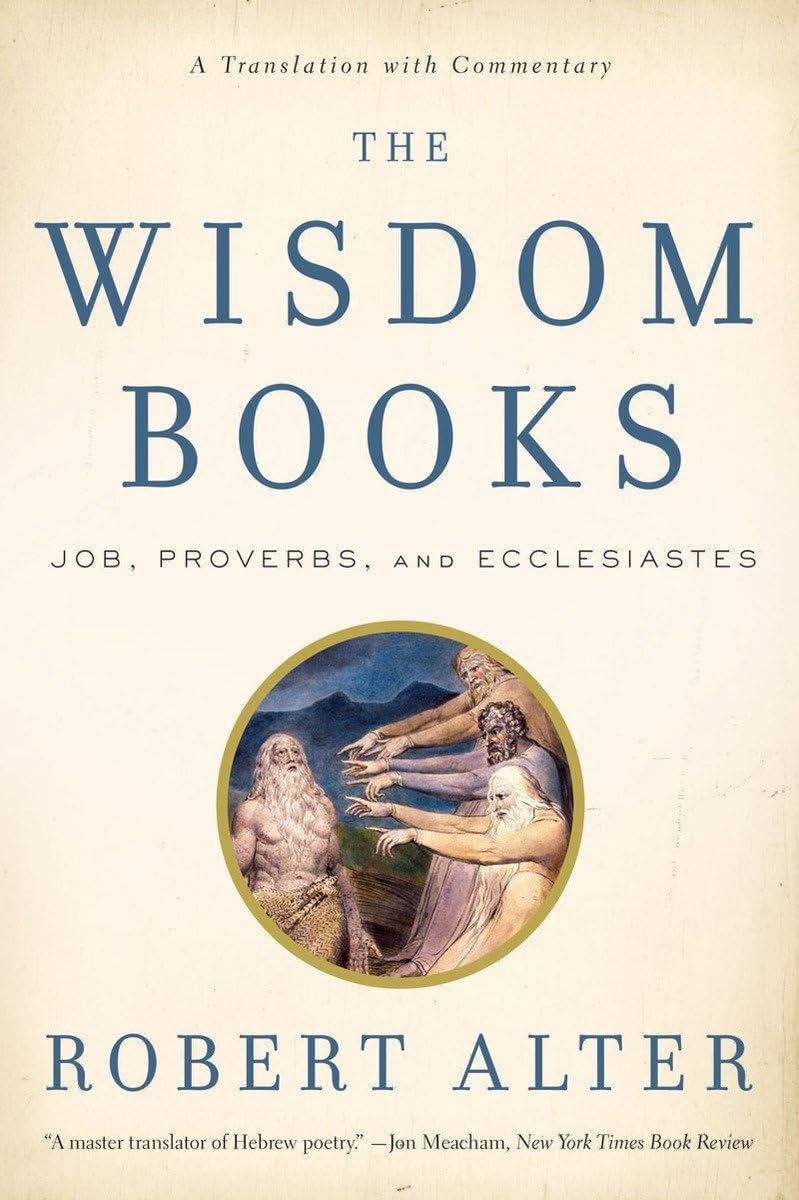
The Wisdom Books: Job, Proverbs, and Ecclesiastes: A Translation with Commentary [Alter, Robert] on desertcart.com. *FREE* shipping on qualifying offers. The Wisdom Books: Job, Proverbs, and Ecclesiastes: A Translation with Commentary Review: Excellent translation with some commentary - Award winning author Robert Alter's many skills include knowing Hebrew, understanding the Bible, and writing well. He translated and commented on many biblical books. He translates and comments upon three "Wisdom Books" in this volume: Job, Proverbs, and Ecclesiastes. Wisdom books are biblical books that emphasize that people should study, understand, and act according to what is wise; thinking and acting by the dictates of reason rather than only observance of God's commands. Each of the three books in this collection approach the subject of wisdom from a different perspective. Job focuses on bad things happening to good people. Proverbs looks at behavior, what is wise behavior and what leads to disaster. Ecclesiastes examines many actions that people engage in that are worthless. Not only Jews, but other cultures also wrote wisdom literature and there are many similarities between the Jewish and non-Jewish books, which Alter explains. The following is an example showing Alter's translation skills: E. Dhorme translates the end of God's explanation to Job in 41:26, "He gazes at every haughty creature, He is king over all wild beasts." Alter writes: "All that is lofty he can see. He is king over all proud beasts." Alter explains that God "introduces a comprehensive overview of the nature of reality that exposes the limits of Job's human perspective." Job focuses on humans and forgets that God is the creator of the entire universe. By focusing only on humans, he does not understand that harm that comes to him may actually be good when one looks at what is occurring to the entire world. A storm can kill a person, but it also cleans the earth. Review: A New Standard - Dr. Alter has set a new standard for translation of this literature. The Bible is part of our tradition in the West and there have been many translations. Many people prefer King James's version for its poetic value, and measure other translations by it. I am reading this book slowly. I read it chapter by chapter. First I read the text twice slowly. Then I read the text with the footnotes. I have compared chapters of Alter's translation with the translation of the 17th century English scholars. Alter's version is magnificent. He is an accomplished stylist in English and very sensitive to the Hebrew he is conveying to the modern reader. He explains some of his decisions in translating an ancient text. How do you take an old old world and make it available to the modern sensibility? Dr. Alter uses scholarship, writing skills, poetic awareness and a knowledge of great English language writers simultaneously to deliver a modern version of these ancient texts. I found the King James Version rather pale after Alter's intensity. When I want to bathe in the 17th century religious sensibility of England, I find Dr. Donne's Sermons (which are available as free downloads) a better experience. The Bible text is often so fraught with controversy that it's very difficult to read it without intrusions from modern ignorance. Alter produces a translation for modern times, free of religious propaganda. He reclaims a great historic tradition for humanism. I don't mean that the sacred text is not presented in a properly religious light. But it does not represent any religious view but its own in Alter's translation. In no sense is this a translation that supports any modern theological viewpoint.
| Best Sellers Rank | #48,911 in Books ( See Top 100 in Books ) #34 in Christian Wisdom Literature (Books) #65 in Old Testament Commentaries #948 in Christian Bible Study (Books) |
| Customer Reviews | 4.6 out of 5 stars 282 Reviews |
I**N
Excellent translation with some commentary
Award winning author Robert Alter's many skills include knowing Hebrew, understanding the Bible, and writing well. He translated and commented on many biblical books. He translates and comments upon three "Wisdom Books" in this volume: Job, Proverbs, and Ecclesiastes. Wisdom books are biblical books that emphasize that people should study, understand, and act according to what is wise; thinking and acting by the dictates of reason rather than only observance of God's commands. Each of the three books in this collection approach the subject of wisdom from a different perspective. Job focuses on bad things happening to good people. Proverbs looks at behavior, what is wise behavior and what leads to disaster. Ecclesiastes examines many actions that people engage in that are worthless. Not only Jews, but other cultures also wrote wisdom literature and there are many similarities between the Jewish and non-Jewish books, which Alter explains. The following is an example showing Alter's translation skills: E. Dhorme translates the end of God's explanation to Job in 41:26, "He gazes at every haughty creature, He is king over all wild beasts." Alter writes: "All that is lofty he can see. He is king over all proud beasts." Alter explains that God "introduces a comprehensive overview of the nature of reality that exposes the limits of Job's human perspective." Job focuses on humans and forgets that God is the creator of the entire universe. By focusing only on humans, he does not understand that harm that comes to him may actually be good when one looks at what is occurring to the entire world. A storm can kill a person, but it also cleans the earth.
J**R
A New Standard
Dr. Alter has set a new standard for translation of this literature. The Bible is part of our tradition in the West and there have been many translations. Many people prefer King James's version for its poetic value, and measure other translations by it. I am reading this book slowly. I read it chapter by chapter. First I read the text twice slowly. Then I read the text with the footnotes. I have compared chapters of Alter's translation with the translation of the 17th century English scholars. Alter's version is magnificent. He is an accomplished stylist in English and very sensitive to the Hebrew he is conveying to the modern reader. He explains some of his decisions in translating an ancient text. How do you take an old old world and make it available to the modern sensibility? Dr. Alter uses scholarship, writing skills, poetic awareness and a knowledge of great English language writers simultaneously to deliver a modern version of these ancient texts. I found the King James Version rather pale after Alter's intensity. When I want to bathe in the 17th century religious sensibility of England, I find Dr. Donne's Sermons (which are available as free downloads) a better experience. The Bible text is often so fraught with controversy that it's very difficult to read it without intrusions from modern ignorance. Alter produces a translation for modern times, free of religious propaganda. He reclaims a great historic tradition for humanism. I don't mean that the sacred text is not presented in a properly religious light. But it does not represent any religious view but its own in Alter's translation. In no sense is this a translation that supports any modern theological viewpoint.
R**S
A thought-provoking slice of Biblical literature
For all of the issues with applying Biblical teaching in the modern world, there is something refreshing about its Wisdom literature. And, of course, Robert Alter's translations and commentary were a pleasure to read, continually providing me with new ways of looking at particular verses/passages, and also a wealth of background information and plenty of English vocabulary to look up. It's scholarly without being tedious. This particular collection contains Job, Proverbs, and Qohelet (Ecclesiastes). Each of them had their own unique style, but also key similarities. In particular, Job and Qohelet espouse a more nuanced, realistic perspective of how the world works. Proverbs was still as dry and full of platitudes as I remembered, but there was the occasional pearl of wisdom, so to speak. My only issue with the book, the Kindle version, is that there aren't direct links to the notes, so I would have to read the chapter and then read the notes instead of going back and forth. Otherwise, this is a great book worthy of your time and money.
I**S
"Without Wisdom we are as animals"
The Wisdom Books are always a joy to read and to ponder. Wisdom belongs to Man - not to the animals. I find it impossible to think of the Bible without the Wisdom Books. I have loved them since my youth. To be able to read the original Hebrew is a boon!! To catch the rhythm, the cadence, the allusions and the alliterations- something to be greatly desired. If you cannot create beauty the next best thing is to be able to appreciate beauty made by others. In Robert Alter's translation of the Wisdom Books we have an excellent example. We thank him for his Translations- the immense amount of time, work, labour and just sweat it all involved is known to him alone. Obviously, Robert Alter is a man steeped in Hebrew and the Hebrew Language. It is wonderful to have Translations by such competent men. You have to read them to get the "taste". Sometimes the translation is somewhat different- but his grip of the Hebrew Language compels him to search for the correct and even exact translation. When I find enough money I am going to buy his translation of the Psalms and the David Story. I recommend these Translations. Read them as Literature first of all- but what I really want you to do is to read them for the sake of gaining Wisdom. The seat of Wisdom is the fear of God. I hope Amazon continues to make available such high class Books. Ignotus
A**A
Fine translations of the most radical books of the Bible
There is a poetic cadence and even clarity in his translations of Job and Qohelet/Ecclesiastes that I find deeply refreshing. Also, the notes are of most invaluable help. They’re really illuminating when it comes to teasing out the meanings from the texts, including with the occasional help of the old rabbinic commentaries. Well worth my time. I especially loved his Qohelet. Also, his respect for the King James Version shows. He adapts phrasings from the famously literal and eloquent English translation while avoiding its clunkier aspects and instead giving us a clear rendering that makes the poetry stick out and shine.
A**R
Excellent translation of Ecclesiastes, with insightful comments
I'm no expert, but I learned a lot reading this translation with commentary. The KJV is probably the finest in a literary sense, but hard to understand in places without more detail.
J**R
Nice translation, but a bit overhyped
While this is a wonderful and insigtful translation I was a bit disappointed; personlly, I think there was so much hype that I was expecting something more special and memorable. In the reviews of the book there is much made of the "bold" new translation; while I found the translation to flow well and it was lucid I did not come away with any one part that I felt overly inspired by, or felt a transformation in my understanding of the wisdom literature. Perhaps the best advice I could give is not to expect so much as is hyped in the reviews and perhaps a new reader then will experience of find something completely new. As for the positives: besides the very fluid translation the book has a wonderful general introdcution and a specific introdcution before each book that highlights the history and special literary features of each of the wisdom books and wisdom literature in general - actual worth the book itself. There is much in-depth analysis of classical Hebrew literary techniques and about the language itself. Neverrtheless, it is not neccesary for the reader to know ancient Hebrew. The most annoying part of the book were the footnotes. There are no links bewteen the main text and the footnotes. The footnotes come after each chapter, but there is no convient means to move from the text to the footnote and vice-a-versa. The footnotes are marked according to the verse number, but sometimes the footnote refers to the whole verse or sometimes just a word, so after a while of clicking many times to go between the text and footnote to put the footnote in context it looses its emphasis. Perhaps here too I was expecting something else. As there was so much mentioned about the unique style of translation and the great scholarly methods used to create this translation I probally excpecting something like the NET Bible in which as they claim something to the effect that they wanted the reader to feel they were looking over the shoulder of the translator as they worked and understood the process. Perhaps I was waiting for something like that, but between swiping my Kindle and hunting for the text and footnote I could not find the enthusiasm I expected from the translator.
H**E
Excellent work
We all need faith like Job.
ترست بايلوت
منذ شهر
منذ شهر