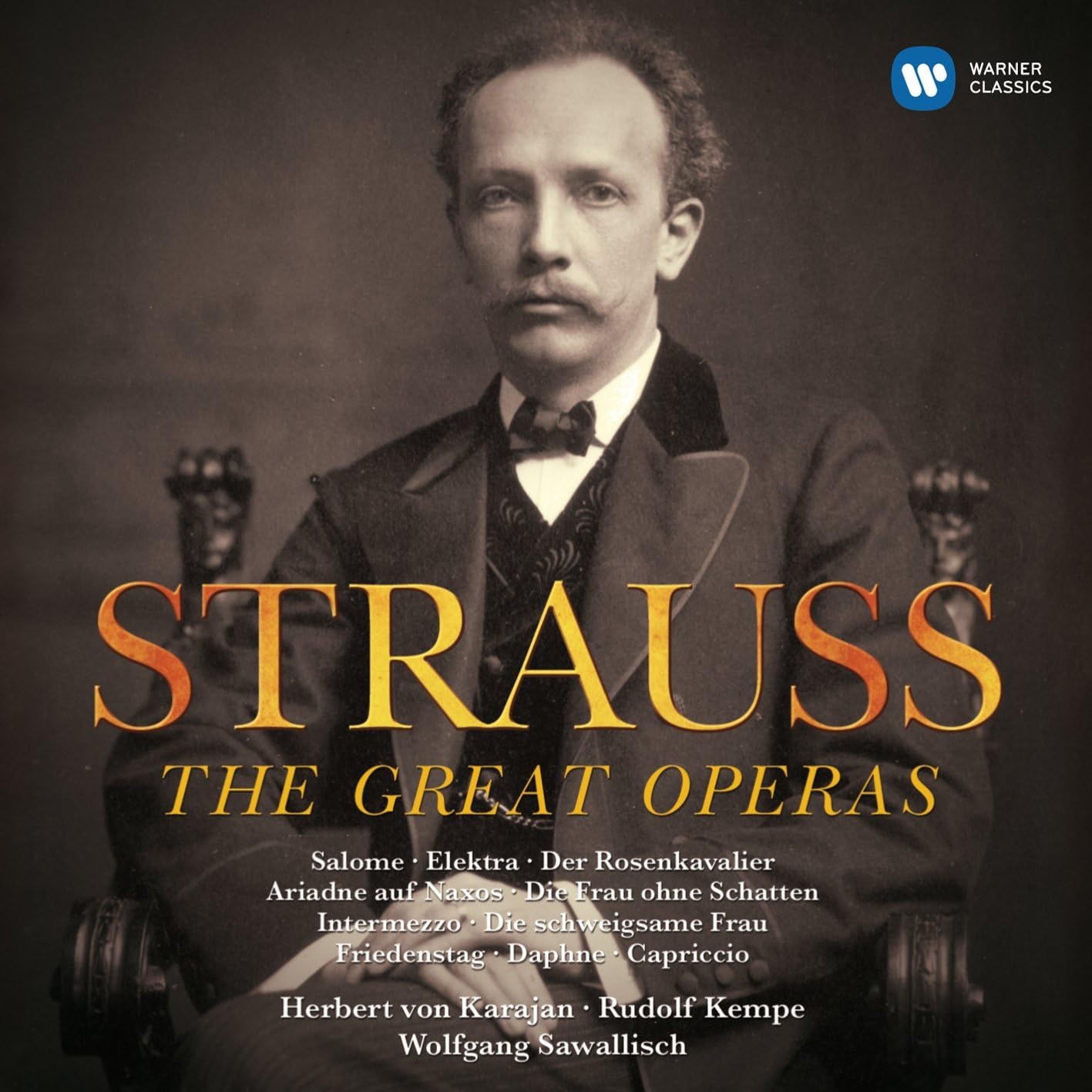

Great Operas
Product ID: 35699333
Desertcart purchases this item on your behalf and handles shipping, customs, and support to KUWAIT.
- 22CD set - includes Salome, Elektra and Der Rosenkavalier - This set of 10 Richard Strauss operas is replete with some of the finest Straussian voices of the 20th century - Nearly every opera in this set is a staple of the operatic repertory Review: Very good, but needs librettos. - The set is a good one with many excellent performances. My only quibble is that they did not provide an easy way to at least access the librettos online. That was the only reason I rated it as a 4. Review: EMI's Fine Strauss...at Bargain Price - Over the years EMI's huge presence in the classical recording field has brought many treasures for opera buffs to savor at home, and it's with gratitude that I welcome this set from Warner, who bought out controlling interest in EMI's vast classical catalog some months ago. Here we have 10 of Strauss' 15 scores including all of the important scores, save ARABELLA. EMI licensed an ARABELLA from Orfeo back in the '80's and collectors will remember it's appearance on Angel LP's here in the USA. By the time CD's appeared, Orfeo issued the set themselves. What we do have in this box is a generally fine collection of recordings. I don't think most listeners will have major problems with any of them (save, of course, a preference for Soprano A over Soprano B in other recordings) and several would be clear "first choices" in their own right. Beginning in chronological order with SALOME, I am disappointed to start on a less than enthusiastic note, but I have never really liked this Karajan recording. Much of the problem lies with the sound, which in itself is rather bizarre in that it was done in Decca's fine Sofiensaal with Decca engineers and the Solti from some 16 years earlier sounds far better. There is a bright top to this recording, but, unaccountably, for the most part the sound is rather opaque, a sort of cloudy "wash" and I think some artificial reverb was added. Balances are poor as well with The Baptist often sounding from his cistern louder than some principals onstage. At this early point in Behrens' international career, it would have been good to have a document of her singing, but she suffers worst from the sound. Often she's reduced to a whisper or just plain off-mike. Karajan's idea? The final scene has her swimming in that huge sonic soup I mentioned earlier, and while the voice does ride over the orchestra at climaxes, I get the distinct impression that Herr von K. would have been happy with the orchestra alone. I know much of the text of SALOME by heart, and I just couldn't understand much of what Behrens was singing. van Dam is his usual, lovely-voiced self with not too much emotion to "spoil" things. Mr. and Mrs. Herod too have lovely, young sounding voices which I think is exactly the opposite of what Strauss had in mind. This SALOME also gets off to a slow start due to Karajan's holding the music back. This is a balmy, moonlit night on the Mediterranean in Karajan's hands. Remember, we're not 2 minutes into the score when the Page sings "something terrible is going to happen!" Indeed, we have a suicide, beheading and an assassination coming. Little of that oppressiveness comes through in this recording. Is it a BAD recording? No, I don't think so, as there's more than enough here to get you hooked on one of Strauss' greatest masterpieces. But you can find better elsewhere. There can be few reservations over the Sawallisch ELEKTRA, however. While Marton's voice was headed for problems in the early '90's, we hear almost none of that in this set. Yes, the voice begins to spread a bit in her second scene with Chrysothemis ("Du! Du! denn du bist stark!") but by and large this is a fine accomplishment. I undestand this recording followed a run at Covent Garden which was a huge success for Marton. That carries over into this fine recording. The rest of the cast is very strong indeed with Studer perhaps the best Chrysothemis on records and strong contributions from both Lipovsek and Weikl. Also superb support from Sawallisch and the balance between voices and orchestra is nearly ideal. While this set may not be at the same white-hot intensity of the Solti, it's still a fine achievement. While it looks as if I've turned my back on Karajan's ROSENKAVALIER, I still go back to it often, and with much love and, yes, emotion. If in the end I now prefer Solti and Crespin that doesn't negate this classic set. Yes, there are cuts to deal with. Edelmann may sound TOO oafish at times, and Stich-Randall maybe not the most ethereal of Sophies. In fact, Streich was Karajan's first choice, but she was DG property and promised to Boehm. No one in his right mind would argue that this ROSENKAVALIER isn't a classic. It defines that term as few other recordings can and have. Kempe's ARIADNE is another recording many consider "tops." But there have been many other truly fine recordings of this enchanting score as well. Rysanek, Price and Norman have all brought richer voices to the role of Ariadne. But Janowitz is really lovely. Geszty is a tad shrill of a Zerbinetta and lacks the sheer elan of a Gruberova. King is but one of many fine tenors to have given us a splendid Bacchus. I'm less happy with both the Composer and the Music Master in this set, but Kempe was a fine Straussian and it shows. Were this Sawallisch FRAU OHNE SCHATTEN the only one available, I think we'd be reasonably satisfied. Sawallisch also had fine credentials as a Strauss interpreter. Often he favored slightly quicker tempos than other conductors, and he knew these scores well as or better than anyone. Above all, in this set I treasure Studer's Empress. Maybe the finest on recordings. This was not one of Rene Kollo's best efforts, often sounding dry and strained on top. The Emperor is not a long role, but it is demanding. I like Jess Thomas on the old VERY flawed Keilberth set on DG. You might be surprised that the longest role in DIE FRAU is actually that of The Nurse (if the score isn't cut!) Schwarz here is in fine voice, but where is the diabolical character in the role? That's lost on Schwarz and we definitely miss out. Moedl and Hoengen were great at this, even if as sheer singing the results could be pretty dire. Muff leaves a rather neutral impression, well sung, but rather lacking in character. Vinzing is most perplexing in this cast. For once we have a Dyer's Wife who isn't a shrill termagant, chewing up the scenery. This is decidedly an unhappy woman, still young but disillusioned. Not all will like her take on this role. Was the voice not merely up to some of the writing? I'm not certain, but her Act 3 is very touching. The whole of this DIE FRAU I think plays better than the sum of its parts. EMI deserve our highest thanks for this INTERMEZZO and SCHWEIGSAME FRAU. No, I don't think either is great Strauss, but both recordings are complete and performed very well indeed. The much-loved, late, lamented Slovak soprano Lucia Popp makes of Frau Storch a truly virtuoso role. She can be a tad hectoring, even manic at times. Listen if you can to Hanny Steffek in the live Keilberth set. A very different approach, but you should be warned that she's about the only thing in that set worth hearing! While Boehm has a very fine cast for his SCHWEIGSAME FRAU, the score is cut in his DG set and is in mono. I don't think there's much to complain about with this EMI effort under Janowski. If you're going to get to know what this score is all about, I feel sure it will be though this EMI set. I won't spend much time on FRIEDENSTAG. Many consider it Strauss' weakest score. It's certainly his shortest. While I would prefer the Sinopoli set on DG, this recording, done live, by Sawallisch isn't a bad one. I may actually prefer Weikl in this recording. But Sinopoli has Voigt who I would prefer over the late Sabine Hass in this EMI recording. Not a lot to choose from either way, really. Haitink's DAPHNE in this box has given me as much pleasure as the old Boehm DG set. It would be impossible for me to choose between the two, and I take both off the shelf regularly. I do like Popp better than Gueden, and while Boehm has Wunderlich, King and Schoeffler, Haitink has Schreier, Goldberg and Moll, not exactly a shoddy lineup. Haitink plays the score intact, Boehm does not and Haitink also has very fine studio sound. It's a toss-up with DAPHNE. CAPRICCIO was a relatively new opera way back when this EMI recording was made in 1957. Critically, at the time at least, CAPRICCIO was not well thought-of. I have uncovered some really scathing critiques. What EMI had on its roster of singers at the time was nothing short of miraculous, so Walter Legge thought he'd put Sawallisch and many of these truly great voices together and give CAPRICCIO it's best chance (and espcially since Mrs. Legge was Elisabeth Schwarzkopf). This recording has never been surpassed. And although it's in mono (Legge was not a great believer in stereo!) Strauss' writing here isn't what you find in SALOME or DIE FRAU and to me it's just fine. Just as an aside, I get a lot of pleasure from the San Francisco video (Te Kanawa, Troyanos, etc.) This box right now is going for $50 on desertcart and that's little more that $2 per CD which is a steal. There is SO much of value here and really little that's objectionable. Why 4 stars? Well, I'd place the Solti set (only 6 operas) in the 5-star category alone. Those readings are pretty sensational, and I suppose one must make a distinction betweer the "superlative" and the very good. I've done my best in sharing a lifetime passion for Strauss (and Wagner) on desertcart and I hope others can put it to good use. If you're only beginning your journey with Strauss, I'd stick with the Solti as a first choice. Others might want this EMI set and purchase Solti's ARABELLA separately. At present, the new DG box is $170, and has many recordings which I would not recommend as first choice. Now, BACK TO LISTENING!
| ASIN | B00FM60U8E |
| Best Sellers Rank | #239,445 in CDs & Vinyl ( See Top 100 in CDs & Vinyl ) #595 in Oratorios (CDs & Vinyl) |
| Customer Reviews | 4.7 4.7 out of 5 stars (27) |
| Date First Available | October 18, 2013 |
| Is Discontinued By Manufacturer | No |
| Label | Warner Classics |
| Manufacturer | Warner Classics |
| Number of discs | 22 |
| Product Dimensions | 5.24 x 5.12 x 2.56 inches; 1.3 Pounds |
P**N
Very good, but needs librettos.
The set is a good one with many excellent performances. My only quibble is that they did not provide an easy way to at least access the librettos online. That was the only reason I rated it as a 4.
R**K
EMI's Fine Strauss...at Bargain Price
Over the years EMI's huge presence in the classical recording field has brought many treasures for opera buffs to savor at home, and it's with gratitude that I welcome this set from Warner, who bought out controlling interest in EMI's vast classical catalog some months ago. Here we have 10 of Strauss' 15 scores including all of the important scores, save ARABELLA. EMI licensed an ARABELLA from Orfeo back in the '80's and collectors will remember it's appearance on Angel LP's here in the USA. By the time CD's appeared, Orfeo issued the set themselves. What we do have in this box is a generally fine collection of recordings. I don't think most listeners will have major problems with any of them (save, of course, a preference for Soprano A over Soprano B in other recordings) and several would be clear "first choices" in their own right. Beginning in chronological order with SALOME, I am disappointed to start on a less than enthusiastic note, but I have never really liked this Karajan recording. Much of the problem lies with the sound, which in itself is rather bizarre in that it was done in Decca's fine Sofiensaal with Decca engineers and the Solti from some 16 years earlier sounds far better. There is a bright top to this recording, but, unaccountably, for the most part the sound is rather opaque, a sort of cloudy "wash" and I think some artificial reverb was added. Balances are poor as well with The Baptist often sounding from his cistern louder than some principals onstage. At this early point in Behrens' international career, it would have been good to have a document of her singing, but she suffers worst from the sound. Often she's reduced to a whisper or just plain off-mike. Karajan's idea? The final scene has her swimming in that huge sonic soup I mentioned earlier, and while the voice does ride over the orchestra at climaxes, I get the distinct impression that Herr von K. would have been happy with the orchestra alone. I know much of the text of SALOME by heart, and I just couldn't understand much of what Behrens was singing. van Dam is his usual, lovely-voiced self with not too much emotion to "spoil" things. Mr. and Mrs. Herod too have lovely, young sounding voices which I think is exactly the opposite of what Strauss had in mind. This SALOME also gets off to a slow start due to Karajan's holding the music back. This is a balmy, moonlit night on the Mediterranean in Karajan's hands. Remember, we're not 2 minutes into the score when the Page sings "something terrible is going to happen!" Indeed, we have a suicide, beheading and an assassination coming. Little of that oppressiveness comes through in this recording. Is it a BAD recording? No, I don't think so, as there's more than enough here to get you hooked on one of Strauss' greatest masterpieces. But you can find better elsewhere. There can be few reservations over the Sawallisch ELEKTRA, however. While Marton's voice was headed for problems in the early '90's, we hear almost none of that in this set. Yes, the voice begins to spread a bit in her second scene with Chrysothemis ("Du! Du! denn du bist stark!") but by and large this is a fine accomplishment. I undestand this recording followed a run at Covent Garden which was a huge success for Marton. That carries over into this fine recording. The rest of the cast is very strong indeed with Studer perhaps the best Chrysothemis on records and strong contributions from both Lipovsek and Weikl. Also superb support from Sawallisch and the balance between voices and orchestra is nearly ideal. While this set may not be at the same white-hot intensity of the Solti, it's still a fine achievement. While it looks as if I've turned my back on Karajan's ROSENKAVALIER, I still go back to it often, and with much love and, yes, emotion. If in the end I now prefer Solti and Crespin that doesn't negate this classic set. Yes, there are cuts to deal with. Edelmann may sound TOO oafish at times, and Stich-Randall maybe not the most ethereal of Sophies. In fact, Streich was Karajan's first choice, but she was DG property and promised to Boehm. No one in his right mind would argue that this ROSENKAVALIER isn't a classic. It defines that term as few other recordings can and have. Kempe's ARIADNE is another recording many consider "tops." But there have been many other truly fine recordings of this enchanting score as well. Rysanek, Price and Norman have all brought richer voices to the role of Ariadne. But Janowitz is really lovely. Geszty is a tad shrill of a Zerbinetta and lacks the sheer elan of a Gruberova. King is but one of many fine tenors to have given us a splendid Bacchus. I'm less happy with both the Composer and the Music Master in this set, but Kempe was a fine Straussian and it shows. Were this Sawallisch FRAU OHNE SCHATTEN the only one available, I think we'd be reasonably satisfied. Sawallisch also had fine credentials as a Strauss interpreter. Often he favored slightly quicker tempos than other conductors, and he knew these scores well as or better than anyone. Above all, in this set I treasure Studer's Empress. Maybe the finest on recordings. This was not one of Rene Kollo's best efforts, often sounding dry and strained on top. The Emperor is not a long role, but it is demanding. I like Jess Thomas on the old VERY flawed Keilberth set on DG. You might be surprised that the longest role in DIE FRAU is actually that of The Nurse (if the score isn't cut!) Schwarz here is in fine voice, but where is the diabolical character in the role? That's lost on Schwarz and we definitely miss out. Moedl and Hoengen were great at this, even if as sheer singing the results could be pretty dire. Muff leaves a rather neutral impression, well sung, but rather lacking in character. Vinzing is most perplexing in this cast. For once we have a Dyer's Wife who isn't a shrill termagant, chewing up the scenery. This is decidedly an unhappy woman, still young but disillusioned. Not all will like her take on this role. Was the voice not merely up to some of the writing? I'm not certain, but her Act 3 is very touching. The whole of this DIE FRAU I think plays better than the sum of its parts. EMI deserve our highest thanks for this INTERMEZZO and SCHWEIGSAME FRAU. No, I don't think either is great Strauss, but both recordings are complete and performed very well indeed. The much-loved, late, lamented Slovak soprano Lucia Popp makes of Frau Storch a truly virtuoso role. She can be a tad hectoring, even manic at times. Listen if you can to Hanny Steffek in the live Keilberth set. A very different approach, but you should be warned that she's about the only thing in that set worth hearing! While Boehm has a very fine cast for his SCHWEIGSAME FRAU, the score is cut in his DG set and is in mono. I don't think there's much to complain about with this EMI effort under Janowski. If you're going to get to know what this score is all about, I feel sure it will be though this EMI set. I won't spend much time on FRIEDENSTAG. Many consider it Strauss' weakest score. It's certainly his shortest. While I would prefer the Sinopoli set on DG, this recording, done live, by Sawallisch isn't a bad one. I may actually prefer Weikl in this recording. But Sinopoli has Voigt who I would prefer over the late Sabine Hass in this EMI recording. Not a lot to choose from either way, really. Haitink's DAPHNE in this box has given me as much pleasure as the old Boehm DG set. It would be impossible for me to choose between the two, and I take both off the shelf regularly. I do like Popp better than Gueden, and while Boehm has Wunderlich, King and Schoeffler, Haitink has Schreier, Goldberg and Moll, not exactly a shoddy lineup. Haitink plays the score intact, Boehm does not and Haitink also has very fine studio sound. It's a toss-up with DAPHNE. CAPRICCIO was a relatively new opera way back when this EMI recording was made in 1957. Critically, at the time at least, CAPRICCIO was not well thought-of. I have uncovered some really scathing critiques. What EMI had on its roster of singers at the time was nothing short of miraculous, so Walter Legge thought he'd put Sawallisch and many of these truly great voices together and give CAPRICCIO it's best chance (and espcially since Mrs. Legge was Elisabeth Schwarzkopf). This recording has never been surpassed. And although it's in mono (Legge was not a great believer in stereo!) Strauss' writing here isn't what you find in SALOME or DIE FRAU and to me it's just fine. Just as an aside, I get a lot of pleasure from the San Francisco video (Te Kanawa, Troyanos, etc.) This box right now is going for $50 on AMAZON and that's little more that $2 per CD which is a steal. There is SO much of value here and really little that's objectionable. Why 4 stars? Well, I'd place the Solti set (only 6 operas) in the 5-star category alone. Those readings are pretty sensational, and I suppose one must make a distinction betweer the "superlative" and the very good. I've done my best in sharing a lifetime passion for Strauss (and Wagner) on AMAZON and I hope others can put it to good use. If you're only beginning your journey with Strauss, I'd stick with the Solti as a first choice. Others might want this EMI set and purchase Solti's ARABELLA separately. At present, the new DG box is $170, and has many recordings which I would not recommend as first choice. Now, BACK TO LISTENING!
H**P
今から、この作曲家のオペラ作品を、楽しんで聞きたいと思います。
M**O
One the best options in Strauss operas. Best price.
F**.
Con motivo del 150 aniversario del nacimiento de Richard Strauss Warner Classics sacó al mercado tres cajas con grabaciones del compositor alemán. La caja de la que hablaré es la dedicada a las óperas. En total esta caja contiene 10 de las 15 óperas que compusiera Strauss: Salomé, Elektra, El Caballero de la Rosa, La Mujer sin sombra, Ariadna en Naxos, Intermezzo, La mujer silenciosa, Día de Paz, Daphne y Capriccio. En realidad en esta caja sólo falta 1 de las grandes óperas de Strauss: Arabella. ¿Por qué recomiendo esta caja? En resumen porque además de contener auténticos clásicos de la discografía como el Rosenkavalier de Karajan - Schwarzkopf o Salomé por Karajan nos ofrece interpretaciones memorables de otras óperas injustamente poco conocidas como Intermezzo (con Popp o Fischer-Dieskau como protagonistas, casi nada), Daphne (Popp - Schreier - Moll - Haitink), Capriccio (Sawallisch Schwarzkopf Hotter Fischer-Dieskau) o La mujer silenciosa (puede que Böhm sea la referencia en esta obra pero la grabación disponible tiene cortes en la partitura, Janowski en esta caja presenta la partitura sin cortes). En gran parte esta caja se nutre de grabaciones del director de orquesta Wolfgang Sawallisch. Es verdad que hay en ciertas óperas grabaciones que superan a los registros de Sawallisch (me vienen a la mente la Elektra de Solti o Richard Kraus, o La mujer sin sombra de Solti) pero de lo que no hay duda es que Sawallisch fue todo un especialista, un artesano en la música del Strauss bueno. Honestamente creo nadie ha interpretado/grabado más Richard Strauss que Sawallisch, es todo un especialista en este repertorio. Y si ya la caja se recomienda sola en estos momentos se encuentra disponible a precio de ganga. No se la pierdan. Como última recomendación les recomiendo complementarla con la caja de óperas de Richard Strauss dirigidas por Sir Georg Solti. Con esa caja conseguirán una magnífica colección straussiana.
U**R
Richard Strauss was born on the 11th June 1864 and so next year is his 150th birthday,but Warner have released the set now before Christmas, a very shrewd business move.(Details of operas below).However, the Strauss opera's were recorded between 1956 and 1990 and are all ex EMI,that is why Arabella is missing,they never recorded it. I checked my vast classical book library. Decca recorded Arabella twice,DGG once and Orfeo once, just in case you wondered. But what is this box set like? I can honestly swear it is well worth obtaining. Well you would write that,you might think. The 10 opera set has all the operas you would expect, but also operas like Die Schweigsame Frau(silent woman), Friedenstag and Intermezzo with marvellous performances.I had hoped they would come on Bluray. The only other ones missing is the agyptische Helena, once recorded by Decca, conducted by Dorati. Die Liebe der Danae is now on bluray.I own it. The cardboard box is tough. The lid when opened lies flat, so you can place CDs you wish to play. The front has a picture of the composer when young, with Strauss the great operas,and the operas name in orange. The spine and back are a light lemony green. The spine has Strauss the great Operas written in Orange. The back of the box has the CD numbers and the names of the Operas in the box. Exactly,the same for the Sleeves. The back has the CD number, plus the operas name, track numbers and arias to be sung, nothing else. The Discs are black with CD number and opera. If it is a one Act opera and requires two discs,on the front of the sleeve is beginning and conclusion. If three acts,each Act is on one disc. The booklet has no synopsis, nor translations, nor a CD with that information on it, like Decca's complete Wagner's operas set which does have this CD. All it has is the operas name and roles taken by the singers, and conductors. There is an essay "Love letters to Opera". This keeps the price down to 2 pounds a disc. I suppose we should be happy. I have some of these operas so I have the libretto's. The sound is naturally good. As far as I can gather from the booklet, the Stereo recordings were digitally remastered in 2001. (CD 1&2)STEREO.(EMI) SALOME:Hildegard Behrens, Agnes Baltsa,Jose Van Dam, Heinz Zednik,Gerald Unger, Erich Kunz,Kurt Rydl. Vienna Philharmonic Cond Herbert von Karajan. Recorded 1978.Recorded after the stage production .He chose as Salome, Hildegard Behrens, then relatively unknown. Her tone is ravishingly conveyed and she is girlish as Salome. The cast is of the finest Salzburg standard. Van Dam stands out as Jochanaan. Von Karajan sound makes one revel in the beautiful music eminating from the Orchestra. For within Salome there are lush melodies His tempo's vary from slowish to fast when required. It is a different approach to Solti's interpretation of this opera. I own that set. His tempo's are fast,bringing out the horror, and the emotion slaps you in the face with Nilsson as splendid as ever. She is eternally wicked. So I thought another interpretation would be fine.The Met Opera Guide to recorded music states "This is one of the best Salomes. Behrens comes about as close to anyone as Strauss's 16 year old with the voice of Isolde." CD (2&4)DIGITAL.(EMI) ELEKTRA.Eva Marton,Cheryl Studer,Marjana Lipovsek,Bernd Weikl,Kurt Moll. Bavarian Radio symphony orchestra. Cond Wolfgang Sawallisch.Recorded 1990. When I was working in Munich years ago,I used to go to the Munich state Opera to see Sawallisch conduct Strauss. The Gramophone 2009 states"Sawallisch is the most experienced conductor of Strauss's operas today." So when the back of the box set says that featured are the finest Straussian conductors of the last half century, they are not far wrong. Sawallisch conducts five of the operas in this set,Von Karajan two. The Penguin guide 1993 "feels that Eva Marton in the role of Elektra finds more light and shade than Birgit Nilsson did for Solti". Orestes Bernd Weikl is fine in his role. Lipovsek as Klytamnestra is the finest on record 1990. Cheryl Studer Chrysothemis has wonderful moments. Penguin Guide feels that this is the finest of all digital sets.The Solti version knocks your socks off, however,one wants to hear other versions to understand the whole picture as it were. The Met Opera guide to recorded music feels that this recording "can be recommended without serious reservations: the EMI/Swallisch set is a distinguished production in every respect". (CD 5-7)STEREO.(EMI)DER ROSENKAVALIER.Elisabeth Schwarzkopf, Otto Edelmann,Christa Ludwig,Eberhard Wachter,Teresa Stich-Randall,Ljuba Welitsch,Paul Kuen,Nicolai Gedda. Philharmonia Orch cond Von Karajan.Recorded 1956. The Penguin Guide 1993 considers this version "one of the greatest of all opera recordings".They give it a Rosette,which means it is excellent. They go on to write,"that it has an emotional intensity that Von Karajan has rarely equalled,even in Strauss,of whose music he is a supreme interpreter".There is the Feldmarschallin from Schwarzkopf,bringing out detail as no one else can,a woman still young and attractive. Christa Ludwig, Mezzo soprano, makes an ideal, ardent Octavian and Teresa Stich-Randall is a radiant Sophie, just hear the presentation of the Rose.Otto Edelmann is a winningly characterful Ochs who yet sings every note clearly. Stage cuts sanctioned by the composer are observed. I already own this recording. EMI mono Vienna Philharmonic Orchestra Cond Robert Heger,made in 1933. Lotte Lehmann as the Feldmarschallin and Elisabeth Schumann as Sophie. Approximately 100 minutes of music. As a bonus,we are offered a Lieder recital with Lehmann and Schumann. Bluray Der Rosenkavalier Cond Luisi. Schwanewilms the greatest exponent of the role today ,Kurt Rydl as Ochs. Staatsoper Dresden. I have not forgotten Renee Fleming. (CD 8-9) STEREO.(EMI).ARIADNE AUF NAXOS.Staatskapelle Dresden.Cond Rudolf Kempe.Gundula Janowitz, Sylvia Geszty, Teresa Zylis-Gara,James King,Peter Schreier, Hermann Prey. Recorded 1968.Janowitz sings with that distinctive heavenly voice of hers.Zylis-Gara is an ardent composer, James King sings the role better then most.Es gibt ein Reich is stunningly sung by Janowitz, sounding as a Strauss singer should. There is in this set featured some of the finest Straussian singers of the last half century and Janowitz is one of them along with Schwarzkopf and Popp. Their voices throb with emotion. The Met Opera guide's critic writes" Kempe's 1968 EMI probably represents the most rewarding combination of good qualities. The orchestra really sounds like a chamber ensemble.The voices stand out" (CD 10-12)DIGITAL.(EMI) DIE FRAU OHNE SCHATTEN.Rene Kollo, Cheryl Studer, Hanna Schwarz, Paul Frey, Marjana Lipovsek, Alfred Muff, Ute Vinzing. Bavarian Radio symphony orchestra Cond Sawallisch. Recorded 1987. Strauss lived in Garmisch, Bavaria.He was born in Munich. So this orchestra has the music in its bones. Sawallisch is a most persuasive Straussian and the Bavarian Radio orchestra plays beautifully for him. Cheryl Studer sings radiantly as the Empress,and Rene Kollo is a powerful Emperor. Hanna Schwarz is marvellous as the nurse. However, Ute Vining as the wife and Alfred Muff as Barak though good, do not capture the emotional Straussian line,so Mir anvertraut Act 3, is not as heartbreaking as it should be. If one has heard the Bluray of the Vienna Phil cond Thielemann, you will know what I mean. Koch,Barak and Herlitzius his wife, are truely heartbreaking in this part. It has very modern staging. The Russian version bluray conducted by Gergiev,which is mostly traditional, understands the emotional impact Strauss's arias have.(Read my review).The Met Opera Guide states about this recording "preference must go to EMI,for its completeness, for Sawallisch's prodigiously insightful conducting, and for the all round competence of its cast." (CD 13-14)STEREO.(EMI)INTERMEZZO.2 Acts. Lucia Popp,Fischer-Dieskau,Adolf Dallapozza. Kurt Moll.Bavarian Radio symphony Orchestra cond Sawallisch.Recording 1980. This opera was originally written for Lotte Lehmann, but even she could not outshine Lucia Popp who has a distinctive voice that is ideal for Strauss's works. She brings to the fore the quirks of Christine and her captivating ways. An emotional powerful performance from Sawallisch. The cast are ideal. Within the opera there are many interludes,the best being after Christine sings Ein hubscher mensch..interlude. The opera is based on an incident in Richard's and Paulines marriage in 1902, when she had opened a letter mistakenly addressed to Richard. Mitzi Mucke wanted some tickets. Pauline suspected the worse and started divorce proceedings. It was cleared up by a friend who explained that the letter was meant for the conductor Stransky. Richard turned it into a opera, changed names, but based it on real exchanges between Pauline and himself. He wrote the Libretto. Strauss and Pauline both coached Lehmann-Christine, and the singer who played Strauss-Storch. At the first performance,Dresden 1924, the sets were replicas of the Strauss's home. Because it was felt to be in bad taste it dropped out of the repertoire. But the opera is back and is gradually becoming popular. Mahler and Hofmannsthal,Struass's Librettist, could not stand Pauline. She was house proud, never stopped talking, treated her servants badly, checked to see if Richard was working on his music. Thought Strauss was a peasant, for she was a General's daughter. She had tantrums. But Strauss was endlessly fascinated by her. Lotte Lehmann thought they both put on an act for their friends. He was laid back; could handle tempermental Prima Donnas,and was very witty. He does portray Pauline in other operas. He spoke though his music,as does Britten. (CD 15 &17) STEREO (EMI) DIE SCHWEIGSAME FRAU.3 Acts.Theo Adam,Annelies Burmeister, Wolfgang Schone, Jeanette Scovotti. Staatskapelle Dresden, Cond Marek Janowski. Recording 1977. The plot is to trick the rich old sea dog,Sir Morosus,who abominates noise, into a mock marriage with a silent woman who will turn into a virago and thus teach him how much happier he is by staying single. The opera is certainly merry and bright. (CD 18) DIGITAL.FRIENDENSTAG. One Act. Bernd Weikl,Sabine Hass.Bavarian State opera, cond Sawallisch.Premiere July 1938-National theate,Munich.It is the final answer by Richard Strauss the artist to critics of his attitude to the politics of his time. This is an anti-war opera. It is his most austere.It drew from Strauss some of his strongest diatonic music. Synopsis. It is the last day of the Thirty years war, 24th October 1648. A besieged city is near to surrender.The inhabitants are starving. Even the mayor begs the commandant to surrender to save their lives. He refuses as his orders are to fight to the last. Bells are rung that means peace is declared. The question often asked about Strauss is, why did'nt he leave Nazi Germany?. I think like Furtwangler, he thought art was life itself, and above everyday events. This is a mistake some individuals make. Art and life are interwoven and each reflects the other. Therefore, we are part of the times within which we live. (CD 19 & 20)DIGITAL (EMI) DAPHNE One Act.Lucia Popp. Reiner Goldberg. Ortrun Wenkel. Kurt Moll. Peter Schreier.Bavarian Radio Symphony Orchestra Cond Bernard Haitink. Lucia Popp is an enchanting Daphne. Peter Schreier bringing lieder-like feeling for detail to the role of Leuikippos,and Reiner Goldberg producing heroic singing as Apollo. Kurt Moll is a fine Peneios. One of my favourite Strauss recordings and operas. The DGG version conducted by Bohm, to whom Strauss dedicated this opera, is good,even though it is live. Hilde Gueden does have the same emotional line as does Popp. I own this DGG version. I have been waiting for the Haitink recording for a long time. It is Strauss's finest part for soprano since Der Rosenkavalier."None can compare with the Loveliness of Daphne" states Michael Kennedy in his book on Richard Strauss. It is about a Greek myth where a Nymph turns into a woman into a tree. This opera is written in his Indian summer, when he wrote the Oboe Concerto, the second Horn Concerto and the Four last songs.Daphne DVD June Anderson,Birgit Remmert,Roberto Sacca,Orchestra teatro La Fenice Di Venezia. Cond Reck. Traditional staging. (CD 21 &22)STEREO.(EMI) CAPRICCIO.Elizabeth Schwarzkopf,Eberhard Wachter,Nicolai Gedda,Fischer-Dieskau, Hans Hotter, Christa Ludwig. Anna Moffo. Philharmonia orchestra cond Sawallisch. Recorded 1958. As the Countess, Schwarzkopf has no equals."The sheer beauty of her voice,poised and pure, shaded with immaculate control. Listen to the Closing scene. Also,supporting her is a cast as starry as could be imagined. They form a wonderfully co-ordinated team, beautifully held together by Swallisch's sensitive conducting". I have the DGG version of this opera conducted beautifully by Bohm. Janowitz has a stunning voice, but Schwarzkopf is in another class. The opera is about words and music, which is superior. No solution is found. I should imagine that music would be the superior art form. There is a bluray just released 2015 March, Richard Strauss Gala, Staatskapelle Dresden conducted by Christian Thielemann, with Sopranos Christine Goerke, Anja Harteros and Camilla Nylund. All first class Strauss singers. The bluray contains excerpts from nine of the 15 operas which were premiered in Dresden. There is also a 45 minute documentary, Christian Thielemann My Richard Strauss. It contains a chat with the conductor about the man, also him conducting excerpts from tone poems and operas. Plus black and white film of the composer conducting, an interview with his grandson and his American biographer. You do get a glimpse into his life, certainly about his inter demons which left him when he composed. References:Gramophone 2009. Gruber,P.(Ed).The Met Guide to Recorded opera.1993.Thames and Hudson. Holden,A. The Penguin Opera guide,1995,Viking. Kennedy,M. Richard Strauss.1976.JM Dent and Sons. The Penguin Guide to Opera 1993.
C**N
MUY INTERESANTE ESTE RECOPILACIÓN DE LAS OPERAS MAS IMPORTANTES DE STRAUSS, ME CUBRE UN CAMPO QUE NO TENIA EN MI DISCOTECA PARTICULAR, CON UNOS INTERPRETES DE PRIMERA LINEA, Y UNA GRABACIÓN EXCELENTE
Trustpilot
1 week ago
3 days ago