📸 Elevate your vision, share your world instantly.
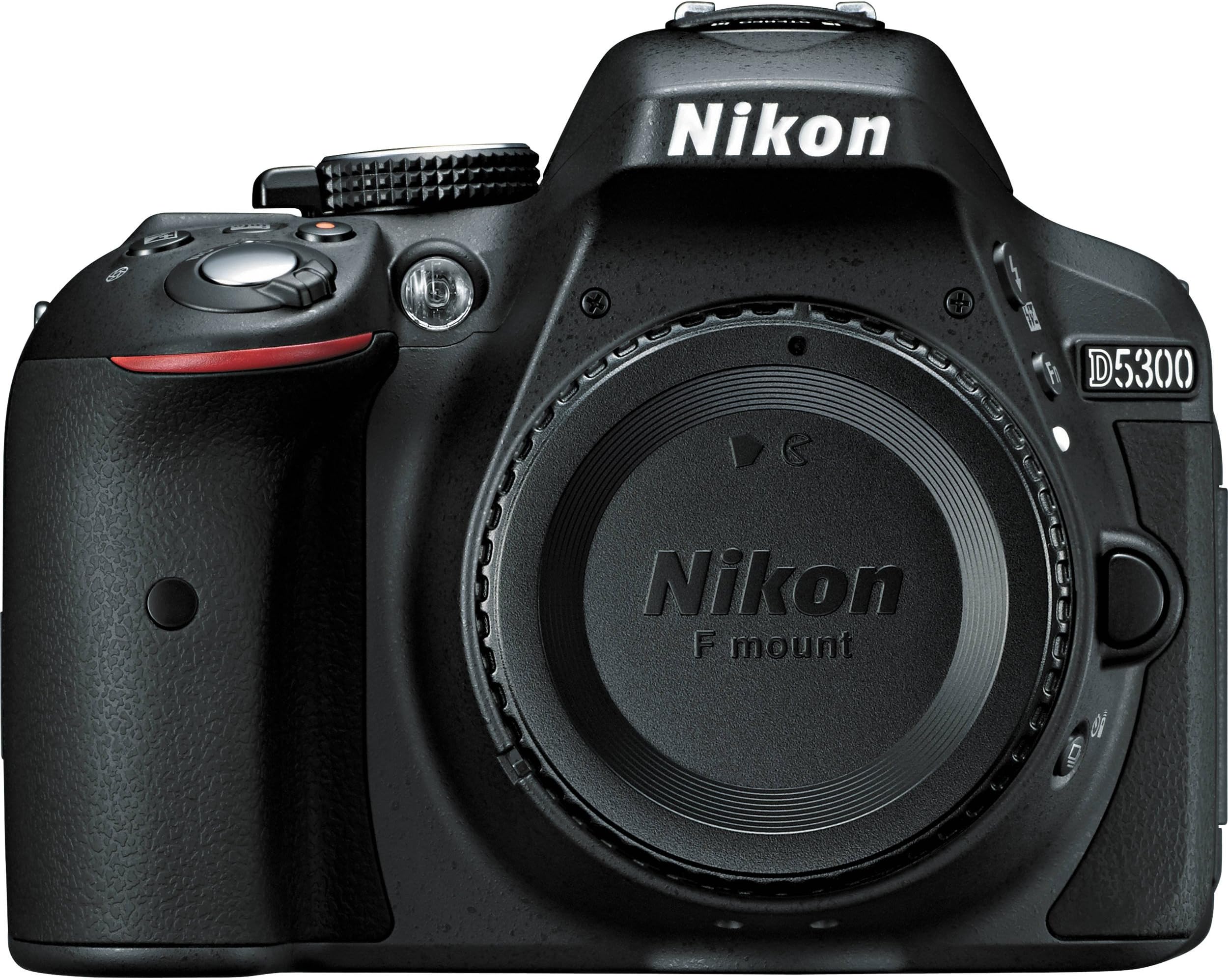
The Nikon D5300 is a professional-grade DSLR featuring a 24.2MP DX-format CMOS sensor, built-in Wi-Fi for effortless photo sharing and remote control, and integrated GPS for precise geotagging. Its 3.2-inch vari-angle LCD and 1080p Full HD video capabilities make it a versatile tool for millennial professionals seeking to blend high-quality imaging with modern connectivity and adventure-ready features.
| ASIN | B00FXYT12G |
| Age Range Description | All Ages |
| Aperture modes | F3.5 |
| Are Batteries Included? | Yes |
| Aspect Ratio | 3:2 |
| Auto Focus Technology | Phase Detection |
| Autofocus | Yes |
| Autofocus Points | 11 |
| Best Sellers Rank | 162,595 in Electronics & Photo ( See Top 100 in Electronics & Photo ) 299 in Digital SLR Cameras |
| Bit Depth | 8 Bit |
| Box Contents | Camera Body Only |
| Brand Name | Nikon |
| Camera Flash Type | Built-In |
| Camera Lens | 18-55mm zoom lens, no image stabilization, good low light performance with various flash modes. |
| Colour | Black |
| Compatible Devices | Computer, smartphone, tablet, external storage |
| Compatible Mountings | Nikon F |
| Continuous Shooting Speed | 5 |
| Crop Mode | 3:2 |
| Customer Reviews | 4.4 4.4 out of 5 stars (325) |
| Digital Scene Transition | False |
| Digital Zoom | 1 x |
| Digital-Still | Yes |
| Display Fixture Type | Articulating |
| Display Type | LCD |
| Dots Per Screen | 53174 dots per square inch |
| Effective Still Resolution | 24.2 MP |
| Expanded ISO Minimum | 50 |
| Exposure Control | Aperture Priority |
| File Format | JPEG, MP4 |
| Flash Memory Bus Interface Type | Wi-Fi |
| Flash Memory Speed Class | UHS Speed Class 1 (U1) or higher |
| Flash Memory Type | SDHC, SDXC |
| Flash Memory UHS Speed Class | U1 |
| Flash Memory Video Speed Class | UHS Speed Class 1 (U1) or higher |
| Flash Modes Description | Automatic, on, off |
| Flash Sync Speed | 1/200 |
| Focus Features | Active |
| Focus Mode | Single-Servo AF (AF-S) |
| Focus Type | Auto Focus |
| Form Factor | DSLR |
| Global Trade Identification Number | 00018208015191 |
| Hardware Interface | AV Port |
| Has Color Screen | Yes |
| Image Capture Type | Stills & Video |
| Image Stabilization Type | Optical |
| Item Weight | 481 g |
| JPEG Quality Level | Normal |
| Lens Construction | Optimized for DX |
| Lens Correction Type | Chromatic Aberration |
| Lens Type | 18-55mm |
| Manufacturer | NIKO9 |
| Maximum Aperture | 3.5 Millimetres |
| Maximum Display Resolution | 24.2 MP |
| Maximum Focal Length | 55 |
| Maximum Image Size | 24.2 MP |
| Maximum Shutter Speed | 1/4000 Seconds |
| Metering Methods | Evaluative |
| Minimum Focal Length | 18 Millimeters |
| Minimum Shutter Speed | 30 seconds |
| Model Name | D5300 |
| Model Number | 1519 |
| Model Series | D5300 |
| Movie Mode | Yes |
| Network Connectivity Technology | USB, Wi-Fi |
| Night vision | No |
| Number of Diaphragm Blades | 7 |
| Optical Zoom | 1 x |
| Photo Sensor Size | 23.6 x 15.6 mm |
| Product Features | Built-in GPS |
| Real Angle Of View | 44 Degrees |
| Rear Webcam Resolution | 24 MP |
| Remote Included | No |
| Screen Size | 3.2 Inches |
| Self Timer | 10 Seconds, 2 Seconds, 20 Seconds, 5 Seconds |
| Sensor Type | CMOS |
| Series Number | 5300 |
| Shooting Modes | Automatic |
| Skill Level | Professional |
| Specific Uses For Product | [INFERS: remote camera control, instant photo sharing, geotagging, tracking adventures, travel, everyday photography, various lighting conditions] |
| Supported Image Format | JPEG |
| Total Still Resolution | 24 MP |
| Total USB 2.0 Ports | 1 |
| Total USB Ports | 1 |
| Total Video Out Ports | 1 |
| UPC | 018208015191 |
| Video Capture Format | MP4 |
| Video Capture Resolution | 1080p |
| Video Output | HDMI |
| Viewfinder Type | LCD screen |
| White Balance Settings | Auto |
| Wireless Technology Type | Wi-Fi |
| Write Speed | 5 fps |
| Zoom | Optical Zoom |
C**B
Great camera
So far so good Haven’t had much use yet, but the quality of the pictures so far is exceptional. Easy to use camera with loads of extra features
T**E
I upgraded to this camera from a Nikon D40x. I love the D40x. I have had that camera since 2009. I got to where I had an almost Zen-like relationship to it. The only reason I upgraded to the D5300 was I wanted to experiment using some features my D40x did not have. In particular, I wanted to be able to bracket my shots. And, after seeing the pictures I got from a friend whose camera gave 16+ megapixel resolution, I wanted to see how 24+ megapixels resolution helped my photography if at all. My first trip out with my D5300 was a disappointment. The disappointment was not, however, with the camera. It was with me. I did not have the settings defined as I thought I had. This was due in part by the excitement of having a new camera and the fact that the menus on the 5300 are much more involved than those on the D40x. I came home and started taking pictures inside. I watched videos, went back to the camera manual and ran through the camera's menus again. I found some settings that were not where I thought they were and changed them, then started shooting some indoor pictures. This is the same style of photography I used with my D40x. Once I got the settings on my D5300 where I wanted them to be, I was blown away by the images. From a technical standpoint, I found nothing to complain about. Great color. Great resolution. Very good color rendition under different settings. While the D5300 is not as easy to figure out as the D40x, I do not see that as a minus. I have a multitude of new features on this camera that I did not have on the D40x. My only complaint about the camera is that the explanations of some of the menu items are not what they should be. There are still menu items I am not understanding. In time I expect the D5300 will become as much a part of my arm as my D40x feels. It may not be a perfect camera in some people's eyes. But, I did a lot of research into which camera would best suit my needs for the price and the Nikon D5300 won over all the others in contention. I have no regrets in my choice. I hope to be able to return to outdoor shooting soon. I will make sure I am all set up for the adventure this time. And, beyond any doubt, I believe the D5300 will take even more amazing photos than does my D40x, if that is possible. I enjoy photography. Nikon builds cameras that are not only technically brilliant, but fun to use as well. I highly recommend Nikon's D5300 to anyone that is interested in learning the possibilities this camera affords the user. *** Six Month Evaluation *** There are no real technical problems with this camera. However, I have changed my feelings towards it after having used it for six months. Some older reviewers may remember when CDs first came out. While they were amazing from a technological standpoint, the music lacked the warmth of a vinyl album. There was a very definite cold and sterile sound to the music. Even technicians admitted there was something different with a digitized sound versus an analog reproduction. Now, almost anyone realizes that a film photo has more depth and warmth to the image than a digital photograph. Yet, hardly anyone cares. I know I don't. The ease of creating a fine image through digitization is a photographer's siren call. Interestingly, however, as concerns my experience with a comparison of the results from my D40x to my D5300, all digitized images are not the same. With my D40x, with a minimal use of Lightroom, I could manage images that had nuance, warmth and a goodly amount of appeal that comes from that undefinable human connection. From the beginning, I recognized there was something different about the D5300's images. From the aspect of a human connection, there was a major disconnect. I concentrated to make sure I was careful in my settings. I assumed that my images were different because a setting or two was not correct. Goodness knows, the D5300 is all about options of settings. Well, after six months of using the D5300, I now realize that, like the sound of music from a CD, its images lacked the warmth and human appeal that I found so abundant with my D40x. I am a user of Flickr. I belong to the Nikon D5300 group. If one surveys the images posted in that group, it will quite soon become evident that the images are amazingly lacking in true appeal. They may look decent from a technical aspect. But, there is no human emotional presence to be found in the photos. If one doubts that a digital camera can present an emotional presence, go to any group dedicated to the Nikon D90. That camera has a soul that is absolutely amazing. I can look at a photograph and recognize if it was made with a D90 camera. What's my bottom line about this camera now? It lacks soul. It's a machine. Personally speaking, I have not been able to connect with it on anything other than a technical level. Technically it is superb. But, something is missing. And, that missing element becomes very apparent when looking at the images the D5300 makes. I use the term "makes" because it doesn't "take" an image. It "makes" one. There is a difference. Some photographers may not see that there is a difference between making an image and taking an image. Some photographers, alas, are not creative in their approach to photography. I do not always succeed in being creative. But, I do, at least, try. Even under the best of circumstances, my photos rarely connect with others. But, I don't take photos for others. I take them for me. Tragically, the D5300 does not create images to which I feel that human connection. If what I am saying makes sense to anyone, my advice would be to go to a site like Flickr and seriously study the images posted for this camera. Determine for yourself how you relate to the pictures on an emotional level. Then make your decision to either purchase or pass on this camera.
D**L
es una buena cámara. Nikon no defrauda. Muy buen producto
A**S
Tip #1: turn OFF the beep on your camera... immediately, no questions, just do it. NOW. It just announces to the world that you just bought it, and don't have a clue what you are doing. This may be true, but why advertise that fact, and annoy everyone around you with the annoying "beep...beep. Click. Beep...click. Beep, beep, beep....click". ;) Moving on: Any DSLR is not for the faint of heart, nor for those unwilling to read the user's manual for any mode other than "auto". Yes, you can leave it in the Green "Automatic mode w/ flash" or the "Auto mode without flash" and you'll do fine for snapshots and some great photographs as those moments present themselves. The "scenes" modes are a quick way to shoot various conditions we all find ourselves in often, without having to slow the fun with deep menu changes, just set it for "party" or "beach" or "candlelight" (etc.) and you'll be shooting very good shots. If you want to shoot huge RAW files, go full manual mode, alter the ISO settings, shoot time-lapse sequences, 1080p/60hz video, it is all there for the semi-professional, too. ISO goes to 12800 if you need it without too much noise. 3200 and 6400 ISO are much less noisy than my D70s model. I have the D70s model from a few years back, and I **REALLY** miss the front sub-control wheel. The D5300 has only one control wheel on the back for your thumb to rotate, and the lack of the second one up front is mind-boggling, forcing the user to hunt-n-peck on the LCD screen or with other buttons to switch up a few settings on the fly. The trade-off for that wheel was the flip-out screen and built in Wifi (vs. the more expensive new cameras with two wheels and more controls, so you don't have to use the LCD menu system). Remember, unless you are blowing up your photos to 30"x40", you can come down on the megapixel size to 6mpx or 12mpx without any drop in on-screen resolution. The files sizes are huge (11MP JPGs), so your hard-drive and uploads to facebook, twitter, etc will take much longer... so just shoot in 6MP "fine" or "normal" and you'll get fantastic pictures, without the bloated file sizes. Remember, MP only count if you do a lot of cropping or print enlargements. Google "Ken Rockwell megapixel myth" to learn more from the best about how "megapixels" are mostly hype. My D70s is a 6MP camera, and the pictures are gloriously beautiful (see the D70s group on Flickr). The battery life is about 200 shots for me, but I've been using the LCD screen alot and playing with settings, menus, etc. If/when I just flip the LCD monitor closed, and shoot through the viewfinder...it will probably shoot 500 photos on one battery. I do like that you can customize the "My Menu" for your most used settings, mine being: ISO, White balance, Set Picture Control, Release mode (timer/remote/continuous), Active-D Lighting, Image Size, Image Quality, Auto Information Display (on/off), Wi-Fi (on/off) Nikon has a great little feature so that when you have highlighted a menu item, you can hit the "?" button, and an on-screen paragraph explains the feature and what it does. Spend the few bucks to get a nice strap, camera bag and by all means the Nikon remote shutter control (under $10)...which is totally the best thing for tripod family shots and be in the picture. You can flip the LCD around to make sure you and everyone else is in the picture, hit the remote, and get a 2sec, 5sec or 10sec time delay to the picture (or instant, but then you can't hide the remote in time!). The WiFi option is pretty cool, and when enabled allows you to hook to the camera via your smartphone, download pictures, or even see what the camera sees (!), and use the phone as a remote shutter release. Once on your phone, hop back on the 4G network or your home wifi, and upload to Facebook, Twitter, Instagram, etc. Pretty sweet. The phone can also act as a temporary backup to your camera memory card. Hope that helps... I'm lovin' it, and still think the flip-out screen is what we needed for selfies and family photos. If you don't need the flip-out screen, need lots of manual controls, and have the budget, move up to a Nikon with dual control wheels. Cheers, Doc Rings
K**E
Really impressed so far. I had an SLR years ago in film days, and very much enjoyed using it. It was broken and for years I simply used point & shoots, eventually moving into digital with an HP 1.5 mp. I moved up through point & shoots and started getting back to the context of framing a picture and the art of photography--especially once I started hiking in our beautiful area mountains a few years ago. I had a 4 mp Kodak at the time, great little camera by the way that taught me the value of good glass-I still have it, but found I wanted to move up to newer and better technology. So, after considerable research, I purchased my Nikon L120. Very satisified, and great pictures, but I found in the last several months I wanted the versatility, options and creativity a dSLR would offer. Yeah, Now there's an expense, right? And here was someone who knew not much about them, having forgotten what she knew in the manual, film days. I have friends who will lay their lives on their Canon's and not as many who would for their Nikons (and possibly might offer their Canon friends as sacrifices, too) )-not that they aren't loyal to, and love their Nikon, there's just fewer of them. From earlier research I liked the image quality of Nikons just a bit better, but still when you're spending a chunk of cash, and if you're like me and are far, far from the top 3%, you want to make sure you're getting a good product, and a reasonably user friendly one for your money. So after considerable research, comparisons (to Canon), scrutinizing images for Canon & Nikons D3200, D5100, D5200, D5300, albeit not many with the 5300 since it was relatively new, and reading reviews here on Amazon (one of the best resources in my opinion, and '7's is a wonderful string with loads of interaction and advice) I started leaning towards the D5300 opposed to the other models, and finally due the reviews and 7's advice, I plunged and bought the D5300 with the 18-55 mm lens--the red one, of course. I love it! I was a little frustrated at first with all the menus's and options. It seemed overwhelming, but refer to the manual, buy a book to supplement ( I ended up buying 2), come here and read and just play with it. As you start experimenting with it and changing settings and modes, it gets less confusing and not as complicated as it felt at first. And it has auto modes, so it's not like you can't get great shots from the start while you learn. One of the things I found, is change your picture quality to fine, it will bring an incredible, realistic feel to your photo's. Images of my cat, a tortoise shell are fantastic, capturing the depth, clarity and colors in her eyes and the contrasts in her fur giving a very living feel to the picture--not to mention the disdainful look she's giving the dog is very clear. Photo's I took of my neighbor picked up the green flecks in his blue eyes, the lines, whiskers and age spots in his skin, making them look very lifelike. Captured him exactly, and with a sharper depth than normally in a photo. Some have noted difficulty with action shots. I haven't done much, but shots of my granddaughters jumping & goofing around captured them in mid air and did a nice job freezing the action. I also snapped some shots of my dog and his fur friends running outside, and captured hair and ears flying as they ran in different modes--Sport and pet, and I'm pretty sure some were in auto. I'm excited to take it out this summer to sporting and action events and see what I can get. I'm optimistic--if it can capture a flying, shaggy Shih-tzu, it's looking positive. I've noticed the single focus setting on auto doesn't stay put if you change modes and back, but as far as skewing the image, I'm not really seeing anything discernible or problematic. If you're taking a picture of a moving object, you won't want it fixed anyway. To me the wandering (and by that I mean it isn't fixed to a central single spot, not that it's randomly floating around) focus point is a little distracting when not fixed to a single point, but that's just me being over aware of it at the moment, I'm focusing on not focusing on it. Not a dealbreaker. I'm picky about image quality and I'm very satisfied with what I've gotten, As I become more familiar with various settings, I'm very much enjoying playing with it and look forward to learning more about a DSLR and what you can do with it. This is a perfect camera for it, and I absolutely recommend it to anyone stepping up to the dSLR universe.
R**N
"Prosumer" cameras have come a long way. I will begin with the end: the D5300 is a superb offering that will do as much as almost all non-professional users will ever need it to do, and has more useful features than most users will ever use. There are many competing cameras at or near this price point. I cannot claim to have researched them all, but the D5300 really does seem to be the leader. This camera is basically a feature-laden prosumer camera -- a camera for the enthusiastic amateur who wants a camera that will do most (but not all) things that a professional camera will do, with as little fuss as possible, and in a smaller package. I am an experienced photographer (amateur) and I demand a lot out of my cameras. I use high quality Nikon lenses. So the issue was whether the D5300, which is not a pro camera, was good enough for my picky needs. Just to show how hard to please I am, I also want a camera that is as small as possible -- I don't like carrying the big professional all-metal Nikons. The pro cameras are fantastic cameras that are deadly expensive, heavy, and built like tanks. Great for pros, but not for me. The short answer is that the D5300 does the job for me. It is light, well-built if you don't plan on shooting in a rainstorm, and nicely designed. The most important attribute of this camera is its ability to produce superb images right out of the camera. And great images start with great exposure. This camera can produce outstanding images that really do not require post-processing. I have been using Nikon digital SLR cameras since the D100 was announced, through the D80 and D200. All have been superb cameras for their days and still are. However, most Nikon DSLRs really benefited (needed, really) a bit of post-processing in order for the images to reach their full potential. In particular, many users have noticed that the auto-contrast settings in Nikon or third-party software programs really brightened up images, giving them better contrast and zip. This camera pretty much does away with that. The D-lighting feature of this camera, combined with an all-around better sensor, exposure algorithm, and exposure system, really do make it possible to produce images right out of the camera that look like they have already been post-processed on the computer. And to make matters even better, the camera allows in-camera editing and post-processing! So if you are on a trip and want to email a few pictures you will not need your computer; the camera will do the post-editing job for you in most cases. And in most cases this is not needed at all. Put simply, the D5300 has about achieved the ideal for digital cameras, whereby it produces a final image right out of the camera that is about perfectly exposed, with contrast and lighting the way you want it. The camera allows for matrix, center-weighted, and spot metering, just like the pro cameras. All are useful at times. I can remember when only professional cameras had all three. We have come a long way. The D5300 continues the Nikon trend of better and better ISO performance, as light amplification technology keeps getting better. ISO roughly corresponds to the exposure ratings of film in days of yore, and basically better ISO performance means that the camera will perform better in low light conditions, making it possible to take clear non-noisy images in dimmer light. My D200, which was one of the very best Nikons in its day, degrades quickly after about ISO 640. This camera will do many multiples of this satisfactorily. For early morning photography, or taking pictures indoors, this is a decisive, tremendous advantage. The result is that, unlike only a few years ago, often you can obtain adequate photos shooting indoors without the use of a flash. This is tremendously important for indoor sports photography, for example. It also helps for early morning wildlife shots. You no longer always need an F2.8 lens to shoot these kinds of shots, although it never hurts. Great images also require fast and accurate focusing. The auto-focusing system on this camera is very well thought out for its market niche. While professional photographers will probably not use this camera to photograph NFL games and the like, this camera features an excellent focusing system that will exceed the expectations of most users. The D5300 features 5 fps continuous shooting for JPEG-only with a 39 point AF system with 9 cross-type AF points and 3D focus tracking. This focusing system is better than even professional cameras of a few years ago and will almost surely meet the needs of anyone. No problem with focusing on fast-moving subjects such as birds, wildlife, or sports. I tested this camera at our local ecological reserve, photographing flying birds. It exceeded my expectations by producing razor-sharp focused shots of these unpredictable subjects time and time again. Even better than my venerable Nikon D200 did back when that camera was near state-of-the-art. Even using the Nikon 18-300VRII lens which is a fine lens but not a pro lens, this camera can produce professional-quality wildlife shots. I cannot ask for more than that from the autofocusing system! Ergonomics. I bought this camera for two main reasons: less size and less weight. The higher-end Nikon cameras sport metal bodies, while this unit is made out of high-impact plastic. Given the fact that even rifles and pistols are mostly made of plastic nowadays, I consider plastic to be a virtue, not a vice. The D5300 features excellent build quality and has every bit of that quality "Nikon feel" that we have all come to expect. While some pros and a few amateurs really may need a weather-sealed metal bodied camera, most of us do not. And every single user will appreciate the very low weight of the D5300. I carried mine all day on a family outing and for once I did not get tired of toting a camera. Further, I often like to use large lenses, such as the Nikon 18-300VRII -- this lens is no lightweight and it is nice to combine it with the lightweight body of the D5300 to lessen the overall weight I am carrying. I found the various buttons and controls to be easy to use and intuitive. Some reviewers have complained about various aspects of the button placements, but honestly, I don't see it. It is true that the camera requires a dedicated ISO button, because its wider ISO capability probably means that users will be varying this setting a lot. Fortunately, the D5300 has a user-assignable Function button. I simply assigned ISO as the function, so my D5300 has a dedicated ISO button (Actually, Nikon defaults this button to ISO--they know that this is what most users will need this button for). I do find myself using it often, as I vary it to high ISO for indoor shots, to low ISO for bright sunny summer days. The menus on the D5300 are the usual Nikon-style menus. Probably the main drawback of the D5300 versus the more expensive Nikon cameras is that you must put a lot of the settings in place using menus rather than buttons or the control dial. For pros this may be important. For me, I am fine with it. Serious users of the D5300 should plan on spending some time in the den with the camera browsing through the menus and getting familiar with them. Fortunately, the camera has a My Menu Settings section where you can place all of the settings that you frequently vary all in one place. This goes a LONG way to taking the complexity out of the menus. And like the D5100-D5200 there is the quick access strip menu that comes up first that actually has most (or even all) of the menu settings that the user is likely to vary. In practice once you are familiar with the D5300 I question the need for more buttons or dials for must users. The color LCD screen on the D5300 opens to the side, and can be rotated 180 degrees. Some reviewers have complained that: a) this means that one cannot put a plastic cover on the LCD to protect it; and b) the swivel arm on the LCD screen may be a mechanical weak link. There may be a little truth to this, but consider. Since the LCD screen folds against the back of the camera, if folded in screen first it is protected during field use, and yet easily accessible by swinging it out if you need to access it for some reason. During field use (hiking, etc.) I rarely need to use the screen, and since it is folded against the camera, it is very well protected. As far as the strength of the swivel arm, well, time will tell. I trust that Nikon knew what it was doing when it designed this component. Hope so. I had a D5100 before this D5300 (still have it, in fact) and I have never had any issues with the swivel design. The D5300 has a larger LCD screen than the D5100, by the way. The LCD screen does multiple duty. It performs the function that the mono LCD screens used to do on other Nikons, i.e. showing exposure mode, picture count, etc. (Many of these things are also displayed in the viewfinder.) It also displays the menu system. And of course you may view and edit the photographs with the LCD. And the LCD also presents live-view, meaning that you get an instant through-the-lens electronic display of the viewfinder; a feature that until a few years ago only point-and-shoot cameras afforded. I was initially skeptical of this feature, but I do find myself using it at times. The viewfinder is bright and crisp, with a pleasing display. The menus are mostly intuitive. I say mostly, because at first I had trouble locating some of the key functions that I wanted. Specifically, the "sharpening" control, which is a critical setting, is buried three layers deep in the menus. Other Nikons place this setting more obviously. This quirk is the exception, and once I understood the logic of the menu setup, I have had no further problems. Most users will adapt quickly to the menu system in this camera. The optical viewfinder features a 95% view of the actual lens picture. Very few users will miss that 5%. The camera allows full shutter, aperture, and programmed mode just like the pro cameras. The camera has other features including "effects," and HDR (high dynamic range) shooting, which combines two shots of an image using different exposures. While many users will never use these features, some will. The HDR feature has real potential for those willing to experiment and put in the time to master it. To keep cost and weight down, the D5300 does not contain an inboard focusing motor. This means that some of the older Nikon lenses do not have autofocus if used with the D5300 since some of these lenses do not have internal focusing motors. This will mainly affect long-time photographers who have some of the older Nikon lenses in the bag. Most newer users will never miss it. Me, I do regret that a couple of my old stand-bys will not autofocus with this camera. I rarely shoot movies, but for those who do, this camera is a very serviceable HD videocamera. Other reviews have no doubt covered this feature adequately. As an upgrade from the D5100, there are a number of advantages. The ISO performance of the camera is better, making it superior for low-light shooting. The image sensor is 24.2MP. The autofocus system is a significant upgrade, with more focus points and an upgraded tracking system. The LCD is larger. There is an on-board GPS (something I never use). The battery life (if not using GPS) is better. The camera has a limited WiFi/hotspot capability that allows it to transfer photos to your Apple or Android device if you download the free App at the App Store. The most important upgrades, to me, are the superior image quality and autofocusing. The WiFi does do away with needed the special Apple cable for the iPad to transfer photos. It is also nice to be able to use the WiFi to upload a photo here and there to Facebook or other social media. At the end of the day it is the images that matter, and the D5300 produces professional-grade images. On trips and other occasions I am often found carrying around a camera, and the light weight and small size of the d5300 make it a joy to use. Highly recommended.
ترست بايلوت
منذ 3 أيام
منذ شهر