
قم بتنزيل التطبيق


معلومات عنا
حقوق الطبع والنشر © 2024 Desertcart Holdings Limited
قم بتنزيل التطبيق


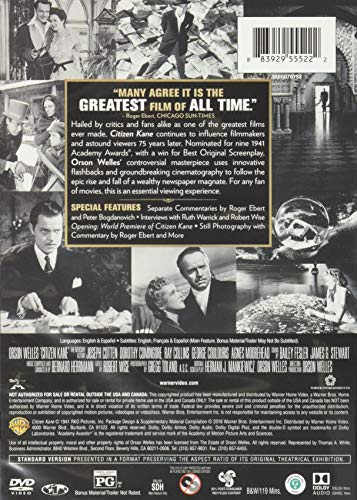


1940. Alone at his fantastic estate known as Xanadu, 70-year-old Charles Foster Kane dies, uttering only the single word Rosebud. So ends the odyssey of a life ... and begins a fabulous tale of the rise to wealth and power--and ultimate fall--of a complex man: A boy abandoned by his parents inherits a fortune, builds a global newspaper empire and aspires to become President of the United States, but he loses everything over an affair with an untalented nightclub singer. This fascinating story unfolds through the eyes of the people important to the tycoon--each showing a different aspect of Citizen Kane. Frequently regarded as the best American film ever made; winner of an Academy Award for Best Writing, Original Screenplay; and nominated for an additional eight Academy Awards including Best Picture, Best Director and Best Actor. Review: Xanadu -- Fact or Fiction? Orson Welles' Magnum Opus!! - I got the two disc DVD set of Citizen Kane. The film was quite controversial of the time and RKO Pictures originally was not going to play it because of the pressure put to bear by William Randolph Hearst, famous newspaper magnate and philanthropist. Even to this day, the Hearst Corporation has its fingers in every pie: radio, television, cable, satellite broadcasting, etc. Hearst did not like that Orson was making what amounted to an unauthorized criticism on Hearst himself. Similarities? Oh yes! Although the names were changed, the film follows Hearst's life to a Tee, with a lot of creative license being taken. Orson Welles, only 24 years old, who, flushed from his success on the Mercury Theater and his famous (or infamous) broadcast, War of the Worlds, he created what many consider the best film of all time and many consider the beginning of the end of Orson's career as a radio, stage and film master of entertainment. [For those who do not know, on Halloween night back in the 1930s, with America concerned about Hitler's advances in Europe, Welles adapted H.G. Wells War of the Worlds with realistic-sounding newscasts and had the Martians invading Grover's Mill, New Jersey. Many people actually believed these broadcasts to be REAL and panicked! Radio was like TV is today, with soaps, westerns, news, and so on as main entertainment and so having your shows interrupted by newscasts and bulletins was common. This created major controversy and put Orson on the map!] But back to the review: Charles Foster Kane, as a child, is being taken away as the family can no longer have him. His mother is played stoically by Agnes Moorhead, a strong character actress in her own right (well before "Bewitched!" the cheesy sitcom of the Sixties.). Kane gets a newspaper, expands his empire, builds a castle (in Florida rather than San Simeon (current location of Hearst Castle), collects art as well as pretty girls, runs for office, confronts scandal and finally dies, dropping a snow globe and whispers "Rosebud." Why Rosebud? Well, the newspaper guys who are creating the news reel (News On The March!) want to know more about Kane and what Rosebud is. The film then goes through a lot of flashbacks and personal interviews with fictional (and thinly disguised) friends of Kane to find out more about the man, his mission and what was Rosebud. Was Kane a self-seeking vampire who sucked the spirit out of everyone he came in contact with? Or did his childhood memories still haunt him decades after the fact? Melodramatic to the extreme, some scenes were slow-paced. The black & white photography was simply gorgeous. And getting a peak at life as it might have been like in the early 20th Century was enjoyable and fascinating. Disc Two: Wow, this was great. Actual filmed interviews with Orson Welles done in the 1980s before his death. You can see his eyes light up as he recalled the creative energy he possessed as a very young man, creating plays in Harlem with an all Black cast in creating Shakespeare for the masses. Touched on are the Mercury Theater broadcasts for CBS and the War of the Worlds broadcast. The narrator said it best: Orson accomplished it all at a young age and then was burned and never came back after Citizen Kane. Extensive biographical data on Welles and Hearst, both driven men, both creative geniuses in their own ways, proud and gifted and heading on a collision course with each other. "A film is never really good unless the camera is an eye in the head of a poet." -Orson Welles "Even if the good old days never existed, the fact that we can conceive such a world is, in fact, an affirmation of the human spirit." Orson Welles "I started at the top and worked down." Orson Welles More on Orson Welles: Orson Welles: Volume 1: The Road to Xanadu Orson Welles: Volume 2: Hello Americans More on War of the Worlds Broadcast: War of the Worlds: Featuring Orson Welles The Orson Welles' War of the Worlds Scandal More on Willam Randolph Hearst: Citizen Hearst: A Biography of William Randolph Hearst The Chief: The Life of William Randolph Hearst Review: KANE is great...but Thompson is a moron!!! - Yes, great film...perhaps the greatest for myriad reasons many of us know and those who do not should excitedly discover on their own. But has anyone ever commented until now that in addition to being an examination of the title character, CITIZEN KANE contains a devastating, damning commentary on the basic idiocy of most "investigative" reporters - in this case the "truth"-seeking Thompson. But was it intentional - or a script oversight - that when Raymond the Butler is giving his two cents worth (in his case actually a thousand bucks worth!) to the meaning of Rosebud.....Thompson - a basic idiot-in-the-shadows (is this then why he is always in shadows? To show he is the man-in-the-dark...the man who cannot see what is before him? Who can't even do his job well!) - when Thompson is told by Raymond that Kane utters the word "Rosebud" both when Susan left him and he pocketed "something" and "that other time" when he dropped the glass ball - yet Thompson does NOT even ask what the hell the glass ball was! If he had known it was of a snow scene he might have had the wits to trace it back to young Kane's winter of discontent when the bank seized hold of him and stole him from his beloved sleigh. How dumb could one get? (Perhaps as dumb as many investigative reporters are who fail to deliver the goods or come up with erroneous nonsense that they pass off as truth - or WMDs?) Anyway - I will forever wonder if Thompson's not picking up the "ball"(in this case albeit a glass, smashed one) was intentional by the makers of KANE or was Thompson just tired at the end of the day or was this a script glitch? Also not mentioned - to my knowledge - is the preponderance of fireplaces in the film...leading up to the end one which consumes the secret for all time. (Notice the fireplace directly behind the young Kane when he is given a new sleigh by Thatcher - portent of things to come.) One other thing that I have never seen mentioned in commentaries of the film is this: the great Kane-as-a-boy snow scene....the snowman....it is a forecast of the endless statues that the elder Kane will collect; plus...it somewhat looks like the bald-domed, fatter Kane when we last see him: in the Colorado scene we thereby have child and future man, together. The fact that a snowman is frozen- as Kane is emotionally frozen (especially at the end of the film after Susan leaves) is another point to be considered. So when we first see the dying Kane he God-like holds his past world in his hand, yet being a limited human being afterall (despite Kane's seeming unlimitness of power and money, etc) he cannot enter the scene in the ball...just like he cannot return to that moment in Time. Conversely, when we first see Kane as a boy, he is in the world of the glass ball - but that world is also about to be shattered by the adults who plot his future within the confines of the warm boarding house. It is then - from this interior - that we see child Kane framed...as he is also about to be "framed" for a crime he did not commit and sentenced to a life of wealth and riches he never asked for - or may have ever even wanted. In both cases, however, the dying Kane at the film's opening and the first time we see K as a child - in both instances, he is....alone. Existentially alone in a frozen world that only the human heart and hearthside can warm. One last thing to anyone familiar with the music of Rachmaninoff: listen to his magnificent tone poem "Isle of the Dead" and you will hear what is essentially the Kane motif throughout it. I absolutely love the music of Bernard Herrmann but cannot help thinking he was influenced - however subconsciously - by Rachmaninoff's piece. Even the painting that Rachmaninoff based his tone poem on is reminiscent of Xanadu, somewhat. Anyway - CITIZEN KANE is the ultimate film about ALL of us....not just powerful, multimillionaire publishers....but ALL of us...because we ALL have a "Rosebud" in our souls and minds that will be on our lips when the curtain closes. "Rosebud" is, in its most basic form, the desire we all share to....start again, conquer Time, turn back the clock and NOT have die and end our dreams or our bodies. This is what ultimately makes KANE....a CITIZEN.
| ASIN | B01LZHNDQC |
| Actors | Agnes Moorehead, Dorothy Comingore, Joseph Cotten, Orson Welles, Ruth Warrick |
| Best Sellers Rank | #2,370 in Movies & TV ( See Top 100 in Movies & TV ) #274 in Drama DVDs |
| Customer Reviews | 4.6 4.6 out of 5 stars (4,995) |
| Director | Orson Welles |
| Dubbed: | English |
| Is Discontinued By Manufacturer | No |
| Item model number | 43298294 |
| MPAA rating | PG (Parental Guidance Suggested) |
| Media Format | DVD, NTSC |
| Number of discs | 1 |
| Producers | Orson Welles |
| Product Dimensions | 0.7 x 7.5 x 5.4 inches; 1.6 ounces |
| Release date | November 15, 2016 |
| Run time | 1 hour and 59 minutes |
| Studio | Warner Home Video |
C**R
Xanadu -- Fact or Fiction? Orson Welles' Magnum Opus!!
I got the two disc DVD set of Citizen Kane. The film was quite controversial of the time and RKO Pictures originally was not going to play it because of the pressure put to bear by William Randolph Hearst, famous newspaper magnate and philanthropist. Even to this day, the Hearst Corporation has its fingers in every pie: radio, television, cable, satellite broadcasting, etc. Hearst did not like that Orson was making what amounted to an unauthorized criticism on Hearst himself. Similarities? Oh yes! Although the names were changed, the film follows Hearst's life to a Tee, with a lot of creative license being taken. Orson Welles, only 24 years old, who, flushed from his success on the Mercury Theater and his famous (or infamous) broadcast, War of the Worlds, he created what many consider the best film of all time and many consider the beginning of the end of Orson's career as a radio, stage and film master of entertainment. [For those who do not know, on Halloween night back in the 1930s, with America concerned about Hitler's advances in Europe, Welles adapted H.G. Wells War of the Worlds with realistic-sounding newscasts and had the Martians invading Grover's Mill, New Jersey. Many people actually believed these broadcasts to be REAL and panicked! Radio was like TV is today, with soaps, westerns, news, and so on as main entertainment and so having your shows interrupted by newscasts and bulletins was common. This created major controversy and put Orson on the map!] But back to the review: Charles Foster Kane, as a child, is being taken away as the family can no longer have him. His mother is played stoically by Agnes Moorhead, a strong character actress in her own right (well before "Bewitched!" the cheesy sitcom of the Sixties.). Kane gets a newspaper, expands his empire, builds a castle (in Florida rather than San Simeon (current location of Hearst Castle), collects art as well as pretty girls, runs for office, confronts scandal and finally dies, dropping a snow globe and whispers "Rosebud." Why Rosebud? Well, the newspaper guys who are creating the news reel (News On The March!) want to know more about Kane and what Rosebud is. The film then goes through a lot of flashbacks and personal interviews with fictional (and thinly disguised) friends of Kane to find out more about the man, his mission and what was Rosebud. Was Kane a self-seeking vampire who sucked the spirit out of everyone he came in contact with? Or did his childhood memories still haunt him decades after the fact? Melodramatic to the extreme, some scenes were slow-paced. The black & white photography was simply gorgeous. And getting a peak at life as it might have been like in the early 20th Century was enjoyable and fascinating. Disc Two: Wow, this was great. Actual filmed interviews with Orson Welles done in the 1980s before his death. You can see his eyes light up as he recalled the creative energy he possessed as a very young man, creating plays in Harlem with an all Black cast in creating Shakespeare for the masses. Touched on are the Mercury Theater broadcasts for CBS and the War of the Worlds broadcast. The narrator said it best: Orson accomplished it all at a young age and then was burned and never came back after Citizen Kane. Extensive biographical data on Welles and Hearst, both driven men, both creative geniuses in their own ways, proud and gifted and heading on a collision course with each other. "A film is never really good unless the camera is an eye in the head of a poet." -Orson Welles "Even if the good old days never existed, the fact that we can conceive such a world is, in fact, an affirmation of the human spirit." Orson Welles "I started at the top and worked down." Orson Welles More on Orson Welles: Orson Welles: Volume 1: The Road to Xanadu Orson Welles: Volume 2: Hello Americans More on War of the Worlds Broadcast: War of the Worlds: Featuring Orson Welles The Orson Welles' War of the Worlds Scandal More on Willam Randolph Hearst: Citizen Hearst: A Biography of William Randolph Hearst The Chief: The Life of William Randolph Hearst
R**I
KANE is great...but Thompson is a moron!!!
Yes, great film...perhaps the greatest for myriad reasons many of us know and those who do not should excitedly discover on their own. But has anyone ever commented until now that in addition to being an examination of the title character, CITIZEN KANE contains a devastating, damning commentary on the basic idiocy of most "investigative" reporters - in this case the "truth"-seeking Thompson. But was it intentional - or a script oversight - that when Raymond the Butler is giving his two cents worth (in his case actually a thousand bucks worth!) to the meaning of Rosebud.....Thompson - a basic idiot-in-the-shadows (is this then why he is always in shadows? To show he is the man-in-the-dark...the man who cannot see what is before him? Who can't even do his job well!) - when Thompson is told by Raymond that Kane utters the word "Rosebud" both when Susan left him and he pocketed "something" and "that other time" when he dropped the glass ball - yet Thompson does NOT even ask what the hell the glass ball was! If he had known it was of a snow scene he might have had the wits to trace it back to young Kane's winter of discontent when the bank seized hold of him and stole him from his beloved sleigh. How dumb could one get? (Perhaps as dumb as many investigative reporters are who fail to deliver the goods or come up with erroneous nonsense that they pass off as truth - or WMDs?) Anyway - I will forever wonder if Thompson's not picking up the "ball"(in this case albeit a glass, smashed one) was intentional by the makers of KANE or was Thompson just tired at the end of the day or was this a script glitch? Also not mentioned - to my knowledge - is the preponderance of fireplaces in the film...leading up to the end one which consumes the secret for all time. (Notice the fireplace directly behind the young Kane when he is given a new sleigh by Thatcher - portent of things to come.) One other thing that I have never seen mentioned in commentaries of the film is this: the great Kane-as-a-boy snow scene....the snowman....it is a forecast of the endless statues that the elder Kane will collect; plus...it somewhat looks like the bald-domed, fatter Kane when we last see him: in the Colorado scene we thereby have child and future man, together. The fact that a snowman is frozen- as Kane is emotionally frozen (especially at the end of the film after Susan leaves) is another point to be considered. So when we first see the dying Kane he God-like holds his past world in his hand, yet being a limited human being afterall (despite Kane's seeming unlimitness of power and money, etc) he cannot enter the scene in the ball...just like he cannot return to that moment in Time. Conversely, when we first see Kane as a boy, he is in the world of the glass ball - but that world is also about to be shattered by the adults who plot his future within the confines of the warm boarding house. It is then - from this interior - that we see child Kane framed...as he is also about to be "framed" for a crime he did not commit and sentenced to a life of wealth and riches he never asked for - or may have ever even wanted. In both cases, however, the dying Kane at the film's opening and the first time we see K as a child - in both instances, he is....alone. Existentially alone in a frozen world that only the human heart and hearthside can warm. One last thing to anyone familiar with the music of Rachmaninoff: listen to his magnificent tone poem "Isle of the Dead" and you will hear what is essentially the Kane motif throughout it. I absolutely love the music of Bernard Herrmann but cannot help thinking he was influenced - however subconsciously - by Rachmaninoff's piece. Even the painting that Rachmaninoff based his tone poem on is reminiscent of Xanadu, somewhat. Anyway - CITIZEN KANE is the ultimate film about ALL of us....not just powerful, multimillionaire publishers....but ALL of us...because we ALL have a "Rosebud" in our souls and minds that will be on our lips when the curtain closes. "Rosebud" is, in its most basic form, the desire we all share to....start again, conquer Time, turn back the clock and NOT have die and end our dreams or our bodies. This is what ultimately makes KANE....a CITIZEN.
S**L
Beautiful Classic
Beautiful classic that discusses everything from childhood trauma to living in a self made prison. Great movie!
E**I
Citizen Kane is one those films that, watching it after reading enthusiastic reviews saying it's the best film ever, you might not agree. Because Citizen Kane is a film whose main values are not so apparent and easy to get by everyone. It is a film for film fans and movie experts, but this does not mean is not a great, unique, magnificent film. It just means that you have to watch it both with an emotional and dramatic approach (that of normal viewers) and with a more careful focus on what a film is made of. And Citizen Kane is made of a powerful drama, structured in a modern and innovative way (an investigation where the puzzles never seem to be enough) dealing with universal and intimate questions (ambition and solitude, will of power vs need of love) as well as a sharp vision of power as based on (self)image and communication and all oriented to embrace and own the world, exactly like a baby does when he thinks that there is no boundaries between his will and the world around him. And it's a sociological and historical revolutionary pamphlet about American Society yet filled with fascination for its dark side and the mavericks, like Kane, who embody it. And last but not least, it is a film where the language not just back and support the story, but complete it and sometimes replace the classic narration through a supermodern visual language, like the fantastic sequence reassuming the whole story between Kane and his wife in few quick scenes all set in the same room and linked by camera pans and ellipsis. And Kane is also photographically evocative and impressive, is grand in its character, the lines of his dialogues and monologues, the impact of shots and scenes, the reckless representation of journalism and politics as well as the collusion between business and war. It is too much for a film but still you can find it cold, calculated, not engaging, like often Welles seems to be. But you can't ignore it and, if you do, you will not recognize it in all the films that came after, up to now, and not able to tell the copy from the original. Because a lots of things come from this film. This edition is the best available, it does not just present a fantastic blu ray transfer, but it is full of extras and has a great box and an interesting little book inside.
T**.
At some point, most people have probably heard or seen a Citizen Kane reference -- I knew what Rosebud was long before I saw the film. But knowing what Rosebud is isn't the importance of the film -- it's the journey and the art. Welles' performance is incredible, but perhaps even more impressive is the composition of the film. There are multiple shots, camera angles and techniques that somehow look fresh and astounding even today. For me, the haunting, otherworldly shots of Xanadu will always stand out as one of the most impressive film scenes I've seen. As for the Blu Ray itself, the quality is very impressive given the age of the movie. The restoration is carefully done, and the contrast is as it should be (dark blacks) instead of the more washed out look some of the previous releases had. The level of detail is fantastic, and the sets and matte paintings used to construct them appear even more impressive once you can see the full details. Overall, it is a noticeable step up from the DVD releases (as expected). The sound, mixed from a mono source, doesn't quite have the same pop as modern sound does, but that is to be expected, and it still does a wonderful job, The only disappointment I had with the film is the extras. In terms of what they offer, they're quite excellent -- we get things like commentary, as well as the initial trailer and scenes from the screening, but the real gems are the 'The Battle Over Citizen Kane' documentary and the 'RKO 281' HBO movie, both of which chronicle the creation and release of the movie. Unfortunately, what brings them down is that they're both in standard definition, which is a bit jarring given the gorgeous high-def picture of Citizen Kane itself. Overall, this is a fantastic release package for an even more impressive movie, and is absolutely worth checking out if you haven't experienced Citizen Kane before.
A**D
tres satisfie
M**8
In "Citizen Kane" geht es um die Geschichte des Presse-Moguls Charles Foster Kane (der hatte ein reales Vorbild, nämlich William Hearst, in den 20er bis 40er Jahren Amerikas größter Zeitungsverleger mit erheblichem politischen Einfluß). Die Story mag heute nicht mehr jeden ansprechen, es ist auch ein typisch amerikanisches Thema vom Aufstieg und Fall eines berühmten Mannes (Allerdings kann man vergleichsweise darüber spekulieren, daß ein Film über Axel Springer, der sein Privatleben ausschlachtet, in den 50er oder 60er Jahren in Deutschland für einen vergleichbaren Skandal gesorgt hätte, und daß die Springer Presse mit ähnlich drastischen Mitteln gegen den Film vorgegangen wäre wie Hearst gegen Welles: am liebsten hätte Hearst alle "Citizen Kane"-Kopien vernichtet). Warum dieser Film heute so häufig als "bester Film aller Zeiten" angesehen wird, das begründet sich in dem (für 1941 wirklich sensationellen) WIE, nämlich die Art, wie die story erzählt wird: in (verschachteleten) Rückblenden! Das war nicht wirklich neu in Hollywood, aber neu war die subjektive Erzählweise: Der Film beginnt mit dem Tod von Kane. Auf dem Sterbebett in seinem märchenhaften Schloß "XANADU" flüstert er als letztes Wort "Rosebud" (Rosenknospe). Ein Reporter soll die Bedeutung dieses rätselhaften Wortes und damit auch den WIRKLICHEN Charles Foster Kane ergründen. Er befragt Weggefährten, Zeitzeugen, Reporterkollegen, Fosters Ex-Frau, Freunde, Feinde...aus deren Erzählungen werden in nicht-chronologischen Rückblenden wie in einem Puzzle Stationen aus dem Leben Kanes geschildert. Wie in einem Puzzle wird auch der Zuschauer gezwungen, sich daraus sein eigenes Bild von Kane zusammenzusetzen ohne wirklich einer obkektiven Wahrheit näherzukommen. Virtuos wird dabei Gregg Tolands Kamera quasi zum "Miterzähler" des Films. Welles und Toland arbeiteten zum ersten Mal mit Tiefenschärfe und speziellen Weitwinkelobjektiven, die Perspektiven verzerrten und es ermöglichten, Figuren im Vordergrund abzubilden, während der Hintergrund genauso "scharf" war. Dabei konnten Personen mal als "Riesen", mal als "Zwerge" erscheinen, prägnante Gegenstände in den Vordergrund gerückt,Räume tiefer gezeigt und Schnitte weitgehend vermieden werden, indem man die Tiefe des Raumes ausnutzte und ganze Einstellungen ohne Schnitte in einem einzigen Raum filmte.Überblendungen, schnelle Montagefolgen (die an Eisenstein erinnern), unterschiedliche Filmgeschwindigkeiten, die Bewegungsabläufe entweder verzögerten oder schneller werden ließen, wurden als Stilmittel eingesetzt, Kontraste erzeugt. In einer Szene etwa befinden sich Kane und sein bester Freund Leland in den Büros des Zeitungsverlages. In dieser Szene scheint die Kamera förmlich im Boden versunken zu sein, durch diese Untersicht wirkt der Raum überdimensional riesig (ebenso Kane, während Leland "klein" im Hintergrund gelassen wird). Tolands Bildersymbolik spiegelt ständig in Darstellung der subjektiven Größe oder den Bewegungen von Kane seine Gemütszustände wieder: mal gigantisch als "Riese" einen ganzen Raum ausfüllend, mal "klein" und aus Untersicht, mal kindlich und in den letzten Szenen geradezu statuenhaft erstarrt, als ihn seine Frau verläßt (die ihm übrigens ganz treffend sagt, sie habe sich nicht anders gefühlt als die vielen Statuen und Kunstgegenstände, als "Eroberung" und Sammlerobjekt für Kanes eigene Befriedigung). Die Kamera ist ständig in Bewegung und wechselt ständig die Perspektiven. Neu war auch eine der Anfangssequenzen des Films, wo in einer fiktiven "Wochenschau" ein Nachruf auf Kane gezeigt wird. Welles wird hier in einige "echte" Szenen mit Hitler oder Winston Churchill "hineinkopiert", diese "halbdokumentarischen" Tricks hatte man so noch nicht gesehen, und sie wirken total realistisch (Woody Allen's "Zelig" greift diese Methode - mit Sicherheit auch als Hommage an Welles - wieder auf). Die Kameraperspektiven lassen Welles mal als "groß und machtvoll", mal als "winzig und gescheitert" erscheinen, sie prägen im wahrsten Sinne des Wortes subjektive Charakterzeichnungen. Sensationell war auch Welles'eigene schauspielerische Leistung: er, damals erst 25, durchlief dabei in überzeugender Maske und Gestik alle Altersstufen bis hin zum 70jährigen. Die Tonspur ist mit Halls, Echos, unterschiedlichen Lautstärken, überbetonten Geräuschen ebenfalls sehr prägnant und erfindungsreich eingesetzt, daneben gibt es fast stumme Szenen, die eine ganze Episode rein visuell erzählen.Nie weiß der Zuschauer mehr als der ermittelnde Reporter (der im ganzen Film nur von hinten gezeigt wird), erst ganz zum Schluß macht die Kamera den Zuschauer zum Mitwisser und enthüllt uns die wahre Bedeutung des Wortes "Rosebud" - und damit auch viel über die Psyche von Kane, über die tiefliegenden Gründe seiner Besessenheit und seines beruflichen und privaten Scheiterns.Denn was ein Mensch macht und wie er sich entwickelt, liegt oft in der Kindheit begründet. Welles spielt ebenfalls mit der Zeit, manche Ereignisse dehnt er aus, manche verkürzt er wie unter einem Brennglas, etwa diejenige Szene, in der in zwei Minuten der Zerfall von Kanes Ehe nur an einem einzigen Alltagsritual deutlich wird: beim Frühstück. Frisch verheiratet, unterhalten sich die beiden angeregt, cut - die zweite Frühstücksszene zeigt das Verhältnis deutlich abgekühlt, Emily macht ihm deutlich, daß sie sich vernachlässigt fühlt, in der dritten fällt kein Wort, Kane liest seine Zeitung und Emily das Konkurrenzblatt. Am Schluß erkennen wir zwar, was eine tiefe Verletzung für Kane bedeutet hat, trotzdem bleibt uns der Mensch Kane weitgehend ein Rätsel wie für den Reporter - weil Welles uns durch seinen Subjektivismus abwechselnd Sympathien und Antipathien für Kane zuweist und wieder entzieht. Wenn wir überhaupt mit einer Figur des Films sympathisieren sollen, dann ist es wahrscheinlich Leland, der eine aufrichtige ethische Haltung darüber hat, was Journalismus bedeuten soll und Kane ständig daran erinnert. Neben den unterschiedlichen Einschätzungen über die Person Kanes schwankt der Film konsequenterweise ständig zwischen Ernsthaftigkeit, (Real-)Satire, überschwenglichen und traurigen und zuweilen bizarren und grotesken Szenen, er ist visuell dermaßen "voll", daß man ihn mehrere Male sehen muß, um zu erfassen mit welchen Mitteln Welles uns seine Vorstellung von Materialismus und Reichtum vermittelt. Erst beim mehrmaligem Sehen erfaßt man auch Welles'Hinweise auf die Lösung des Rätsels Rosebud: In einer Szene mit Mr. Bernstein brennt im Hintergrund ein Kaminfeuer, das schon auf den an ein Krematorium erinnernden Ofen, in dem privater Plunder von Kane am Filmende verbrannt werden,hindeutet. Die Glaskugel mit Schnee und der Blockhütte taucht mehrere Male im Film auf. Doch viele Zuschauer haben vermutet, daß diese Glaskugel, die an Kanes Kindheitsabschiedsszene vor dem winterlichen ärmlichen Blockkhaus seiner Eltern erinnert, aus eben jenen in einem Laherhaus verstauten Besitztümern Kanes stammt. Irrtum: Schaut man aufmerksam hin, so kann man in einer Szene bei Susan Alexander zuhause (in der Sequenz als sich beide kennenlernen) auf dem Garderobentisch deutlich jene Glaskugel erkennen. Mehrmals führt uns Kane mit versteckten oder offensichtlichen Bildern und Kameraeinstellungen in die Irre. Die Raffinessen vor allem auch der Tonspur kann man besser in der Originalfassung erfassen, die deutsche Synchronisation ist für meine Begriffe nicht immer glücklich. Und das einzige Manko dieser hervorragend restaurierten Fassung ist eben leider auch, daß der Soundtrack von Bernard Herrmann immer noch nicht vollständig wiedergegeben wird, denn auch die Musik als "subjektiven Stimmungserzeuger" hat Welles überzeugend integriert. Der Film hat seinen bleibenden Wert auch als Essay über Macht, den Verlust von Idealen und als kritische Abrechnung mit dem american way of life. Kane macht nichts anderes als sich den Liebesentzug, den er in seiner Kindheit erfahren hat, durch zu einer regelrechten Profilneurose gesteigertes Geltungsbewußtsein zurückzuholen. Macht, Einfluß und Besitz werden ihm wichtiger als ehrlicher Journalismus - eigentlich treibt er seine Zeitung und die Entwicklung seines Imperiums von Anfang an wie einen Eroberungsfeldzug voran. Und nicht zufällig gemahnt sein Name (und das Schloß Xanadu, daß er sich erbaut hat) an einen anderen Machtbesessenen: Kublai Khan. Und wer sich auf die Kino-Magie, die oft ihre eigenen Gesetze hat, einläßt, sieht auch mit einem Lächeln über die wohl größte Logik-Lücke der Filmgeschichte hinweg. Das Wort "Rosebud", welches Charles Foster Kane kurz vorm Exitus flüstert, hat NIEMAND außer ihm selbst gehört... Ein findiger Reporter hatte das auch schon 1941 erkannt und Welles darauf angesprochen. Welles sagte: "Erzählen Sie das ja niemandem weiter!"
ス**ん
国内では500円DVDで、あまり映像の美しくない状態でしか観られない 名作『市民ケーン』ですが、この海外盤ブルーレイの映像はハッキリ言って凄いです。 まるでネガフィルムから映像化されたようなシャープさ、 (2度目の妻に捨てられたケーンの目から落ちる涙がはっきりわかるほど) パンフォーカス撮影の素晴らしさを堪能できるのは、 このブルーレイならではと思います。 残念ながら日本語字幕はありませんが、 市民ケーン (名作映画完全セリフ集スクリーンプレイ・シリーズ)という、 セリフを英語と日本語で完全に文字化したテキストも発売されているので、 私はこれを字幕がわりに利用しています。 この映像が徹底的に修復された『市民ケーン』や『キング・コング(33年度版)』など、 海外ワーナーホームビデオからは素晴らしいディスクが多いです。 是非、国内盤も出してもらいたいものですね。 本編のブルーレイはリージョンAなので国内プレイヤーで観られます。 ちなみに特典DVDディスクのドキュメンタリー『Battle over citizen kane』は リージョン1とディスクには表記がありますが、実際はリージョンフリーで視聴可です。 (もう1枚の特典DVDディスク、『RKO281』はリージョン1です) 私はお薦めのディスクです。
ترست بايلوت
منذ أسبوعين
منذ شهرين