We remain fully operational. Our teams are working around the clock to ensure your deliveries continue safely.

قم بتنزيل التطبيق


معلومات عنا
حقوق الطبع والنشر © 2024 Desertcart Holdings Limited
قم بتنزيل التطبيق
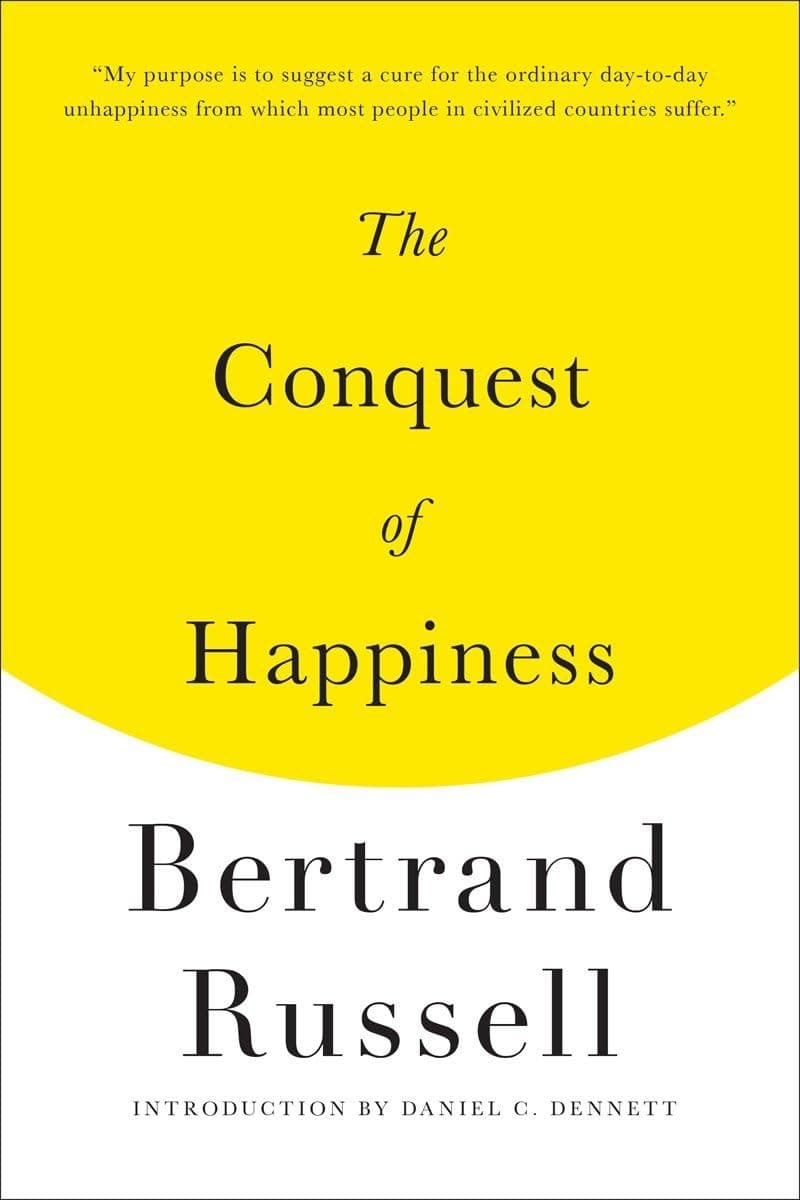
The Conquest of Happiness [Russell, Bertrand, Dennett, Daniel C.] on desertcart.com. *FREE* shipping on qualifying offers. The Conquest of Happiness Review: A great read from one of the greats! - Although Bertrand Russell was first and foremost a mathematician, he was also a brilliant philosopher who wrote on various topics, happiness being one of them. Russell stands apart from many of his contemporaries in that his writing is candid, plain, and sometimes humorous. In this essay, Russell expounds on the different facets of happiness. He tells us we must spread our interests far and wide as possible for a more fulfilling life. He highlights the difference between what he considers superficial and fleeting happiness versus a form of happiness that is deeper and lasting. Russell also reminds us that our problems are not as significant as we make them out to be and to change our perspective by asking ourselves, what’s the worst that can happen? Overall, I thoroughly enjoyed this book; it was a quick read. If you think philosophy is stuffy, unrelatable, or abstruse, you haven’t read Russell. Although Russell was from a different era, many of his thoughts are refreshingly modern, and his prose is as timeless as ever. You’ll come away with a piece of wisdom that will help shift your perspective and get you thinking. Happy reading! Review: one of the best books I have ever read - Short, simple and illuminating. A fascinating piece of writing from a brilliant mind. I will most surely read it again.
| Best Sellers Rank | #144,027 in Books ( See Top 100 in Books ) #151 in Modern Western Philosophy #251 in British & Irish Literature #256 in Philosophy of Ethics & Morality |
| Customer Reviews | 4.5 4.5 out of 5 stars (1,293) |
| Dimensions | 5.5 x 0.6 x 8.3 inches |
| Edition | 1st |
| ISBN-10 | 087140673X |
| ISBN-13 | 978-0871406736 |
| Item Weight | 2.31 pounds |
| Language | English |
| Print length | 224 pages |
| Publication date | August 5, 2013 |
| Publisher | Liveright |
T**A
A great read from one of the greats!
Although Bertrand Russell was first and foremost a mathematician, he was also a brilliant philosopher who wrote on various topics, happiness being one of them. Russell stands apart from many of his contemporaries in that his writing is candid, plain, and sometimes humorous. In this essay, Russell expounds on the different facets of happiness. He tells us we must spread our interests far and wide as possible for a more fulfilling life. He highlights the difference between what he considers superficial and fleeting happiness versus a form of happiness that is deeper and lasting. Russell also reminds us that our problems are not as significant as we make them out to be and to change our perspective by asking ourselves, what’s the worst that can happen? Overall, I thoroughly enjoyed this book; it was a quick read. If you think philosophy is stuffy, unrelatable, or abstruse, you haven’t read Russell. Although Russell was from a different era, many of his thoughts are refreshingly modern, and his prose is as timeless as ever. You’ll come away with a piece of wisdom that will help shift your perspective and get you thinking. Happy reading!
P**W
one of the best books I have ever read
Short, simple and illuminating. A fascinating piece of writing from a brilliant mind. I will most surely read it again.
D**K
Analytic Philosophy Meets Pop Psychology
This is a wonderful book, despite the passage of considerable time. Written shortly after WWI, there are occasional references to people and things no longer on the modern radar scope. And, as philosophical writing goes, Russell is better than most in constructing intelligible sentences and paragraphs that don't require repeated reading to understand. This book is about life. Russell uses his analytic empiricism to discuss typically pop-psychological issues: Boredom, Excitement, Envy, Sin, Persecution, Public Opinion, Zest, etc. But his approach, dated back in time, is refreshingly new and helpful in the present. Indeed, Russell shows himself redolent in wisdom, the true aim of philosophy, and tackles issues that are at the core of what constitutes happiness and its opposites. Because Russell appeals to his empirical views analytically arrived, there is a sense of wonderment and awe at such simple solutions to difficult problems in modern life. These solutions aren't dressed in pop-ism, but in a perennial philosophy that takes wisdom, not pop-up tapes of life, seriously. The Atlantic Monthly claimed this book to be a "primer of self-regeneration . . . a most excellent book." This praise is not unwarranted, and given that commonsense is the center of the whole enterprise, its wisdom will endure not only when it was written in the 1920s, but today, and tomorrow.
D**S
Must-read book for everyone
Bertrand Russell wrote this masterpiece almost a century ago, yet it is valid today in its full length. It is actually mind-blowing how little has changed in society and human nature in such a long time. Inner complex workings of the mind and emotions that create dysfunctional behavior and therefore prevent us from connecting with others and enjoying living are explained simply, directly and thoroughly. Value of the material is very high considering how short this book is, you can read it in matter of hours, but what you learn will serve you forever. Publication explains complex aspects in a way that is very easy to understand. This work represents philosophical and psychological excellence and has been written to the highest standard in self-help publications. I recommend this book to everyone, because everyone can learn something from it.
G**W
Ethic of Happiness
The obviously brilliant Bertrand Russell explains to us the ethic of his day. In 1930 it was the social ethic of Happiness. We just need to learn to get along and be happy, so he says. As humans we can adjust the way we live together to be happy. The definition is engaging, accurate, clear and is to some extent a good read. Over the last eighty years Americans have been content to swallow and chew on Russell's happiness hypothesis. The result was and is the often advertised pursuit of the American dream. As well expressed and sound the happiness hypothesis may be, it has one serious flaw. It is mere secular thinking that has no divine imperative. Does God have an ethic of happiness? The Scriptures say no but the church decided to co-mingle the thinking of Russell with that of the Gospel instead of confronting it. In ignorance, I hope, the church says that the Gospel will bring happiness, upward mobility, prosperity, success, health and social acceptance. This partnership with Russell, whom the church despises on paper, has denigrated the authenticity of the church. The Scriptures have no patience with Russell or the church. Moses was called from the happiness of Midian to confront the other God of his time. Jesus was called from happiness in the countryside to die in Jerusalem. The Pharisee of Pharisee's was called from the happiness and social acceptability of the religious family to be a Christian renegade. A monk in an Egyptian monastery is called to leave his happy life to go to Rome and die in the Area to shame Rome for their unethical happiness. This is only a few of the contradictions,in Scripture and history, to the thinking of Bertrand Russell. The Gospel is about giving it up, happiness that is,under the direction of God. This being the case, "the Conquest of Happiness" is an important read.
A**R
This book exemplifies the importance of reflection when trying to give advice to others. While reading it, I can see that Russell did not write the book for the sake of filling the 'self-help' section in a book store, but he wrote with the earnest attention of sharing what he thought, after experiencing life and reflecting on it, a person must consider if he is to conquer happiness. Such a great book.
A**R
This great philosopher of 20th century has written this master piece sometimes in 1930s and the book is a gem as it tackles the most fundamental issues confronting all of us- issues of envy, family and our over important perception of self. I would rate this book as one of the top 10 I have enjoyed ever.
R**O
Comportamentos, Pensamentos. Herança humana imutável
C**E
This is a short and very enjoyable read. There isn’t really anything new or sensational about Mr. Russell’s advice on how to live a happy life but it’s easy to understand, (most of it) makes total sense and it’s all nicely tucked into a nutshell and sprinkled with humour. Although the book was first published in 1930, many of the topics are as relevant today as they were nearly a hundred years ago. Others not so much, e.g. his ideas on the nature of women and their role in society and his views on “savages” and “civilisation”. The chapter on “Family” comes across as quite ironic as Mr. Russell was not famous for being a good family man. I don’t know anything about his relationship with his children but I understand that he was quite the womaniser, went through four marriages and strayed plenty so he didn’t quite heed his own advice in that respect.
L**K
I have to say that when I bought this book I was pretty skeptical and even cynical about the topic matter, having read Russell's History of Western Philosophy and some of the other titles in the Routledge Classics and expecting something similar. I was very pleasantly surprised and intend to re-read this book annually, Russell wrote this book for a mass audience, combining philosophy, psychology and common sense Russell first surveys what he believes to be the main causes of unhappiness, byronic unhappiness, competition, boredom and excitment, fatigue, envy, the sense of sin, persecution mania and fears of public opinion, and then proceeds to consider the possible sources of happiness Zest, affection, the family, work, impersonal interests and effort or resignation. Some of it can appear dated and the work of the age in which it was written, for instance I think that he wrote about a sense of sin at a time where this could be a great deal more troubling to the conscience than present day, then again I remind myself that there are probably people and places where this remains very much the case today. I cant fault Russell in his ultimate conclusion that to be happy one should live objectively, have a wide range of interests and be as sincerely and genuinely interested in and warm towards others, engaging with the world instead of retreating from it where possible. The book is full of great advice about how living after this fashion can permit you to cope with the sources of unhappiness which Russell perceives. Russell also, in his wisdom, does not pretend to have all the answers and when he does touch upon the topic of psychology does say that it is possible that on occasion more professional advice and assistance could be called for, something that I think is very much lacking in other self-help genres or treatise. I would also recommend this book as very readable, its jargon free, the pace is excellent and I enjoyed it as much as any book of its kind or more light reading like genre fiction.
ترست بايلوت
منذ 3 أيام
منذ شهرين