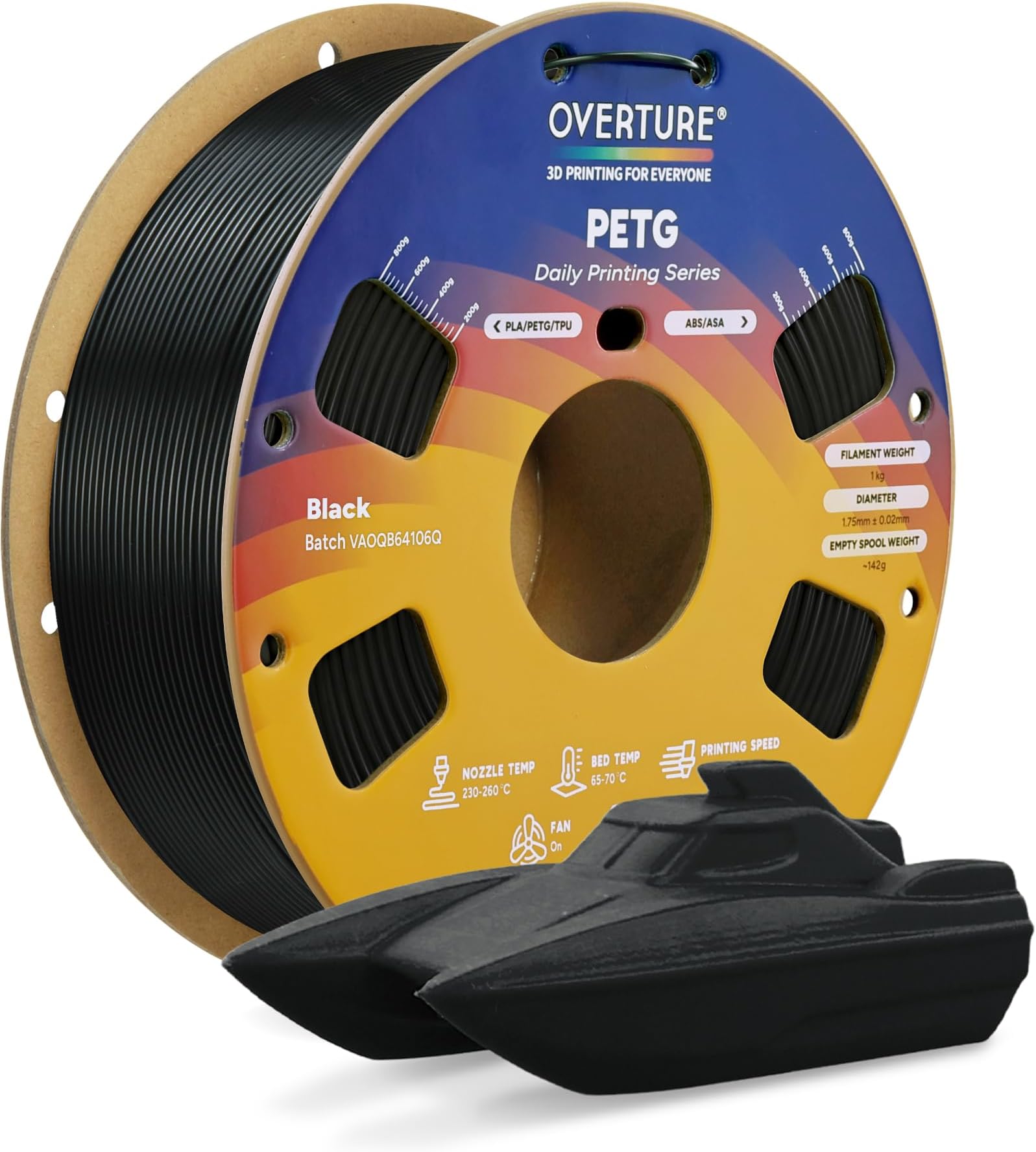
🖤 Print Bold, Print Strong — Overture PETG Powers Your Next-Level Projects
OVERTURE PETG filament offers a premium 1.75mm diameter with ±0.02mm accuracy, optimized for most FDM 3D printers. Combining the toughness of ABS with the ease of PLA, it delivers high impact strength, low shrinkage, and excellent layer adhesion. The precision-wound 1kg spool ensures tangle-free printing, while vibrant, fade-resistant black color adds a subtle shine to your creations. Ideal for functional parts and outdoor applications, it prints best at 230-250°C nozzle and 80-90°C heated bed temperatures, backed by dedicated support and a 1-year shelf life.
| ASIN | B08WZBYDRJ |
| Brand Name | OVERTURE |
| Color | 00-Black |
| Customer Reviews | 4.3 4.3 out of 5 stars (3,535) |
| EU Spare Part Availability Duration | 2 Years |
| Global Trade Identification Number | 90810031294346 |
| Item Diameter | 1.75 Millimeters |
| Item Weight | 1 Kilograms |
| Manufacturer | OVERTURE |
| Manufacturer Part Number | UK-PETG17511 |
| Material Type | Polyethylene Terephthalate Glycol |
| Model Number | UK-PETG17511 |
| Number of Items | 1 |
| Unit Count | 1000.0 Grams |
J**R
Very Bad quality
Models keep warping when using this filament, but for the same model when using other filament is okay. Would not recommend it, waste of money and your printing time
S**R
Hi, works really well, you do need the right settings mine was 245 nozel temp , bed temp 75, prints worked first time, using it to make aquarium caves and feeding holes, and plant pots, better under tropical water heat than pla, very good stuff, good value and arrived quickly 😀
D**I
It's a softer petg, the way it should be. I noticed other brands produce prints that somewhat resemble PLA in hardness, but not this one. The consistency is maybe a bit harder than the plastic in a soda bottle cap. Printing-wise, I just used the indications on the roll and I had zero issues with it. Stringing was almost non-existent, I had some prints with basically zero stringing. It bridges well, especially if the printer has adequate cooling (yes, for bridges you will have to ramp it up a little). No clogs, no issues, no headaches. I'm really pleased by Overture Light Grey PETG. This being said, I did not try any other color or material from them, but now I'm interested to try and see if other filaments are squally good.
D**X
This is my usual “go to” filament. It’s usually dry right out of the box, well wound and prints really well. I’ve bought Overture at least 10 times and have been impressed every time. However until my last order. I opened the usual Mylar bag, first off it appeared tangled, most unusual. It looked like it had been rewound by hand. Secondly when I loaded it into the printer it hissed and popped like never before, so wet. Then I tried to print it just clogged, so much I had to rebuild my hotend. So while I was rebuilding I tried to dry it out for 48hrs and it was pretty grim. Very poor finish. So I’m going to send this one back. See photos. 1st is the dodgy batch, second is the usual quality from the end of the last reel. So is this dodgy 1. Just a QA mistake 2. Counterfeit 3. Really old stock? Who knows?
B**E
I used Overture Rock White PETG for a larger 'functional' print, and it's worked out quite well. I have Bambu printers which print pretty fast - too fast for this filament. My first print I could pull apart quite easily with bare hands. Instead, I found at 0.2mm layer height with a 0.4mm nozzle, I had to keep the speed to 150mm/s or lower. At this speed the quality was excellent, and the print seems to be as strong as any other PETG print. The behaviour seems to be the same as normal PETG, and all that entails (flex, less brittle than PLA, etc.). Appearance-wise I think it's pretty stunning. It is a very vibrant white which is what I wanted. I've provided a photo comparing this Rock PETG to eSun PLA Marble. The surface is matte rather than shiny, which is unusual for PETG. The surface feels rough to the touch, rather than shiny and smooth. The 'black' pieces I think are very shiny because if they reach the surface they appear somewhat mirror-like. Occasionally this can result in a blemish on the print. I think a piece gets briefly stuck on the nozzle and drags for a bit. This can result in a line or 'divot' where it was dragged. I'm not sure if you need a hardened nozzle when printing this. I would follow the general rule that if there's anything else in the filament (glitter, fibres, etc.), use a hardened nozzle just in case.
K**C
The only reason for 4 stars instead of 5 is because of their claim "prints easy like PLA." It took me a few failed prints using settings they list on the packaging before i finally got it dialed in. By contrast, PLA is much less finicky and has a lot more wiggle room. The initial problems i had on the failed prints were the printout being too brittle, bad bed adhesion, and really bad stringing. Once i managed to dial it in though, it was as good as i can expect from the base model Ender 3. Actually i think the print quality was better than their own PLA. But again, i would not agree with it being "easy." The only upgrade i have is the glass bed. The "clear" miniature in the pictures was printed with a 0.4 mm nozzle and 0.16 layer height (more slicer settings listed below). For comparison the painted model is PLA 0.12 layer height and a glued-on acrylic base. The paint fills in most of the layer lines though anyway. One of the pictures makes it look like there might be bubbles but i assure you that's just model detail and light refraction. My intention was to print out copies of my miniatures with the clear PETG to indicate when they're invisible. I knew i wouldn't achieve anything close to glass but i thought i'd get more translucency than what i got. I'm not a 3D printing expert so maybe you can get better results than me. There is some very minor stringing around the hands but it did fantastically with everything else despite being so small. There are a couple support artifacts leftover on the circle base but that's just my fault. Another thing to note is that the hardness of PETG is quite noticeable compared to PLA when doing cleanup on the printed model. Just FYI the painted miniature was printed in OVERTURE white PLA. I've never had a problem with OVERTURE filaments and i don't see any reason to buy from another brand. I don't even have a filament dryer but the filament has always been reliable even when sitting for a couple years. I'll update this in case my experience changes with the PETG. These are the main points in the slicer settings i used for the miniature. Layer height: 0.16 mm, wall line count: 1, infill density: 100%, infill pattern: Lines, connect infill lines: Enabled, infill line directions: [45], infill overlap percentage: 15%, printing temperature: 245 C, build plate temperature: 80 C, (all) print speed: 20 mm/s, travel speed: 150 mm/s, enable retraction: Enabled, retraction distance: 3 mm, retraction speed: 20 mm/s, enable print cooling: Enabled, fan speed: 30%, initial fan speed: 0%, generate support: Enabled, support structure: Tree, build plate adhesion type: None. I use generic glue stick on the glass bed and do the slicing in Cura 5.9.
ترست بايلوت
منذ شهر
منذ 4 أيام