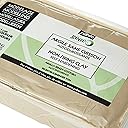
🎨 Mold your vision, no kiln required—air-dry brilliance awaits!
Gedeo 1.5 Kg Air Drying Clay is a premium, soft, and malleable grey clay made in the UK, designed for creative professionals and hobbyists alike. It air-dries naturally within 4-5 days without cracking, eliminating the need for firing. Perfectly sized for extensive projects, this non-firing clay offers a smooth texture ideal for pottery, sculpting, and diverse craft applications.


| ASIN | B005SBG8K2 |
| Age Range Description | Kid |
| Best Sellers Rank | 9,271 in Home & Kitchen ( See Top 100 in Home & Kitchen ) 10 in Clay |
| Brand Name | PEBEO |
| Colour | Grey |
| Country Of Origin | United Kingdom |
| Customer Reviews | 4.4 4.4 out of 5 stars (8,985) |
| Educational Objective | Creative Skill |
| Global Trade Identification Number | 03597587663027 |
| Included Components | 1 x GEDEO Air Drying Clay 1.5 kg , QPA302 |
| Item Dimensions | 17 x 11 x 4 centimetres |
| Item Weight | 1500 Grams |
| Manufacturer | Pebeo |
| Manufacturer Part Number | QPA302 |
| Material Type | Clay |
| Model Name | 766302 |
| Model Number | 766302 |
| Number of Items | 1 |
| Other Special Features of the Product | Air Drying |
| Recommended Uses For Product | Modeling |
| UPC | 787162487169 |
| Unit Count | 1500.0 Grams |
J**K
its clay
Gay Head cliffs in Martha's Vineyard consist almost entirely of clay. Clay is a finely-grained natural rock or soil material that combines one or more clay minerals with possible traces of quartz (SiO2), metal oxides (Al2O3 , MgO etc.) and organic matter. Clay deposits are mostly composed of phyllosilicate minerals containing variable amounts of water trapped in the mineral structure. Clays are plastic due to particle size and geometry as well as water content, and become hard, brittle and non-plastic upon drying or firing.[1][2][3] Depending on the soil's content in which it is found, clay can appear in various colours from white to dull grey or brown to deep orange-red. Electron microscope photograph of smectite clay – magnification 23,500× Although many naturally occurring deposits include both silts and clay, clays are distinguished from other fine-grained soils by differences in size and mineralogy. Silts, which are fine-grained soils that do not include clay minerals, tend to have larger particle sizes than clays. There is, however, some overlap in particle size and other physical properties. The distinction between silt and clay varies by discipline. Geologists and soil scientists usually consider the separation to occur at a particle size of 2 µm (clays being finer than silts), sedimentologists often use 4–5 μm, and colloid chemists use 1 μm.[1] Geotechnical engineers distinguish between silts and clays based on the plasticity properties of the soil, as measured by the soils' Atterberg limits. ISO 14688 grades clay particles as being smaller than 2 μm and silt particles as being larger. Mixtures of sand, silt and less than 40% clay are called loam. Loam makes good soil and is used as a building material. Formation Deforestation for clay extraction in Rio de Janeiro, Brazil. The picture is of Morro da Covanca, Jacarepaguá. Clay minerals typically form over long periods of time as a result of the gradual chemical weathering of rocks, usually silicate-bearing, by low concentrations of carbonic acid and other diluted solvents. These solvents, usually acidic, migrate through the weathering rock after leaching through upper weathered layers. In addition to the weathering process, some clay minerals are formed through hydrothermal activity. There are two types of clay deposits: primary and secondary. Primary clays form as residual deposits in soil and remain at the site of formation. Secondary clays are clays that have been transported from their original location by water erosion and deposited in a new sedimentary deposit.[4] Clay deposits are typically associated with very low energy depositional environments such as big lakes and marine basins. Grouping Depending on the academic source, there are three or four main groups of clays: kaolinite, montmorillonite-smectite, illite, and chlorite. Chlorites are not always considered to be a clay, sometimes being classified as a separate group within the phyllosilicates. There are approximately 30 different types of "pure" clays in these categories, but most "natural" clay deposits are mixtures of these different types, along with other weathered minerals. Varve (or varved clay) is clay with visible annual layers, which are formed by seasonal deposition of those layers and are marked by differences in erosion and organic content. This type of deposit is common in former glacial lakes. When fine sediments are delivered into the calm waters of these glacial lake basins away from the shoreline, they settle to the lake bed. The resulting seasonal layering is preserved in an even distribution of clay sediment banding.[4] Quick clay is a unique type of marine clay indigenous to the glaciated terrains of Norway, Canada, Northern Ireland, and Sweden. It is a highly sensitive clay, prone to liquefaction, which has been involved in several deadly landslides. Historical and modern uses Clay layers in a construction site. Dry clay is normally much more stable than sand with regard to excavations. Clay used to form tiles and other ceramic products. Bottle stopper made of clay, 14th century Clays exhibit plasticity when mixed with water in certain proportions. However, when dry, clay becomes firm and when fired in a kiln, permanent physical and chemical changes occur. These changes convert the clay into a ceramic material. Because of these properties, clay is used for making pottery, both utilitarian and decorative, and construction products, such as bricks, wall and floor tiles. Different types of clay, when used with different minerals and firing conditions, are used to produce earthenware, stoneware, and porcelain. Prehistoric humans discovered the useful properties of clay. Some of the earliest pottery shards recovered are from central Honshu, Japan. They are associated with the Jōmon culture and deposits they were recovered from have been dated to around 14,000 BC.[6] Clay tablets were the first known writing medium.[7] Scribes wrote by inscribing them with cuneiform script using a blunt reed called a stylus. Purpose-made clay balls were also used as sling ammunition. Clays sintered in fire were the first form of ceramic. Bricks, cooking pots, art objects, dishware, smoking pipes, and even musical instruments such as the ocarina can all be shaped from clay before being fired. Clay is also used in many industrial processes, such as paper making, cement production, and chemical filtering. Until the late 20th century, bentonite clay was widely used as a mold binder in the manufacture of sand castings. Clay, being relatively impermeable to water, is also used where natural seals are needed, such as in the cores of dams, or as a barrier in landfills against toxic seepage (lining the landfill, preferably in combination with geotextiles).[8] (See puddling.) Studies in the early 21st century have investigated clay's absorption capacities in various applications, such as the removal of heavy metals from waste water and air purification.[9][10] Medical use Traditional uses of clay as medicine go back to prehistoric times. An example is Armenian bole, which is used to soothe an upset stomach. Some animals such as parrots and pigs ingest clay for similar reasons.[11] Kaolin clay and attapulgite have been used as anti-diarrheal medicines. As a building material Clay as the defining ingredient of loam is one of the oldest building materials on Earth, among other ancient, naturally-occurring geologic materials such as stone and organic materials like wood.[12] Between one-half and two-thirds of the world's population, in both traditional societies as well as developed countries, still live or work in buildings made with clay, often baked into brick, as an essential part of its load-bearing structure. Also a primary ingredient in many natural building techniques, clay is used to create adobe, cob, cordwood, and rammed earth structures and building elements such as wattle and daub, clay plaster, clay render case, clay floors and clay paints and ceramic building material. Clay was used as a mortar in brick chimneys and stone walls where protected from water.
I**O
Good for Pottery
Very simple but worked very well for my pottery pots!
A**A
Good quality
Clay is perfect for moulding.
T**A
Clay
Once you are donr sculpting You should keep the clay sculpture in a cold dry place and don't touch it for 4 or 5 days or it will prevent cracks and it will fall apart. If you add too much water it will be sticky. It does smell a bit but its not as bad, Its very easy to use and its a great value of money. Im so happy.
M**M
review
as described, good value .good clay really easy to work with
A**4
Dense clay, easy drying
It's not like the clay I used in school and it's not polymer - it's like a cross between both. It's quite dense and you have to be strong to handle large amounts at once. If rolled too thin it will break when drying, so I used large chunks. It dried easily, was easy to wash from my hands. If you are a total beginner willing to make a mess maybe opt for something more cheap. This is a higher quality product. Also have to store in a damp plastic bag when not in use so it doesn't dry out!
C**E
A Decent Product with Some Caveats
I recently purchased this product, and while it has its merits, there are a few important considerations to keep in mind. The clay, when wet, is easy to work with and mold into various shapes and designs. It's pliable and great for creative projects. However, once it dries, it has a tendency to shrink and may develop cracks, which can be a bit frustrating. The extent of shrinking and cracking seems to be more noticeable when working with larger or thicker pieces, so be prepared for that. Another important point to note is the drying time. While the product claims a fast drying time, in reality, it varies significantly depending on the thickness of the material you're working with. Thicker pieces can take well over 24 hours to dry completely. So, if you're in a hurry to finish your project, you might want to consider a different product with a quicker drying time. In summary, this product is decent for creative projects, but you need to be prepared for the possibility of shrinking and cracking during the drying process. Also, keep in mind that drying times can be longer than advertised, especially for thicker pieces. If you're patient and plan accordingly, it can still be a useful addition to your art supplies.
C**Y
Great Air dry clay
This is a great air dry clay. Comparing it to Das - it has a smoother finish. So for example when you have rolled out both types of clay and you are cutting with a blade - with Das you get a bit of drag down the sides - with this clay, you get a super smooth cut that needs no tidying up. As anyone knows when you work with 'any' air dry clay you need water! But I found with this clay for rolling out and using with cutters, perfectly smooth finish. but more importantly for me, it was smoother to use on an armature for figure work. Saying that it is a very slightly firmer clay to Das so the figure work took a bit more effort to get the shape you wanted - but if the right sized amounts are used for adding to an armature, this wasn't generally a problem. Ie I found when trying to add smaller pieces and blending, it was harder to smooth one piece on to the next. Das is easier in this context. So for flat rolled out clay work where sharper edges and finishes are required - ie if using cutters? I would go for this clay. If you want to have a softer clay that spreads and can be manipulated more easily then Das maybe better. This clay needed less sanding than Das when dried too. Making slip with this clay is fine. Like all ADC it will crack unless dried properly ie with a damp cover and turned on occasion. I would def buy again and am now just going to attempt a wall hanging pot to see how it holds up to that.
E**E
Came quicker than expected perfectly intact. Clay is perfect for beginners, drys really quickly so make sure to have a spray bottle if you want to keep it sculptable.
C**N
Il a très content 🙂
A**Z
Rolig för att pyssla med
M**G
Von dem Ton bin ich absolut begeistert. Im Weichzustand ist er geschmeidig, hat eine angenehme Konsistenz und lässt sich super bearbeiten. Lässt sich prima mit Wasser anfeuchten, falls es spröde wird. Im ausgehärteten Zustand ist der Ton erstaunlich stabil. Habe mein erstes Probestück (ca. 1cm dick, teilweise gebacken im Ofen für 10 min) öfters fallenlassen, ohne dass es zerbrach. Auch als ich versucht habe es zu zerknicken, bot es guten Widerstand ohne zu zerbrechen. Bei größeren, "bewussten" Kraftaufwand würde es aber tatsächlich nachgeben. Dass aus Versehen was abbricht weil man irgendwohin drankommt, wird zumindest nicht passieren. Im Hartzustand lässt sich der Ton prima schmirgeln und schnitzen und es ist möglich sehr feine Details damit zu ritzen. Die Rissbildung, die manche Anwender hier beschreiben, kommt vermutlich vom schwankenden Wasseranteil in der Masse, schwankende Temperatur oder schwankende Luftfeuchtigkeit beim Trocknen. Ich formte zwei Probestücke, ohne zusätzlich Wasser zuzugeben d.h. direkt aus der Packung. Diese ließ ich beide im Ofen bei 100° für ein paar Minuten stehen. Da hatte ich nur minimale Rissbildung zu verzeichnen, selbst bei der teilweise sehr feinen Form von einem der Probestücke. Lässt sich aber prima herausarbeiten durch anschließendes Feilen oder Schmirgeln. (Achtung: Die Modelliermasse lässt sich nach einem Besuch im Ofen vermutlich nicht mehr mit Wasser einweichen). Bei Werkstücken, die dicker als 4cm sind, dauert das Aushärten sehr lange, selbst mit Ofen. Angenehm ist die Aushärtezeit bei 1-3cm dicken Formen: 30 Minuten im Ofen bei 100° Grad und einen Tag stehen lassen und das Ding ist fast komplett ausgehärtet, verglichen mit 3-4 Tagen laut Verpackung. Wie gesagt, aushärten im Ofen nur dann, wenn die Form auch tatsächlich final und komplett fertig modelliert ist! Mittlerweile arbeite ich eher mit Sculpey und habe seit fast 10 Jahren nicht mehr mit selbsttrocknendem Ton gearbeitet. Dieser Ton hier ist um vieles besser als jener, den ich vor langer Zeit mal benutzt hatte. Ich habe ihn ursprünglich zum Erstellen von Schokoladenformen mit lebensmittelfreundlichen Silikonkautschuk erworben, und weil das Material so gut ist, werde ich seine Einsatzgebiete definitiv erweitern!
H**S
prima
ترست بايلوت
منذ أسبوعين
منذ شهرين