Buy anything from 5,000+ international stores. One checkout price. No surprise fees. Join 2M+ shoppers on Desertcart.
Desertcart purchases this item on your behalf and handles shipping, customs, and support to KUWAIT.
⚙️ Master your airflow with precision power control — because comfort is a choice.
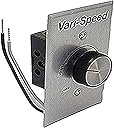
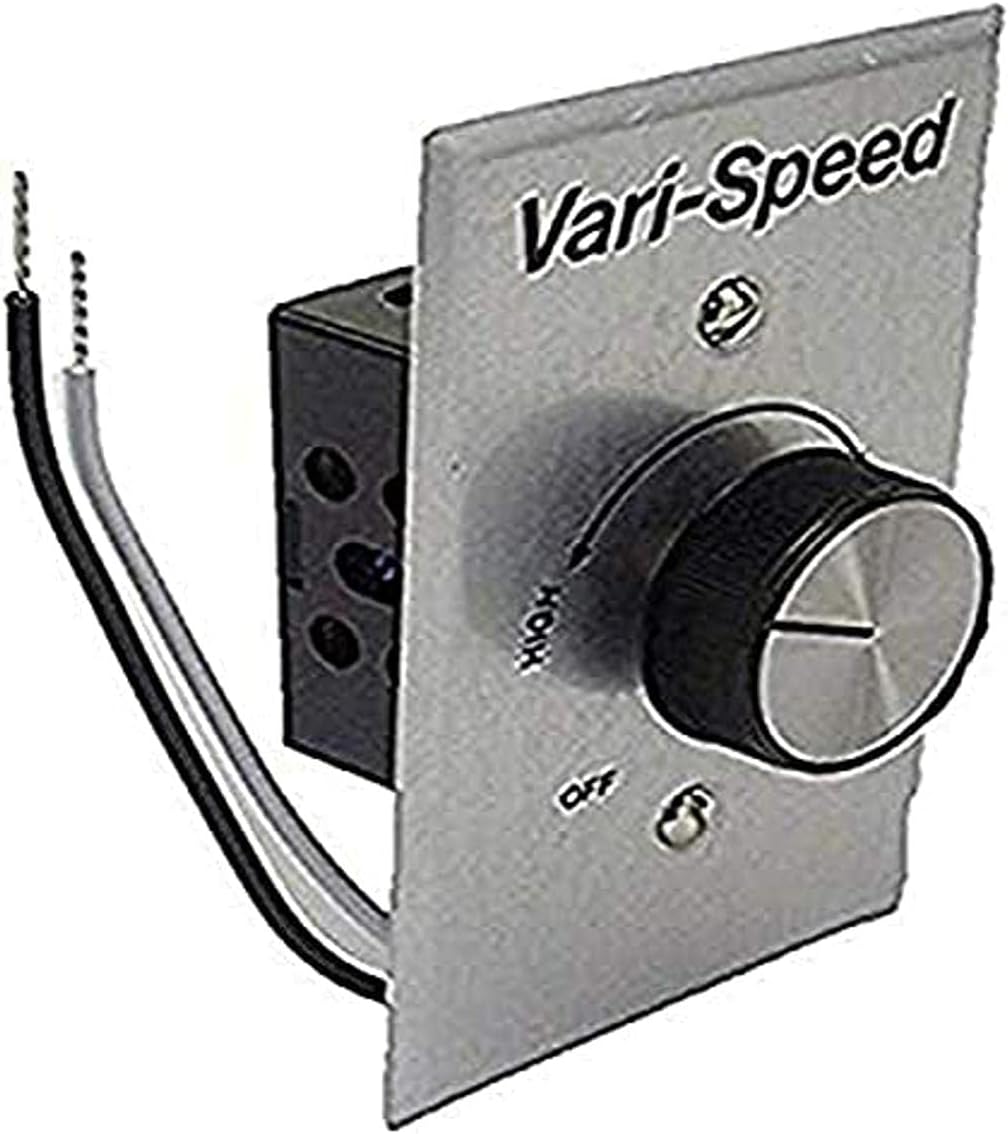
The KB Electronics 8811006 is a UL & CSA certified solid-state variable speed AC motor controller designed for shaded pole and PSC motors. Operating at 115V with a max current of 2.5 amps, it fits standard 2" x 4" wall boxes and offers infinite speed adjustment for fans, blowers, and ventilators. Its built-in minimum speed setting prevents motor stall, ensuring safe, quiet, and efficient operation—perfect for millennial professionals optimizing home comfort and energy savings.
| ASIN | B000F9B712 |
| Best Sellers Rank | #33,456 in Tools & Home Improvement ( See Top 100 in Tools & Home Improvement ) #3 in Electrical Motor Controls |
| Brand | KB ELECTRONICS |
| Brand Name | KB ELECTRONICS |
| Circuit Type | multi-way |
| Compatible Devices | Fans, Blowers, Fireplace Blowers, Attic Fans, Humidifiers, Ventilators |
| Connector Type | Screw |
| Contact Material | Copper |
| Contact Type | Normally Open |
| Control Method | Touch |
| Control Type | Variable Speed |
| Current Rating | 2 Amps |
| Customer Reviews | 4.4 out of 5 stars 293 Reviews |
| Global Trade Identification Number | 00663001020516 |
| Item Weight | 0.01 Pounds |
| Manufacturer | KB Electronics |
| Material Type | Plastic |
| Model | 8811006 |
| Mounting Type | Wall Mount |
| Number of Items | 1 |
| Operating Voltage | 115 Volts (AC) |
| Operation Mode | manual |
| Part Number | 8811006 |
| Smart Home Compatibility | Not Smart Home Compatible |
| Specification Met | CSA, UL |
| Switch Type | Push Button |
| Terminal | Screw |
| UPC | 663001451662 663001020516 |
| Unit Count | 1.0 Count |
| Wattage | 287.5 watts |
A**N
High quality construction, simple design, easy to use and set up
This review is for the KBWC-13K solid state speed control. I purchased this controller with intent of modifying it so the fan of my Magic Heat unit would run slower and be less noisy when the woodstove fire was producing less heat. The Magic Heat uses a simple (on/off) thermostat controlled 1/200 hp single speed shaded pole fan motor to circulate heat into the room. So my next step after receiving the KBWC-13K was to disassemble it to see what I was working with. The attached photo illustrates the few components that are inside. Overall the components, assembly and soldering are of very good quality. The only oddity is the small trimmer potentiometer (black circular part with blue center located in middle front of the picture) which is wedged up against the larger control knob potentiometer leads. There's no real problem here; just not a typical component mounting. I suspect the trimmer is located in this manner to prevent heavy handed screwdriver users from damaging the trimmer. Overall I am very pleased with the construction/quality of this product. There are three minor design “features” to keep in mind with this speed controller given it was originally developed back in the 1960's. Most users probably won't notice these; but should be aware of them. The first requires understanding that the two potentiometers are set up in parallel. The circuit triggers on whichever potentiometer is set to a lower resistance. So, if the trimmer is set so the motor has a high minimum speed, then there's very little usable speed adjustment range from the control knob and vice versa. The second is that the circuit has control setting hysteresis. This can be observed if you dial the speed of a motor down to a very slow steady rpm and then disconnect the power to the circuit (as happens with the thermostat switch of the Magic Heat). When power is reapplied, the fan may struggle to start, if it does at all. If there was no hysteresis, the fan would spin back up to the original slow rpm setting. The third is the circuit's asymmetrical triggering of the triac. This can sometimes be heard as a repetitive, very low volume, loud-soft, HUM-hum-HUM-hum sound. This noise is often louder when working with old, poorly mounted, or cheaply made motors. I can usually identify this sound when I'm in an adjacent room where the low frequency of this noise comes through over the fan airflow noise. There's a ten page Teccor Electronics application note AN1003 on the web that provides a more technical understanding of this type of speed control. The entire controller operates at AC line voltages so disassembly and modification should only be done by a person educated/trained in AC power circuits/electronics. Here I'm suggesting an alternative use for the KBWC-13K; not a detailed modification process with essential safety considerations. The KBWC-13K potentiometers are configured as two-terminal components (center terminal, the “wiper”, is connected to one of the end terminals). This means I can easily replace the trimmer potentiometer with a two terminal negative temperature coefficient (NTC) thermistor. With a suitable NTC in place of the trimmer, the motor rpm will hold a steady slow speed at room temperature and increase the motor rpm with increasing temperatures up to the full motor speed at some desired high temperature. The control knob potentiometer is now used like the original trimmer to increase the minimum motor speed if it happens to be too slow at the desired low temperature. Another similar modification back in the 1970's/1980's was using a photocell in place of the trimmer which makes the fan speed up with increasing light levels. Keep in mind that these are low cost, simplistic controllers; the performance can vary significantly from one installation to another. After the modified controller was connected into the Magic Heat circuit, I decided to measure the fan current consumption. While the shaded pole fan was performing very well with the controller from minimum to maximum speed; measurements showed the fan was only 10% efficient at full speed and only slightly better at reduced speeds. Shaded pole motors under 1/15-1/20 hp are known to have very low efficiency which is what prompted me to test the current consumption. A Permanent Split Capacitor (PSC) motor usually has about double the efficiency of a similar hp shaded pole motor. So I modified the Magic Heat to use a PSC motor. However, the PSC motor was surprisingly noisy and sluggish when starting at low speed settings. An on-line search revealed that for a PSC motor, only the main (“run”) winding should be controlled by a phase type speed controller while the auxiliary (“start”; one with the capacitor) winding should bypass the speed control so it always has full AC power. The common two wire installation of the speed control has it wired in series with the motor so the motors' run and start windings are in parallel and powered by the controller simultaneously. This alternate approach makes the motor a 3-wire configuration, eliminating use of the built-in on/off switch of the speed controller (which I wasn't using anyway), and requires a separate on/off power switch (Magic Heat thermostat covers that). Having full voltage on the start winding, regardless of the speed controller setting on the run winding, provides full power for motor starting at all speed control settings. This modification reduces the slow speed operating noise (to a point) and increases motor efficiency at reduced speeds. In my installation, the 3-wire PSC motor configuration operates at a full speed efficiency of 33% and increases to a high of 53% at the minimum speed. Again, this is a modification that should only be performed by an electrician. Final note. If plan on buying 3 or more controllers; find a seller that reduces the selling price for buying multiple units vs a flat rate per unit. Sellers that adjust the built-in shipping costs according to the weight of your purchase may save you some money for multiple units. The single unit pricing of this Amazon seller is reasonable for a one or two unit purchase.
E**S
Works well for a parts washer pump speed/flow control
I needed a way to control the speed/flow of the pump in a parts washer tank, and this fit the bill. Its a low wattage / low amp motor but even the lowest flow one I could find would still spray too hard. This motor control works great to vary the power to the motor as needed.
Z**N
Works as described - satisfied.
Works as described. This was purchased to permit speed variations for a fireplace insert fan as the one we had before was not designed for that and was hard to use and difficult to have a nice range of speeds over the turn of the knob. I have installed similar devices so this was easy for me and really should be for anyone. The task of getting new outlets and running wires, etc. was a bit of a task as I needed to wire this in line to a new outlet for the fireplace fan to plug into - but that has nothing to do with the item itself. It has a nice range of gradual speeds for the fireplace insert fan and a nice "click" for the off position. Nothing really to complain about yet.
M**N
Tested working, can't comment on longevity, but it effectively controls an AC motor.
Works so far. I was able to adjust it down to having it almost not be able to run the exhaust fan. Sadly the fan makes a lot of noise (seems angry) when it's barely running so I adjusted it to run at 50% at the lowest. I notice other commenters remarking that they can't get it to go low enough, make sure the Amperage of the version you buy fits the application. I got the 2.5 amp for something that will at most take 1 amp. So it worked pretty well. Documentation is meant for electricians it seems, but I figured it out.
R**C
KB Electronics 8811006 Solid State Speed Control - full speed control plus on/off switch!
I just replaced the 50 year old Hydronic Unit Heater in our garage. The fan motor had finally given out and parts were not available. It had a 2 speed fan and I usually ran it on the slower speed to cut down the fan noise. We have a bedroom on the other side of the back garage wall. I bought a Modine model HC33 unit heater with a 1/25th HP single speed fan motor rated at 1550 rpm. The fan is pretty noisy so I needed to add a Solid State Speed Control to slow it down. 1/25th HP at 120 vac draws about 0.3 amps. I ordered the KB Electronics 8811006 Solid State Variable Speed AC Electric Motor Control, 2.5 Max amp, 115V, KBWC-13K from Amazon. The on/off switch was a bonus! I am also using a Honeywell Aquastat to turn the fan on when the water is hot and off when cold. That should add some longevity to the motor. It works great! I turned down the speed until the heater is quiet and it still keeps our garage warm!
D**S
Works But Knob Is Wonky Plastic Junk
It works but the knob is wonky / wobbly /crooked. Either the post for the knob or the knob itself isn't straight. But I'm keeping it because it works electrically. One more not, the stem is plastic instead of metal so the nut that holds it on can't be tightened to hard or you'll strip it quickly. I wish they had made the stem and main shaft out of metal.
J**N
Works perfect for fireplace fans
Works good for fireplace fan control, much better than 3 position switch i had before.
D**5
Not a smooth taper
The control has a small adjustment screw on the side that you are supposed to tweak when you install. The screw allows you to set the lowest speed (which should not be so slow that the motor stalls). You can set a slow speed easily enough, but two problems crop up after installation: 1. The taper isn't smooth, meaning that (in may case, with a fireplace fan) there really isn't a "medium" speed. In other words, as you turn the control towards "low" the speed of the fan stays pretty much the same until you reach a certain point at which the speed drops to the previously mentioned lowest setting. Same deal in reverse, i.e., as you turn the dial toward "high," the fan runs slow until it jumps to full speed. 2. If you set the control low enough to be, well...low, then any additional draw put on the same circuit stalls the motor. In my case I turned on a light, so we aren't talking major draw. I tried changing the adjustment (putting more load on the circuit and then setting the "low" adjustment a bit higher), but I couldn't find a happy medium. If I set the adjustment high enough to not be bothered by a minor additional stress on the circuit, the "low" setting was almost the same as the "high" setting. So, with these limitations, this speed control is effectively an on/off switch, something I could have purchased locally for less than a buck.
Trustpilot
1 month ago
2 weeks ago