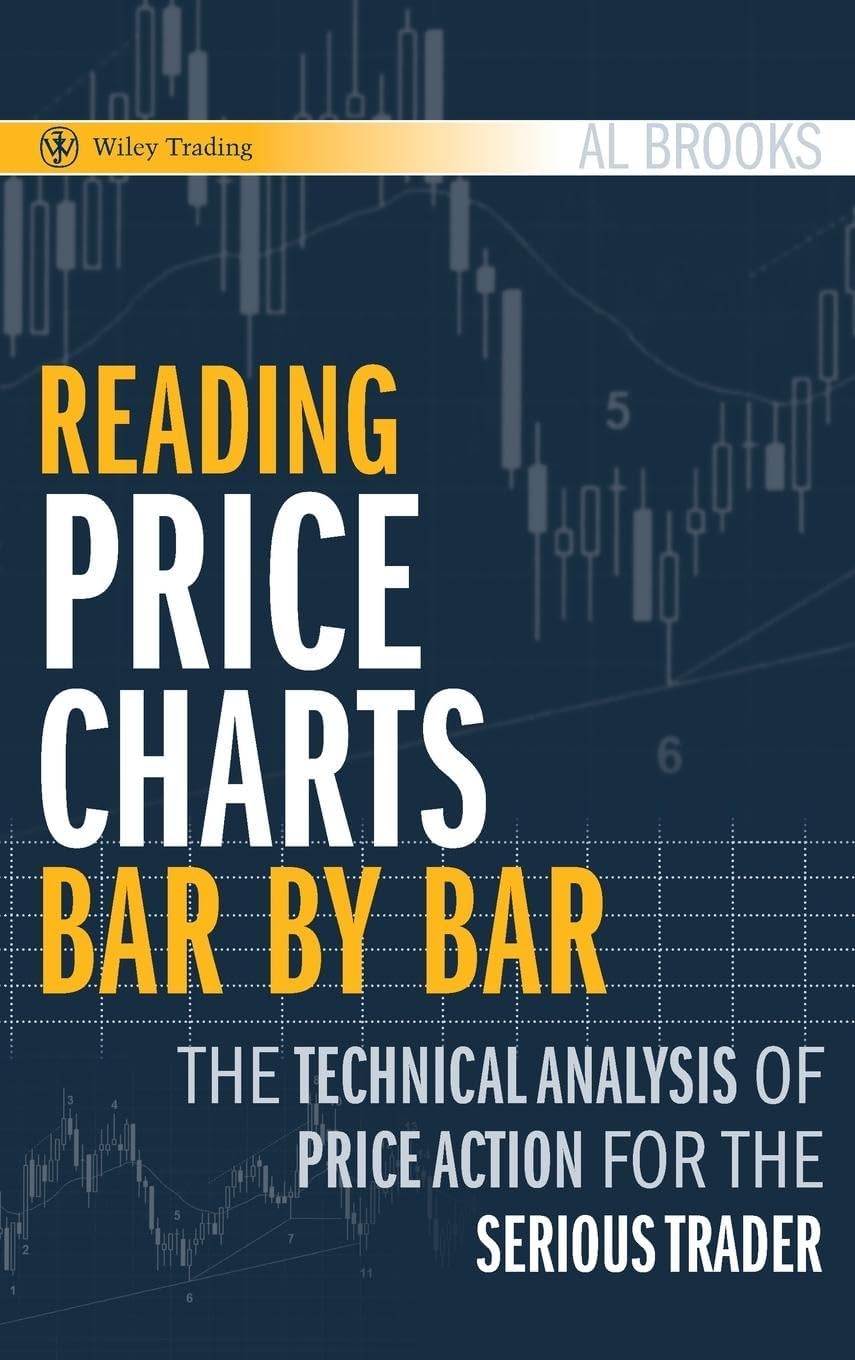
Reading Price Charts Bar by Bar: The Technical Analysis of Price Action for the Serious Trader: 416 (Wiley Trading)
Product ID: 53680979
Buy anything from 5,000+ international stores. One checkout price. No surprise fees. Join 2M+ shoppers on Desertcart.
Desertcart purchases this item on your behalf and handles shipping, customs, and support to KUWAIT.
Buy Reading Price Charts Bar by Bar: The Technical Analysis of Price Action for the Serious Trader: 416 (Wiley Trading) 1 by Brooks (ISBN: 9780470443958) from desertcart's Book Store. Everyday low prices and free delivery on eligible orders. Review: Worth it's weight in £50 notes! - This is by far the best book on technical trading I've read. Brooks works from the notion that every bar on the chart is important, and reading what each one tells you will help you reliably and consistently identify high probability trade setups using nothing more than a few trendlines and the 20ema. Every page is crammed to bursting with information and Brooks makes no attempt to comfort the reader by making his explanations easy to follow - you have to work hard at sentence on every page to get the most out of it, and at times it's hard going, but it'll reward you with a much more in depth appreciation for the markets and where the money is. My understanding of charts and my confidence in placing trades based purely on price action has been transformed by this book. The printed charts can be difficult to read as they're quite small, but you can download them all from [...] which makes them much easier to follow. While the author trades predominantly US stocks and Eminis, his methods and analysis are applicable to all major markets including forex, indices, commodities and futures. I absolutely love this book, and my copy looks ten years old because I'm in it constantly, underlining passages, making notes, sticking stickies into it and generally reading and rereading. If you work hard at it and give it the effort it deserves (nay, demands), it's a goldmine. Brilliant. Review: but it gives a absolute brilliant explanation for all the major setups and patterns what ... - haven't, read the whole yet, but it gives a absolute brilliant explanation for all the major setups and patterns what you can find in Bukolwski's encyclopedia. Easy to read, but it's not for beginners for sure. Loads of books out there what you can start with and you will need it to understand what Al Brooks trying to give you. As I read, I feal like someone actually want to teach and not refering to websites or forums like Bigalow or John Carter. Well written, somethimes need to go back a few pages to see on the charts what he's actually talking about. Do need to do your own research in the mean time, but this book changes the view I look at my charts. Failers, possibilities, late entry, exits and targets, stops, you name it it's in here bar by bar. cannot recommend high enough.
| Best Sellers Rank | 463,143 in Books ( See Top 100 in Books ) 7 in Technical Analysis of Personal Finances 346 in Professional Finance |
| Customer reviews | 4.4 4.4 out of 5 stars (475) |
| Dimensions | 15.75 x 3.3 x 23.11 cm |
| Edition | 1st |
| ISBN-10 | 0470443952 |
| ISBN-13 | 978-0470443958 |
| Item weight | 644 g |
| Language | English |
| Print length | 432 pages |
| Publication date | 9 April 2009 |
| Publisher | Wiley |
A**9
Worth it's weight in £50 notes!
This is by far the best book on technical trading I've read. Brooks works from the notion that every bar on the chart is important, and reading what each one tells you will help you reliably and consistently identify high probability trade setups using nothing more than a few trendlines and the 20ema. Every page is crammed to bursting with information and Brooks makes no attempt to comfort the reader by making his explanations easy to follow - you have to work hard at sentence on every page to get the most out of it, and at times it's hard going, but it'll reward you with a much more in depth appreciation for the markets and where the money is. My understanding of charts and my confidence in placing trades based purely on price action has been transformed by this book. The printed charts can be difficult to read as they're quite small, but you can download them all from [...] which makes them much easier to follow. While the author trades predominantly US stocks and Eminis, his methods and analysis are applicable to all major markets including forex, indices, commodities and futures. I absolutely love this book, and my copy looks ten years old because I'm in it constantly, underlining passages, making notes, sticking stickies into it and generally reading and rereading. If you work hard at it and give it the effort it deserves (nay, demands), it's a goldmine. Brilliant.
G**.
but it gives a absolute brilliant explanation for all the major setups and patterns what ...
haven't, read the whole yet, but it gives a absolute brilliant explanation for all the major setups and patterns what you can find in Bukolwski's encyclopedia. Easy to read, but it's not for beginners for sure. Loads of books out there what you can start with and you will need it to understand what Al Brooks trying to give you. As I read, I feal like someone actually want to teach and not refering to websites or forums like Bigalow or John Carter. Well written, somethimes need to go back a few pages to see on the charts what he's actually talking about. Do need to do your own research in the mean time, but this book changes the view I look at my charts. Failers, possibilities, late entry, exits and targets, stops, you name it it's in here bar by bar. cannot recommend high enough.
P**Y
Worth the work
Like the other reviewers have mentioned, this book is work. Real work. You must put the time and effort in to understand what this man is saying, keep at it and go over it repeatedly untill you understand the lessons contained within. Its far from easy, but the majority dont do the necessary work to become skilled at this profession, they are the ones who provide liquidity and get eaten by the pros who do what it takes to become phenenomenal. These methods work regardless of the time frames that you trade, the principles work. If you are comitted to your goal of being a trader to be reckoned with, buy this book and master it.
L**.
Such great information. So badly organised. Such terrible diagrams.
I read the other reviews that said this was a hard book to read and wondered how hard it could be. I've been involved in the financial markets both professionally and personally for well over ten years. I'm an investor and a trader and I've also developed financial software. So I'm not a beginner. I had heard lots about Brooks' methods and decided to learn them from the horse's mouth. First of all, this book is NOT "badly written" in the obvious sense. That is, the author can write perfectly intelligible sentences. Certainly the book begins well with a clear discussion of what moves markets, institutional trading and the impact of things like news and algorithmic trading. It's when he starts discussing price action (about halfway through chapter one!) that things take a turn. First of all, the book is really, really badly organised. For example, as early as page 10 he mentions the "EMA Gap Bar short setup" and the "Failed Final Flag". Now AFAIK these are Brooks' own terms for particular chart patterns. But he talks about them as if you should know what they mean, despite the fact he does not attempt to explain them until chapters 4 and 9 respectively. Let me be clear: he does not mention them in the sense of an introduction to things you'll learn on page whatever - no, he says look at the Failed Final Flag on Fig. 1.2, with no further explanation. This is something that happens on almost every page. You are forever consulting the index and looking half a dozen chapters ahead. And often the explanations, when you find them, are very hard to follow. This is what people mean by difficult to read. To continue with the Failed Final Flag example, I ended up asking AI, which also seemed a little confused (presumably because it had read Brooks' books). Eventually I found a forum where someone explained it more clearly than the author. Really fundamental concepts to Brooks' trading strategies, such as High/Low 1 and 2 patterns are really badly explained. He expounds in dense passages like (to pick one at random): "If there is a bear and there have been several bull entries that failed as the market continued to sell off, each of these entry prices (the high of each signal bar) will be targets once the reversal up finally succeeds." That is fairly typical, and to me that is hard to follow. But the worst thing is the diagrams. Words almost fail me here. If there is one thing that could help a book about technical trading it is clear diagrams. So much of that abstruse text could be explained by a simple picture. But no. Instead, we have hundreds of diagrams that are simply black-and-white screenshots of a full chart window. The only annotations are numbers, and it is totally unclear what the numbers refer to unless you have 20:20 vision, a 10x magnifying glass and a micron-scale ruler. A simple chart might have 20 numbers on it, of which maybe half will be mentioned in the text. What's more, he might only discuss one or two relevant candlesticks on a chart, but he prints the full chart, zoomed out to max, with maybe two whole days' worth of 5-minute candles on it. I really cannot get my head around it. Why would anyone do that? I assume it's to do with "context", i.e. knowing what happens leading up to the interesting candles, but the way he does it is infuriating and I found most of the charts to be useless because this. So why did I give it 3 stars? Because if you persevere, and use the internet like a dictionary for every term you don't understand, then it is clear Al Brooks knows his stuff. I learned a lot from this book, and it made me think about day trading in a whole new light. He explains price action in ways I'd never considered, literally discussing the significance of every bar of a trade. His big thing is context, knowing what "phase" the market is in moment to moment, and that alone will save you a fortune as a trader. Just be prepared for some long evenings and some frustration understanding it all!
J**T
Great story but badly written
Recently hospitalised for 3 days which gave me the opportunity to get through the worked examples in Chapter 15 alongside the charts (downloaded from Wiley) printed on A4. Now able to understand what Al is on about in the remainder of this book and in his webinars. He knows how to scalp. Very grateful to him for sharing his ideas. Likes to point out 3 or 4 reasons to enter any trade rather than focusing on the set up and key trigger. This complicates the story and clearly made it impossible for whoever proof read the work to have any idea what was going on, so he simply signed off the first draft and ran for the hills! Managed to extract a few key elements from the book and traded them last week on CL, NG, GC, TF, 6B & 6E futures. 42 winning trades (average = 4.1 ticks), 12 loosing trades (average = 3.2 ticks). Been in this game for 10 years and find it hard to believe anyone who claims to consistantly deliver better results than these.
V**A
good information on this book
M**O
This is the top book on reading price action and understanding Technical Analysis of today's institutions. But the quality of the print is bad, as it seems for every new Wiley book sold. The print is advertised as a hardcover, where actually it is not, its a paperback (gluebonded) inside a fake carton cover. In the first page it says "Printed in the United States of America" and "Printed on Acid free paper" where in the last page it is written "Print and bound by CPI Group (UK)". The paper used for this print is cheap copy machine paper. First picture is the book for sale new, second picture is the actual book by Al Brooks printed in the United States of America.
A**S
I am a full-time trader, and have been for well over 10 years. I will not write in great detail about this book, but just want to share some general impressions and reactions to a few of the other reviews. First of all, this is a difficult book to read. One reason is simply that there is so much information in the book, and all of it is important. It really is necessary to read the book 2-3 times, taking notes, and taking notes on the charts. Consider this book to be an advanced course in trading (more than chart reading). On that same thought, I think this would be an enormously difficult book for someone new to trading. If you do not have a good understanding of the basics of traditional technical analysis (Wyckoff, Edwards and McGee or Murphy, maybe the Schwager book on Technical Analysis) then I cannot imagine that this book will be productive for you. You would be better spent putting in the serious (probably more than a year) time needed to get a good background, and then come here. I think this book will also be of limited utility for someone who has not traded and maybe even who has not traded actively. If you make a few decisions a year in your Ameritrade account, there is still value in this book for you, but you are not the target audience. There is no magic method or guru to be followed in this book. This is a profound book that deals with applying sound fundamentals to market action. Some (much) of the analysis is subjective and flexible, but that is the nature of real time trading -- it often is possible to read any given moment in 4-5 different ways. Because this book makes an effort to show you the thought process of trading, it appears needlessly thick to some reviewers who have suggested that more simple examples are needed. I disagree. If you go through the examples in this book 4-5 times each you will only have the entry level understanding necessary to start learning from the live market. This is not the fault of the author by any means -- he has actually done an exceptional job of presenting the information you need to trade profitably. There are two legitimate production issues with the book. The first is that the charts are tiny, but Wiley makes the chart graphics available from their website for free. You would be well advised to download all the graphics files there and print them out or study on your screen. For my own learning, I found annotating printed versions of the chart by hand to be very useful. The second is the issue that the book introduces concepts in the wrong order. Frankly, I agreed on my first read through and was fairly lost because I didn't understand the author's labeling system or some of his unique terminology. I would recommend skimming the entire book, then starting over and referring to the glossary frequently on your second read through. A second edition would benefit from a brief first chapter "primer" to introduce concepts like H1, H2, etc. (Another aside, don't get too caught up in labeling H1 and H2 bars!) Lastly, some reviewers have been critical of the writing style. I completely disagree. It is obvious that the writer has a technical writing background and the actual quality of writing is head and shoulders above most trading books. In short, this is a fantastic book. Certainly one of the best trading books I have read in a long time, but this is a book that demands you study it and study it again. Not a book for new traders and not a book to be read casually.
J**N
This is one of the best books available on technical analysis and price action. I picked it up after hearing Tom Hougaard recommend Al Brooks’ work in Best Loser Wins (another must-read). A heads-up: some concepts in the early chapters can feel dense at first. But if you stick with it, the ideas become much clearer as you progress—many of the hard sections click later because the book revisits and expands them with better context. I found it especially helpful to go back and re-read earlier chapters after finishing a few more; with the additional understanding, the material becomes far more intuitive. If you’re serious about learning price action properly, this book rewards patience and repeat reading.
R**O
O livro(conteúdo) e o autor dispensam qualquer tipo de comentário. Não foi por acaso que ambos e sua filosofia de leitura gráfica são talvez a maior referência atual de Price Action. Se você quer ter aprender a alma da leitura de preço esse é o primeiro livro que deveria ler. Não há qualquer tipo de “porém” quanto a esse aspecto, exceto por ser um conhecimento extremamente metódico e minucioso, para não dizer cirúrgico, a se aprender. É um livro para quem tem gosto na área. No entanto, infelizmente todo esse sabedoria não teve devido reconhecimento se comparado com a qualidade do papel das páginas . Por ser um livro de conhecimento para vida toda, as folhas deveriam ser pelo menos semelhantes às outras dos 3 livros referência do autor. O que não acontece. São folhas fracas, como se fossem oriundas de reciclagem de papel. O que acaba dificultando a marcação para estudo e maior durabilidade do material para consultas do dia a dia. A editora e a Amazon poderiam rever esse problema porque quem compra esse tipo de livro, não está atrás de apenas uma leitura casual ou uma leitura de curiosidade.
Trustpilot
1 month ago
2 months ago