




550kg High Torque RC Servo, 2 in 1 Servo and Motor 16V~24V High Voltage Full Metal Gear Digital Servo
Product ID: 560004172
🔋16V-24V high voltage range
⚙️550kg.cm max torque
🛡️Full metal gear + multi-protection
Buy anything from 5,000+ international stores. One checkout price. No surprise fees. Join 2M+ shoppers on Desertcart.
Desertcart purchases this item on your behalf and handles shipping, customs, and support to KUWAIT.
⚡ Dominate your robotics game with torque and precision that won’t quit!
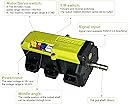
The DOCYKE 550kg High Torque RC Servo is a robust, full metal gear digital servo designed for high voltage (16-24V) applications. Delivering a staggering 550kg.cm max torque and 0-360° rotation, it features dual servo/motor modes, magnetic encoder feedback, and comprehensive protection systems. Compatible with major RC and Arduino platforms, it’s engineered for demanding robotics, remote control vehicles, and advanced mechanical projects.


| Best Sellers Rank | #154,262 in Toys & Games ( See Top 100 in Toys & Games ) #222 in RC Servos |
| Customer Reviews | 4.4 out of 5 stars 54 Reviews |
T**G
Excellent servo for robotics
I am building a large (5 foot tall) robot for Halloween and needed a way to rotate the head (a 16" plywood cube). This easily handles the job and is far more powerful than the strongest 1/5 hobby RC servo that I could find at double the price. It also has a D-profile 8mm output shaft which is much better for high torque applications than a 25T RC servo output. I really like the manual potentiometers for precision adjustments of center point and range. Mounting this is easy as well. Lots of holes with pre-molded nut retention, etc. The plastic housing I believe is glass reinforced nylon so is very strong.
R**K
Powerful servo! Perfect for tinkering
Solid piece of equipment. Perfect for tinkering! Very heavy duty, in fact be careful you could hurt yourself if not careful
B**Y
Good
Worked well with Docyke controller
W**N
Very strong at this price
The difference between the s350 and s550 is the planetary gear ratio. I use both of these. The S550 is slower but has 57% higher torque. The mounting holes are the same. Electrically they are similar. The power connector on the s550 is capable of higher current and is an improvement over the 2.54 mm spaced pins on the s350. My application needs two of the higher torque units, but the final drive gears failed on one (per mfg specs, the motor torque limit should have prevented this). Amazon immediately replaced the bad unit.
A**R
Beware of the 5VDC Control Power; Product Development at Customer Expense
I previously purchased two of the 350kg servos for an RC model skid-steer project. This was a long-term build, and so the servos were not put into service until a couple of years after purchase. I tested them initially and was satisfied with their function and performance and I, essentially, "designed around them". They were used to control two hydraulic valves and loaded about 25% of their rated torque. Full travel was around 30 degrees at 2 second timing. Once they were put into service, the servos functioned perfectly for the first 5 days of testing at about 4 hours per day. On the 6th day, while under very minimal load and/or movement (driving at constant speed and in a straight line}, both servos began to jump back and forth erratically and at full travel for around 10 seconds, and then stopped. In addition, other controls failed simultaneously. What I found during inspection was that both servos were completely dysfunctional (unresponsive, no movement) except that one servo still supplied 5VDC as control power. In addition, all control electronics downstream were destroyed except for those of another powered servo of another brand. There was no evidence of circuit heating/burning, just electronic failure. Because the DOCYKE servos were the only power source for control, and because they were powered by a stable 24VDC supply, the only conclusion I can come to is that a failure within one of the servos PC boards (likely the one with no 5VDC output after failure) caused a high voltage (presumably servo supply voltage) to be induced into the controls. $500 in parts and three days of labor later, the problem was fixed. I've now decided to use a separate 5VDC power source for control and isolate the servos' supply power by clipping the positive conductor from each to prevent this from happening again. I have sent two service inquiries to the customer support email regarding this issue and inquiring as to whether or not I could purchase two replacement PC boards to repair my otherwise like-new servos. Replacement would be simple, with only two soldered motor connections. These emails were sent a month or so apart. I have received no response to either. While I didn't expect "warranty service", and would have accepted "sorry, we don't sell parts", I find being ignored somewhat offensive. I'm left to wonder if this is a known problem that they simply don't want to talk about. I previously had had problems with the power connectors and one of the pots that controlled the throw of my original servos. The connectors came loose easily and were inadequately sized for the amperage and appropriate conductors. They were a ridiculous design choice, in my opinion. Also, one of the "throw" adjustments was dysfunctional, which I was able to correct by adjusting transmitter settings. These pots also made it difficult to coordinate parallel operation of two (or more) servos. Customer service responded within a day to direct me to replacement connectors available on Amazon. I didn't report the throw adjustment defect because of my "workaround". Interestingly, the new replacement servos I purchased recently have improved power connectors, and the "throw" adjustment has been eliminated. This leads me to conclude that these servos are still in the development stage, and improvements are being based upon negative customer experience. These are powerful servos that have some anomalies that may or may not affect your application. They do have some erratic behaviors and haven't proven to me to be reliable, but they do have some redeeming qualities. I would classify them as somewhere between "toy" and "hobby" quality. I've been flying RC planes for years and would not put a product of this quality into one of my planes. So I'll continue to experiment with these servos in my (mini) skid-steer project, although now with a completely isolated (power supply, transmitter, and receiver) kill switch, and not much expectation of support from DOCYKE. I think the price of these servos is reasonable for what they are.
C**Y
Very powerful
I have three of these servos, and they're very, very powerful. Crazy amounts of torque, and easy to set up, overall. The physical design is nice, with good placement of bolt positions. Pretty accurate in positioning, too. I wish they had a different and more-rugged power connector, though. One caveat: They're powerful enough and fast enough to be moderately dangerous. Make sure to stand clear of them and _keep your hands away_ when they're powered up. You can limit their arc and initial position easily enough, but if you moved the controller position while they're turned off, they'll go to the new position right away, at full speed and power. I ended up including some physical stops for the lever one was driving, and used a belt drive (that can slip some) for another. For the price, you won't find another servo with more power and features, especially in this form factor.
S**H
Infant failure with first use.
I was going to use this servo to provide the steering for a large RC project. The servo is solidly built and has multiple mounting choices. Once I got it mounted I temporarily wired it to the 6S (22.2V)battery being used to power the project so I could center it and connect the front wheels. I applied the power and the power was on for a few minutes before I turned it off. Nothing happened as expected. Next I connected the PWM output from the RC receiver and started to cycle it. That's when the magic smoke was released and a loud pop was heard before I could turn off the power. Before things went wrong the shaft was responding to the controller input. I checked the polarity and voltage of the supply and signal. The batteries were actually at 11.8V with proper polarity. The signal and ground were properly connected. I am using a DumboRC X6FG receiver. The receiver is supplied with 7.4VDC to power another servo. I don't know if the issue was caused by the signal voltage was too high or this was an infant failure issue. I have ordered a replacement servo and reduced the receiver supply to 5.0 VDC.
Q**N
Beefy
Slings a ten pound weight around like nothing. One of the beefiest hobby servos I've used and will be getting more. Just wish I could get individual parts from kits on here
N**O
Nice product
Nice product and service
Trustpilot
2 months ago
1 month ago