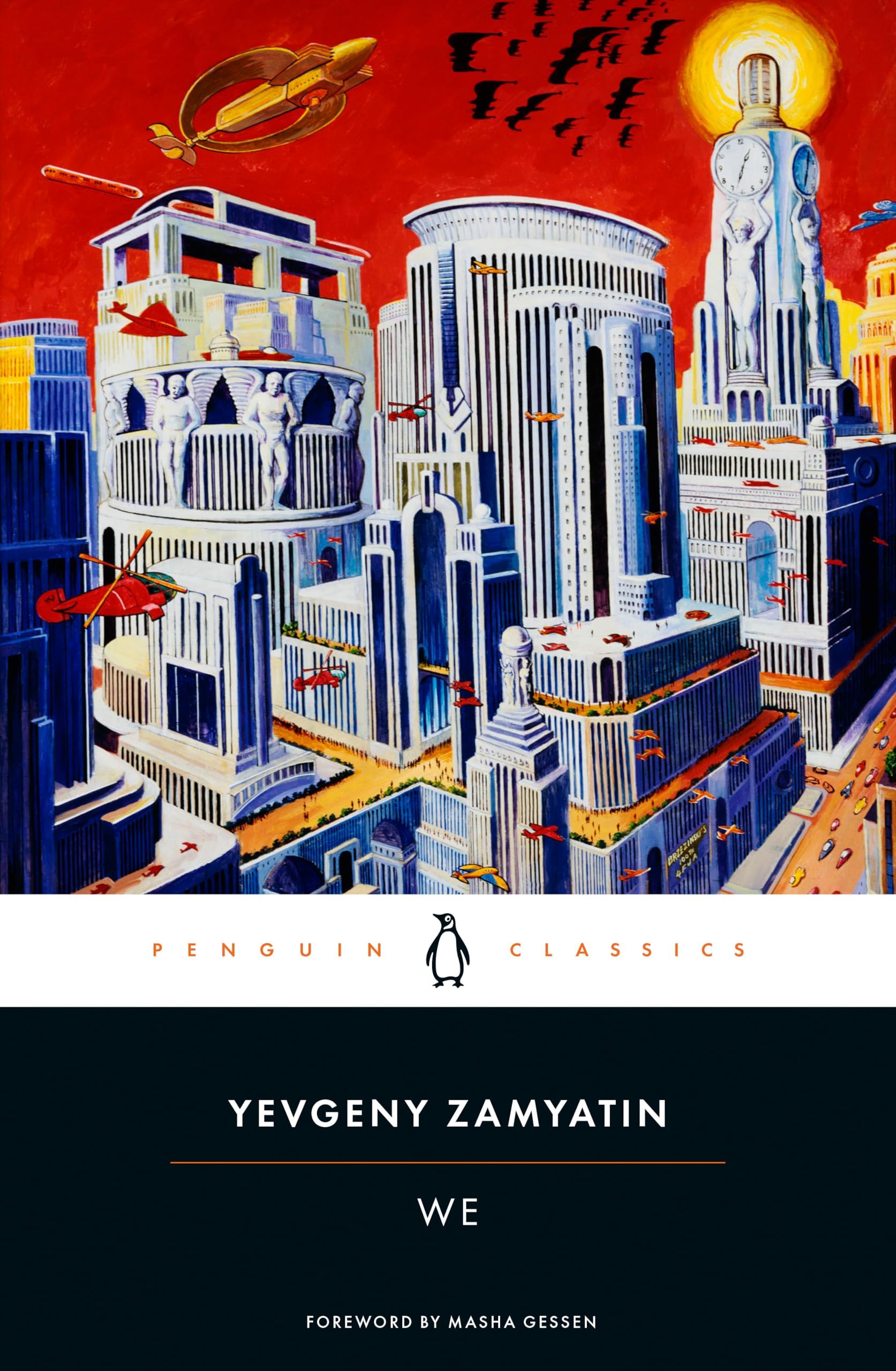

We [Yevgeny Zamyatin, Clarence Brown, Clarence Brown] on desertcart.com. *FREE* shipping on qualifying offers. We Review: An Examination of Us - Yevgeny Zamyatin in his creation of We the novel allows the reader into the personal issues of a number of the One State. This internal struggle not only affects the mind of this number but it starts to get him into situations that he never imagined. While this overall plot is an impressive feat, it is the inner working that Zamyatin is subtly commenting on that really drives a reader to keep going. The dystopian world the Zamyatin sets up has both equal creativity as well as reality. The time he is writing in, during world war one and his own country’s revolutions, brings forth a fear that readers of the time could relate to. This dystopian world was a possibility, in some capacity, for all of it’s futuristic details, and as the readers of the time, settled into their minds for the long haul. As a present day reader, it still resonates ninety years later. As a member of the One State, the character D-503 brings to light the rebellion within us all. Whether we like it or not, it seems hardwired within our system to question what is around us, including our authorities and systems. And yet, his final choices contrast to the struggle underneath all humans: order and the loyalty of repetition. We have proven as people that we will give up freedom for peace, and will submit to the yoke if the promise is happiness. The allusions the Zamyatin makes to the weakened human soul, of any soul being a negative thing, only enhances the fear we may one day feel as members of this futuristic One State. The book brings about many emotions in a reader, but leaves some parts hanging. Whether this is the intent of the author or not, I was left wanting a little bit more. I wanted to see the next chapter of the book, which I guess all good books have within them. While it was difficult going through the first few chapters, or entries, it was well worth hanging on to see the result. Each entry gives a little more insight to the picture, and sometimes I got that D-503 was either letting it all out, his entire thoughts, or that he was holding something back, for fear of making it come real. The vivid descriptions allow one to easily picture life in the One State, allowing the reader to proceed as they will: personally, I took it in as D-503, trying to see as he saw, and not watching him from above, an observer. There were some times I felt that I had to be the observer than the character, but it was only to get the bigger picture of what was going on, just something that D-305 couldn’t. To be honest, I would be excited to see a sequel to this story, but I know that almost never happens with dystopian novels: so i shall wonder after the affairs of the One State and the beloved D-503 Review: I am he as you are he as you are me - and we are all together. These lyrics by the Beatles provide some flavor of the atmosphere of the futuristic society found in Yevgeny Zamyatin's dystopian classic "WE". Written in the fledgling Soviet Union in 1920 "WE" had a direct influence n Aldous Huxley's Brave New World, George Orwell's Nineteen Eighty-Four and Ayn Rand's Anthem. In fact, Rand's Anthem tracks "WE" so closely both as to plot and character development that one cannot help but think that Zamyatin's influence on Rand was significant, to say the least. Zamyatin was born in 1884 and studied naval engineering as a young man. Like many young Russian intellectuals Zamyatin was something of a revolutionary. He was arrested and exiled more than once by the Tsar's secret police for revolutionary activities. During the First World War Zamyatin, by now a naval enginner was sent to England were he supervised the construction of icebreakers for the Russian navy. He returned to Russia upon the outbreak of the October 1917 revolution. Zamyatin turned to writing full time after the revolution. Although a Bolshevik, Zamyatin chafed at the increasing censorship the Bolshevik's imposed on artists and writers. In fact, WE was the first novel to be banned by the newly formed literary censorship board, GLAVLIT. WE was not officially published in Russia or the USSR until 1988. Not able to earn a living as a writer in the USSR, Zamyatin applied for an exit visa. Zamyatin was granted an exit visa and he emigrated to Paris, were he died a sick and poverty stricken man in 1937. WE takes place in the twenty-sixth century a time in which a totalitarian regime has created an extremely regimented society where individual expression simply does not exist. All remnants of individuality have been stripped from its inhabitants including their names. Their names have been replaced with an alpha-numeric system. People are not coupled. Rather, each individual is assigned three friends with whom they can have intimate relations on a rigid schedule established by the state. Those scheduled assignations are the only times the shades in a citizen's glass houses can be closed. Apart from those hourly intervals everyone's life is monitored by the state. As in Orwell's 1984 language has been turned on its head. Freedom means unhappiness and conformity and the submission of individual will to the state means happiness. D-503 is a mathematician. He is busily engaged working on the construction of a spaceship, the Integral, which will carry the wonderful benefits of "The One State" to those living on distant planets. He keeps a diary to provide a record of his feelings in the weeks before the launch. But into his perfectly well-structured life walks I-330. She evokes in D-503 feelings which he has long suppressed or never knew he had. He falls in love, can't sleep, and starts breaking rules and generally acting like most of us do today. But I-330 is a heretic, an individual who smokes, drinks, loves carnal knowledge and seeks nothing more but the dissolution of the One State. The next thing you know D-503 finds himself on the side of revolution. As the book reaches it climactic moments questions as to the failure or success of the revolution are answered. WE was a fascinating book to read. Some of the language is a bit dated and Zamyatin's 1921 idea of what the future might look like has been outstripped by the reality of 20th-century developments. However, the underlying themes of conformity v. freedom and "the state" v the individual still have great contemporary significance that keeps WE as fresh as it was when originally written. Some have said that WE represented Zamyatin's attack on the oppression of the Soviet system. I would have to disagree. The book was written in 1920 well before the Soviet regime consolidated enough power to be considered a totalitarian society. Further, even though WE contains some reference to the damage caused by regimes such as the fledgling USSR it also contains reference (looking back from the 26th-century) to societal ills caused by both capitalism and organized religion. As such, Zamyatin believed in equal opportunity when it came to instruments of oppression. At the end of the day it seems that what Zamyatin valued most in society were those people will to play the role of heretic. It certainly was a trait he valued in artists. As he noted in an essay written in 1919: True literature can exist only where it is created, not by diligent and trustworthy functionaries, but by madmen, hermits, heretics, dreamers, rebels, and skeptics. Zamyatin was a heretic, a dreamer, and a rebel. WE is a worthy monument to a person who believed that the individual was more important than the state without regard to whether that state had `all life's answers'. WE should be enjoyed by anyone who has read and liked H.G. Wells (who influenced Zamyatin), Huxly, or Orwell. This is a book worth reading.
| Best Sellers Rank | #38,852 in Books ( See Top 100 in Books ) #181 in Dystopian Fiction (Books) #1,009 in Classic Literature & Fiction #2,150 in Literary Fiction (Books) |
| Customer Reviews | 4.1 4.1 out of 5 stars (5,015) |
| Dimensions | 0.75 x 5.84 x 7.84 inches |
| ISBN-10 | 0140185852 |
| ISBN-13 | 978-0140185850 |
| Item Weight | 5.8 ounces |
| Language | English |
| Print length | 221 pages |
| Publication date | August 1, 1993 |
| Publisher | Penguin Twentieth Century Classics |
G**A
An Examination of Us
Yevgeny Zamyatin in his creation of We the novel allows the reader into the personal issues of a number of the One State. This internal struggle not only affects the mind of this number but it starts to get him into situations that he never imagined. While this overall plot is an impressive feat, it is the inner working that Zamyatin is subtly commenting on that really drives a reader to keep going. The dystopian world the Zamyatin sets up has both equal creativity as well as reality. The time he is writing in, during world war one and his own country’s revolutions, brings forth a fear that readers of the time could relate to. This dystopian world was a possibility, in some capacity, for all of it’s futuristic details, and as the readers of the time, settled into their minds for the long haul. As a present day reader, it still resonates ninety years later. As a member of the One State, the character D-503 brings to light the rebellion within us all. Whether we like it or not, it seems hardwired within our system to question what is around us, including our authorities and systems. And yet, his final choices contrast to the struggle underneath all humans: order and the loyalty of repetition. We have proven as people that we will give up freedom for peace, and will submit to the yoke if the promise is happiness. The allusions the Zamyatin makes to the weakened human soul, of any soul being a negative thing, only enhances the fear we may one day feel as members of this futuristic One State. The book brings about many emotions in a reader, but leaves some parts hanging. Whether this is the intent of the author or not, I was left wanting a little bit more. I wanted to see the next chapter of the book, which I guess all good books have within them. While it was difficult going through the first few chapters, or entries, it was well worth hanging on to see the result. Each entry gives a little more insight to the picture, and sometimes I got that D-503 was either letting it all out, his entire thoughts, or that he was holding something back, for fear of making it come real. The vivid descriptions allow one to easily picture life in the One State, allowing the reader to proceed as they will: personally, I took it in as D-503, trying to see as he saw, and not watching him from above, an observer. There were some times I felt that I had to be the observer than the character, but it was only to get the bigger picture of what was going on, just something that D-305 couldn’t. To be honest, I would be excited to see a sequel to this story, but I know that almost never happens with dystopian novels: so i shall wonder after the affairs of the One State and the beloved D-503
L**3
I am he as you are he as you are me
and we are all together. These lyrics by the Beatles provide some flavor of the atmosphere of the futuristic society found in Yevgeny Zamyatin's dystopian classic "WE". Written in the fledgling Soviet Union in 1920 "WE" had a direct influence n Aldous Huxley's Brave New World, George Orwell's Nineteen Eighty-Four and Ayn Rand's Anthem. In fact, Rand's Anthem tracks "WE" so closely both as to plot and character development that one cannot help but think that Zamyatin's influence on Rand was significant, to say the least. Zamyatin was born in 1884 and studied naval engineering as a young man. Like many young Russian intellectuals Zamyatin was something of a revolutionary. He was arrested and exiled more than once by the Tsar's secret police for revolutionary activities. During the First World War Zamyatin, by now a naval enginner was sent to England were he supervised the construction of icebreakers for the Russian navy. He returned to Russia upon the outbreak of the October 1917 revolution. Zamyatin turned to writing full time after the revolution. Although a Bolshevik, Zamyatin chafed at the increasing censorship the Bolshevik's imposed on artists and writers. In fact, WE was the first novel to be banned by the newly formed literary censorship board, GLAVLIT. WE was not officially published in Russia or the USSR until 1988. Not able to earn a living as a writer in the USSR, Zamyatin applied for an exit visa. Zamyatin was granted an exit visa and he emigrated to Paris, were he died a sick and poverty stricken man in 1937. WE takes place in the twenty-sixth century a time in which a totalitarian regime has created an extremely regimented society where individual expression simply does not exist. All remnants of individuality have been stripped from its inhabitants including their names. Their names have been replaced with an alpha-numeric system. People are not coupled. Rather, each individual is assigned three friends with whom they can have intimate relations on a rigid schedule established by the state. Those scheduled assignations are the only times the shades in a citizen's glass houses can be closed. Apart from those hourly intervals everyone's life is monitored by the state. As in Orwell's 1984 language has been turned on its head. Freedom means unhappiness and conformity and the submission of individual will to the state means happiness. D-503 is a mathematician. He is busily engaged working on the construction of a spaceship, the Integral, which will carry the wonderful benefits of "The One State" to those living on distant planets. He keeps a diary to provide a record of his feelings in the weeks before the launch. But into his perfectly well-structured life walks I-330. She evokes in D-503 feelings which he has long suppressed or never knew he had. He falls in love, can't sleep, and starts breaking rules and generally acting like most of us do today. But I-330 is a heretic, an individual who smokes, drinks, loves carnal knowledge and seeks nothing more but the dissolution of the One State. The next thing you know D-503 finds himself on the side of revolution. As the book reaches it climactic moments questions as to the failure or success of the revolution are answered. WE was a fascinating book to read. Some of the language is a bit dated and Zamyatin's 1921 idea of what the future might look like has been outstripped by the reality of 20th-century developments. However, the underlying themes of conformity v. freedom and "the state" v the individual still have great contemporary significance that keeps WE as fresh as it was when originally written. Some have said that WE represented Zamyatin's attack on the oppression of the Soviet system. I would have to disagree. The book was written in 1920 well before the Soviet regime consolidated enough power to be considered a totalitarian society. Further, even though WE contains some reference to the damage caused by regimes such as the fledgling USSR it also contains reference (looking back from the 26th-century) to societal ills caused by both capitalism and organized religion. As such, Zamyatin believed in equal opportunity when it came to instruments of oppression. At the end of the day it seems that what Zamyatin valued most in society were those people will to play the role of heretic. It certainly was a trait he valued in artists. As he noted in an essay written in 1919: True literature can exist only where it is created, not by diligent and trustworthy functionaries, but by madmen, hermits, heretics, dreamers, rebels, and skeptics. Zamyatin was a heretic, a dreamer, and a rebel. WE is a worthy monument to a person who believed that the individual was more important than the state without regard to whether that state had `all life's answers'. WE should be enjoyed by anyone who has read and liked H.G. Wells (who influenced Zamyatin), Huxly, or Orwell. This is a book worth reading.
A**R
I've read this story a dozen times. It never ages. Prescience in pages ;)
O**O
It's not an easy book for beginners, but a good read if you persevere. You can notice how this book inspired many dystopian novels and media in the 20th century and beyond.
S**A
Well, I didn't know that this book started it all - the dystopian novels that have become classics. Written in 1921 Zamyatin created a world that is quite disturbing and hauntingly familiar. "We" is a really good read, it has it all, really. I especially like the way the book ends - somehow I hadn't seen that one coming.
J**N
Por el precio, la calidad es la de un libro de bolsillo, el papel no es de buena calidad, es delgado y grisáceo. Realmente esperaba algo un poquito mejor, pero bueno, quería una versión de bolsillo para poder llevar y leer y para eso funciona bien. El forro es de pasta blanda pero no se siente de mala calidad
C**S
Great classic book.
ترست بايلوت
منذ أسبوع
منذ 3 أسابيع