We remain fully operational. Our teams are working around the clock to ensure your deliveries continue safely.

قم بتنزيل التطبيق


معلومات عنا
حقوق الطبع والنشر © 2024 Desertcart Holdings Limited
قم بتنزيل التطبيق
Buy anything from 5,000+ international stores. One checkout price. No surprise fees. Join 2M+ shoppers on Desertcart.
Desertcart purchases this item on your behalf and handles shipping, customs, and support to KUWAIT.
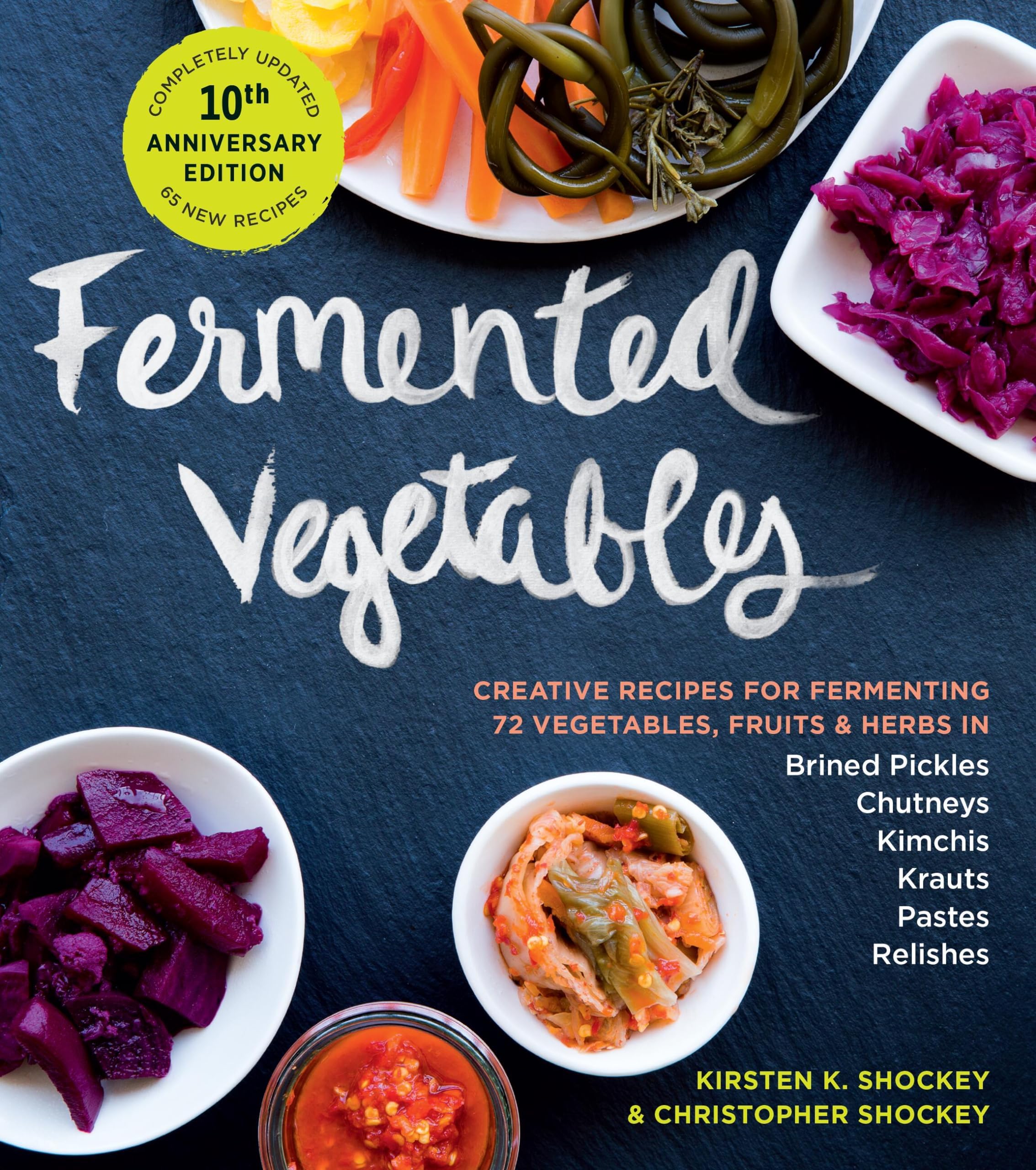
Fermented Vegetables, 10th Anniversary Edition: Creative Recipes for Fermenting 72 Vegetables, Fruits, & Herbs in Brined Pickles, Chutneys, Kimchis, Krauts, Pastes & Relishes [Shockey, Kirsten K., Shockey, Christopher] on desertcart.com. *FREE* shipping on qualifying offers. Fermented Vegetables, 10th Anniversary Edition: Creative Recipes for Fermenting 72 Vegetables, Fruits, & Herbs in Brined Pickles, Chutneys, Kimchis, Krauts, Pastes & Relishes Review: Perfect starter book for me. - Love this book. It is exactly what I was looking for out of my first book on the topic. It gives you a full explanation of lacto-fermentation science and history along with sections on salts, troubleshooting and equipment; the basic procedures behind sauerkraut, brine pickling and kimchi; and then a whole bunch of recipes (A-Z) for a multitude of veggies and even a few fruits What I really like is that there is a lot of explanation of techniques and not just simple recipes so that you develop an understanding of what you are doing instead of just blindly following step-by-step. For example, for many of the vegetables there is more than one recipe and it will discuss the various types of that veggie or similar veggies. If you can't ferment almost any vegetable you can think of with this book, then you clearly did not read it! This book only deals with lacto-fermentation which is using the naturally occurring Lactobacillus to ferment your veggies. It does not deal with starter cultures or use of whey or any other inoculation method. It is also strictly tailored for vegetable fermentation. It does not discuss yeast fermentation of beer, wine or sourdough or the aging fermentation of meats. Review: A wealth of knowledge. So worthwhile! "Submerge in brine and all will be fine." - I wanted to gain the skill of fermentation, but I was nervous about possibly making a mistake and ending up with food poisoning. This book was exactly what I needed. I love this recipe book so much, because it troubleshoots everything that might cause a problem with your ferments. It explains the pros and cons of various options, equipment, techniques, etc. How to make sure that the salinity is in the best range to prevent spoilage without hindering fermentation. How to choose ingredients that will give you the best results. It has saved me a lot of trial and error. The authors have extensive experience with making sauerkraut, pickles, etc. They also have experience in teaching these skills. As a result, the book does a wonderful job of explaining everything you need to know. They address the concerns that weigh on the mind of every new "fermentista"; such as, "how can I be sure that the food I've fermented is safe to eat?" The photographs in the book are excellent. I especially appreciated the "scum gallery" photos that have helped me evaluate what I was seeing in my fermentation jars. SO USEFUL in resolving concerns! The book is designed to encourage every household to harness the benefits of fermenting food for the family table. The instructions emphasize the simplest and most cost-effective techniques, so that anyone can gain these traditional skills. They also provide useful tips on which foods will blend well together, and how to get the results in flavor and texture that you personally prefer. I read Sandor Katz' first book, but found it difficult to picture how to emulate, in my own kitchen, the techniques he described. This book makes the deeply nourishing art of fermentation a very attainable skill.


J**T
Perfect starter book for me.
Love this book. It is exactly what I was looking for out of my first book on the topic. It gives you a full explanation of lacto-fermentation science and history along with sections on salts, troubleshooting and equipment; the basic procedures behind sauerkraut, brine pickling and kimchi; and then a whole bunch of recipes (A-Z) for a multitude of veggies and even a few fruits What I really like is that there is a lot of explanation of techniques and not just simple recipes so that you develop an understanding of what you are doing instead of just blindly following step-by-step. For example, for many of the vegetables there is more than one recipe and it will discuss the various types of that veggie or similar veggies. If you can't ferment almost any vegetable you can think of with this book, then you clearly did not read it! This book only deals with lacto-fermentation which is using the naturally occurring Lactobacillus to ferment your veggies. It does not deal with starter cultures or use of whey or any other inoculation method. It is also strictly tailored for vegetable fermentation. It does not discuss yeast fermentation of beer, wine or sourdough or the aging fermentation of meats.
A**N
A wealth of knowledge. So worthwhile! "Submerge in brine and all will be fine."
I wanted to gain the skill of fermentation, but I was nervous about possibly making a mistake and ending up with food poisoning. This book was exactly what I needed. I love this recipe book so much, because it troubleshoots everything that might cause a problem with your ferments. It explains the pros and cons of various options, equipment, techniques, etc. How to make sure that the salinity is in the best range to prevent spoilage without hindering fermentation. How to choose ingredients that will give you the best results. It has saved me a lot of trial and error. The authors have extensive experience with making sauerkraut, pickles, etc. They also have experience in teaching these skills. As a result, the book does a wonderful job of explaining everything you need to know. They address the concerns that weigh on the mind of every new "fermentista"; such as, "how can I be sure that the food I've fermented is safe to eat?" The photographs in the book are excellent. I especially appreciated the "scum gallery" photos that have helped me evaluate what I was seeing in my fermentation jars. SO USEFUL in resolving concerns! The book is designed to encourage every household to harness the benefits of fermenting food for the family table. The instructions emphasize the simplest and most cost-effective techniques, so that anyone can gain these traditional skills. They also provide useful tips on which foods will blend well together, and how to get the results in flavor and texture that you personally prefer. I read Sandor Katz' first book, but found it difficult to picture how to emulate, in my own kitchen, the techniques he described. This book makes the deeply nourishing art of fermentation a very attainable skill.
C**A
Great book to get you started on fermentation! Tons of recipes.
The best book to get you started on fermentation. I am going to get the other books; they are well written with a lot of good information.
P**D
Buy and read, BEFORE you start spending money on the bottles, weights and related cooking supplies..
What I liked most about Kirsten K. Shockey and Kirsten K. Shockey’s Fermented Vegetables: Creative Recipes for Fermenting 64 Vegetables & Herbs in Krauts, Kimchis, Brined Pickles, Chutneys, Relishes & Pastes Kindle Edition was the fact that it quickly and efficiently proved to me that I was not going to be able to ferment vegetables in my condo. Rather than make my negative case, I would rather focus on the value received by getting both the good and bad news. At no more cost that this one book I was spared the business of buying containers and foods and other such supplies, only to find that the down side of the fermenting would make this an impractical choice. Throughout the language is clear, and the instruction read as easy to follow. Fermenting Vegetables makes a compelling case for the advantages to anaerobic fermentation of foods. I liked reading the text for its information, for the honest enthusiasm and tell all attitude of the authors. Fermented Vegetables: Creative Recipes for Fermenting 64 Vegetables & Herbs in Krauts, Kimchis, Brined Pickles, Chutneys, Relishes & Pastes is highly recommended as a first read, must read for anyone with no experience, uncertain of what they are likely to experience and not only why they should become an at home fermenter and as in my case why they may prefer to be a customer of a home fermenter.
J**K
Makes vegetable fermenting easy
I loved this book! It's not just a recipe book/cookbook. It's a complete guide to essentially everything you could want to know about fermenting vegetables. I like the alphabetized lists of foods to ferment, the guides to selecting the best quality ingredients, and the suggestions for creating your own ferments. This book made me feel confident enough to experiment as it shows which parts of the recipe are important to keep the same and which parts can change. Fermenting is a lot more forgiving than I thought it was!
P**S
I would recommend this book above all others! Get the spiral version!
I have made a few batches of Kraut from the directions of a friend and a few from online recipes. I also plan to take a class from the local county extension office this fall. I came across this book while surfing Amazon and all I can say is WOW! It wasn't a prime delivery and I had to wait over a week to get it - I checked the tracking number everyday I was so excited for it to arrive. I chose the spiral bound version because if I think I will refer to a book over and over I will take it to the print shop and have th spine cut and add a spiral binding. I find the book will last longer and stay open while in use. I am attracted to all the beautiful photography and my first few pages has had great writing and engaging information. I find I no longer enjoy reading for entertainment - I need to get something out of it and I know I will go back to this book often and I will be filled with new and useful information each time!!!
J**N
Love this book! There are so many recipes to look through, and it's well organized. If you're insecure about fermenting, I definitely recommend this book. If you just want some recipe inspiration, this is a great resource. I use this book mostly for inspiration, then do a little research on the side as well regarding fermentation times. Mostly because they recommend fermenting sauerkraut for about a week, but it's actually pretty common to ferment it for a month. There's nothing wrong with doing a shorter ferment, but the different suggestions for time might be a little confusing to those new to fermenting. That aside, I think this is an amazing book for people new to fermenting or those who have an interest in it. Not only does it have detailed recipes, it explains the process, and best of all has images of what's normal in a ferment, and what's not. I gifted this book to someone who was nervous about the process (because nobody wants food poisoning!) and it made them feel so much more confident.
D**Z
Excelente libro, muy buenas recetas, excelente contenido. Gracias!
J**.
Fermentation is well explained, easy to follow.
C**N
'E un libro fantastico. Facile da seguire, bellisime immagini. Lo consiglio a tutti gli appassionati della alimentazione naturale e sana.
M**S
An exhaustive and in depth voyage into the techniques of fermentation
ترست بايلوت
منذ أسبوعين
منذ أسبوعين