We remain fully operational. Our teams are working around the clock to ensure your deliveries continue safely.

قم بتنزيل التطبيق


معلومات عنا
حقوق الطبع والنشر © 2024 Desertcart Holdings Limited
قم بتنزيل التطبيق
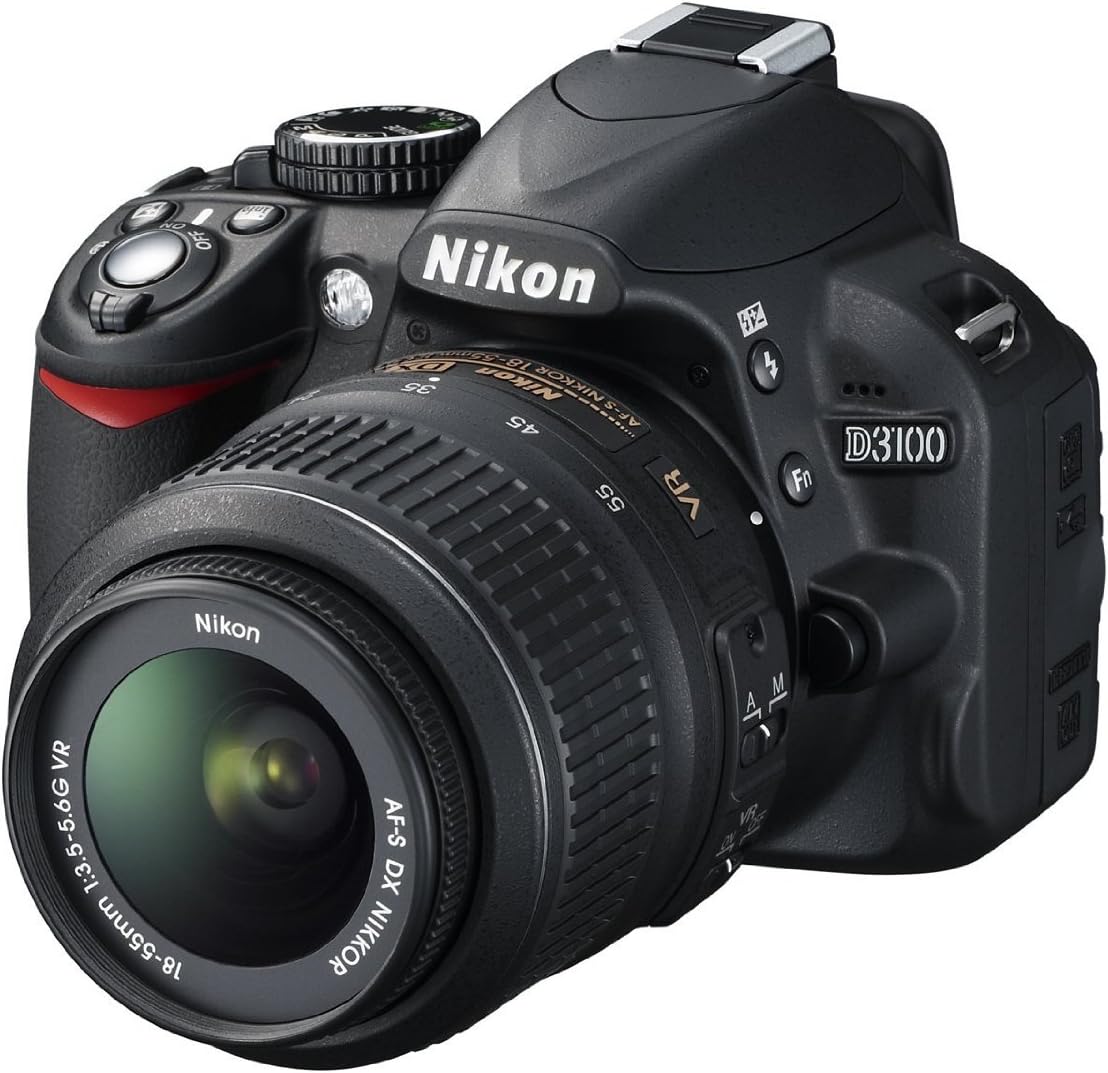
📷 Capture brilliance, create envy.
The Nikon D3100 is a lightweight, entry-level DSLR featuring a 14.2MP DX-format CMOS sensor, 11-point autofocus with 3D tracking, and Full HD 1080p video recording. Its intuitive Guide Mode and vibration reduction lens make it perfect for millennials eager to elevate their photography skills and share stunning visuals that stand out in any social feed.
| ASIN | B00403MA4M |
| Aperture modes | Automatic |
| Are Batteries Included? | Yes |
| Aspect Ratio | 16:9 |
| Aspect ratio | 16:9 |
| Auto Focus Technology | Phase Detection |
| Autofocus | Yes |
| Autofocus Points | 11 |
| Available Memory Slots | 1 |
| Best Sellers Rank | 49,866 in Electronics & Photo ( See Top 100 in Electronics & Photo ) 77 in Digital SLR Cameras |
| Bit Depth | 8 Bit |
| Box Contents | Nikon D3100 AF-S DX 18-55 VR Lens and German User Manual |
| Brand Name | Nikon |
| Camera Flash Type | No flash |
| Camera Lens | AF-S DX 18-55 mm VR (variable aperture 3.5-5.6) with 52 mm filter thread (zoom lens with image stabilization) |
| Colour | Black |
| Compatible Devices | Nikon F mount devices |
| Compatible Flash Memory Type | SD |
| Compatible Mountings | Nikon F |
| Compatible mountings | Nikon F |
| Continuous Shooting Speed | 60 FPS |
| Crop Mode | [POSSIBLE] 16:9 |
| Customer Reviews | 4.5 out of 5 stars 1,131 Reviews |
| Digital-Still | Yes |
| Display Fixture Type | Fixed |
| Display Type | LCD |
| Dots Per Screen | 921600 |
| Dynamic Stops | 10 Stops |
| Effective Still Resolution | 14.2 MP |
| Expanded ISO Minimum | 100 |
| Exposure Control | [Shutter Priority, Program, Aperture Priority, Manual, Automatic] |
| File Format | JPEG |
| Flash Memory Bus Interface Type | UHS-I |
| Flash Memory Speed Class | 2 |
| Flash Memory Type | Micro SDHC |
| Flash Memory Video Speed Class | UHS U1 or U3 |
| Flash Modes Description | Automatic, suppressed, high-speed sync, exposure compensation, back curtain sync, slow synchronization |
| Flash Sync Speed | Non Definito |
| Focus Features | Autofocus |
| Focus Mode | Manual Focus (MF) |
| Focus Type | Auto Focus |
| Form Factor | DSLR |
| Generation | 3 UK |
| Hardware Interface | SDHC |
| Has Color Screen | Yes |
| Image Capture Type | Stills & Video |
| Image Stabilization Type | Optical |
| Image stabilisation | Optical |
| Item Part Number | Nikon D3100, VBA280K001 |
| Item Weight | 505 Grams |
| JPEG Quality Level | Normal |
| Lens Construction | 14 elements in 11 groups |
| Lens Correction Type | Chromatic Aberration |
| Lens Type | 18-55 millimeters |
| Manufacturer | Nikon |
| Manufacturer Part Number | VBA280K001 |
| Maximum Display Resolution | 1080p Full HD |
| Maximum Focal Length | 55 Millimeters |
| Maximum Shutter Speed | 30 Seconds |
| Maximum focal length | 55 Millimeters |
| Metering Methods | Matrix, [Other metering modes] |
| Minimum Focal Length | 18 Millimeters |
| Minimum Shutter Speed | 0.001 seconds |
| Model Name | d3100 |
| Model Number | VBA280K001 |
| Model Series | D |
| Movie Mode | Yes |
| Network Connectivity Technology | USB |
| Night vision | No |
| Number of Diaphragm Blades | 7 |
| Optical Zoom | 3 x |
| Photo Filter Size | 52 Millimeters |
| Photo Filter Thread Size | 52 Millimetres |
| Photo Sensor Size | aps_h |
| Photo sensor technology | CMOS |
| Product Features | 3D |
| Real Angle Of View | 63.4 Degrees |
| Rear Webcam Resolution | 14.2 MP |
| Remote Included | No |
| Screen Size | 3 Inches |
| Self Timer | 10 |
| Sensor Type | CMOS |
| Series Number | 3100 |
| Shooting Modes | Automatic, Deleted, Exposure compensation, High-speed synchronization, Rear Curtain Synchronization, Slow Sync |
| Skill Level | Amateur |
| Specific Uses For Product | [GENERAL USES] |
| Supported Image Format | JPEG |
| Supported file format | JPEG |
| Total Still Resolution | 14.2 MP |
| Total USB 2.0 Ports | 1 |
| Total USB Ports | 1 |
| UPC | 018208919567 182089195676 |
| Video Capture Format | MP4 |
| Video Capture Resolution | FHD 1080p |
| Video Output | HDMI |
| Viewfinder Magnification | 0.85x |
| Viewfinder Type | Optical |
| White Balance Settings | Auto |
| Wireless Technology Type | Wi-Fi |
| Write Speed | 6 fps |
| Zoom | optical |
W**E
A proper camera and simply brilliant.
I thought I should add my voice to the chorus of praise for this camera. I learnt the principles of photography back in the 70's when cameras were proper cameras and you had to carry a light-meter and understand the relationship between film & shutter speed, aperture and focal length to get your pictures exactly how you wanted. My trusty old Pentax SV (and later a P30) and selection of lenses served me well until I was reluctantly seduced by the convenience of a digital camera. Digital SLR's were, until recently, well beyond the means of lesser mortals and I had been perfectly happy with my Canon Powershot S3 bridge camera until the shutter finally became permanently stuck. The repair bill here in France was so close to the price of a new, higher spec camera that I decided to up the budget and go for this entry level DSLR offering from Nikon (I assume the price had been heavily discounted due to the release of the D3200), unarguably the best name in still photography for innovation, reliability and build & picture quality since the groundbreaking introduction of the Nikon F in the late 50's. Anyway, enough of the history lesson. I love this camera and paradoxically, given the stupendous level of technology crammed inside, it takes me right back to those simpler Pentax days. Yes, of course it has a range of fully automatic modes for those point and shoot moments or sudden photo opportunities, but its real strength lies in the incredible level of control you have over the auto-focus (and, when all else fails, proper lens-ring manual focus - how I've missed that!), metering modes and in the simplicity of use of the program & aperture and shutter priority modes. Also, unlike `standard' digital cameras there is none of the annoying lag between pressing the button and the shutter releasing - hoorah! The user interface presented on the bright & clear rear screen is intuitive and every camera option can be controlled by a simply navigated menu system. Mind you, I did spend a whole day working through the book of words and the reference manual on CD but really it is very easy once you've had a bit of a play. Despite not being made of brass like my old SV, the camera has a solid, well balanced feel and the somewhat chunky 18-55mm lens (equivalent to a 35mm 22-82.5mm zoom) sits nicely in the left hand. The auto-focus is rapid and accurate & the results are pin-sharp and distortion & vignette free. Manual focus on close-ups (although the auto mode works perfectly anyway) is easy thanks to the clear, bright viewfinder. I even experimented with the vibration reduction system built into the lens by taking hand-held pictures at slow shutter speeds and, yes, it does make a difference. For those digital camera traditionalists, the `live-view' mode provides a screen-based viewfinder and a load of clever variations on the standard `viewfinder' framing focus options (e.g. face recognition & tracking). This mode also allows movie recording but I haven't experimented much beyond the basic as it isn't something I'm particularly interest in doing. I'm extremely happy with this camera and although another lens would be useful (either the Nikon 55-200mm or the Sigma 70-300mm macro) for wildlife stuff I certainly can't justify the expense and I'm perfectly content with what I have for the time being. There are a couple of essential accessories: A clear filter to protect the front lens element (I bought the Hoya 52mm Pro-1 Digital Protector Screw in Filter which is excellent) and a protection film for the rear screen (I bought the atFoliX FX-Antireflex screen-protection film for Nikon D3100 although on reflection (ha-ha) I should have got the clear equivalent).
T**H
Nikon D3100 - Entry Level DSLR
Firstly, I am not one of those techno buffs, I don't really know what ISO is, and what the apeture does... Well, I kind of do but not enough to explain it to you. But I think this is captured by the D3100, as it is an entry level SLR your not supposed to know all that. It teaches you with its built in guide mode. This is my first DSLR and I am so glad I bought it. It is a tie between buying the D3100, the D5000 or splashing out on the new D5100. But I decided to go for this baby; its reasonably priced and full of fancy features, for instance; full 1080p HD movie recording (10 minute intervals,) HDMI connectivity, A well detailed, informative manual and simple OS. But lets forget all that and start of with what people want to know.... Does it take good photos? YES! The picture quality is excellent, it gives sharp clear photos with minimal input from your brain. Is it simple to use? YES! The nikon GUIDE mode is very simple, it gives you a whole range of types of photo, it then explains what the camera is doing so you can do it by yourself next time! Is it a professional camera? No, it is an entry level Digital SLR. You should not expect the best from it. It is not a D3. Its a D3...100. You cannot expect pro quality from an entry level camera. The camera is fantastic for anyone thinking of joining the world of DSLRs, it is reasonably priced for what you get... But one thing I did want was a rotating screen (which you get on the D5000 and D5100) But that is a sacrifice. I am very happy with what I got and I would recommend the camera to anyone! This is my first proper review.. Please give me feedback on if it was helpful for you. If you have any questions, feel free to comment and I will do my best to answer! Thanks for reading!
R**A
Excellent Entry Level DSLR, great for beginners like me, and plenty of features for camera professionals and veterans alike!
As the first time stepping in the D-SLR market I needed something that was affordable but offered value for money, and was greatly put off by the large cost of the higher range Nikon, and Canon cameras, and this camera looking at its features and specifications, it literally ticked all the boxes and more. It arrived on time, and everything I expected when first opening the box, only quirk really is the lens it comes with doesn't come with an actual backplate just a white generic packaging cap, so I recommend you don't throw it away until you pick up a Nikon F-Mount rear lens cap from here or your local camera store as soon as possible, perhaps before it arrives to save the hassle. The camera is a decent 14MP camera capable of great things, with a full range of features for the novice, right up to the advanced professional, the scene selection and guided modes it offers, compliment it greatly, allows the camera to do all the hard work with focus and white balance and allows you to just worry about your shot, and zoom. The flash pops up automatically in low light conditions too. The good thing about the guided mode is it actually tries to teach you what settings you have to adjust to prepare for a shot to produce that chosen effect. It shouldn't be used as a short-cut, but something you could learn from\remind yourself stuff you have forgotten how to do. I tend to read about the settings I need to change then switch to manual and try make those changes myself. But I do recommend you white balance the camera manually like any D-SLR, for optimal photographs. Images come out really well and vibrant, there is a little noise when zooming in on the outputted RAW. But that's not an issue when printing or outputting to a smaller file for use on the web. Overall a very good entry-level D-SLR, ideal for me to pick up the paces and progress onto amateur and eventually professional photography, and anyone looking to do the same.
J**R
First DSLR....loving it.
As a first DSLR i think maybe this Nikon is a no-brainer? Having used a Fuji bridge for a year i decided a DSLR was the obvious next step and having researched the field the Nikon edged the Canon...just. What do i like: * Easy to use...Nikon are really clear with menus/buttons and settings. There is lots to learn but if you are systematic in using the manual it all becomes clear and you can really set the camera up to work for you. The FN button in particular is toggled for example to provide quick ISO settings which really cuts down on menu navigation...i wish it had one more for white balance though. Also the guide mode will likely start most people on the right direction (but it is not full-proof...and why should it be?) * SHOT QUALITY - SHOT QUALITY - SHOT QUALITY....The reason you buy it really and i am really impressed. At first i thought it was no better than my bridge camera (Fuji HS10) but only once you have blown a picture up (say on a 46" tv screen) do you appreciate the relative merits. It was brought home by the reflection i could see in one specific picture. A portrait shot of my wife with sunglasses was ideal for me to zoom in on a big screen and see the whole of the reflection behind me...including me, the background etc.....all this from a tiny portion of the original shot.....really impressed. Since then ive realised you really have to work for the 'good' shot (thats the fun part of it anyway?) but once you hit it and start to understand why you hit it the camera does the rest and suddenly the results are very impressive. The ease with which you can move focus to get really nice close ups and portraits is my real favorite and makes the activity really pleasurable. The results of the multi-focus system mean mundane shots come alive with lots of foreground detail and a lovely blurred background...and really easy when you've learnt how. The ISO at high levels is super impressive at such a price and i have started to look at my old camera shots and really wish id had this one earlier. In the final analysis it really does what it means to from the start...it teaches you to abandon the auto settings and really begin to understand the fundamentals of photography! Once you've started to get really these detailed shots you just get addicted and you no longer want to just point and shoot!!! * I read before hand that it wasnt classed as particularly 'fast' in either shot reaction and most critically in burst modes (inc multiple single shots) but if you are coming from a bridge camera you will wonder what they all talking about as i find it stunningly quick and very responsive. * Battery time...i have no complaints, it does drain quickly towards the end though so just make sure you get a spare as once its started to go its a very rapid movement towards being non-operable. * Build quality....feels quality. Only things i dont like are the placement of the image review button as i find i turn it on loads when using the view-finder...annoying. Also the focus system is based on contrast so sometimes in ow light you have to cajole it to take a shot. Also factor in other lens and equipment as the 18-55 supplied though flawless is limited and already i am looking at 55-300 and maybe a macro to compliment my kit....money money money! Really love the Nikon D3100 for the shot quality and the ease of use, great learners tool and has me hooked on photography at a new level. Highly recommend....£50 cheaper today that when i bought it as well.
L**M
A great first DSLR
I'm no expert, and I chose this camera as an affordable, first DSLR to step up from my bridge camera Why Nikon ? - my neighbour owned a previous version of this, and although she has progressed to a D7000 she really rated this. My remit was small - I wanted to be able to take lovely, clear and crisp lowlight shots and also liked the look of long exposure images. I did lots of internet searching, checked tons of online photo forums, talked to my neighbour and could see I could achieve this with the D3100 as my 'body' and some extras at a later date... I expected it to take me a long time to move out of ' Auto' mode - but no, within 2 days I was happily using both exposure and shutter priority, and now 4 weeks later am fully 'manual' The camera is easy to use, menus easy to navigate but reading the manual and watching some fantastic, helpful videos on You Tube really helped me understand how to use the camera properly. This is invaluable, and if you are a beginner looking for some guidance to make the most of your first DSLR I can recommend You Tube series' from Greg Cazillo, Jared Polin, Easy exposure and Mark Wallace as of particular help. (The kit lens is OK, and have used it when out and about but poor weather has kept me indoors and I wanted better low light, flash free ability so have treated myself to the 35mm 1.8 lens and got some crisp, beautiful, flash free shots at an indoor party last weekend) I love mine, and can recommend it to a beginner with a limited budget. Its a comfortable size to hold, not too bulky, light and easy to carry round...perfect...
N**S
SHOCKING AFTER CARE SERVICE
I brought a recondition unit from this seller, when the unit arrived I was very happy with it looked good arrived very quickly and worked well. However I took the unit on holiday with and during my holiday the unit started not letting change the shutter speed, aperture or ISO. Not being able to change these settings pretty much turns your DSLR into a point and shoot camera. Anyway I though its fine by the time I return from holiday I will be within 30days of the date of purchase, so I can return the unit. When I contacted the seller, they firstly advised that I would have to pay for the return, I did point out to them that did not comply with the distance selling regulations, but they said it was because they had no way of providing a free return post label, and that if I included the receipt for postage they would refund this, so I did. Now here is where the problems started, the seller contacted me and advised they could not find the fault and that I had not returned the battery, obviously I returned the item in full and it was faulty, so I provide detail of how the battery had been placed in the box and more detail on the fault. The seller came back again and advised they found the battery (surprise) but that "We have checked and tested the camera fully and also the mode dial but can not find a fault. We will send the item back to you in full working order today? Or as the camera has been returned to us in a used state outside the 7 days return policy with all the accessories opened, dirt on the screen, box damaged etc we can issue a refund minus a 20% re-stocking fee." The seller is refusing to accept the item is faulty, or was incapable of using it enough to find the fault, as such they think I should have this faulty kit back, because clearly I am a liar and its not faulty, or they have fixed and don’t want to refund me!? or because it was USED I should take a %20 hit on my purchase cost, please check the sellers T&C, nothing is mentioned about re-stocking fees. I am still working with the seller and amazon to resolve this issue, however my purchase experience to-date has been very very poor.
D**R
So much fun
I came to the D3100 from only having owned compact cameras and phone cameras before. I've had such a great learning experience over the last 6 months with this and learned so much about the art of photography. This little gem is aimed at amateurs and beginners, and more than adequately fulfils the requirements of the same. The 14.2MP sensor more than supplies what you need for your average computer screen sized photo and even when I've been doing some wildlife photography leaves high enough pixel density to allow close cropping (using 55-200mm lens) to enhance subject. The camera is designed to not be too daunting. There are all the options any beginner would need, with manual mode, shutter and aperture priority modes, scene modes and guide mode. As I learned how to use this camera, I've now found the advantages of shutter and aperture priority modes and this camera has gave me the confidence to investigate these modes, while still receiving feedback on the screen. The lens with this seems to produce good images. Being in the UK I guess I could benefit from the 1.8F lens available elsewhere but as I mostly use this lens for landscapes or portrait photography with flash, lighting and the need for wide aperture hasn't been an issue, and considering the 1.8 is more expensive than this camera even, it has different target audience and will be one to try later. There now is the D3200 out for £100 extra and higher MP count but I don't feel I've missed out with this camera. Well worth the money and I'm glad I decided to finally take the jump into DSLR photography. It has given me more options and I feel more creative knowing more about the art of photography. The only issue is, once you take the jump into DSLR photography, you will probably end up spending more than the ~£300 for this - it becomes an addiction - so far have also bought telephoto lens (great for wildlife), tripod, external flash, and some other small things like filters and remote shutter. Enjoy your experience with this great camera. Don't worry about it going out of date - all those great photos you see now will still be able to be got in the future.
C**G
Perfect DSLR for Beginners
I purchased this camera for a couple of reasons. Firstly, because I've wanted an SLR for a while now and wanted to get into amateur photography. Secondly, every time I go on holiday I always wish I had something better than a point and shoot to capture images. Lastly, because I required a decent camera to take pictures at my brother's wedding. I chose the D3100 over the D3200 because I didn't feel the need to spend extra for more megapixels and perhaps slightly enhanced features and spec because I was after a beginner SLR after all. The spec of the D3100 was more then enough in my opinion and it was also cheaper than the D3200. For somebody that has never used a DSLR before, the D3100 was easier to use than what I thought it would be. I used the camera in AUTO mode to start off with. I shot all of my brother's wedding photos in Auto and I've had so many comments from people stating how great the clarity of the images were. The camera has the capability to offer so much more in Manual modes, so I've spent a lot of time watching YouTube videos teaching myself how to use the camera in Manual modes. It is daunting and I am learning something new everyday. I now use the camera in a mixture of Auto and Manual so I can get to grips with the camera's capabilities and learn more about photography. The camera has the added feature of a Guide to assist you in learning the camera and taking certain type of shots, which I think is very handy. The D3100 is by no means the best DSLR out there but it's miles better than a point and shoot and worth the extra investment in my opinion. I'm already looking to purchase a D7000 and better lenses and I've only had the camera a few weeks. Loving my new camera and new found hobby :-)
ترست بايلوت
منذ أسبوعين
منذ شهر