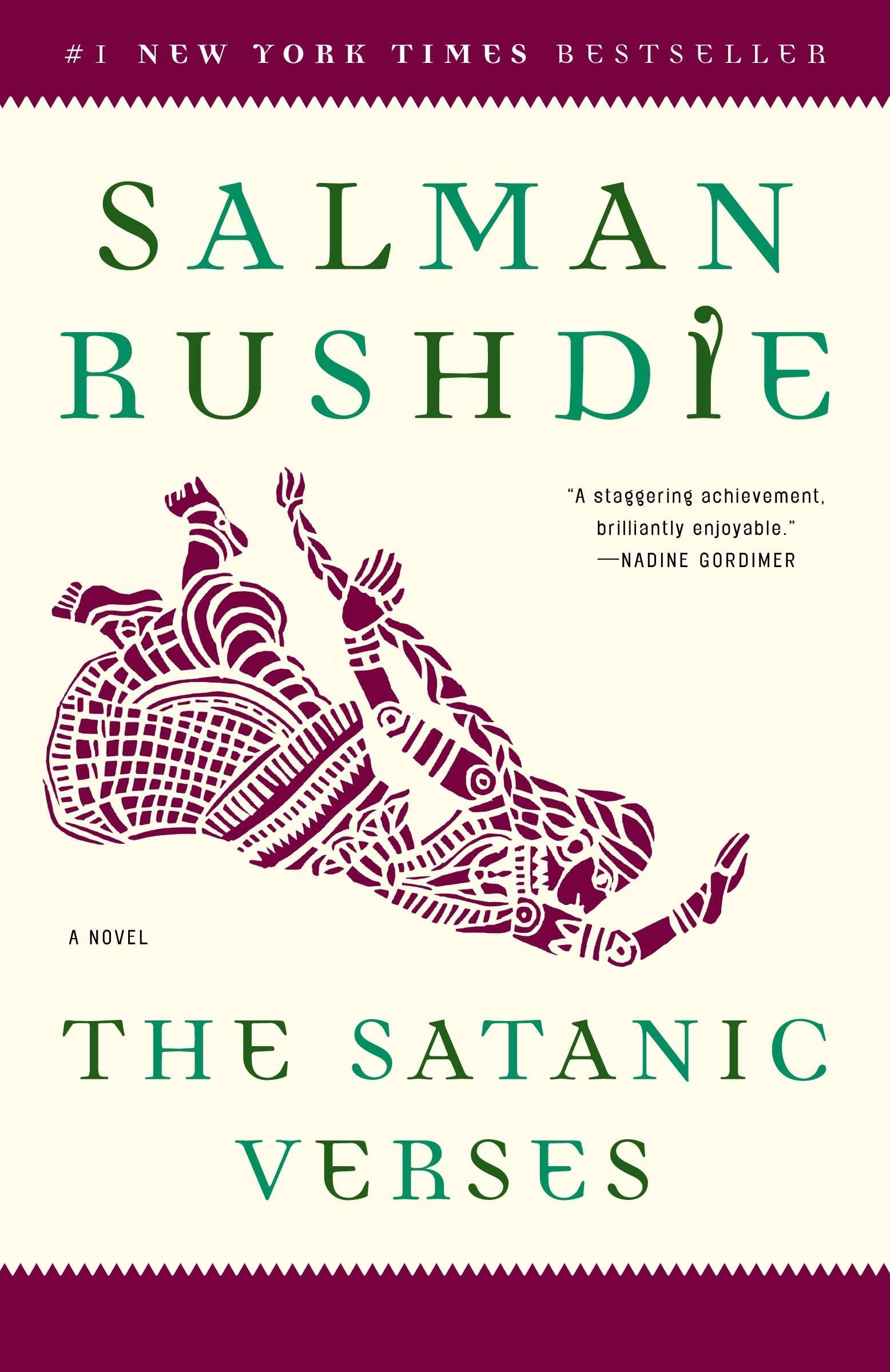
The Satanic Verses: A Novel
Product ID: 6571206
Desertcart purchases this item on your behalf and handles shipping, customs, and support to KUWAIT.
#1 NEW YORK TIMES BESTSELLER • “[A] torrent of endlessly inventive prose, by turns comic and enraged, embracing life in all its contradictions. In this spectacular novel, verbal pyrotechnics barely outshine its psychological truths.”— Newsday Winner of the Whitbread Prize One of the most controversial and acclaimed novels ever written, The Satanic Verses is Salman Rushdie’s best-known and most galvanizing book. Set in a modern world filled with both mayhem and miracles, the story begins with a bang: the terrorist bombing of a London-bound jet in midflight. Two Indian actors of opposing sensibilities fall to earth, transformed into living symbols of what is angelic and evil. This is just the initial act in a magnificent odyssey that seamlessly merges the actual with the imagined. A book whose importance is eclipsed only by its quality, The Satanic Verses is a key work of our times. Praise for The Satanic Verses “Rushdie is a storyteller of prodigious powers, able to conjure up whole geographies, causalities, climates, creatures, customs, out of thin air.” — The New York Times Book Review “Exhilarating, populous, loquacious, sometimes hilarious, extraordinary . . . a roller-coaster ride over a vast landscape of the imagination.” — The Guardian (London) “A novel of metamorphoses, hauntings, memories, hallucinations, revelations, advertising jingles, and jokes. Rushdie has the power of description, and we succumb.” — The Times (London) Review: A Most Excellent Novel. Worth Reading Over And Over. - I am reading this for the third time. It is one of my favorite books. Mr. Rushdie obviously has a brilliant, quick intellect. This book is comprised of several stories, mostly centering on the experiences of a man who is elevated to the status of an angel, the other demoted to the status of a devil. Even though this book has a large imaginative and intellectual scope, there are some scenes of such tenderness and pathos that lead me to believe that Mr. Rushdie is a most compassionate soul. However, even though I have read it several times, I am still unable to determine if Mr. Rushdie had any theme in mind or if he was just spewing out his brilliant mind. The book starts with the two protagonists falling through the sky after the plane they were riding was hijacked and bombed by a terrorist. For what seems forever, Mr. Rushdie creates the sensation of falling, falling, falling. This book is a tour de force of writing. Actually, there are two possible themes that are coming to mind. First is the pain of not belonging which is shown clearly by the lives of South Asian and black immigrants in London; and very poignantly by a character in India who earns his living as a clown. He was born a lower caste Hindu and to escape the pain of it converted to Islam, but he isn't even accepted in that world either. His only true companion is his pet bull who he dresses up and uses in his clown acts. The other possible theme could be the paradox of good and evil existing side by side. Gibreel Farishta's lover's father, a Holocaust survivor, says, "'...the most dangerous of all the lies we are fed in our lives,' which was in his opinion, the idea of the continuum. 'Anybody ever tries to tell you how this most beautiful and most evil of planets is somehow homogenous, composed only of reconcilable elements, that it all adds up, you get on the phone to the straightjacket tailor...'" Yes, there is a destructive Mahound and imam who either themselves or whose helpers torture and gorge on innocent people, but that is a fact of life. I read several reviews in which the writers were claiming that Rushdie was being spiteful in writing this book, but even though I believe he knew exactly what were going to be the results of publishing it, I doubt he meant spite. An artist reacts intellectually and emotionally to the world around them, gets ideas, thoughts, tastes, and a writer is compelled to write them. However, I am waiting for someone to write a novel about a writer with only one successful book behind him, whose sales are diminishing, who makes an arrangement with a notorious religious despot that he will write a disparaging expose and the despot will put a fatwa on his head, thereby ensuring fame and fortune for them both by the sheer magnitude of the ensuring notoriety. Review: Fascinating and Complex - I had read midnight's children as a teenager years ago and had tried reading The Satanic Verses then but had found the book quite impenetrable. Last month with time in hand, I took to the book again attracted by the controversy it generated and was left with memories of a fascinating story. Before you read this book you should adept yourself with some knowledge of Islam and life of Prophet Mohammed (which basically boils down to reading the wikipedia pages on Prophet Mohammed, Islam and the Holy Quran). Satanic Verses is a complex satire of two Indian actors Saladin Chamcha and Gibreel Farishta. The alter-egos undergo mutation after the bombing of their boarded plane where Saladin takes the satanic form and Farishtaa an incarnation of Archangel Gabriel. It is not clear why each get their form - one may view them to be a result of perception - Farishtaa made fame playing Indian deities in Bollywood while Saladin, an immigrant in London is a voiceover artist mostly doing voiceover for consumer products. There is nothing demonic about Saladin and Farishta is anything but an angel. The story begins and ends with Bombay but a lot of Satanic verses is about London and life of an immigrant in the vibrant city. Most of the cast are first or second generation south asian immigrants in London . Rushdie devotes a lot of pages on their character development. Saladin and Farishta are pursuing reconciliation with their love interests ( who live in London) after the events of their mutation. Farishta's dream sequences form the sub-plot of the story. The dreams involve the city of Mecca during the time of revelations , after Prophet's return to the city after the exile and a sequence during the Prophets death. A short dream sequence involves an Imam in exile ( possibly Khomeni) and his attempt to overthrow the empress of the country of his origin. The last dream sequence is about a butterfly eating teenager who takes an entire Indian village onto a fatal pilgrimage. Each of these are captivating , follow a chronicle order and you are left with three or four different stories somehow kept loosely connected by Farishta. It is these dream sequences where the controversy stems from. There are some who suggest that in reality the book does not have a lot of scandalous elements , and they are wrong. The dream questions the authenticity of the revelations that the Prophet received and how they suit the worldly conveniences. The twelve prostitutes in Mecca each take the names of the Prophet's twelve wives in order to attract business. The venture is successful. Finally, the death of the Prophet is shown as a result of Al-Lat's vendetta. Al-Lat is one of the pre-Islamic Meccan Goddesses , who were all declared false in the earliest of Prophet's revelations. Ayatollah Khomeini who issued the original fatwa may also have been offended by the comic elements surrounding his dream sequence. What is Satanic Verses about philosophically? - It depends on the interpretation of the reader. It can be viewed as the clash of faith vs doubt or that of a life of an immigrant , or the role of a satirist in a society etc. While Midnight's children was a literary marvel , Satanic Verses is a fascinating story and makes Rushdie a great story teller.


| Best Sellers Rank | #19,823 in Books ( See Top 100 in Books ) #66 in Censorship & Politics #221 in Contemporary Literature & Fiction #330 in Horror Occult & Supernatural |
| Customer Reviews | 4.2 out of 5 stars 5,105 Reviews |
M**S
A Most Excellent Novel. Worth Reading Over And Over.
I am reading this for the third time. It is one of my favorite books. Mr. Rushdie obviously has a brilliant, quick intellect. This book is comprised of several stories, mostly centering on the experiences of a man who is elevated to the status of an angel, the other demoted to the status of a devil. Even though this book has a large imaginative and intellectual scope, there are some scenes of such tenderness and pathos that lead me to believe that Mr. Rushdie is a most compassionate soul. However, even though I have read it several times, I am still unable to determine if Mr. Rushdie had any theme in mind or if he was just spewing out his brilliant mind. The book starts with the two protagonists falling through the sky after the plane they were riding was hijacked and bombed by a terrorist. For what seems forever, Mr. Rushdie creates the sensation of falling, falling, falling. This book is a tour de force of writing. Actually, there are two possible themes that are coming to mind. First is the pain of not belonging which is shown clearly by the lives of South Asian and black immigrants in London; and very poignantly by a character in India who earns his living as a clown. He was born a lower caste Hindu and to escape the pain of it converted to Islam, but he isn't even accepted in that world either. His only true companion is his pet bull who he dresses up and uses in his clown acts. The other possible theme could be the paradox of good and evil existing side by side. Gibreel Farishta's lover's father, a Holocaust survivor, says, "'...the most dangerous of all the lies we are fed in our lives,' which was in his opinion, the idea of the continuum. 'Anybody ever tries to tell you how this most beautiful and most evil of planets is somehow homogenous, composed only of reconcilable elements, that it all adds up, you get on the phone to the straightjacket tailor...'" Yes, there is a destructive Mahound and imam who either themselves or whose helpers torture and gorge on innocent people, but that is a fact of life. I read several reviews in which the writers were claiming that Rushdie was being spiteful in writing this book, but even though I believe he knew exactly what were going to be the results of publishing it, I doubt he meant spite. An artist reacts intellectually and emotionally to the world around them, gets ideas, thoughts, tastes, and a writer is compelled to write them. However, I am waiting for someone to write a novel about a writer with only one successful book behind him, whose sales are diminishing, who makes an arrangement with a notorious religious despot that he will write a disparaging expose and the despot will put a fatwa on his head, thereby ensuring fame and fortune for them both by the sheer magnitude of the ensuring notoriety.
R**I
Fascinating and Complex
I had read midnight's children as a teenager years ago and had tried reading The Satanic Verses then but had found the book quite impenetrable. Last month with time in hand, I took to the book again attracted by the controversy it generated and was left with memories of a fascinating story. Before you read this book you should adept yourself with some knowledge of Islam and life of Prophet Mohammed (which basically boils down to reading the wikipedia pages on Prophet Mohammed, Islam and the Holy Quran). Satanic Verses is a complex satire of two Indian actors Saladin Chamcha and Gibreel Farishta. The alter-egos undergo mutation after the bombing of their boarded plane where Saladin takes the satanic form and Farishtaa an incarnation of Archangel Gabriel. It is not clear why each get their form - one may view them to be a result of perception - Farishtaa made fame playing Indian deities in Bollywood while Saladin, an immigrant in London is a voiceover artist mostly doing voiceover for consumer products. There is nothing demonic about Saladin and Farishta is anything but an angel. The story begins and ends with Bombay but a lot of Satanic verses is about London and life of an immigrant in the vibrant city. Most of the cast are first or second generation south asian immigrants in London . Rushdie devotes a lot of pages on their character development. Saladin and Farishta are pursuing reconciliation with their love interests ( who live in London) after the events of their mutation. Farishta's dream sequences form the sub-plot of the story. The dreams involve the city of Mecca during the time of revelations , after Prophet's return to the city after the exile and a sequence during the Prophets death. A short dream sequence involves an Imam in exile ( possibly Khomeni) and his attempt to overthrow the empress of the country of his origin. The last dream sequence is about a butterfly eating teenager who takes an entire Indian village onto a fatal pilgrimage. Each of these are captivating , follow a chronicle order and you are left with three or four different stories somehow kept loosely connected by Farishta. It is these dream sequences where the controversy stems from. There are some who suggest that in reality the book does not have a lot of scandalous elements , and they are wrong. The dream questions the authenticity of the revelations that the Prophet received and how they suit the worldly conveniences. The twelve prostitutes in Mecca each take the names of the Prophet's twelve wives in order to attract business. The venture is successful. Finally, the death of the Prophet is shown as a result of Al-Lat's vendetta. Al-Lat is one of the pre-Islamic Meccan Goddesses , who were all declared false in the earliest of Prophet's revelations. Ayatollah Khomeini who issued the original fatwa may also have been offended by the comic elements surrounding his dream sequence. What is Satanic Verses about philosophically? - It depends on the interpretation of the reader. It can be viewed as the clash of faith vs doubt or that of a life of an immigrant , or the role of a satirist in a society etc. While Midnight's children was a literary marvel , Satanic Verses is a fascinating story and makes Rushdie a great story teller.
R**E
Very unique writing style, unexpected ending, sort of offensive I guess
I bought this book in support of freedom of speech, like so many others. I didn't know a whole lot about the actual story ahead of time, but I did enjoy it quite a bit. That said, it was tough to read, and it's not for everyone. You'll get more out of this if you have some foundational knowledge of Islam and Indian culture. The writing style is certainly interesting and unlike anything I've seen, but some of the sentences run on for what feels like an entire page. In spite of my best efforts to focus and pay attention through some of the longest sentences, I found myself having to re-read pages quite a bit. The story itself jumped around and sometimes I couldn't tell what was really happening from what was metaphorical, or what order events were happening in. Everything came together by the end, and the ending itself was not what I expected, leaving me to question my interpretation of some things. I do feel like I need to re-read it, or maybe read a study guide, in order to understand more of the story. The story is based on the Islamic version of historical events, and insults Muslims, apparently. I had to look up the reasons why so many people were outraged by this book, and I do get some of the points. But I'm left wondering if the Western world is just more accustomed to (and less offended by) coexisting with people who don't share their beliefs. I can think of some of the book's subtleties that Salman Rushdie could have tweaked to be far more offensive if he'd really wanted to. I'm still mulling over how offensive I really consider this to be, but admittedly I'm agnostic and not sensitive to material that questions religious orthodoxy.
J**8
Great gift ideas
Was given as a gift
G**M
NOT a Page-Turner, But Historically Important
I've waited a good two weeks after finishing this book to write this review. I wanted to let my mental dust settle. Now I feel obliged to my fellow readers and to my own academic pursuits to have at it. First, I must say that this is one of the few books I've read since my retirement nine years ago that was really WORK to read. Nevertheless, I was compelled to buy it, because of its historical importance: I needed to see what it was that caused its author to receive a condemnation to death by a very highly placed religious source. They put a price put on his head — a bounty — to encourage his murder. The author suffered years of agonizing grief hiding from the madmen searching him out. Fortunately, in the best interests of civilization, they haven't found him — yet. As for the literature, indeed the author is brilliant — an artist with the language, sometimes a poet. But the author, while brilliant with his craft, is NOT a good story teller. The story rambles painfully. I found my own agony just trying to follow it. The genre is called "magical realism," if I recall correctly. After finishing the book, I had to call it up on Wikipedia to learn that it's actually three stories in one. Yes, I knew going in that it was offensive to Islam, thus the fatwa. Nevertheless, I hung in, trying to stay up with the different characters, some of whom have three different names. Had I not some background with Islamic studies, I would have been left behind on page five. I've lived in Saudi Arabia for almost a year in the mid seventies, I've read the Quran, the hadith and a biography of Muhammad. Even with that background, I was BARELY able to recognize the satire. I say EMPHATICALLY, unless you FIRST read at least a biography of Muhammad, DO NOT read this book!! Then, tape your ankles!! Finally, apart from recognizing the author's genius, I'll assess the real value of this novel at the bottom line: Together with the outrageous reaction to it and the advocation of a heinous crime by those offended, we are helped in our understanding of the utterly low level of civilization among a large part of our population today. Is there hope for them in the 21st century? You tell me.
E**傑
A forbidden but riotous fun filled and mischievous tale of two Indian emigrants to London. One with wings the other with horns.
In The Satanic Verses: A Novel , the paths of the arch angel and the devil crossed several times in this bizarre supernatural framed narrative. Written by the worlds most notorious author because after 30 years on the run, he is still a fugitive with a 3 million dollar bounty on his head. Dead preferably. Salman, although Indian muslim by heritage, has been a very accomplished and confident English writer. Although interestingly he did allude to his roots in this tale because most of his characters were Indian and certain segments of the story took place in India, Bombay for example. His two main characters were Indian anglophiles, who like most Indians in real life, gravitate towards the colonial masters. Hence, a certain understanding of Indian culture, especially the behaviour of muslim Indians, would go a long way in appreciating the story. Salman Rushdie's style was refreshingly unique for me. He used frame narratives to expose us to the many plots and characters in the story. So much so that Kindle's x-ray notes were very helpful to refresh myself with the background of names in this rather heavy and substantial tale. Written in the omniscient style, Rushdie wrote fearlessly with aplomb and mischievously satirised or parodied his negative and often contemptuous views of his own people (Indian Muslims) and their blind unquestioning faith. A style he must have regretted when the late Ayatollah Khomeini gifted him the fatwa soon after publication. The number of assassinations on various folks around the world because they translated the book to a different language increased the notoriety of the book and the author. For the average person who can get hold of this forbidden book, the surrealism, cultural, historical, religious context and vocabulary present a challenging read. I can see why devout muslims would take offence to the contents because a huge premise was based on the life of Prophet Mohammed, the interpretation of the Koran and the unquestioning attitude of the believers. For me this was such a riotous fun read with many many gems on life's observations. The million dollar question as I approached the end of the book was what was the final outcome of the fates of the two protagonists. The arch angel Gibreel and the horned devil Saladin.
C**R
Falling in love with prose again...
The Satanic Verses is a book I've had on my bookshelf for a few years now, having purchased it with every intention of reading it, but never quite pulling it from the shelf to do so. I now regret that procrastination - deeply. I finally began reading the book when all of Islam reared its how-dare-you-criticize-us head again following the posting of an amateur movie on YouTube. By the time violence had erupted in 20+ countries and a Fatwa had been issued on the "artist" responsible for the video, I thought, "Hmph, that Salman Rushdie went through this Fatwa business. I should read that book he wrote." My reading tastes tend to be cyclic: fiction, non-fiction, favorite author, new author, a best-seller, a classic, fiction, non-fiction, etc. But every once in a while I simply need to read something that features beautiful, daring, insightful, and even opaque prose. Sometimes I want to read a sentence over and over again not because it was informative or advanced the story well, but because the sentence itself was beautiful, as well as informative. That's exactly what happens once or twice on every page of The Satanic Verses. There are entire passages I've read three times simply to revel in the splendor of how much I enjoy how the passage was written. Over and over again I find myself positively grinning, and positively in awe, over Rushdie's ability to weave gems of sentences out of the most simple plot element or character description. I've found similar pleasure in Tom Robbins' novels, but alas, have read them all (some of them thrice), and I've been delighted to finally dive into The Satanic Verses and find someone who writes in a way that makes you notice the sentences, instead of just passing them by. As well, the story is complex and twisted, passionate and aloof, funny and heart-breaking - all at once. I still don't see why anyone wanted Rushdie dead, but I reckon it's because they were only seeing offensive adjectives, and not appreciating the wonderfully woven and sometimes critical (insightful) art.
H**R
Great Book, Puzzling Reaction
I finally got around to The Satanic Verses. You just have to read a book which got a death sentence for the author. Really, after the Ayatollah Khomeini issued the fatwa calling for Salmon Rushdie's death, Rushdie's Japanese translator was killed, his Italian translator and his Norwegian publisher were both stabbed (didn't die) and his Turkish translator ducked, but the miscreants burned down his hotel and killed 37 non-fatwa folks. So I sort of had to see what it was all about. I assumed it was culturally rich and I attended two lecture series on Islam to help me catch at least some of the obscurities. I'm sure I missed a bunch, though. It is culturally rich, alright, but more in Indian culture than Islamic and I did not attend any Indian lectures. There are two major characters in the book: Gibreel Farishta and Saladin Chamcha. Both are more or less self made guys who have each attained some success in entertainment fields. Gibreel in movies, a regular heartthrob, and Saladin in voiceover work where his speciality is upper class English diction. Saladin hates being Indian and has decided that his heart belongs to England and to his ultimately and callously unfaithful wife, wait for it, Pamela (is that English or what?). The two (Saladin and Gibreel) find themselves on a flight from India to England which is first hijacked and then blown up at cruising altitude where the two, during the long trip to Earth, have a discussion which is interrupted by, of all things, their survival from the fall (it is instructive to note that during the plummet, Saladin chooses to use up some of his apparently limited time by singing Rule Britannia). Things change, one might say. Fourteen or so centuries earlier we are introduced to Mahound (I am given to understand that referring to The Prophet Muhammed in that fashion is disrespectful) who is in the process of attempting to convert the polytheistic Arabs of Jahilia. What? I thought it was Mecca. Well, it's deep, see? Jahilia is apparently an Arabic term meaning "ignorance of the will of God", which describes the pre conversion state of the Meccans, I assume. Things are not going well. Muhammed is in the process of receiving the Holy Quran from God through the angel Gabriel (Arabic "Gibreel". See where this is going?), while at the same time preaching monotheism with only limited success. Temptation arises when the head Sultan (or something) asks Muhammed to just spare a few, only three, of the three hundred sixty gods to please the ruler's wife whose family is in charge of the temples of the three female gods and gets money during the pilgrimages. Muhammed goes to the mountain cave, enters his trance and comes back down the hill and permits the three female gods to be honored. There is a hoo-hah among the followers of Muhammed because they have bought into monotheism and are disappointed. Muhammed goes back up the mountain, into the cave, back down the mountain into Jahilia and announces that the verses allowing the three gods were from Satan, not God, and withdraws them. Get it? The Satanic Verses. They're the real deal, actually existing in some ancient Islamic texts, but fervently denied currently. That's it. That's the story which got people stabbed and burned up. Muhammed was misled by Satan, caught on, rectified the mistake and continued to receive valid revelation from God through Gabriel so that ultimately the Quran was the direct and pure word of God. I don't get it. Seems to me like the God who created the entire Cosmos would have enough horsepower to deal with an errant author on His own. It even seems to me that it wasn't all that nasty in the first place - most Muslims assiduously avoid deification of Muhammed. I think they are just grouchy. I oversimplify somewhat. It can be said that the general tone of the episodes concerning the revelations to the Prophet can fairly be said to call into question whether maybe some of the revelations were Muhammed dealing with ad hoc situations in his personal life. Was there a disagreement with his favorite wife? Up comes a revelation setting her straight on the issue. So some Muslims got angry with Salmon. Here I must digress and impose a hiatus while I read Nikos Kazantzakis, The Last Temptation of Christ, a book which had a similar effect in the Christian community, although I do not think anyone was stabbed or burned. Also, not atypically, the reaction was not to the book, which is sort of fat and not likely to be read by our Christian lot, but rather to the movie made from the book. I shall choose the book as the basis for my comparison knowing full well that I am opting for twelve hours or so as opposed to two, a significant sacrifice to the blogger's muse. I will get back to this when I complete Last Temptation and can think more clearly about the rather common, but to me inexplicable, violent response to perceived blasphemy. Okay, now I am better informed. The Last Temptation of Christ is a book from the 1950's and is afflicted with theology even older than that. I suspect that Kazantzakis wrote it as a sort of Midrash, a riff on Jesus' humanity, which seems a legitimate and loyal-Christian kind of thing to do. There are distractions, of course, which seize the attention (Mary Magdalene is nowhere in the Bible described as a whore), but all in all the attempt is nicely done to make the point, which seems to be that Jesus is an example of how the most attractive and intense temptations of life can be overcome. The point is made with rather extreme examples: Jesus waiting in line at a whorehouse, Jesus sucking up to Romans by making crosses for their executions, Jesus trying to make God hate Jesus so that the load of Messiah-ship may be taken off, but it all comes out alright in the end, good triumphs, evil is defeated. So what's wrong with that? What on Earth about the book prompted such vituperative rants from offended believers? It's fundamentalism, that's what it is. Not exactly a spoiler. Those who struggle with a subconsciously held worry that their beliefs are fragile, puny, ephemeral and subject to destruction by countervailing views will always react with violence to any description of their orthodoxy which strays from the company line. And so it is with Satanic Verses. The true believer must leap to the defense of God, who by reason of frailty one supposes, is insufficiently strong to handle the defense himself. Apparently God exhausts himself with the first iteration of the revelation and must rely on believers to keep the revelation pure and unsullied by those who would vary the storyline. It's sort of silly, although the silliness is somewhat blunted by the firebombs and terrorism with which believers often make their point. The Satanic Verses is beautifully written, funny and marvelously inventive. Saladin, for instance, does not quite get the angelic treatment of Gibreel in that Saladin morphs into a faun, Pan, some sort of goat-legged horned-head Priapic sulfur stinking denizen of Hell with the personality of a complete sissy. It is a delightful read, and I wholeheartedly recommend it - just don't read it looking for some hardcore blasphemy. Beats me if it's in there anywhere.
M**K
Interesting book that's a little dark
This book is one of those reads that pulls you in, shakes you about a bit, and leaves you thinking long after you’ve put it down. Rushdie’s writing is rich, layered, and sometimes a bit wild — but in the best way. You get sharp humour, surreal moments, and chapters that feel like they slip between dreams and reality without warning. It’s definitely not a light read, but that’s part of what makes it so memorable. The characters feel alive, the themes hit deep, and the storytelling is bold enough that you can’t help but admire it. Whether you agree with everything in it or not, the creativity and craftsmanship are undeniable. A challenging, powerful novel that rewards you for sticking with it.
C**N
Not a beach read
This is an incredible book, if you invest the time to understand it. I underlined metaphors and beautiful bits of poetic prose, circled words to look up later, and often had to read pages over again to understand what on earth was happening in the plot. The first few pages of the book were all but impenetrable. That said, this is a work of genius, a masterpiece worthy of all the laurels it receives, and you sort of owe it to yourself to give it a try. Not a beach read.
A**W
Must read at least once
An illuminating work. Easy to see why some oppose it. Bit of a mirror.
M**I
Libro culto un po’ complesso nella versione inglese
Libro bellissimo un po’ complesso da leggere in inglese se non di madre lingua !
M**P
Worth its money
Salman Rushdie got my attention when I heard about him having been attacked by a religious fanatic. Learning about the authors life on the news got me interested in finding out what was so "offensive" about his writings. So I bought this book, not knowing whether it would be a literary masterpiece or just some average writing that got way too much attention through the story around it. In short: I was not disappointed. The book is comedic and entertaining. As a native German speaker, I even learned one or two new English words (which is always a gain, given most of the vocabulary used in everyday English is pretty repetitive and therefore hardly improves my language skills).
Trustpilot
5 days ago
3 days ago