
قم بتنزيل التطبيق


معلومات عنا
حقوق الطبع والنشر © 2024 Desertcart Holdings Limited
قم بتنزيل التطبيق


🎶 Elevate your riffs with strings that never quit!
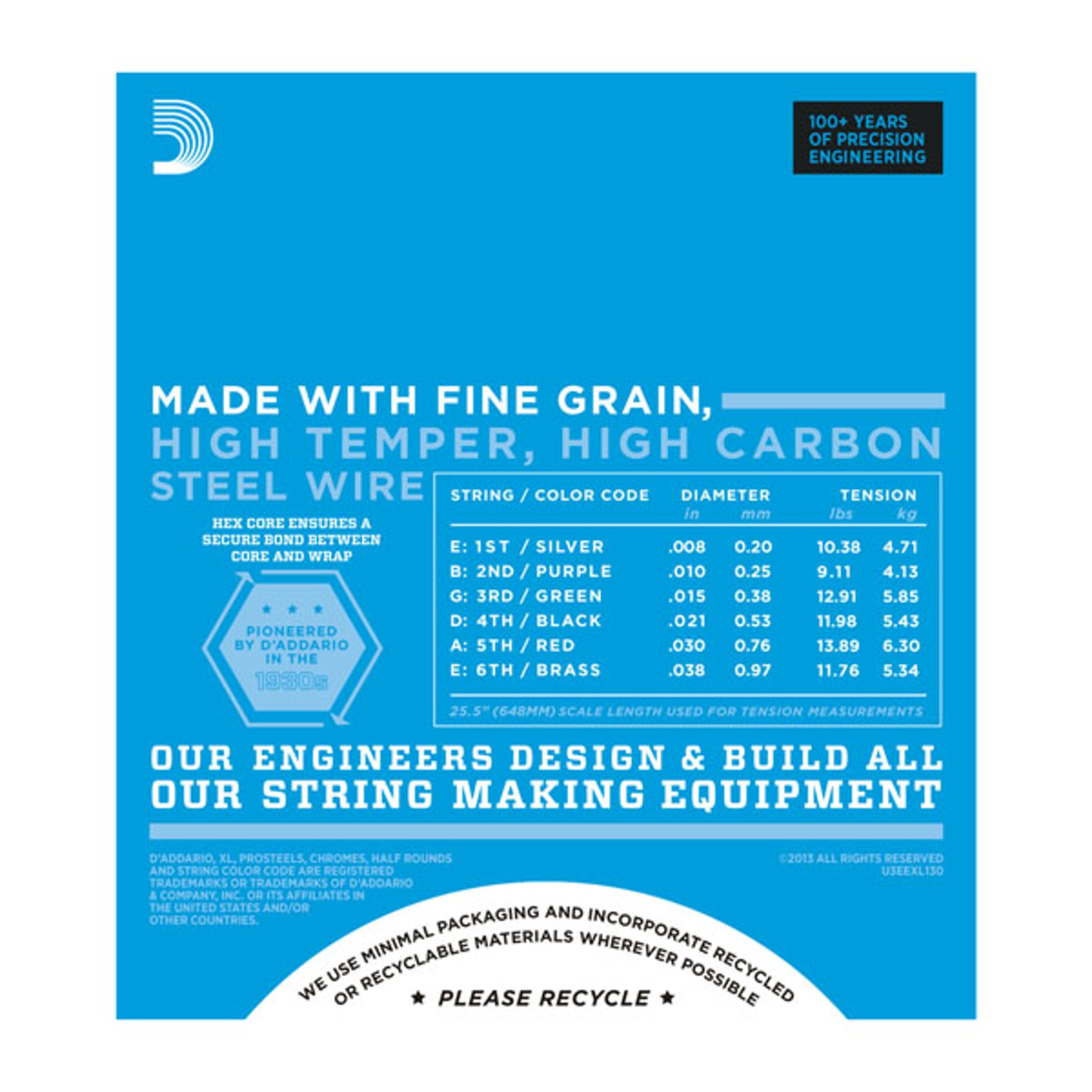
D'Addario XL Nickel Electric Guitar Strings (EXL130) are the industry standard since 1974, featuring extra super light 08-28 gauge nickel-plated steel strings with proprietary Hex-Core technology for perfect intonation and durability. Made in the USA, these strings offer a bright, versatile tone ideal for all styles, with consistent feel and long-lasting performance. Plus, earn rewards with every pack through the Players Circle program.


| ASIN | B000EEHDK2 |
| Best Sellers Rank | #19 in Musical Instruments ( See Top 100 in Musical Instruments ) #2 in Electric Guitar Strings |
| Brand | D'Addario |
| Brand Name | D'Addario |
| Coating Description | coated |
| Customer Reviews | 4.8 out of 5 stars 46,117 Reviews |
| Finish Type | Uncoated |
| Global Trade Identification Number | 00019954141318 |
| Instrument | Electric Guitar |
| Item Height | 0.1 inches |
| Item Type Name | Nickel Wound Electric Guitar Strings |
| Item Weight | 0.1 Grams |
| Manufacturer | D'Addario &Co. Inc |
| Recommended Uses For Product | Electric Guitar |
| String Gauge | Extra Super Light |
| String Material Type | Nickel Plated |
| UPC | 019954141318 |
| Unit Count | 1.0 Count |
| Warranty Description | No warranty. |
A**R
Best strings for electric guitar
I've been using these strings since 1978 - they sound great, last a long time, easy to bend, feel great under the fingers. These are the ones to get. Great price too!
M**M
Reliable, Long-Lasting Guitar Strings That Hit Every Note
I bought these guitar strings for my husband, and they’ve exceeded our expectations. He plays regularly, and these strings offer a perfect balance of tone, feel, and durability. The nickel winding gives a smooth, consistent feel across all frets, and the sound is bright without being harsh, making it. perfect for both rhythm and lead playing. What makes these sets stand out compared to others we’ve tried is their reliability and consistency. Every set in the box felt exactly the same as the last, which is a huge plus if you restring frequently. They also hold tuning well, even with heavy strumming or bending notes, and resist corrosion better than other strings we’ve used. For anyone looking for high-quality, long-lasting strings at a reasonable price, this 10-pack is a smart buy. My husband’s guitar sounds incredible, and he’s thrilled to have plenty of sets on hand. Definitely a purchase we’d make again.
P**R
It doesn't get any better than D'Addario (from a 30-year player)
I've been playing D'Addario strings for over 30 years now and I've bought hundreds of sets over the years. I've tried many others in the past, but now I just figure why bother, nothing has ever exceeded them, and usually other brands come up short. D'Addario strings never seem to have problems like excessive breakage, old/tarnished strings, or just inferior tone/quality that I have experienced with others. I buy both acoustic and electric strings, and also bass strings, although acoustic is my main instrument. If I have one tip for you, it's this. If you are wondering why you can't get the vintage sound of 70s acoustic guitars or earlier, BUY THE D'ADDARIO 80/20 ACOUSTIC STRINGS. Personally I live for this sound and I consider it the ultimate and most superior tone of tones. If you want the modern acoustic sound (1980s onward), then sure, buy Phosphor Bronze or the coated strings. But those 80/20 D'Addario strings are the holy grail imo. I also consider these strings (EXL140 light top/heavy bottom) to be the pinnacle of electric strings, but honestly, if you play only heavy metal, maybe try the Pro Steels, and if you only play blues, maybe try the Pure Nickel instead of Nickel Wound. But these to me are the Goldilocks strings, perfect, right down the middle, balanced, tough, stay in tune really well. You can't go wrong. The heavy bottom really helps eliminate string buzz and gives a solid strong bass, while the light top allows for great bending and perfect playability.
A**S
The Best Guitar Strings I've Ever Played On!
I'm thrilled to share my experience with these incredible D'Addario Guitar Strings! As a guitarist, I've had the pleasure of trying various string brands over the years, but none have impressed me as much as these. Whether you're a seasoned pro or just starting out, trust me when I say that these strings are a game-changer. The Sound: The tone is rich and full-bodied, with a clarity that's hard to match. From bright and snappy to warm and mellow, these strings seem to bring out the best in your guitar. Whether you're playing jazz, rock, or folk, D'Addario strings will make your music shine. The Feel: The texture is smooth and even, making for a comfortable playing experience. The tension is spot-on, with just the right amount of resistance to keep your fingers moving freely. No more worrying about muting or adjusting; these strings feel like an extension of your own hands. Durability: I've been using these strings on my main gigging guitar for months now, and they still sound like new. That's a testament to D'Addario's legendary quality control! Whether you're playing live shows or recording in the studio, these strings will withstand the demands of constant use. The Value: Considering the level of craftsmanship that goes into each set, I believe these strings are an absolute steal at their price point. You won't find a better value anywhere else! Cons: None! Okay, okay, maybe one: you might find yourself getting too attached to your new favorite strings and forgetting about all those other strings sitting in the case...
T**R
Reliable quality electric guitar strings
Reliable strings. These are my favorite brand of 9s. Only complaint is if 1 string from the set breaks it’s always the high e string. I’ve been using them on my top load telecaster and the low e is thin enough that I can fit the string through the small hole in the bridge to load the string. I’ve noticed sometimes the end of the string near the ball end is too wide to load. But no problem with these strings.
S**E
Classic standard strings, authentic
Classic strings, work well, sound great, authentic strings from this seller. Feel great
D**B
Does the job, Good quality for the price
These have been my go to before going to coated strings. Never had one break, and the tone seems good for a couple months
Y**P
Best-sounding, longest-lasting, best-playing, affordable strings for electric guitar
First off, reviewing guitar strings objectively is extremely difficult. Any new set of strings will generally sound, feel, and play better than any old set of strings. Moreover, changing strings, tuning them, and breaking them in takes enough time that it is practically impossible to get an exact AB comparison across different brands in real-time. You need two otherwise identical guitars with otherwise identical wood, setup, electronics, fret age, etc, and you need to fit them both with new strings of the exact same gauge and type but different brands, in order to really assess the differences between two brands objectively. Which is close to impossible. That said, I personally own four electric guitars, and the studio I work at has about a dozen more. Over the past 15+ years as a musician, sound engineer, and stage hand, I have almost certainly played or recorded well over a hundred. So while I cannot personally swear to have done a scientific head-to-head double-blind test between every brand of strings, I can say a few things pretty categorically. And I have tried a ton of different makes of string, from Ernie Ball to GHS to La Bella to mail-order to store-brand, etc etc. (For bass, I prefer other brands than D'Addario, but that's a seperate review). Sound-wise and playability-wise, these D'Addario Nickel Wounds are great. They have a high-quality, "as-expected" sound for a new guitar string, straight down the middle of how a roundwound nickel string should sound. Longevity is a more-complicated story, and widely misunderstood. First off, here are the things that compromise metal guitar strings, in approximate order or importance: 1. Metal fatigue. Over time, bending and vibrating a piece of metal causes it to become more brittle and to develop microscopic cracks. Tension, stretching, and deformation exacerbate this condition, which is why even coated strings that are never played become dull and dead-sounding after a couple months of sitting on a guitar, compared to an identical set sitting in its package. This wears out strings faster if you play them, but also even if you just leave them sitting on your guitar. In my experience, D'Addario strings are among the best, if not the best, in terms of mainstream commercial guitar strings when it comes to staying supple, soft, and flexible. 2. Surface oxidization/corrosion. This is where coatings can help. Exposure to air, moisture, skin oils, perspiration, etc has a corroding effect on metal strings. Those black, coppery-smelling stripes that you get on your fretting hand are the product of some kind of chemical breakdown in the alloy your strings are made from, releasing certain minerals from the metal onto your fingers. These effects are often over-stated in the marketing materials of coated-strings: they are real, but they are not usually anywhere close to the first thing that kills a set of strings. The conspicuousness of the symptom (black, dull-looking old strings) is often confused with the effects of metal fatigue, and people sometimes think that if they can keep their strings shiny, they will sound and play like new. Not so. Coatings only help the specific problem of surface corrosion, which can be a real one, but is a minor one for most players who keep their guitars in conditioned spaces and who play with clean hands. After a couple weeks of being installed at tension, even coated strings start to succumb to metal fatigue, and need to be changed even if they have never been played or taken out of the case. 3. Physical deformation is the final and most unavoidable symptom. Unless your frets are made of softer metal than your strings (and we should hope that they are not), then playing your guitar inevitably creates "flat spots" on the strings, where they contact the frets. Probably similar at the bridge and nut. These become physical deformities in the string's resonant characteristics, as well as exacerbating metal fatigue and compromising surface integrity at those points, affecting both of the above. Taking all of the above into consideration, and assuming that you want soft, supple nickel strings that won't chew up your frets, I think these are your best overall choice. My one exception might be if you have serious problems related to surface corrosion, due to bodily PH imbalances or outdoor gigs, etc, in which case you might benefit from coated strings. But for most players, the strings are going to wear out from metal fatigue long before corrosion has a real effect on the sound or playability.
ترست بايلوت
منذ 5 أيام
منذ 3 أسابيع