We remain fully operational. Our teams are working around the clock to ensure your deliveries continue safely.

قم بتنزيل التطبيق


معلومات عنا
حقوق الطبع والنشر © 2024 Desertcart Holdings Limited
قم بتنزيل التطبيق

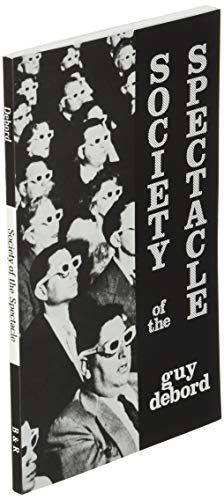



Society of the Spectacle : Debord, Guy: desertcart.in: Books Review: This book is unique of its kind because of its ... - This book is unique of its kind because of its subject. Author is knowledgeable and prolific writer famous for his intrigued thoughtfulness. Review: GOOD - good for post structuralists
| Best Sellers Rank | #458,479 in Books ( See Top 100 in Books ) #736 in Economic Conditions (Books) #1,663 in History of Civilization & Culture #2,998 in Political Theory |
| Customer Reviews | 4.6 4.6 out of 5 stars (947) |
| Dimensions | 13.34 x 1.27 x 21.59 cm |
| ISBN-10 | 0934868077 |
| ISBN-13 | 978-0934868075 |
| Item Weight | 159 g |
| Language | English |
| Print length | 132 pages |
| Publication date | 1 June 1983 |
| Publisher | Black & Red |
A**H
This book is unique of its kind because of its ...
This book is unique of its kind because of its subject. Author is knowledgeable and prolific writer famous for his intrigued thoughtfulness.
S**R
GOOD
good for post structuralists
N**N
Possibly the most important book of the 20th century. Cool edition. I love guy debord
A**S
I bought this for a gift for a history buff and he is really pleased with it. Already all read and keeps talking about it.
M**O
This edition features its most iconic cover; even though for new readers I would recommend Ken Knabb's translation, easier to read and including the original annotations.
E**O
Debord’s Society of the Spectacle (1967) is a prescient indictment of modern capitalism’s structural framework expressed as a ‘spectacle.’ Most people who read Society of the Spectacle confuse it with a critique of ‘mass media.’ They accept it on its face and ascribe a literalism to Debord which is not there: namely, that Debord critiques society’s obsession with ‘mass media.’ Although he does include mass media in his critique, it is merely a feature and outgrowth of the overall spectacle. In Chapter I:24, Debord writes of ‘mass media’ as the spectacle’s “most glaring superficial manifestation” that “seems to invade society as mere equipment…” One must read Debord’s subsequent work Comments on the Society of the Spectacle (1988) to learn of Debord’s nuanced distinction. Therein, Debord writes, “[r]ather than talk of the spectacle, people often prefer to use the term ‘media,’ and by this they mean to describe a mere instrument, a kind of public service.” The idea of ‘media’ as itself a mode of influence is more thoroughly explored by Marshall McLuhan, who in the same year of ‘Society of the Spectacle’ in 1967 wrote ‘The Medium is the Message’ which expands on his earlier work 'Understanding Media' (1964). Therein he describes how different media/medium embeds itself into the message it transmits, which thereby influences how the message is delivered and ultimately received by individuals. But, the ‘spectacle’ is much more than just media. The ‘spectacle’ that Debord is concerned with is based on capitalism’s all-encompassing ability to metabolize, overtake, and absorb every facet of life it contacts, including individuals. It thereby transforms the individual into an alienated passive spectator who watches the flow of life reduced to the movement of commodities, and a reification of life events in general. The ‘spectacle’ is thus the dominant regime which shapes and directs the ‘lived time’ of individuals, who become fetishistically ensnared within the daily struggle of commodified relations and things. It is captured by the opening line: “In societies where modern conditions of production prevail, all of life presents itself as an immense accumulation of spectacles. Everything that was directly lived has moved away into a representation.” This book not only denotes, describes and distills capitalism’s immense spread into every sinew of reality through the spectacle, but it also describes the spectacle’s tentacles spread to the present post-internet age embodied by so-called ‘social media.’ Debord foreshadows this when he writes that “the spectacle is not a collection of images, but a social relation among people, mediated by images.” Thus, Debord’s point is that as individuals we have been captured by capitalism’s method of operations embodied in the spectacle. The ‘spectacle’ in turn alters and transforms our relationships both with ourselves and others. Thus, we succumb to the influence of living mediated lives – mediated by technology, consumer goods, financialization, entertainment, etc. Our reality is thus interpreted for us and neatly presented in curated commodified narratives. Debord was no doubt influenced by Hegel, Marx and Lukacs. However, he attempted to transcend Hegel and Marx in that for Debord, both Hegel and Marx attribute history’s march to forces other than human agency – Spirit for Hegel and economy for Marx. For Debord, although the individual is captured by time, the individual is nonetheless capable of acting and shaping history through social actions within time. Ultimately, Debord’s work provides a slim sliver of hope. In light of Marcuse’s One Dimensional Man (1964), one can argue that radical/revolutionary critique was pacified and all opposition subdued by the material comforts which capitalism’s ‘spectacle’ offered. Thus, any attempt to critique, rebel or resist the march of post-capitalism’s desire was rendered impotent and absorbed within the spectacle. This is both an easy yet hard read in that some of the writing needs to be re-read by the reader to understand the meaning behind the text. Moreover, one needs to read this book in the context of the time – and Debord’s involvement with the Situationist International. Additionally, one should read Debord’s subsequent Comments on the Society of the Spectacle, as both inform each other for a more holistic understanding. Ultimately, this is a must read for anyone who seeks to question the received reality we are presented with and approach life critically.
A**N
Buen libro, pero mala calidad de material por lo que pague. No estoy completamente satisfecho.
ترست بايلوت
منذ شهرين
منذ شهر