Buy anything from 5,000+ international stores. One checkout price. No surprise fees. Join 2M+ shoppers on Desertcart.
Desertcart purchases this item on your behalf and handles shipping, customs, and support to KUWAIT.
🚀 Upgrade your home network to pro-level speed & control — don’t get left buffering!
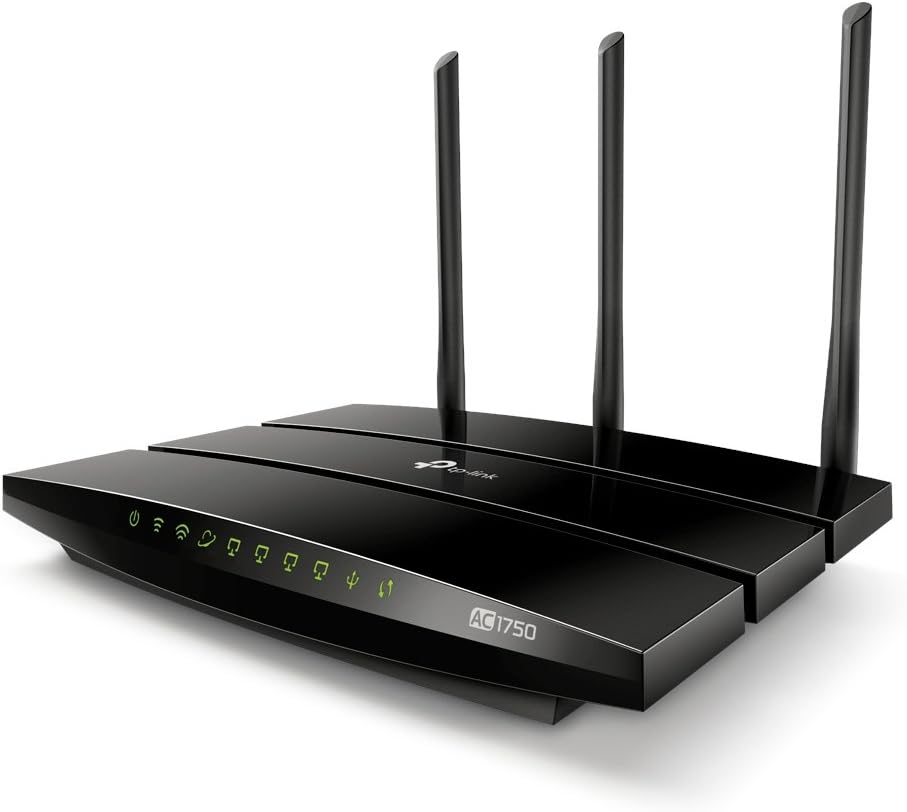
The TP-Link Archer C7 AC1750 is a dual-band wireless router delivering up to 1.75Gbps combined speed (450Mbps on 2.4GHz + 1300Mbps on 5GHz). Equipped with five gigabit Ethernet ports and dual USB 2.0 ports, it supports fast wired connections and easy media/printer sharing. Advanced features include guest network access for secure sharing and IP-based bandwidth control for device prioritization. Ideal for busy homes and small offices, it offers reliable coverage, easy setup, and compatibility with smart home devices.


| ASIN | B00BUSDVBQ |
| Antenna Location | Indoor/Outdoor |
| Antenna Type | Internal |
| Best Sellers Rank | #14,361 in Computers & Accessories ( See Top 100 in Computers & Accessories ) #470 in Computer Routers |
| Brand | TP-Link |
| Built-In Media | Routers, hub, networking |
| Color | WiFi Router |
| Compatible Devices | Tablet |
| Connectivity Protocol | ethernet, wi-fi |
| Connectivity Technology | USB |
| Control Method | App |
| Controller Type | vera |
| Customer Reviews | 4.2 out of 5 stars 18,783 Reviews |
| Data Transfer Rate | 1750 Megabits Per Second |
| Frequency | 5 GHz |
| Frequency Band Class | Dual-Band |
| Global Trade Identification Number | 00845973070601 |
| Item Dimensions L x W x H | 9.57"L x 6.32"W x 1.28"H |
| Item Part Number | Archer C7 |
| Item Type Name | TP-LINK Wireless Dual Band Gigabit Router (Archer C7) |
| Item Weight | 0.51 Kilograms |
| LAN Port Bandwidth | 10/100/1000 (Gigabit) |
| Manufacturer | TP-LINK USA |
| Maximum Upstream Data Transfer Rate | 1300 Megabits Per Second |
| Mfr Part Number | Archer C7 |
| Model Name | Wifi Router |
| Model Number | Archer C7 |
| Number of Ports | 5 |
| Operating System | Microsoft Windows 8/7/Vista/XP/2000/NT/98SE, MAC OS, NetWare,UNIX or Linux. |
| Other Special Features of the Product | Alcohol-Free |
| Security Protocol | WPA-PSK/ WPA2-PSK |
| Smart Home Compatibility | Smart Home Compatible |
| Special Feature | Alcohol-Free |
| UPC | 845973070601 971736088382 |
| Unit Count | 1.7 Ounce |
| Voltage | 110 Volts |
| Warranty Description | 2-year. |
| Wireless Communication Standard | 2.4 GHz Radio Frequency , 802.11a/b/g/n |
| Wireless Compability | 2.4 GHz Radio Frequency, 802.11a/b/g/n |
L**Z
Awesome!
This will be kinda long, since I like the product and I'd like to give the review this product deserves. First of all, why I needed a new router? The router my ISP gave me dropped connection sometimes when I had about 5 wireless client and 2 wired clients. So now all that router does is feed Internet to my new router. I made sure to assign DMZ to the router so I can have full management of ports as well. The router I received, and of course that I'm reviewing, is V2. (Most of the apple problems with this device is from V1, but it seems TP-Link can RMA them with a V2 if you have problems with it) Now, my Internet connection. ATM it's optical fiber with about 10Mbps download and about 4Mbps upload. Needles to say that this router can handle that without any problem at all. Now, some of my devices, their capabilities and how they are connected. (All wireless connection are 5GHz unless specified otherwise) 1.- PS3 CECHA01, connected to the WUMC710 (Which is an ac client) wired 1 Gbps. 2.- PS3 CECHA01 connected directly to the router. Wired at 1 Gbps. 3.- Nintendo Wii U connected as n client. 2.4 GHz and 150 Mbps (Support for 5 GHz is only for the gamepad) 4.- Nintendo Wii connected as g client. 2.4 GHz and 54 Mbps. 5.- Nintendo 3DS connected as g client. 2.4 GHz and 54 Mbps. 6.- Nintendo 3DS XL connected as g client. 2.4 GHz and 54 Mbps. 7.- Media connector WUMC710 connected as ac client. Rated as 1300 Mbps, but really showing 1170 Mbps. 8.- HP dv2125la laptop connected as a client (a/b/g capable). 54 Mbps. 9.- Custom desktop (2006), wired at 100 Mbps. Also wireless as n client 150 Mbps. 10.- Xperia Z2 (D6503) smartphone connected as ac client. 450 Mbps~433 Mbps. 11.- Xperia Tx (LT29i) smartphone connected as n client. 150 Mbps. 12.- Samsung Y S6310 smartphone connected as g client. 2.4 GHz and 54 Mbps. I'm only mentioning them because it's a great variety, and I haven't experienced any problem at all with any client. I also have one DS and one DSi, but since those don't support WPA2 they are connected wireless to my old router. I tested them with WEP once and they work OK, tho. I'm also planing to get a PS4 at some point, but this will share the WUMC710 with the PS3. I don't want to use the PS4's wireless because IMO it has a crappy antenna. In the USB ports I have: 1.- Toshiba HDD 500GB 5400 rpm 2.5" with USB 2.0 2.- HP Photosmart D7160 with USB 2.0 (This is not listed in TP-Link web page, but it works like a charm) About performance, I haven't been able to test the Ethernet at its full capacity (1 Gbps), since I only have the PS3 with 1 Gbps connection at home (I have a newer desktop, but I moved it to my school since I spend a lot of time there due my Masters It has 1 Gbps and ac 2x2 at 867 Mbps). But I've tested 100 Mbps and as expected, they work OK and at full speed. Ping times to wired devices is less than 1ms. To wireless, it depends on the signal, but the average is about 10ms, which is good, if you ask me. The router has a "Diagnostics" tab where you can ping any device in your network or even web pages. The max speed reported is in the WUMC710, but I cannot fully stress that connection. This is a 3x3 ac client. So technically, it can take the most advantage of the wireless of this router. On the USB department, the printer has like a 10 sec delayed, compared when it was directly connected to the desktop. But once the work starts, it's the same time. I can stream full HD content (about 6 Mbps) with 5.1 channels to the PS3 or the Xperia smartphones without any buffering time. This was not possible for me before with g clients (expected). This router is DLNA capable. The storage is accessible as well from my computers and smarphones, but max writing speed is about 8 MBps. It's not a limitation in the ethernet ports per se, but I'm guessing the USB port is not as fast as it could be. USB 2.0 can give speeds of about 30 MBps in laptops/desktops. I won't complain here, since there are devices with worse performance in the USB ports. Range: Even while A/N/AC (5 GHz) has less coverage, I can see good signal in every room that I need it. My house is about 100 square meters and the router is in the center, more or less. B/G/N work OK, even when the antennas are internal. Setup: With at least little knowledge about network, it takes about 5 mins. You don't need the CD that comes in the box. Extra: Make sure to install the latest firmware. It'll let you use the TP link tether app. This router has a 2.5 A, which is enough for powering HDD with the USB. Since I wanted to install OpenWRT I also checked the full specs of the router. Here are some: CPU: MIPS74Kc@720 MHz Flash: 16 MiB SPI Flash model: Winbond W25Q64FV RAM: 128 MiB RAM model: Winbond W9751G6KB-25 x 2 Wireless 1: QCA9558 (QCA9558-AT4A) 3x3 b/g/n Wireless 2: MiniPCIe: QCA9880-BR4A 3x3 a/n/ac (This is what changed from V1. V1 is: MiniPCIe: QCA9880-AR1A 3x3 a/n/ac) Wired: GbE AR8327N-BL1A 2 USB 2.0, It suports Serial and JTAG (Programing ports) From this specs I can tell that it has a decent CPU, and good RAM and Flash. So I should be able to install different packages and run them in the router. This router is fully supported by OpenWRT. Sadly for the moment I don't have time to "play" with it. It also does almost everything I'd need, so no need atm. (I'd love to have a torrent client in the router, tho. Possible with OpenWRT) If you think I missed anything, let me know in the comments. I can check it and modify this review. I'll update it once I finish my Masters and my desktop is back home. L8er!
S**Y
Great Bang for the Buck
I'd been getting by with an old 2.4Ghz D-Link N router since about 2009. It worked well enough, until I built a Plex server for the living room and setup a home network on the LAN. I set up a homegroup and had the Plex server transcoding and streaming to other devices on the LAN. It would work for a few days and then randomly stop working, for example my office PC spontaneously could no longer reach the server, I couldn't ping the server, could not access its shared network drive, etc. Everything would work for anywhere from 2-4 days and then just stop working until I rebooted the router. I figured it must be some kind of IP routing conflict, so I assigned EVERYTHING static IP's, but the problem persisted. Also, signal degradation between the router (which is at one end of the house) and the Plex server (which is at the other end) was very noticeable when running speedtest. While my office PC (which is about 12ft from the router) would pull about 27-30Mbps down over 2.4Ghz, the Plex server (which is about 40ft from the router) would only pull about 16Mbps down over 2.4Ghz. My motivation was to increase the speed for the Plex server, so I decided to take a chance on this TP-Link Archer C7. I did not want to spend $250 on an AC router, and the TP-Link had many good reviews, so I figured I'd try it and hope for the best. Setup was easy and the gateway interface is nice, lots of configuration to play around with. I had 8 devices up and running on the network within the span of maybe 30 minutes. I reserved addresses for the Plex server and the office PC, and left everything else DHCP. The network has been up and running for several days now without any issues, even with DHCP devices coming and going. My Plex server speedtest increased from ~16Mbps to ~30Mbps, and the office PC increased from ~27-30 to a whopping ~88-90Mbps. Caveat there though, is that the office PC is running on the 5Ghz band while the Plex server is too far away to connect to the 5Ghz band, so it's still on 2.4Ghz. Still, speeds have increased across the board without having really done anything other than swapped out the router, so I'm happy. Seems the 5Ghz range is limited, so I will likely get a range extender here soon. Definitely recommend this router to anybody wanting to upgrade an old router without spending 250-300 on a Nighthawk or something like that.
A**R
A Good Router (with Information about Warranty Replacement Experience)
------------------ Initial Setup ------------------ The TP-Link Archer C7 wireless router was easy to set up. I used the Quick Start Guide to set up the basic functionality of the router, mostly keeping the defaults but changing the SSID and WPA2 password to match those of the router it was replacing (thus preventing me having to go to every device on the network to change the SSID and password). It took a little bit of searching to find where to change the admin password. Changing the default admin password really should be in the Quick Start. Speedtest.net reported an average speed of about 52 Mb down (very good for a cable modem in my neighborhood) and about 18 Mb up. Curiously, even though the built-in Ethernet switch ports are Gigabit Ethernet the connection to my Netgear GS608 v2 8-port switch seems to run at 100 Mb (or at least according to the status lights on the Netgear, that is what the connection is running. The computers connected to the Netgear are able to connect to each other at Gigabit speeds as are computers connected to the Archer C7 just not over the uplink from the Netgear to the Archer. Signal strength was greatly improved in rooms that had bare minimum coverage with the previous router, a Linksys WRT54G v5. Speeds for client machines that have 802.11n or better hardware has improved since they were previously restricted to 802.11g speeds. Having separate wireless radios that support 802.11b/g/n and 802.11ac is nice. Most wireless clients are still g and n devices. --------------------------------- Warranty Replacement --------------------------------- The router worked great for about 4 months and then went out one morning. I restarted it and it did not stay up for more than about a minute. I was able to reset it and rerun the Quick Start setup. It then crashed again and I was unable to ever log in to it again. I put the 10 year old Linksys WRT54G back in service and contacted TP-Link through email. Over the next week and a half I worked with TP-Link’s tech support, describing what I had done and sending pictures of the status lights. Replies from tech support generally came in around 4:00 AM Central Time, given that that the tech support center was in China, this is expected. I would do a round of troubleshooting in the evening, send off the results, and have a reply first thing in the morning. The tech was always courteous and helpful, but I have to admit that it was a little frustrating that the rapidly rebooting router didn’t raise a flag with them more quickly. Finally they referred the case to the Return Merchandise Department for TP-Link USA in San Dimas, CA. A day or two after the support tech referred the case to the RMA Department, I got an email from them telling me how to return the router. The email said that TP-Link offers an Advance RMA service, where they charge $12.99 to send a replacement router immediately and send a return shipping label for the defective router. This sounded good to me, and I replied back that I wanted to do the Advance RMA. The email said that they would call me to get a credit card number. I did not hear back after waiting two days, so I called the RMA department directly and got their voice mail. I left my name, phone number, and RMA number. I did not get a call back, but the next day I got an email with a FedEx tracking number. About three days later, the replacement router arrived. It was a new, shrink wrapped retail box, not a refurbished router as far as I can tell. I boxed up the defective router and put the return shipping label on it, and checked to see that it arrived back at TP-Link’s RMA Department. They never did charge me for the Advance RMA. The replacement router setup was the same easy experience as the original and it is up and running. Their standard warranty is 2 years from date of purchase. I’ll be keeping an eye on it. I’m not ready to extol the virtues of TP-Link, nor am I ready to trash the company. The product is good when it is working as expected, and they did take care of the problem when it was not working.
B**M
The C7 solved 3 major network headaches
I have been looking for many months for a solution to solve these 3 problems: 1. The Amazon Echo disconnect issue (with ATT-DSL modem) 2. Monitor and manage a family home network and not only assign bandwidth, but also LIMIT USAGE per device 3. Improve signal strength, consistency and reach throughout the house to connect multiple devices After extensive research, I ordered this router and I am happy to report that it solved all my above problems: Ad 1: We got frustrated that our Echo kept disconnecting constantly to the point that it became unusable. I researched this problem and the issue seemed to be the interaction between the ATT-modem when one also uses the ATT-modem as WIFI-router. After installing the C7 as the router (turning the WIFI-mode on the ATT-modem off and directly connecting the C7 via CAT5-LAN cable and making the C7 the WIFI-router) the problem was immediately fixed. NOT a single disconnect ("Sorry, I am having trouble understanding you right now") came up since the C7 took over. Ad 2: Like many, we have a monthly cap on our home internet and with multiple devices and family members streaming video, we often went over that limit and incurred additional charges. For many months I looked into how I could 1. find out who uses the most data and 2. how to allocate and limit data usage per user/device to avoid the overage fees. Unfortunately the only solution that kept coming up was installing and maintaining a home proxy server and route all traffic through the proxy. A major headache....I just wanted a router based (simple) solution. I eventually came across the "Gargoyle Router Management" firmware and I can happily report that this router works perfectly with this firmware. I followed the instructions and replaced the original firmware with the Gargoyle (do this at your own risk, as this may "brick" your router and void the warranty) and I can now monitor usage data and assign data usage caps for the whole network through the router interface. Most routers do have parenteral or user access controls, but none I came across could truly assign USAGE limits (most only let you put limits on TIME, BANDWIDTH and WHITE/BLACK-listing sites). This custom firmware lets you do all this PLUS assigning DATA QUOTAS. The issue is that not every router works perfectly with the Gargoyle firmware (some have 5GHz-issues etc.), but the C7 works great and I could not be happier. Ad 3: Before the C7, the ATT-modem also served as the WIFI-router an we had to buy a "range extender" to get the signal everywhere. After installing the C7, I was amazed to find out that we could eliminate the range extender! Since the C7 is connected to the ATT-modem via LAN-cable, it is in the same location, and still delivers a constant, strong signal to places that we could only reach via the extender before. Now, I cannot report how the C7 performs with the built-in, original firmware, but with the Gargoyle firmware running I solved 3 major headaches within an hour that I think many of us experience these days. This router can even pay for itself, if you consider eliminating overage fees (or "distribute" the fees to the responsible parties because now you know who the data hogs are, if you don't want to set the router to disconnect the internet once the limit is reached) and also not needing the range extender in my case. I even looked into the high end router category, but even those would have needed the Gargoyle firmware (none had the data usage cap option built in). And "bricking" a 300+ dollar router was not an option. Summary: The C7 not only solved 2 major headaches immediately on the first try (that usually never happens), but as an added bonus helped me eliminate my range extender. I am one happy customer!
A**A
5Gz signal disappears in less than a day and has to be rebooted
Update: After not hearing anything from support for 5 days and then emailing them again, I contacted the Amazon specific email as posted in some reviews. Received a call in a few hours and had an RMA number. But then also right after heard back from the Chinese support who sent a beta version of the firmware. That firmware has fixed the 5G problem, but I'm not sure it is fully stable as the Xbox One on the wired connection seems not as fast a connection. However, I do consider the router fixed. But where are you going to get the beta software from? I told the local people that I wasn't going to RMA so that they could close it out. They requested that I send the beta to them so they could have it, since they weren't aware of any beta or who had sent it to me. The support is so disorganized that a full 6 days after someone had sent me the beta, I received an automated email saying I had not replied to their email. Which I had sent 3 responses to, including the one that seems to have resulted in getting the beta. So I'm leaving one star because I seem to have by luck managed to get a beta firmware that worked. Otherwise it would have cost between $7 to $9 shipping, and a week wait in getting an RMA replacement. Prior: Other than having to be rebooted every day to get the 5gz signal back, this is a very nice router. The signal is strong and my devices will even keep connected the 2.4gz signal most of the time when the microwave is running. With my last router, everything would lose the signal with the microwave running. The 5gz signal would also get around that issue, if it didn't take constant rebooting. The actual speeds the router delivers are faster than what I got before. Wired connections have been fine. So all that is great. Another good thing is TP-Link has an Android app, so it can be rebooted from my phone without needing to go to a wired PC, or going to router itself to do that. But I should not need to reboot it at all. The signal has been spotty starting soon after I got it. At some point maybe weeks or months in, the 2.4gz signal would be connected, but there would not be any internet service. Rebooting would fix that for a while. Not sure when that happened since only one computer could not also switch to the 5.0gz signal so my devices were switching to the 5gz signal and working fine. I was even going to buy a new wifi card for my computer thinking it had gone bad. But after checking, I found out it was the 2.4gz signal that was the problem. Installing a firmware upgrade fixed the 2.4gz problem (I think). But now the 5.0gz signal will just disappear in a day and actually seems to be getting worse, to maybe 12 hours now. It just can't be seen by any device though the panel light will be blinking as if all is fine. I'm using a logging program on my phone to track when it changes to the 2.4gz network, and today it changed 15 hours after the router was rebooted yesterday. I assume the 2.4gz problem is solved since it hasn't happened again. But since I'm rebooting every day now, maybe I still have that problem and just haven't had the router running long enough for it to show up again. I've been trading emails with support for a week now, with screen shots and trying things out. But haven't heard from them in 4 days at this point. I had held off on reviewing to give them a chance. But 4 days without any communication from them is a joke on top of the router having problems.
U**Y
TP-Link's workhorse, with the speed and features of routers twice the price.
UPDATE: Nov. 2017. This thing is still working great. I've power cycled it once in a while but that was also along with the cable modem, and I think the cable modem is more to blame for sluggishness as my internal network communications haven't suffered when incoming bandwidth has seemed to dry up. We have been using this unit for approx. 2 months now and we haven't given it a thought. Being a network admin in IT as a profession, I spent some time researching what was the best bang for the buck. This Archer C7 AC1750 (Version 2) had a great deal of features built in, 4 gigabit ethernet ports, a USB print server port, USB expansion port for media, as well as an FTP server. I also liked the ability to have a hardware switch to turn the wireless off/on as well as a dedicated power button. The unit has been super reliable and I haven't had to power cycle it since the initial setup. The setup was straight forward. For the different frequencies (5ghz, 2.4ghz), you do need to set up individual networks, and since they work simultaneously there's no slowdowns with multiple devices connected. Both my wife and I work via Citrix and with both of us logged into our respective networks, a child on Amazon Fire TV or a mobile device/laptop, and there's no lag or dropped sessions. We have a 60Mbps internet connection and we get every bit of it whether wireless, wired or both simultaneously. The external antennas (used only for 5ghz) are a great feature as that frequency doesn't have the range of 2.4, which uses 3 internal antennas. There are a bunch of other features this router has, such as bandwidth throttling on a per-device basis, 1-touch WPS, and a dedicated guest network that works on both 2.4gzh & 5ghz. For the home & small office user, this is all that is needed, and the price is right. While there are a bunch of more expensive wireless routers out there, I don't see the need to spend that extra money for little to no extra features or wireless range. The big brands are still charging a premium for their names. I've used other TP-Link products and I've been very happy with their quality and lifespans. You can read all sorts of reviews, focus on nit-picky things like the upstream 5ghz AC speed when the moon is in its 3rd quarter, and your head will explode, and you'll find yourself paralyzed with indecision, but the bottom line is this is a solid wireless router with a ton of features at a great price. The first version of this unit suffered from some glitches, but TP-Link ironed things out for the second iteration, and this unit has really become their workhorse.
J**G
Extremely fast with amazing range. My previous Netgear router had problems hitting ...
Extremely fast with amazing range. My previous Netgear router had problems hitting the backyard but the C7 easily reaches all four corners of our 1/4 acre backyard. Similarly we don't have any issues with signal strength in our 2500 sq ft home. The 5Ghz band doesn't have as long a range as the 2.4Ghz but we still get high Internet download speeds (100mbps+) from the other side of the house. We've owned the router for about two years and a half years with no problems. The router is commonly used by at least four devices watching HD Netflix and now 4K video. There are no noticeable slowdowns even with a ton of data going over the network. Sadly we'll need to be getting a new one sometime soon as we're occasionally losing signal in the past two weeks. 2.5 years is about the average lifespan of a router in our household so I'm calling this one a win. I'm very likely to order another to replace it since the range is outstanding and the price is ridiculously low. I've had $200+ routers go out in less time and have about half the range. PS. No clue how Amazon handles reviews but there were way more reviews back when I bought this a few years back. Now there are only 91 reviews! The Netgear R7000 router I was just looking at has something like 11,000 reviews and is a much newer router that isn't considered one of Amazon's top selling routers. What gives, Amazon? I'd love it if they took some lessons from Yelp and got rid of the B.S. reviews. Other notes: Works great as a fileserver. We use ours' for Kodi. Works great with Xbox Live. Never had lag issues either wired or wireless. DLNA works as designed but the fileserver with Kodi was easier, faster, and better looking The UI could use some work but there is an amazing amount of configuration/customization available 5ghz band doesn't support DD-WRT. :( Existing feature set is very robust so I doubt I am missing anything.
J**F
Mediocre Router at Best
10-1-15 Sent this router back for a refund. Like I previously stated I think its a good router for someone that lives in a small home or apartment but for a large home and where good range is needed it just didn't live up to my expectations. Update: 9-25-15... I am now changing my initial review. Initially, I wasn't pleased with the range of this router and I was praising the Netgear R7000 but this is what happened. I had already thought about returning this router and was going to keep the Netgear Nighthawk R7000 but what I learned was this: I was streaming some live sports via my Roku 3 on the 5GHz band with the Netgear Nighthawk; the router was in the same room as the Roku and wouldn't you know it! started dropping connection every two to three minutes and this was with the firmware up to date. I immediately disconnected from the 5G and connected to the 2.4 G and the dropped connection went away but that was a big disappointment! my whole purpose of buying an AC router was to get some of the congestion off the 2.4G because I have several devices that can use the 5GHz band. So I plugged the TP-Link back up and connected the Roku 3 to the 5 GHz and it didn't drop the connection not the first time.... I even went into my living room which is about 25 to 30 feet away and was able to stream on another Roku device without any dropped connections. So even though the range may not be everything I was hoping for with the Archer C7 what I've learned is that its connections are very stable and fast! In the end, the expensive Netgear Nighthawk went back to Staples and I may be keeping the TP-Link.... to be honest ,I had never had good luck with Netgear anything and this time was no different. For the price, the Archer C7 is a great deal and as stated in the first review I like that it has a 2 year warranty and free 24/7 tech support; there aren't too many others that offer that. It seems as this point that the great review this router received on the wire cutter.com website is a fair review. 9-19-2015 (Initial Review) I bought this router based on its high recommendation from the wire cutter. I received the router yesterday and it didn't take me long to make a quick decision to send it back for a refund. This was my first time buying a TP-Link product and may be my last. I live in a one story ( ranch style ) home that is approximately 1500 square feet. The set up out of the box was very easy and straight forward and I had no issues setting it up with my cable modem and configuring my networks and connecting my devices. The router seemed to be of good quality and I really liked the black, sleek look that it has and the antennas were very sturdy compared to others I have attached to other routers. Also this router seemed to run very cool and didn't even get warm.... At first everything seemed fine and I really wanted to like this router because of the specs and price as compared to others. Things went south whenever I started testing out the signal strength (range) in various places in my home. I don't have the greatest setup as my cable modem for my internet is at the far end of my house in my bedroom. Reviews had suggested that the 5GHz band on this router was very fast and strong but when I tested it in my living room that just wasn't the case unfortunately. I connected my roku and the signal strength was " good" and at times fell to "poor"... I also tested the 2.4GHz and it was ok but nothing great. I did all of this testing after immediately disconnecting a Netgear R7000 that I bought a week ago.....I wanted to see if the great claims of this router would live up to its expectations as I paid nearly double for the Netgear Nighthawk and TP-Link also had a better warranty ( 2 years) and 24/7 support as where Netgear has 90 days of phone support and a 1 year hardware warranty. This router didn't even come close in performance to the Nighthawk, particularly with the wifi range. I think if you live in a small apartment or small to medium house this router would serve your needs just fine but if you live in a large home its best to just pay out the extra and invest in the better routers. I guess its true you get what you pay for as it was in my case. I understand everyone has different environments and what may work well in my home may not in yours but in my situation this router just didn't live up to expectations. Even my older Asus RT N66 had better range than this router. I hope my review will help some others out there.
P**É
Produit conforme, fonctionne très bien comme relais
Utilisé pour prolonger mon réseau wifi et avoir des ports ethernet supplémentaires, le routeur remplit pleinement sa fonction. Après avoir un peu tâtonné à l'installation (1er démarrage long), le résultat est très satisfaisant. La première étape était de le basculer en mode point d'accès, puis copier coller le SSID et mot de passe Wifi de la box dans les paramètres du routeur : il n'apparaît alors plus q'un seul réseau auquel les appareils se connectent automatiquement sans que j'ai pour le moment rencontré de problème de bascule (MacBooks et iPhones). En ethernet j'ai connecté ma box TV HD 4K qui fonctionne sans aucun problème ou bug. Mais je n'ai pas testé le débit exact par rapport à celui de la box. Les test de débit Wifi sont concluant et dépassent régulièrement 200Mbits (l'image postée est un peu le débit mini). J'ai souvent un upload plus fort que mon download donc il me reste quelques paramétrages à creuser... Dans tous les cas, il remplit sa fonction d'extension de wifi et de hub ethernet : les débits sont suffisant pour tous les usages, y compris un téléchargement rapide (un fichier de 2,5Go en 3mn en wifi). Enfin au niveau tarif, le routeur était en promo à 56,10€ et Amazon offrait 10€ pour toute commande supérieure à 50€ : au final cela me revient à 46€10, un tarif imbattable. Difficile de ne pas être satisfait ! Si mon avis vous est utile, cliquez, cela fait toujours plaisir !
S**)
Mejoró el wifi y el alcance. Con muchísimas funciones. Tope de gama.
PUNTOS POSITIVOS: - El router doble banda más rápido que he probado hasta ahora. - Muchísimas opciones de configuración en el panel del administrador. - Servidor DLNA, Servidor FTP, Servidor de impresora USB, y Servidor de almacenamiento. - Puede emitir a 2 frecuencias (2,4ghz y 5ghz). *En mi caso mi portatil no reconoce la frecuencia de 5ghz aunque el movil (Nexus 5) si. La frecuencia de 5ghz es la recomendada para por ejemplo streaming de video o juegos online (al no tener tantas interferencias con otras redes wifi o aparatos electrónicos). Puedes desactivar alguna de las frecuencias si no las necesitas o si tus aparatos no la reconocen. PUNTOS NEGATIVOS: - Tamaño físicamente grande (mayor que otros routers que he probado). - El panel del administrador puede resultar algo confuso (de tantísimas opciones que tiene y la manera en que se organizan). Cuento mi experiencia: Hace tiempo mi proveedor de internet me aumentó la velocidad a 50 megas y me tuvo que cambiar el router antiguo por uno que soportara una mayor velocidad (Netgear CG3100D). Todo fue “más o menos” bien, con la excepción de que: 1)No llegaba el wifi al salón de mi piso (no es exageradamente grande, 90m2). 2)la velocidad se reducía un poco con respecto al cable (en principio normal, ya que por wifi siempre llega menor velocidad). 3)A veces se “trababa” cuando había muchas conexiones al mismo tiempo y había microcortes de conexión. Hace muy poco se me aumentó a 200 megas, y la cosa fue peor: No me llegaba ni un 30% de la velocidad contratada por wifi, etc y seguía sin tener acceso al wifi en el salón. Este router: 1) Mejoró la cobertura wifi del piso y ahora tengo wifi en donde no llegaba. 2) Aumentó considerablemente la velocidad de internet (sigue sin llegarme el 100%, pero si el 60%). 3) Tiene muchísimas opciones que en principio no sabía ni que existían. La instalación básica fue muy sencilla. En la caja había un mini-cd (también se puede descargar desde su página web), seguí los pasos tal como indicaba y listo. Los usuarios más avanzados pueden meterse en el panel del administrador a través de su explorador (en mi caso 192.168.0.1) y cambiar las opciones que deseen, pero para los que somos novatos la instalación standard a través del mini-cd fue una maravilla y en 10 minutos lo tuve montado. Como curiosidad en páginas web especializadas comentan que TP-Link usará de ahora en adelante la nomenclatura "Archer" para los routers con el estándard ac (último standard de wifi lanzando en 2013). ALTERNATIVAS: TP-LINK TL-WDR4900 Una buena alternativa. Al sacar el Archer han reducido bastante de precio este modelo (80€ en diciembre 2013). Sería un router que no se adecúa al último standard ac pero que para muchos otorga un rendimiento más que de sobra (y muchísimas funciones al igual que este. Puedes ver tablas comparativas que proporciona TP-Link para tomar tu decisión de un modelo u otro. ASUS RT-AC66U 139,59€ diciembre ‘13 (envío gratis si eres de amazon premium). Es un poco más caro que el router que el TP-Link que adquirí. Emite doble banda, Gigabit LAN, 802.11ac - 802.11 a/b/g/n/ac, wifi para invitados, multitud de características… y con la garantía de una buena marca referente en la informática como es Asus. Además está en el Top 10 de routers comprados, por algo será…. ASUS RT-N66U 117,71€ en diciembre ’13 (envío gratis por amazon premium) El modelo antiguo del anterior, Gigabit LAN, 802.11ac - 802.11 a/b/g/n… CONCLUSIÓN: El router TP-Link Archer C7 es fantástico y mi experiencia ha sido muy positiva. ¿Merece la pena gastarse más de 25€ por adquirirlo en lugar de TP-LINK TL-WDR4900? Probablemente no, ya que el rendimiento por lo que comentan en los foros es muy parecido. Yo me decidí a comprar el Archer ya que uso internet muchas horas diariamente y no me arrepiento de mi decisión.
Z**R
Incredible consumer router. Add Gargoyle firmware and you have the best consumer router, hands down
I am coming from a TPLink WDR-4300 environment so the bar was already set very high. My WDR-4300 when running other firmware (Gargoyle) was a bulletproof router/AP. Not a single reboot/freeze/crash in months of operation even when my 25/10 connection was saturated. The C7 is a step above and the best rated consumer router/AP by many publications. Some routers costing 5x more only provide marginal performance boosts. I paid $80, a real steal. The C7 happily runs OpenWrt/Gargoyle/DDWRT firmwares meaning you can tailor the controls/logging/protection levels for your network and your clients. Most of these allow you to configure a guest network which is amazing. You can provide access to someone who drops in and not have to worry that your main password will escape into the community, requiring you to reconfigure all your wireless devices, of which I have about 50 on my network. I put the adult children living here on the guest network which I have speed limited them to a paltry 256Kbps (this is about 5x dialup as they have misbehaved in a major disrespectful way and now have to suffer the consequences or buy their own internet service. Sometimes being the older adult is a blast.) Mind you, I've been running the stock firmware now for a month and there's not been a single reboot/freeze or dropped packet on my network. I recommend the stock firmware for non network savvy people. It's fairly simply to configure, not Netgear simple, but not command line impossible. I get 867mbps connection speed on 5ghz AC band with real world speeds of 50+ Mbps when moving files around. This is roughly half of 1ghz wired speeds but the convenience of wireless can't be emphasized enough. The only real shortcoming of this router doesn't even affect me directly. I've noticed/read that compared to other routers GUI controls for child safety aren't as powerful or flexible. You can implement anything you want, but some things require command line configuration which can intimidate. This may be a concern if you're router shopping with child safety as a primary requirement. I'm going to flash Gargoyle in shortly, after it properly supports 5ghz through the GUI. Gargoyle is my recommended firmware for the Tp Link series of routers. I find it bulletproof, incredibly stable, flexible beyond my dreams, and easy enough for a semi techotool like me to understand. So, TP Link router + Gargoyle firmware = perfect consumer router at unbeatable price.
R**L
Werkt goed en simpel te installeren
Deze ruim 8 maanden in gebruik als een accespoint voor wifi in het hele huis. Ik heb een nieuwbouwwoning en dan heb je tegenwoordig geen of een matige wifi op sommige plekken in huis. Ik heb eerst verschillende wifi versterkers geprobeerd, maar een accespoint werkt voor mij stukken beter. De TP link is super makkelijk te installeren en geeft een sigmaal op 2,4 en 5 g hertz. Helemaal top.
O**O
Five Stars
Well pleased, thank you.
Trustpilot
1 month ago
2 days ago