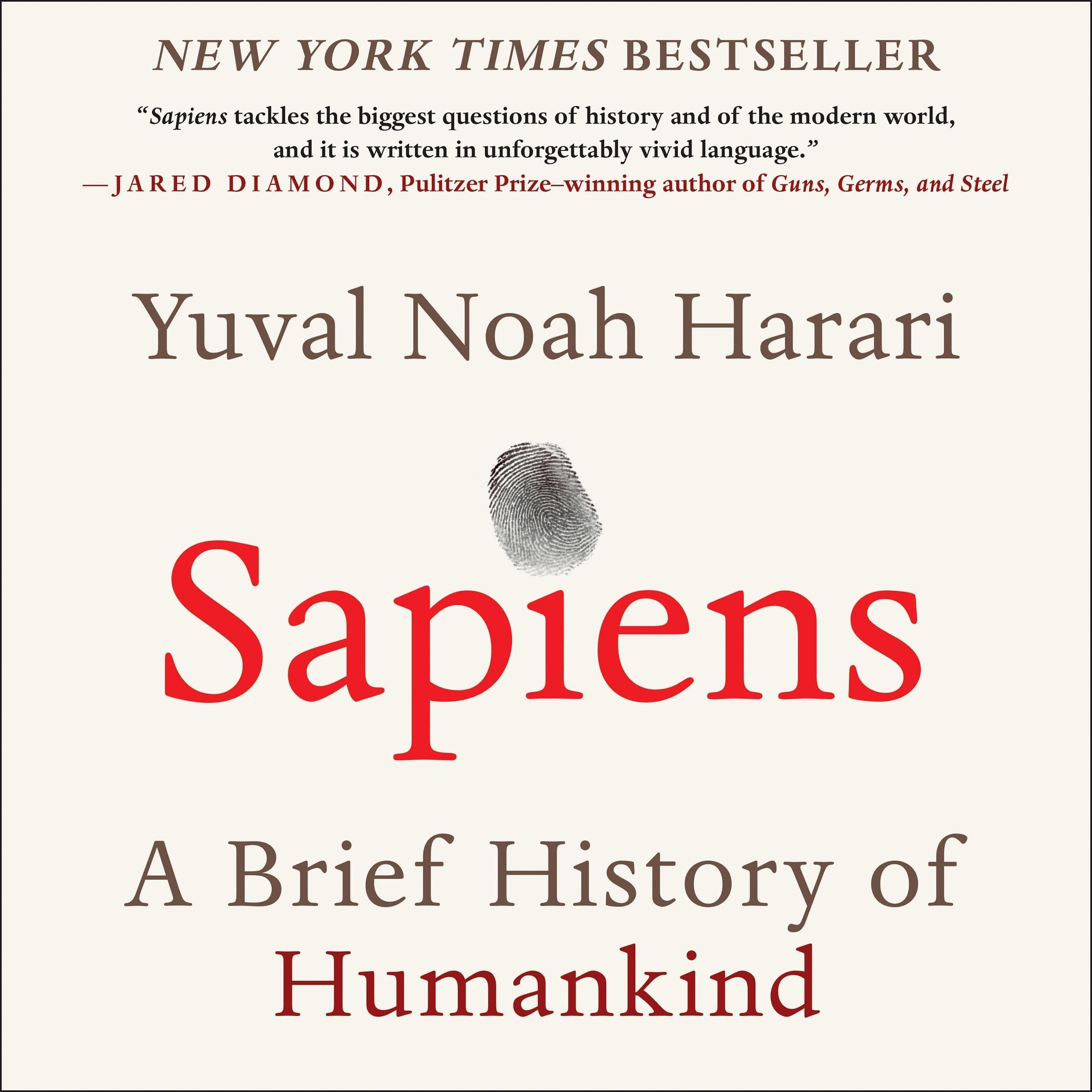
Sapiens: A Brief History of Humankind
Product ID: 89744949
Buy anything from 5,000+ international stores. One checkout price. No surprise fees. Join 2M+ shoppers on Desertcart.
Desertcart purchases this item on your behalf and handles shipping, customs, and support to KUWAIT.
desertcart.com: Sapiens: A Brief History of Humankind (Audible Audio Edition): Yuval Noah Harari, Derek Perkins, Harper: Audible Books & Originals Review: Excellent overview of how modern society got to this point and ways to think about the future - Sapiens is a brief overview to the major stages of human history. It is definitely a unique account in that it focuses on a few major events in human history that catalyzed changes to how people organized. The writing style is engaging and the author always tries to focus on issues from all perspectives and as a consequence many people reading might feel shaken at times or perhaps even insulted. The result is a success though and the author forces the reader to rethink the way they look at human culture and ideological preferences. The author also forces the reader to think about in what light should we be thinking about human progress and the course of history as it is a deep issue that is often glazed over with a final focus on what our conception of progress is for the future given we have put ourselves on the borders of being able to engage in intelligent design of ourselves. Sapiens is split into 4 parts. The first starts with the species which includes those now extinct within the homo genus. The reader learns about the spread of various branches of the family tree and the timing of their diffusion. It gives a sense of the initial diversity proto humans had several hundred thousand ago. We learn that there was nothing inevitable about the human form and how in certain environments larger species evolved and in others dwarfs had a competitive advantage. The author from the beginning convincingly describes how our history is very hard to see as destiny when looking back at the initial conditions we faced. The author describes how around 70k years ago there seemed to be a change in our mental structure that led to an advantage over other proto-human species and we soon eradicated other homo genus competitors. The actual events that catalyzed this is impossible to know and the author describes to the reader the impossibility of looking into the past as the data is non-existent and the best we can do is imagine and such an exercise is largely fruitless. The author also details how the spread of humans led to the death of local ecosystems and notes how humans in Australia and elsewhere led to the extinction of a great number indigenous species. The author then focuses on how hunter gatherers migrated to farming with the Agricultural Revolution which began around 10,000 years ago. The author discusses how individuals had a more difficult lifestyle in agriculture but human density increased. The agricultural revolution can be seen as an oddity through this lens as the happiness of people was diminished though the ability to procreate was amplified. The lifestyle of hunter gatherers was less cyclical than farming as one could move with the seasons and change diet accordingly. Farming forced people in closer proximity with animals which led to higher disease and in addition cyclical crop yields. The author also discussed how farming led to larger communities and as the bonds of association weakened the growth of the state began. The author notes that people can live in communities of 100-150 people before intimate trust breaks down. Early rulers of civilizations all exploited the fact that people were tied to the land in farming communities and things like the pyramids were built due to the ability to organize large labor pools which was only possible when farming could be depended upon. The author discusses how different Hammurabi's code with the declaration of independence. The system of law of the agricultural revolution is profoundly different than today and the author forces the reader to think about whether there is such a thing as right and wrong or is there just context and human construct. The author then starts to focus on perhaps one of the most important human constructs in history - money and religion. The author describes how money allowed people to coordinate to a degree that was impossible in its absence. Barter economies are impractical at very low levels of trade but money solves these problems amazingly well. The author gives some basic economics lessons and describes how money solves issues of trade and created a medium for people to trust one another. The author also discusses religion and how that also allowed people to have something in common with one another on a grand scale. The author discusses how religion shouldn't be viewed through the lens of God alone as religions like Buddhism are not centered on God. The author focuses on what religion does for people and how it creates social relations. The author also discusses the evolution of polytheism to monotheism and dispels with why polytheism seems silly in todays world by describing the conditions in which it arose and was applied. The author then moves into the modern era and discusses the scientific revolution and the growth of capitalism. The author discusses our discovery of our place in the solar system and the transition to the scientific method. The author then re-focuses on money and the transition from money as a medium of exchange to money as a store of wealth and the growth of the banking system as a means of allocating savings to investment. The author very intuitively introduces the concept of the money multiplier and how belief in growth in the future greased the wheels for investment today. The author over simplifies a little and infers that lending in the past was not due to the fact that people were unaware of lending but rather there was no economic growth so loans were seen as much riskier as the world was zero sum. Nonetheless as the merchant class grew and embraced the framework of double entry bookkeeping the power of capitalism to fuel growth emerged with force and propelled smaller merchant nations to take on global roles. These included the likes of Holland and England at the expense of countries like Spain. The author gives good examples of how enforcement of contract and rule of law led commerce driven growth. Interwoven throughout the history are questions of whether growth in and of itself should be a goal and discusses the philosophy of capitalism and libertarian ideology but contrasts it with other conceptions of fairness as well as how markets can fail. The author then moves on to the impossibly deep subject of happiness and asks what it is intrinsically. He goes through monotheist religious conceptions, Buddhist conceptions and biological conceptions and discusses the limitations of each and every view, especially as they are not mutually consistent. He highlights how framing of expectations defines happiness and how things like money are helpful to a point then are of no consequence to happiness. The author then discusses the technological frontier and what current science is doing in the area of biotechnology. This is a motivated overview which then brings up the question of what is the point of those focusing on ethics or the science etc. In particular the author asks whether when we take actions that enhance our "progress" they are driven by deep reflected beliefs about the long term effects. The author frames his question so that answers like extension of human life can no longer seem like undoubtedly beneficial as they have spillover effects on distribution of inequality, livelihood of animals and ecological deterioration. Sapiens gives a history of humankind through a very different lens to other books that I have read. It focuses not on the history of events but on certain social constructs that changed our fundamental means of association. There are of course not discrete events but a continuum that leads to our human history but the author frames things in such a way that his ordering is very intuitive. The author reminds the reader throughout the book that concepts of right and wrong are situational at best and will always be subjective. He continually highlights that our lives are sustained by our beliefs in self sustaining myths. It is a scary thing to realize at times but the lessons being taught are true as there were times where we did not have the same myths and our social construct was entirely different. The author ends with important questions about how to think about the future. It is not a guide to give one a sense of what to do but rather it is a guide against being complacent in the importance of where we stand in history. This is an entertaining and thoughtful book. Review: A simply wonderful book. Six stars. - High level, thought-provoking ideas, lucid exposition, engaging language, and interesting examples. I would recommend this book to ANYONE. In addition to reading, I also listened to the audiobook narrated by Derek Perkins - also highly recommended. The book focuses on "big" history, i.e., macroscopic historical patterns and principles, rather than individual or microscopic historical events and processes. Examples include the three major unification forces of human cultures (money, empires and religions) and the interactions between science, imperialism and capitalism that buttress Western empires' dominion since 1750. Each chapter is organized around these themes, rather than around individual historical regions, eras or institutions (eg, empires and religions) which seems to be the approach of most traditional history textbooks or even university curricula (as judged from for example the course offerings in the History Department of my university: https://classes.cornell.edu/browse/roster/FA15/subject/HIST). [This paragraph contains some personally thoughts only marginally relevant to the book under review; feel free to skip it] Personally, I am utterly enthusiastic about the author’s approach while enormously frustrated about the traditional approach: the traditional approach is like stamp collecting, analogous to providing a long list of mechanical devices without teaching Newton's laws in the case of mechanics, or displaying a wonderful array of organismal diversity without mentioning the unifying principle of evolution in the case of biology, turns people into "scholars" rather than "thinkers" and defeats the overall purpose of our intellectual endeavors. IF there is some element of truth to my impression of history research and education as traditionally practiced having fallen to a lamentable state of stamp collecting, why so? As an outsider of the field I don’t know, and I am speculating that the major reason is we simply don’t know the principles with a level of certainty like that in mechanics or biology, and the minor reason is there is a culture of stamp collecting. In any case, I admire and support the author’s effort which helps to establish the “big history” approach. Once in a while, the author jumped out of any historical context altogether and provided some sweeping accounts on some central questions of history whose relevance holds for history as a whole. Examples include justice in history (Chapter 8), the arrow of history (Chapter 9) and the secret of cultural success (Chapter 13). My personal favorite on this is the chapter on happiness (Chapter 19), which examines the following question: are we getting happier as history rolls along and our power accumulates? By the end of an informative and thought-provoking discussion, the author claimed that the subject has traditionally been shunned by historians despite its central importance and he was trying to fill the gap; I personally believe the claim and think it attests to the author’s courage and intellectual prowess. Staying at the “big history” level, the book contains many thought-provoking ideas. Examples include the point of studying history is not to make predictions but to understand the vast possibilities of our future (in Chapter 13), and we Homo sapiens about to turn into superhumans (in Chapter 20). My personal favorite on this is Agricultural Revolution as history’s biggest fraud (Chapter 5) and the nature of human happiness and how to achieve it (Chapter 19). Connected, the two discussions tell me that humans’ choices and actions may sometimes be fundamentally antithetical and counterproductive to their long-term happiness, which holds profound philosophical and ethical implications to me. The exposition of the book is lucid and the flow natural. To supplement and concretize the discussions on macroscopic principles, the author provided many detailed (microscopic) examples, and here he exhibited great skills in zooming in and out between the two levels and choosing most telling microscopic examples. Examples fall into several categories. In demonstrating that social orders are of an imagined nature, he carefully chose the CASES of the Code of Hammurabi and the Declaration of Independence, and the result is an informative and intriguing comparison (Chapter 6). In showing that in fact the conquered are usually part of the imperial legacies despite their sometimes great reluctance in admitting so, he drew the STORY of siege of Numantia by the Roman Empire (Chapter 11). In explaining the emergence of credit, he concocted a TALE of the fictional characters McDoughnut, Stone and Greedy (Chapter 16). Moreover, the book is scattered with examples down to the more vivid and explicit level, such as a mathematical equation of Relativity to exemplify our mathematical cognition (Chapter 7) and an ingredient list of a hand cream to illustrate the modern industrial sophistication (Chapter 17). Occasionally for some difficult topics in the book it seems a clearer exposition would make it easier for me to understand the author’s argument (eg, on how language enabled us to enjoy competitive advantage over other Homo species and ultimately drive them to extinction (Chapter 2), and the sequence of events that got us trapped in agriculture (Chapter 5)), but having not thoroughly gone through those difficult parts a few times, I understand that it might actually be my understanding deficiency. Moreover, I am aware of some complaints over the potential handwaviness of some of the author’s arguments as exemplified by his overuse of the phrase “exceptions that prove the rule” (eg, http://www.theguardian.com/books/2014/sep/11/sapiens-brief-history-humankind-yuval-noah-harari-review). In this my thought is the following: I see an AUTHOR’s primary duty as to provoke readers’ own thinking rather than to produce bulletproof arguments (this secondary duty of an author would be the primary duty of a SCIENTIST); in other words, if the author is writing an academic paper, he might need to tighten up his arguments, and since he is now writing a general history book, I think he has succeeded in his primary duty superbly. Lastly, I think it is hard to read through the book without noticing its literary appeal. This book is apparently an English translation that the author did himself from the original Hebrew version. The beautiful and idiomatic language adds much to the exhilarating reading experience. The book affects me nontrivially at a personal level. Aside from the philosophical and ethical implications from history on the relationship between our decisions and long-term happiness as mentioned above, the broad spectrum of social norms described in the book broadens my ethical outlook and makes me less dogmatic about whatever ideas I used to hold as absolute principles and cherish unwaveringly (a positive change I think), echoing the point of studying history which in the author’s opinion is to understand the myriad of possibilities (also mentioned above). I feel sincerely grateful to the author and the book in this. It is in part my wish of extending this positive impact of reading this book and understanding history in general to other people that prompted me to write this review. I can think of some minor improvements for the book. Aside from the potential refinements on the exposition and argument mentioned above, I think the book can be supplemented with more data and plots of them, to inject a more quantitative sense to the matters under study. Lastly, I think the Table of Contents should also include sections of each chapter, which I think would help us grasp the overall structure of the discourse and I provide below for the convenience of other readers. For example, with a listing of the sections of Chapter 12 on religion, one can easily see that the discussions go from the transition from animism to god-based religions, polytheism, monotheism, dualism, Buddhism and Humanism. Table of Sections I. The Cognitive Revolution 1. An animal of no significance a. Skeletons in the closest b. The cost of thinking c. A race of cooks d. Our brothers’ keepers 2. The Tree of Knowledge a. The legend of Peugeot b. Bypassing the genome c. History and Biology 3. A day in the life of Adam and Eve a. The original affluent society b. Talking ghosts c. Peace or war? d. The curtain of silence 4. The Flood a. Guilty as charged b. The end of sloth c. Noah’s Ark II. The Agricultural Revolution 5. History’s biggest fraud a. The luxury trap b. Divine intervention c. Victims of the revolution 6. Building pyramids a. The coming of the future b. An imagined order c. True believers d. The prison walls 7. Memory overload a. Signed, Kushim b. The wonders of bureaucracy c. The language of numbers 8. There is no justice in history a. The vicious cycle b. Purity in America c. He and she d. Sex and gender e. What’s so good about men? f. Muscle power g. The scum of Society h. Patriarchal genes III. The unification of humankind 9. The arrow of history a. The spy satellite b. The global vision 10. The scent of money a. How much is it? b. Shells and cigarettes c. How does money work? d. The Gospel of gold e. The price of money 11. Imperial Visions a. What is an empire? b. Evil empires c. It’s for your own good d. When they become us e. Good guys and bad buys in history f. The new global empire 12. The law of religion a. Silencing the lamb b. The benefits of idolatry c. God is one d. The battle of good and evil e. The law of nature f. The worship of man g. Humanist religions – religions that worship humanity 13. The secret of success a. The hindsight fallacy b. The blind clio IV. The Scientific Revolution 14. The discovery of ignorance a. Ignoramus b. The scientific dogma c. Knowledge is power d. The ideal of progress e. The Gilgamesh Project f. The sugar daddy of science 15. The marriage of science and empire a. Why Europe? b. The mentality of conquest c. Empty maps d. Invasion from outer space e. Rare spiders and forgotten scripts 16. The Capitalist creed a. A growing pie b. Columbus searches for an investor c. In the name of capital d. The cult of the free market e. The Capitalist hell 17. The wheels of industry a. The secret in the kitchen b. An ocean of energy c. Life on the conveyor belt d. The age of shopping 18. A permanent revolution a. Modern time b. The collapse of the family and the community c. Imagined community d. Perpetuum mobile e. Peace in our time f. Imperial retirement g. Pax Atomica 19. And they lived happily ever after a. Counting happiness b. Chemical happiness c. The meaning of life d. Know Thyself 20. The end of Homo Sapiens a. Of mice and men b. The return of the Neanderthals c. Bionic life d. Another life e. The singularity f. The Frankenstein prophecy


A**N
Excellent overview of how modern society got to this point and ways to think about the future
Sapiens is a brief overview to the major stages of human history. It is definitely a unique account in that it focuses on a few major events in human history that catalyzed changes to how people organized. The writing style is engaging and the author always tries to focus on issues from all perspectives and as a consequence many people reading might feel shaken at times or perhaps even insulted. The result is a success though and the author forces the reader to rethink the way they look at human culture and ideological preferences. The author also forces the reader to think about in what light should we be thinking about human progress and the course of history as it is a deep issue that is often glazed over with a final focus on what our conception of progress is for the future given we have put ourselves on the borders of being able to engage in intelligent design of ourselves. Sapiens is split into 4 parts. The first starts with the species which includes those now extinct within the homo genus. The reader learns about the spread of various branches of the family tree and the timing of their diffusion. It gives a sense of the initial diversity proto humans had several hundred thousand ago. We learn that there was nothing inevitable about the human form and how in certain environments larger species evolved and in others dwarfs had a competitive advantage. The author from the beginning convincingly describes how our history is very hard to see as destiny when looking back at the initial conditions we faced. The author describes how around 70k years ago there seemed to be a change in our mental structure that led to an advantage over other proto-human species and we soon eradicated other homo genus competitors. The actual events that catalyzed this is impossible to know and the author describes to the reader the impossibility of looking into the past as the data is non-existent and the best we can do is imagine and such an exercise is largely fruitless. The author also details how the spread of humans led to the death of local ecosystems and notes how humans in Australia and elsewhere led to the extinction of a great number indigenous species. The author then focuses on how hunter gatherers migrated to farming with the Agricultural Revolution which began around 10,000 years ago. The author discusses how individuals had a more difficult lifestyle in agriculture but human density increased. The agricultural revolution can be seen as an oddity through this lens as the happiness of people was diminished though the ability to procreate was amplified. The lifestyle of hunter gatherers was less cyclical than farming as one could move with the seasons and change diet accordingly. Farming forced people in closer proximity with animals which led to higher disease and in addition cyclical crop yields. The author also discussed how farming led to larger communities and as the bonds of association weakened the growth of the state began. The author notes that people can live in communities of 100-150 people before intimate trust breaks down. Early rulers of civilizations all exploited the fact that people were tied to the land in farming communities and things like the pyramids were built due to the ability to organize large labor pools which was only possible when farming could be depended upon. The author discusses how different Hammurabi's code with the declaration of independence. The system of law of the agricultural revolution is profoundly different than today and the author forces the reader to think about whether there is such a thing as right and wrong or is there just context and human construct. The author then starts to focus on perhaps one of the most important human constructs in history - money and religion. The author describes how money allowed people to coordinate to a degree that was impossible in its absence. Barter economies are impractical at very low levels of trade but money solves these problems amazingly well. The author gives some basic economics lessons and describes how money solves issues of trade and created a medium for people to trust one another. The author also discusses religion and how that also allowed people to have something in common with one another on a grand scale. The author discusses how religion shouldn't be viewed through the lens of God alone as religions like Buddhism are not centered on God. The author focuses on what religion does for people and how it creates social relations. The author also discusses the evolution of polytheism to monotheism and dispels with why polytheism seems silly in todays world by describing the conditions in which it arose and was applied. The author then moves into the modern era and discusses the scientific revolution and the growth of capitalism. The author discusses our discovery of our place in the solar system and the transition to the scientific method. The author then re-focuses on money and the transition from money as a medium of exchange to money as a store of wealth and the growth of the banking system as a means of allocating savings to investment. The author very intuitively introduces the concept of the money multiplier and how belief in growth in the future greased the wheels for investment today. The author over simplifies a little and infers that lending in the past was not due to the fact that people were unaware of lending but rather there was no economic growth so loans were seen as much riskier as the world was zero sum. Nonetheless as the merchant class grew and embraced the framework of double entry bookkeeping the power of capitalism to fuel growth emerged with force and propelled smaller merchant nations to take on global roles. These included the likes of Holland and England at the expense of countries like Spain. The author gives good examples of how enforcement of contract and rule of law led commerce driven growth. Interwoven throughout the history are questions of whether growth in and of itself should be a goal and discusses the philosophy of capitalism and libertarian ideology but contrasts it with other conceptions of fairness as well as how markets can fail. The author then moves on to the impossibly deep subject of happiness and asks what it is intrinsically. He goes through monotheist religious conceptions, Buddhist conceptions and biological conceptions and discusses the limitations of each and every view, especially as they are not mutually consistent. He highlights how framing of expectations defines happiness and how things like money are helpful to a point then are of no consequence to happiness. The author then discusses the technological frontier and what current science is doing in the area of biotechnology. This is a motivated overview which then brings up the question of what is the point of those focusing on ethics or the science etc. In particular the author asks whether when we take actions that enhance our "progress" they are driven by deep reflected beliefs about the long term effects. The author frames his question so that answers like extension of human life can no longer seem like undoubtedly beneficial as they have spillover effects on distribution of inequality, livelihood of animals and ecological deterioration. Sapiens gives a history of humankind through a very different lens to other books that I have read. It focuses not on the history of events but on certain social constructs that changed our fundamental means of association. There are of course not discrete events but a continuum that leads to our human history but the author frames things in such a way that his ordering is very intuitive. The author reminds the reader throughout the book that concepts of right and wrong are situational at best and will always be subjective. He continually highlights that our lives are sustained by our beliefs in self sustaining myths. It is a scary thing to realize at times but the lessons being taught are true as there were times where we did not have the same myths and our social construct was entirely different. The author ends with important questions about how to think about the future. It is not a guide to give one a sense of what to do but rather it is a guide against being complacent in the importance of where we stand in history. This is an entertaining and thoughtful book.
L**G
A simply wonderful book. Six stars.
High level, thought-provoking ideas, lucid exposition, engaging language, and interesting examples. I would recommend this book to ANYONE. In addition to reading, I also listened to the audiobook narrated by Derek Perkins - also highly recommended. The book focuses on "big" history, i.e., macroscopic historical patterns and principles, rather than individual or microscopic historical events and processes. Examples include the three major unification forces of human cultures (money, empires and religions) and the interactions between science, imperialism and capitalism that buttress Western empires' dominion since 1750. Each chapter is organized around these themes, rather than around individual historical regions, eras or institutions (eg, empires and religions) which seems to be the approach of most traditional history textbooks or even university curricula (as judged from for example the course offerings in the History Department of my university: https://classes.cornell.edu/browse/roster/FA15/subject/HIST). [This paragraph contains some personally thoughts only marginally relevant to the book under review; feel free to skip it] Personally, I am utterly enthusiastic about the author’s approach while enormously frustrated about the traditional approach: the traditional approach is like stamp collecting, analogous to providing a long list of mechanical devices without teaching Newton's laws in the case of mechanics, or displaying a wonderful array of organismal diversity without mentioning the unifying principle of evolution in the case of biology, turns people into "scholars" rather than "thinkers" and defeats the overall purpose of our intellectual endeavors. IF there is some element of truth to my impression of history research and education as traditionally practiced having fallen to a lamentable state of stamp collecting, why so? As an outsider of the field I don’t know, and I am speculating that the major reason is we simply don’t know the principles with a level of certainty like that in mechanics or biology, and the minor reason is there is a culture of stamp collecting. In any case, I admire and support the author’s effort which helps to establish the “big history” approach. Once in a while, the author jumped out of any historical context altogether and provided some sweeping accounts on some central questions of history whose relevance holds for history as a whole. Examples include justice in history (Chapter 8), the arrow of history (Chapter 9) and the secret of cultural success (Chapter 13). My personal favorite on this is the chapter on happiness (Chapter 19), which examines the following question: are we getting happier as history rolls along and our power accumulates? By the end of an informative and thought-provoking discussion, the author claimed that the subject has traditionally been shunned by historians despite its central importance and he was trying to fill the gap; I personally believe the claim and think it attests to the author’s courage and intellectual prowess. Staying at the “big history” level, the book contains many thought-provoking ideas. Examples include the point of studying history is not to make predictions but to understand the vast possibilities of our future (in Chapter 13), and we Homo sapiens about to turn into superhumans (in Chapter 20). My personal favorite on this is Agricultural Revolution as history’s biggest fraud (Chapter 5) and the nature of human happiness and how to achieve it (Chapter 19). Connected, the two discussions tell me that humans’ choices and actions may sometimes be fundamentally antithetical and counterproductive to their long-term happiness, which holds profound philosophical and ethical implications to me. The exposition of the book is lucid and the flow natural. To supplement and concretize the discussions on macroscopic principles, the author provided many detailed (microscopic) examples, and here he exhibited great skills in zooming in and out between the two levels and choosing most telling microscopic examples. Examples fall into several categories. In demonstrating that social orders are of an imagined nature, he carefully chose the CASES of the Code of Hammurabi and the Declaration of Independence, and the result is an informative and intriguing comparison (Chapter 6). In showing that in fact the conquered are usually part of the imperial legacies despite their sometimes great reluctance in admitting so, he drew the STORY of siege of Numantia by the Roman Empire (Chapter 11). In explaining the emergence of credit, he concocted a TALE of the fictional characters McDoughnut, Stone and Greedy (Chapter 16). Moreover, the book is scattered with examples down to the more vivid and explicit level, such as a mathematical equation of Relativity to exemplify our mathematical cognition (Chapter 7) and an ingredient list of a hand cream to illustrate the modern industrial sophistication (Chapter 17). Occasionally for some difficult topics in the book it seems a clearer exposition would make it easier for me to understand the author’s argument (eg, on how language enabled us to enjoy competitive advantage over other Homo species and ultimately drive them to extinction (Chapter 2), and the sequence of events that got us trapped in agriculture (Chapter 5)), but having not thoroughly gone through those difficult parts a few times, I understand that it might actually be my understanding deficiency. Moreover, I am aware of some complaints over the potential handwaviness of some of the author’s arguments as exemplified by his overuse of the phrase “exceptions that prove the rule” (eg, http://www.theguardian.com/books/2014/sep/11/sapiens-brief-history-humankind-yuval-noah-harari-review). In this my thought is the following: I see an AUTHOR’s primary duty as to provoke readers’ own thinking rather than to produce bulletproof arguments (this secondary duty of an author would be the primary duty of a SCIENTIST); in other words, if the author is writing an academic paper, he might need to tighten up his arguments, and since he is now writing a general history book, I think he has succeeded in his primary duty superbly. Lastly, I think it is hard to read through the book without noticing its literary appeal. This book is apparently an English translation that the author did himself from the original Hebrew version. The beautiful and idiomatic language adds much to the exhilarating reading experience. The book affects me nontrivially at a personal level. Aside from the philosophical and ethical implications from history on the relationship between our decisions and long-term happiness as mentioned above, the broad spectrum of social norms described in the book broadens my ethical outlook and makes me less dogmatic about whatever ideas I used to hold as absolute principles and cherish unwaveringly (a positive change I think), echoing the point of studying history which in the author’s opinion is to understand the myriad of possibilities (also mentioned above). I feel sincerely grateful to the author and the book in this. It is in part my wish of extending this positive impact of reading this book and understanding history in general to other people that prompted me to write this review. I can think of some minor improvements for the book. Aside from the potential refinements on the exposition and argument mentioned above, I think the book can be supplemented with more data and plots of them, to inject a more quantitative sense to the matters under study. Lastly, I think the Table of Contents should also include sections of each chapter, which I think would help us grasp the overall structure of the discourse and I provide below for the convenience of other readers. For example, with a listing of the sections of Chapter 12 on religion, one can easily see that the discussions go from the transition from animism to god-based religions, polytheism, monotheism, dualism, Buddhism and Humanism. Table of Sections I. The Cognitive Revolution 1. An animal of no significance a. Skeletons in the closest b. The cost of thinking c. A race of cooks d. Our brothers’ keepers 2. The Tree of Knowledge a. The legend of Peugeot b. Bypassing the genome c. History and Biology 3. A day in the life of Adam and Eve a. The original affluent society b. Talking ghosts c. Peace or war? d. The curtain of silence 4. The Flood a. Guilty as charged b. The end of sloth c. Noah’s Ark II. The Agricultural Revolution 5. History’s biggest fraud a. The luxury trap b. Divine intervention c. Victims of the revolution 6. Building pyramids a. The coming of the future b. An imagined order c. True believers d. The prison walls 7. Memory overload a. Signed, Kushim b. The wonders of bureaucracy c. The language of numbers 8. There is no justice in history a. The vicious cycle b. Purity in America c. He and she d. Sex and gender e. What’s so good about men? f. Muscle power g. The scum of Society h. Patriarchal genes III. The unification of humankind 9. The arrow of history a. The spy satellite b. The global vision 10. The scent of money a. How much is it? b. Shells and cigarettes c. How does money work? d. The Gospel of gold e. The price of money 11. Imperial Visions a. What is an empire? b. Evil empires c. It’s for your own good d. When they become us e. Good guys and bad buys in history f. The new global empire 12. The law of religion a. Silencing the lamb b. The benefits of idolatry c. God is one d. The battle of good and evil e. The law of nature f. The worship of man g. Humanist religions – religions that worship humanity 13. The secret of success a. The hindsight fallacy b. The blind clio IV. The Scientific Revolution 14. The discovery of ignorance a. Ignoramus b. The scientific dogma c. Knowledge is power d. The ideal of progress e. The Gilgamesh Project f. The sugar daddy of science 15. The marriage of science and empire a. Why Europe? b. The mentality of conquest c. Empty maps d. Invasion from outer space e. Rare spiders and forgotten scripts 16. The Capitalist creed a. A growing pie b. Columbus searches for an investor c. In the name of capital d. The cult of the free market e. The Capitalist hell 17. The wheels of industry a. The secret in the kitchen b. An ocean of energy c. Life on the conveyor belt d. The age of shopping 18. A permanent revolution a. Modern time b. The collapse of the family and the community c. Imagined community d. Perpetuum mobile e. Peace in our time f. Imperial retirement g. Pax Atomica 19. And they lived happily ever after a. Counting happiness b. Chemical happiness c. The meaning of life d. Know Thyself 20. The end of Homo Sapiens a. Of mice and men b. The return of the Neanderthals c. Bionic life d. Another life e. The singularity f. The Frankenstein prophecy
N**)
Book is great! Strongly recommended!
Z**E
👌🏻
J**O
awesome
K**A
Brilliant!
O**O
Ce livre est une grande réussite ! A lire absolument pour tout personne intéressée par l'histoire longue, et les questions existentielles fondamentales associées. Il décrit les grandes phases de l'humanité, articule les passages de l'une à l'autre, et s'efforce d'identifier les courants de fonds de l'histoire, les dynamiques stables, mais aussi son aspect chaotique i.e. imprévisible. Ce survol historique est TRES bien écrit. Dense mais j'aimais étouffant. Bien documenté mais pas ostensiblement érudit. Très structuré et facile à suivre, mais puissant. Il y a aussi dans le ton une certaine décontraction rafraîchissante. Lorsque des questions n'ont pas de réponses définitives (souvent sur un sujet pareil) l'auteur décrit clairement les opinions scientifiques les plus fréquentes et ne conclus en général pas définitivement. Dans l'ensemble l'approche parait d'une grande honnêteté intellectuelle. Et je le répète, c'est un régal à lire ! Ce lire m'a fait pensé à 'Guns, Germs and Steel' de Jared Diamond. Et effectivement, celui ci est mentionné dans les remerciements de fin de livre comme quelqu'un qui lui a appris à rechercher la vision d'ensemble.
Trustpilot
3 weeks ago
2 weeks ago