We remain fully operational. Our teams are working around the clock to ensure your deliveries continue safely.

قم بتنزيل التطبيق


معلومات عنا
حقوق الطبع والنشر © 2024 Desertcart Holdings Limited
قم بتنزيل التطبيق
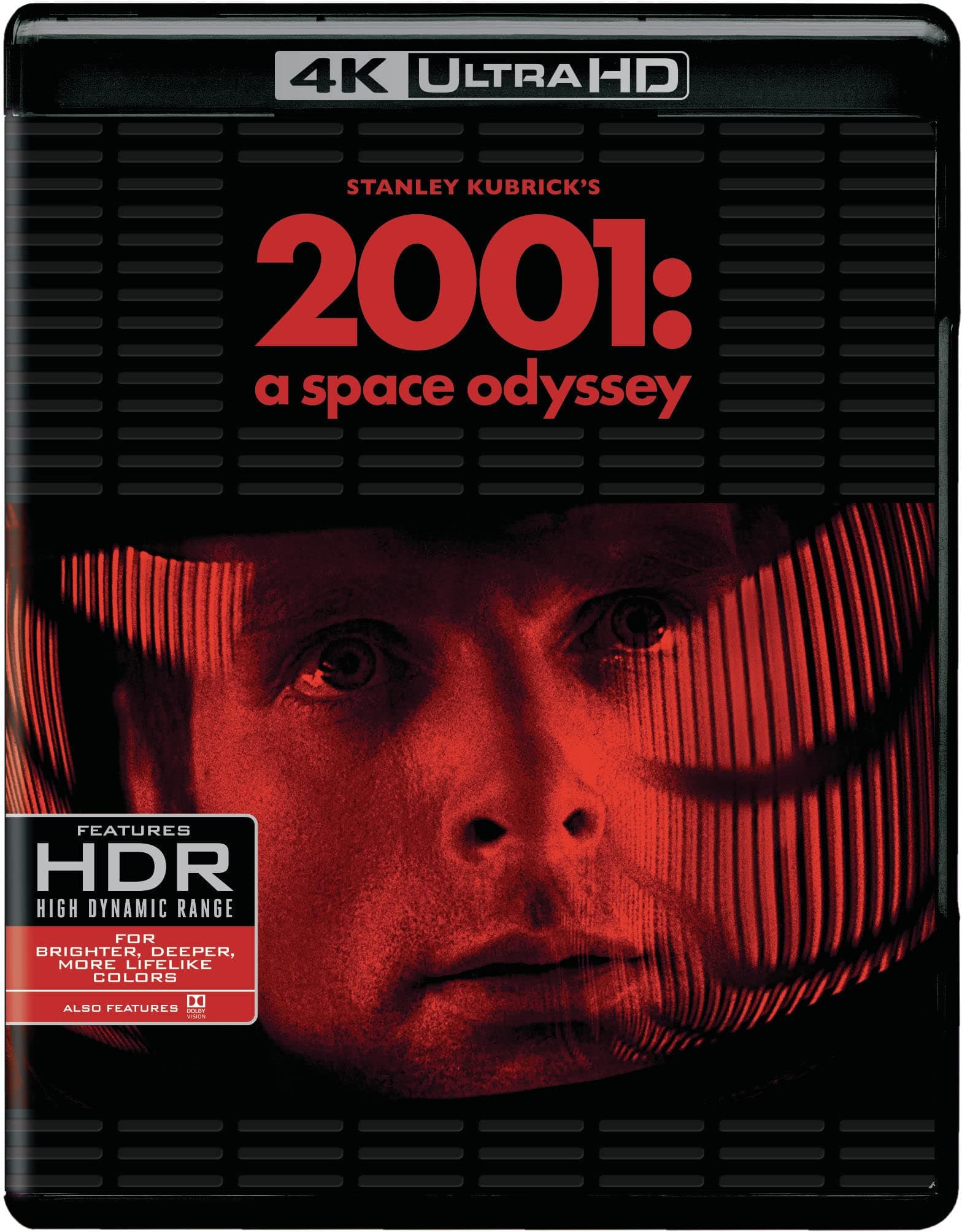

Stanley Kubrick redefined the limits of filmmaking in his classic science fiction masterpiece, a contemplation on the nature of humanity, 2001: A Space Odyssey. Stone Age Earth: In the presence of a mysterious black obelisk, pre-humans discover the use of tools--and weapons--violently taking first steps toward intelligence. 1999: On Earth's moon astronauts uncover another mysterious black obelisk. 2001: Between Earth and Jupiter, the spacecraft's intelligent computer makes a mistake that kills most of the human crew--then continues to kill to hide its error. Beyond Time: The sole survivor of the journey to Jupiter ascends to the next level of humanity. Review: 2001: A Space Odyssey - Bring Your Thinking Helmet - 2001 is an epic film that suffers from the passage of time. In the 50+ years since its release, audiences have becomes a lot less patient and analytic towards movies such as this one. Stanley Kubrick's set of well-renowned classics all have a touch of this to varying degrees, but 2001 is admittedly a hard watch for first time viewers. I had seen this movie twice previously, both times in full, and couldn't quite wrap my head around why this film was not only popular, but held to be one of the greatest films of all-time. It was upon the third viewing that I had all of the pieces click and I finally understood, or at least felt that I understood some of the messages that the film tries to convey. It's a film that requires the utmost of patience at a nearly two and a half hour run-time, and it doesn't do you any favors. It starts with a long sequence that features no dialogue, grand orchestral music, and a lot of monkeys/apes. In doing so, you are required to immediately forget what you know about movies that lay stories out for you and allow you to settle in. You have no context at this point, and it's mostly monkeys fighting over natural resources, land, and getting into tribal feuds. While it's not largely important to the main plot featured in the latter half of the film, it's a very heavy, visual concept that helps to sink the ending and overall story into your brain. After the first 30 minutes or so of no dialogue, we are thrust into space with a new character that again is only featured for about 15-20 minutes prior to the main story of the film. This, is the other contextual piece to what has already been seen, and sets out to show how humans are exploring and analyzing space in an aggressive way because of a new discovery. These two initial pieces are definitely needed in the film and can't be cut, because of their importance to the themes and overall presentation of the story. They really require the viewer to hold their attention, because after each one you're seemingly left with zero information on what the movie is actually about other than a large black rectangle, which is very simple yet complex. This wondrous black rectangle is essentially what the viewer is looking for throughout the film, and represents knowledge of man, the universe, and perhaps much more depending on the viewer. Then, we settle into the meat of the film which features two actors and a voice actor in mostly enclosed spaces, further requiring the viewer to detach themselves from what a typical movie usually plays out as. We've seen apes, we've seen spacemen exploring, we've seen tons of beautiful shots, and then are dumped into a space station with 2 people alone. It's stark, quiet, and still lacking a lot of dialogue, but this is where the plot begins. The super computer HAL 9000 has notified them of a malfunction but the two conscious crew members doubt the robot's diagnosis of the problem. This is when the film gets interesting, if you're still there... and is what the movie wants you to remember after watching. HAL 9000 is an OG villain, extremely cold and calculated, and all in all is just an intelligent computer advertised as "perfection". The uneasiness and skepticism surrounding technology in the modern era is very well-packaged into this robot character of HAL. There is a reason that this film and specifically this character are frequently referenced and repackaged into other films that take place in the science fiction genre to this day. Odds are you've seen a robot with a red eye, or a highly superior artificial intelligence try to conquer mankind in a movie before. For the rest of the film, we see the struggle of man vs. robot, knowledge of man vs. artificial intelligence, and thus showcase the unique talents of Stanley Kubrick to paint a picture broader than the film itself. Keir Dullea and Gary Lockwood shine as the crew members cast opposite of the robot, who was voiced by Douglas Rain throughout the film, sometimes played by Stanley off-screen. Their smarts as astronauts really put them in a unique situation, because they think of almost everything they can to fix their situation and get home safely. For a film as old as it is, it's really well done to show that astronauts are not stupid characters in a film manufactured on their own, but rather they take all of the necessary precautions to try and survive their predicament. However HAL has other plans, and this film devolves into a psychological sci-fi thriller the likes of which we'll probably never see again. The sterile, white interiors of the ship with the vastness of space combined with the excellent early miniature work really create just as much tension and again serve as visual examples that are still used and reused in science fiction films to this day. There are plenty of great Special Features included in this release, but unfortunately I found the film commentary to be lacking from Gary Lockwood and Keir Dullea. I like Keir's commentary, but Lockwood's is mostly depressing and shows perhaps his outlook on life at the time of recording. Both commentaries seem to be pieced together either from separate sessions or interviews, and at times seem to stray away from the film itself. It's interesting to hear their thoughts over the playtime of the movie, especially due to its length and lack of dialogue, but I wouldn't go as far as saying it's a definitive commentary for fans of the film. This edition also includes the 4 inserts pictured, in an envelope along with a standard black 4K case that all fit snugly into the cardboard box also pictured. The box has a foil-shine to the red which really make it pop on the shelf, and I'm incredibly happy to finally own this movie in this edition. The 4K, Blu-ray, and digital copies are all included in this release. I have watched the film over the years in DVD and Blu-ray formats, and while I do think that this popped in 4K, I didn't think that it exceeded the Blu-ray transfer in any visible way. If you don't own the film already but are a newer fan like me, I'd highly recommend this collector-ish set at its current price point of $25. If you're an owner of the Blu-ray versions, I'd only recommend if the Special Features are any different but I do not think they are. Of course, if you're a fan of the film and also into 4K... well we all know that the beautiful visual presentation of this story is worth viewing in whichever format you feel is superior. Just remember that when you're watching this film, it's being shown to you through a big, black rectangle... Review: The Most Influential Film Ever Made - This review covers the film — not the specific BluRay presentation. I’ll review that later. Within the industry and art form of motion pictures, the importance and influence of Kubrick’s “2001: a space odyssey” cannot be overstated or even overestimated. There is quite possibly no other film that has had the level of impact and inspiration on subsequent generations of filmmakers and the art of filmmaking that 2001 has had. Yet for many modern film viewers, the movie is often perceived as dull, opaque, unfathomable and pretentious. In fact, when 2001 debuted it received many of the same criticisms. The film was pilloried by critics and at premiere screenings audiences booed and even walked out of theaters. But despite this initial reaction, audiences lined up to see the movie. The film became not just a commercial success, but a popular phenomenon with the younger generation of movie-goers in the 60s. Partially fueled by the drug and counter-culture of the time — 2001 was ultimately accepted in the way Kubrick had intended — people went to “experience” the movie. Instead of being told a clear, specific story with conflicts and resolutions, 2001 presented the audience with a grand mythological journey — from the origins of humans to their technological future and beyond. And it did so by abandoning the conventions of storytelling and asking the viewer to simply absorb the sights and sounds of the film and allow themselves to have an instinctual, emotional response. 2001 is not a movie that delivers the standard conventions of plot and character in a 3 act structure. It does not follow the rules and precepts of Joseph Campbell’s “Hero Of a Thousand Faces” that so many thousands of screenwriters were told to adhere to lest they lose the audience’s attention and interest. 2001 is a narrative. But it is a meta narrative. Its story concerns the very nature of existence. It proposes a secular solution to the mystery of life. How did we get get here? Are we alone? Clarke and Kubrick imagined a a story that answered the notion of why humans are self aware and technologically capable by way of a mythology that is based on the mystery of science. Science so deep and advanced, we cannot distinguish it from magic. Kubrick wanted a movie that told the story of mankind’s evolution in the universe — from lowly ape to early man to eventually a Superman. The next step in higher intelligence. Kubrick was drawn to an Arthur C. Clarke short story that suggested an advanced alien race travels the universe looking for nascent intelligence and then once discovered, helps it along in critical next steps steps of cognitive abilities. Just enough to see if the formative intelligence becomes capable of developing technology that allows that to start traveling their local solar system and exploring their origins. The aliens leave a buried artifact on the closest nearby moon that — when uncovered — signals to the aliens that — yes indeed — this group of intelligence has made the leap — and are now possibly ready for the next step in evolution. To achieve this — Kubrick felt that trying to tell this story in ordinary fashion with lots of dialogue and conversations and drama would come off as pretentious or hokey — or at the very least would drain the mystical and magical quality he felt the film needed. He knew he had to get the audience to experience such moments of alien contact and alien manipulation of the human mind in way that felt experiential — magical and holy. He knew he needed viewers to have a personal, spiritual experience with the film — not a dramatic one. What Kubrick was seeking was much closer to the experience one has when walking quietly through a massive cathedral — one of the grand medieval cathedrals of Europe — where the person is overwhelmed by the stunning beauty and grandiosity and silence of the cathedral — Kubrick knew he needed the viewer to experience space in this manner. And that is why the movie seems slow to many modern, younger viewers. Kubrick needed you to sit in the cathedral of space — and in the austerely beautiful technology of 2001 — in order that you could absorb the reality of the mind-bending spiritual myth he was laying on you. SPOILERS In traditional narrative-sense, Kubrick actually moves the story along at quite a clip. Man-apes are fighting for shrubs in a desert. Alien artifact appears. Man-apes learn to use weapons. First murder in human history. A bone club weapon cuts to an orbital nuclear weapon 200,000 years later in 2001. Mystery of something dug up on a moon base. It’s the same artificat we saw with apes. It sends a signal to Jupiter. Humans follow that signal to Jupiter to find out where alien artifact came from — or is leading them to. Along the way, humans murder the first machine intelligence it ever created. A test? The last vestige of violence humans will leave behind? END OF SPOILERS All along the way — Kubrick is telling you the story with an incredibly efficient, fast moving narrative structure — but he also needs the viewer to settle into the elongated time-scape of space travel. Why? Because it’s vital the viewer experience the space mission in a way that gets them to fully believe in what’s happening. To get them to accept what they are watching is real. So that the viewer stops thinking they’re watching a movie. Think of it this way — you’ve gone to see your Dr and you’re placed in a Waiting room — expecting bad news. The longer you sit, the more you absorb all the various specific elements of the waiting room. All the mundane details and objects you see become more than just real — they become important — and the stakes about what you’re going to hear gather weight. Now imagine your Dr is about to tell you mind-bending news about having cancer and needing chemo therapy. Your body is about to be transformed. That long, long moment in the waiting room is all about accepting the reality of that journey. In 2001, humans are in a waiting room about to meet their alien doctor — their alien overlord — who will deliver the prognosis of their future. Life, death or transformation awaits. In other words the “boredom” of 2001 is not a flaw — it’s a feature. A vital feature. Beyond that — it’s nearly impossible to explain to the young film movie-goer how far advanced the effects of 2001 were at their time. Today’s films have the advantage of powerful computers to easily create seamless special effects of almost type. But back in 1966-67 there were no computer—generated effects. No CGI. It was all created on film. Analogue film. Multiple shots on differed strips of films are combined in an optical printer to look like they are all in one shot. Think of it as “artisanal” special effects — hand-crafted special effects. Even Doug Trumbull’s breakthrough slit-scan device that created the very computer-generated-looking Star Gate sequence that gives a dizzying sensation of flying through a wormhole of wildly colorful light — was a hand-built machine that achieved the illusion of fast movement with stop-motion animation — requiring days of filming to create just seconds of screen time. Same with the interior sets. All real. All painstakingly built by hand. Many of them rotated. The giant centrifuge set for the Discovery set was a massive Ferris wheel. Cameras and actor bolted to floor while it turns. The Dawn of Man man-apes were created with costume designs that were decades ahead of their time — all donned by a mime troupe that spent months studying real ape movements. The effect was so convincing that many people simply assumed real apes had been trained to “act out” the scenes. To the point where make-up and costume designer Stuart Freeborn’s amazing accomplishment was completely overlooked by the Academy awards — giving best make-up effects instead to the much more primitive and unconvincing “Planet of the Apes.” In the end, 2001 is not a film to be seen like one would go see Star Wars or a Marvel movie. It’s not entertainment. Its not a consumable flight of fancy — no matter how enjoyable those types of movies are. As pretentious as this sounds — 2001 is a work of art. It’s meant to challenge the viewer. To stimulate their senses and creat an instinctive impression. It’s not meant to be easily understood. It is a film that was made to present a mythology of how humanity came into existence. So it’s meant to be an experience. You can’t have normal movie expectations when you watch it. There’s no bad guy. No good guy. Justice is not served. It’s much bigger than that. It’s more — “What if we’re here because of alien intervention? And what if we passed the aliens’ first test? And they want us to take the next step in evolution? Evolution that will open our minds the inner workings and mysteries of the universe? We will become beings that will be capable of transforming matter and energy in a way that appears entirely magical to us now? Kubrick knew he couldn’t tell that story in normal Chris Nolan terms. Not even in Marvel Thanos Iron Man Capt Marvel tesseract terms. That’s why 2001 is not a normal movie to watch. It’s a cinematic experience the likes of which we have never seen before.
| Contributor | Daniel Richter, Douglas Rain, Frank Miller, Gary Lockwood, Keir Dullea, Leonard Rossiter, Margaret Tyzack, Robert Beatty, Sean Sullivan, Stanley Kubrick, William Sylvester Contributor Daniel Richter, Douglas Rain, Frank Miller, Gary Lockwood, Keir Dullea, Leonard Rossiter, Margaret Tyzack, Robert Beatty, Sean Sullivan, Stanley Kubrick, William Sylvester See more |
| Customer Reviews | 4.6 out of 5 stars 9,279 Reviews |
| Format | 4K |
| Genre | Action & Adventure |
| Initial release date | 2018-12-18 |
| Language | English |
S**Y
2001: A Space Odyssey - Bring Your Thinking Helmet
2001 is an epic film that suffers from the passage of time. In the 50+ years since its release, audiences have becomes a lot less patient and analytic towards movies such as this one. Stanley Kubrick's set of well-renowned classics all have a touch of this to varying degrees, but 2001 is admittedly a hard watch for first time viewers. I had seen this movie twice previously, both times in full, and couldn't quite wrap my head around why this film was not only popular, but held to be one of the greatest films of all-time. It was upon the third viewing that I had all of the pieces click and I finally understood, or at least felt that I understood some of the messages that the film tries to convey. It's a film that requires the utmost of patience at a nearly two and a half hour run-time, and it doesn't do you any favors. It starts with a long sequence that features no dialogue, grand orchestral music, and a lot of monkeys/apes. In doing so, you are required to immediately forget what you know about movies that lay stories out for you and allow you to settle in. You have no context at this point, and it's mostly monkeys fighting over natural resources, land, and getting into tribal feuds. While it's not largely important to the main plot featured in the latter half of the film, it's a very heavy, visual concept that helps to sink the ending and overall story into your brain. After the first 30 minutes or so of no dialogue, we are thrust into space with a new character that again is only featured for about 15-20 minutes prior to the main story of the film. This, is the other contextual piece to what has already been seen, and sets out to show how humans are exploring and analyzing space in an aggressive way because of a new discovery. These two initial pieces are definitely needed in the film and can't be cut, because of their importance to the themes and overall presentation of the story. They really require the viewer to hold their attention, because after each one you're seemingly left with zero information on what the movie is actually about other than a large black rectangle, which is very simple yet complex. This wondrous black rectangle is essentially what the viewer is looking for throughout the film, and represents knowledge of man, the universe, and perhaps much more depending on the viewer. Then, we settle into the meat of the film which features two actors and a voice actor in mostly enclosed spaces, further requiring the viewer to detach themselves from what a typical movie usually plays out as. We've seen apes, we've seen spacemen exploring, we've seen tons of beautiful shots, and then are dumped into a space station with 2 people alone. It's stark, quiet, and still lacking a lot of dialogue, but this is where the plot begins. The super computer HAL 9000 has notified them of a malfunction but the two conscious crew members doubt the robot's diagnosis of the problem. This is when the film gets interesting, if you're still there... and is what the movie wants you to remember after watching. HAL 9000 is an OG villain, extremely cold and calculated, and all in all is just an intelligent computer advertised as "perfection". The uneasiness and skepticism surrounding technology in the modern era is very well-packaged into this robot character of HAL. There is a reason that this film and specifically this character are frequently referenced and repackaged into other films that take place in the science fiction genre to this day. Odds are you've seen a robot with a red eye, or a highly superior artificial intelligence try to conquer mankind in a movie before. For the rest of the film, we see the struggle of man vs. robot, knowledge of man vs. artificial intelligence, and thus showcase the unique talents of Stanley Kubrick to paint a picture broader than the film itself. Keir Dullea and Gary Lockwood shine as the crew members cast opposite of the robot, who was voiced by Douglas Rain throughout the film, sometimes played by Stanley off-screen. Their smarts as astronauts really put them in a unique situation, because they think of almost everything they can to fix their situation and get home safely. For a film as old as it is, it's really well done to show that astronauts are not stupid characters in a film manufactured on their own, but rather they take all of the necessary precautions to try and survive their predicament. However HAL has other plans, and this film devolves into a psychological sci-fi thriller the likes of which we'll probably never see again. The sterile, white interiors of the ship with the vastness of space combined with the excellent early miniature work really create just as much tension and again serve as visual examples that are still used and reused in science fiction films to this day. There are plenty of great Special Features included in this release, but unfortunately I found the film commentary to be lacking from Gary Lockwood and Keir Dullea. I like Keir's commentary, but Lockwood's is mostly depressing and shows perhaps his outlook on life at the time of recording. Both commentaries seem to be pieced together either from separate sessions or interviews, and at times seem to stray away from the film itself. It's interesting to hear their thoughts over the playtime of the movie, especially due to its length and lack of dialogue, but I wouldn't go as far as saying it's a definitive commentary for fans of the film. This edition also includes the 4 inserts pictured, in an envelope along with a standard black 4K case that all fit snugly into the cardboard box also pictured. The box has a foil-shine to the red which really make it pop on the shelf, and I'm incredibly happy to finally own this movie in this edition. The 4K, Blu-ray, and digital copies are all included in this release. I have watched the film over the years in DVD and Blu-ray formats, and while I do think that this popped in 4K, I didn't think that it exceeded the Blu-ray transfer in any visible way. If you don't own the film already but are a newer fan like me, I'd highly recommend this collector-ish set at its current price point of $25. If you're an owner of the Blu-ray versions, I'd only recommend if the Special Features are any different but I do not think they are. Of course, if you're a fan of the film and also into 4K... well we all know that the beautiful visual presentation of this story is worth viewing in whichever format you feel is superior. Just remember that when you're watching this film, it's being shown to you through a big, black rectangle...
K**T
The Most Influential Film Ever Made
This review covers the film — not the specific BluRay presentation. I’ll review that later. Within the industry and art form of motion pictures, the importance and influence of Kubrick’s “2001: a space odyssey” cannot be overstated or even overestimated. There is quite possibly no other film that has had the level of impact and inspiration on subsequent generations of filmmakers and the art of filmmaking that 2001 has had. Yet for many modern film viewers, the movie is often perceived as dull, opaque, unfathomable and pretentious. In fact, when 2001 debuted it received many of the same criticisms. The film was pilloried by critics and at premiere screenings audiences booed and even walked out of theaters. But despite this initial reaction, audiences lined up to see the movie. The film became not just a commercial success, but a popular phenomenon with the younger generation of movie-goers in the 60s. Partially fueled by the drug and counter-culture of the time — 2001 was ultimately accepted in the way Kubrick had intended — people went to “experience” the movie. Instead of being told a clear, specific story with conflicts and resolutions, 2001 presented the audience with a grand mythological journey — from the origins of humans to their technological future and beyond. And it did so by abandoning the conventions of storytelling and asking the viewer to simply absorb the sights and sounds of the film and allow themselves to have an instinctual, emotional response. 2001 is not a movie that delivers the standard conventions of plot and character in a 3 act structure. It does not follow the rules and precepts of Joseph Campbell’s “Hero Of a Thousand Faces” that so many thousands of screenwriters were told to adhere to lest they lose the audience’s attention and interest. 2001 is a narrative. But it is a meta narrative. Its story concerns the very nature of existence. It proposes a secular solution to the mystery of life. How did we get get here? Are we alone? Clarke and Kubrick imagined a a story that answered the notion of why humans are self aware and technologically capable by way of a mythology that is based on the mystery of science. Science so deep and advanced, we cannot distinguish it from magic. Kubrick wanted a movie that told the story of mankind’s evolution in the universe — from lowly ape to early man to eventually a Superman. The next step in higher intelligence. Kubrick was drawn to an Arthur C. Clarke short story that suggested an advanced alien race travels the universe looking for nascent intelligence and then once discovered, helps it along in critical next steps steps of cognitive abilities. Just enough to see if the formative intelligence becomes capable of developing technology that allows that to start traveling their local solar system and exploring their origins. The aliens leave a buried artifact on the closest nearby moon that — when uncovered — signals to the aliens that — yes indeed — this group of intelligence has made the leap — and are now possibly ready for the next step in evolution. To achieve this — Kubrick felt that trying to tell this story in ordinary fashion with lots of dialogue and conversations and drama would come off as pretentious or hokey — or at the very least would drain the mystical and magical quality he felt the film needed. He knew he had to get the audience to experience such moments of alien contact and alien manipulation of the human mind in way that felt experiential — magical and holy. He knew he needed viewers to have a personal, spiritual experience with the film — not a dramatic one. What Kubrick was seeking was much closer to the experience one has when walking quietly through a massive cathedral — one of the grand medieval cathedrals of Europe — where the person is overwhelmed by the stunning beauty and grandiosity and silence of the cathedral — Kubrick knew he needed the viewer to experience space in this manner. And that is why the movie seems slow to many modern, younger viewers. Kubrick needed you to sit in the cathedral of space — and in the austerely beautiful technology of 2001 — in order that you could absorb the reality of the mind-bending spiritual myth he was laying on you. SPOILERS In traditional narrative-sense, Kubrick actually moves the story along at quite a clip. Man-apes are fighting for shrubs in a desert. Alien artifact appears. Man-apes learn to use weapons. First murder in human history. A bone club weapon cuts to an orbital nuclear weapon 200,000 years later in 2001. Mystery of something dug up on a moon base. It’s the same artificat we saw with apes. It sends a signal to Jupiter. Humans follow that signal to Jupiter to find out where alien artifact came from — or is leading them to. Along the way, humans murder the first machine intelligence it ever created. A test? The last vestige of violence humans will leave behind? END OF SPOILERS All along the way — Kubrick is telling you the story with an incredibly efficient, fast moving narrative structure — but he also needs the viewer to settle into the elongated time-scape of space travel. Why? Because it’s vital the viewer experience the space mission in a way that gets them to fully believe in what’s happening. To get them to accept what they are watching is real. So that the viewer stops thinking they’re watching a movie. Think of it this way — you’ve gone to see your Dr and you’re placed in a Waiting room — expecting bad news. The longer you sit, the more you absorb all the various specific elements of the waiting room. All the mundane details and objects you see become more than just real — they become important — and the stakes about what you’re going to hear gather weight. Now imagine your Dr is about to tell you mind-bending news about having cancer and needing chemo therapy. Your body is about to be transformed. That long, long moment in the waiting room is all about accepting the reality of that journey. In 2001, humans are in a waiting room about to meet their alien doctor — their alien overlord — who will deliver the prognosis of their future. Life, death or transformation awaits. In other words the “boredom” of 2001 is not a flaw — it’s a feature. A vital feature. Beyond that — it’s nearly impossible to explain to the young film movie-goer how far advanced the effects of 2001 were at their time. Today’s films have the advantage of powerful computers to easily create seamless special effects of almost type. But back in 1966-67 there were no computer—generated effects. No CGI. It was all created on film. Analogue film. Multiple shots on differed strips of films are combined in an optical printer to look like they are all in one shot. Think of it as “artisanal” special effects — hand-crafted special effects. Even Doug Trumbull’s breakthrough slit-scan device that created the very computer-generated-looking Star Gate sequence that gives a dizzying sensation of flying through a wormhole of wildly colorful light — was a hand-built machine that achieved the illusion of fast movement with stop-motion animation — requiring days of filming to create just seconds of screen time. Same with the interior sets. All real. All painstakingly built by hand. Many of them rotated. The giant centrifuge set for the Discovery set was a massive Ferris wheel. Cameras and actor bolted to floor while it turns. The Dawn of Man man-apes were created with costume designs that were decades ahead of their time — all donned by a mime troupe that spent months studying real ape movements. The effect was so convincing that many people simply assumed real apes had been trained to “act out” the scenes. To the point where make-up and costume designer Stuart Freeborn’s amazing accomplishment was completely overlooked by the Academy awards — giving best make-up effects instead to the much more primitive and unconvincing “Planet of the Apes.” In the end, 2001 is not a film to be seen like one would go see Star Wars or a Marvel movie. It’s not entertainment. Its not a consumable flight of fancy — no matter how enjoyable those types of movies are. As pretentious as this sounds — 2001 is a work of art. It’s meant to challenge the viewer. To stimulate their senses and creat an instinctive impression. It’s not meant to be easily understood. It is a film that was made to present a mythology of how humanity came into existence. So it’s meant to be an experience. You can’t have normal movie expectations when you watch it. There’s no bad guy. No good guy. Justice is not served. It’s much bigger than that. It’s more — “What if we’re here because of alien intervention? And what if we passed the aliens’ first test? And they want us to take the next step in evolution? Evolution that will open our minds the inner workings and mysteries of the universe? We will become beings that will be capable of transforming matter and energy in a way that appears entirely magical to us now? Kubrick knew he couldn’t tell that story in normal Chris Nolan terms. Not even in Marvel Thanos Iron Man Capt Marvel tesseract terms. That’s why 2001 is not a normal movie to watch. It’s a cinematic experience the likes of which we have never seen before.
E**M
"Its origin and purpose.....still a total mystery."
NOTE: This review contains major spoilers..... The late Stanley Kubrick has to be my favorite director of all time. He was the director of five of my top favorite films: Paths of Glory, Dr. Strangelove, 2001: A Space Odyssey, The Shining, & Full Metal Jacket. I can acknowledge that he was a very sophisticated perfectionist, but I can never deny that most of his movies are unbelievably mesmerizing. These are the exact kinds of films that I can never look away from. I feel almost hypnotized by them. But out of all of Kubrick's films, 2001: A Space Odyssey is a film that works the most wonders. It's the finest sci-fi epic ever made, and it's officially my #1 favorite film of all time. But what exactly makes 2001 so special? Well, in my opinion, it has perfected the sci-fi genre. Before this film was ever released, people have never completely taken science fiction very seriously. In the 50's and early 60's, sci-fi films often had crude special effects and silly storylines. Most of them (The Thing from Another World, The Day The Earth Stood Still) had very good plots and decent effects, but as a whole, the look and feel of these motion pictures still lacked realism and importance. Keep in mind, I don't have anything against the 50's and 60's sci-fi classics, but they are not my personal favorites, either. So along came 2001: A Space Odyssey. Released in 1968, critics were sharply divided. Some said it was fantastic, while others believed it to be dull. But this film grew among audiences (especially the psychedelic kinds), and slowly, people have acknowledged this to be not only the greatest sci-fi film ever made, but also one of the greatest films ever made. The year is now 2010, and this film is still considered to be a classic, which is a bit surprising since a majority of moviegoers are now accustomed to over-the-top action and pointless comedies. Hey, I still like some over-the-top action, but comedies nowadays aren't very clever anymore. Anyway, back to 2001. The reason why this film is so brilliant is that it became a sci-fi revolution. It's entirely distinctive for its realistic special effects, serious storyline, and influence on space travel & evolution. Even when compared to Star Wars, Star Trek, and Stargate, 2001 still looks and feels completely different from the rest. Look at how slow and steady the spaceships move. Listen to the lack of sound in the vacuum of space. Observe the planets and stars and how realistic they actually look. I don't think I have ever seen another sci-fi film that was ever this scientifically accurate before. Critics and audiences have analyzed this movie ever since it was released. Some believe it to be an ode to science, while others see it as an example of alien intelligence. Some even believe that it is about God and the paradise that we yearn for (the last thirty minutes of the film). As a middle-of-the-road agnostic, I think this film is about everything. Even if the main point of the film remains mysterious, it seems to explore everything about space and the future. The black monolith could either symbolize God, Darwinism, or alien benevolence & intelligence. HAL 9000 could represent the errors of future technology, or the cause and effects of artificial intelligence. The last twenty minutes of the film, in which David Bowman grows old and is reborn as the star-child, could be seen as a religious experience. But even if all of these were true, 2001 is "still a total mystery." We don't really know what it's all about. What really works, I think, is how these possible representations are shown through images and sound. The messages can be very clear once the visuals can make you understand what they are. And speaking of visuals, the special effects still don't cease to amaze me. I don't think I have ever seen such real-looking effects (and this was WAY before computers were used). It's a bit obvious that the apes in the first fifteen minutes of the film are on a soundstage, but the space sequences are such a delight to watch. The spaceships look almost as if they were really moving in space, and the planets Earth & Jupiter don't look like miniature models at all (perhaps they were matte paintings of photographs, I can't really tell). And how did they manage to have Frank Poole float away in space? They must have used a wide-angle lens for that. And just how DID they create that famous "stargate" sequence? I know they used macro photography for some shots, but what did they use for the other shots? There are just so many questions that maybe it's time for me to listen to the audio commentary. As an avid fan of classical music, I really do love the classical pieces that were chosen for this film. 2001 does not have an original score, but the music of J. Strauss, R. Strauss, Ligeti, and Khachaturian always get to me. Every musical piece is used to actually enhance the story. Ligeti's "Requiem" signifies the presence of the black monolith. J. Strauss's "The Blue Danube" is played during two scenes involving space travel. Khachaturian's "Gayane: Adagio" is heard when we begin to see what goes on during the Jupiter Mission. And of course, R. Strauss's "Also Sprach Zarathustra" is used to remind us how majestic the universe really is. Basically, the music really does add more importance to the story. "The Blue Danube" is starting to get on my nerves, though. Well, this is it. This is my all-time favorite film. I can name at least a hundred films that I really admire (such as The Godfather and Collateral), but this is the one that I admire the most. Everything about it is barely above perfection. It may be too slow and tedious for some people, but to me, it's an excellent visual spectacle. As for the 2-Disc Special Edition DVD, I would highly recommend it. It has some fascinating special features, including an audio commentary by actors Keir Dullea (Bowman) and Gary Lockwood (Poole), the original theatrical trailer, and seven behind-the-scenes featurettes. The picture quality of the film itself looks a bit different. About ten years ago, I bought the film on VHS. The picture quality on that cassette tape was surprisingly clear, and the light/dark bits were about correct. Since I no longer have a VCR, I decided to buy the DVD, and while I was watching the film, I saw the difference. Compared to the VHS, the picture on the DVD does look dimmer. It's obvious when the "stargate" sequence is on: for example, the original blue colors convey some heavy shades of gray. Another noticeable change is the introduction and the intermission: the words "Overture" and "Entr'acte" have been taken off the screen completely. So Ligeti's "Atmospheres" plays while there is nothing but black on the screen. Fortunately, I wouldn't decide these sorts of things as flaws since I don't really mind them. I'm glad that I made the purchase, and furthermore, I'm glad that I now have my all-time favorite film in my own DVD collection. Grade: A+
6**3
One of the greatest films of all time.
Many think that "2001: A Space Odyssey" (1968) is one of the greatest films of all time, and even some think that it's the greatest, and I can say that this Stanley Kubrick masterpiece is one of my favorite films of all time! Everything in this film is absolutely beautiful. The stunning visuals, the harrowing plot, the haunting music, the lush cinematography, the beautiful directing by none other than Kubrick. "2001" is way more than a film. It's a cinema masterpiece like no other, just like Kubrick's other films, like "A Clockwork Orange", or "The Shining". This film is simply one of the greatest. The thing about "2001" is some think it's one of the best, and some think it's one of the worst (although very few, and I don't know why they would hate it so much), but the reason that they hate it is for it's slow pace and that there's only about 40 minutes of dialouge in a 2 1/2 hour movie, but the scenes without dialouge, with slow pace really show the beauty of the film, and only Kubrick could have made each and every scene a masterpiece. If you see it for the first time, you might not like it, but the second or third time you see it, you'll most likely be blown away by the beauty (although in just my first viewing, I absolutely loved it). "2001" is an epic sci-fi that questions life on other planets and human destiny, that apparently gets affected whenever a striking black monolith appears. You may not understand this film fully the first time, but the beauty of Kubrick's films is that it takes a few viewings to understand Kubrick's message, and it's amazing. "2001" is broken down into four sections, "The Dawn of Man" where it shows what the title suggests. It shows ape-like humans who learn to fend for themselves. It's about 20 minutes. "TMA-1" shows a Pan-Am space plane orbiting Earth. It focuses on Dr. Heywood Floyd (William Sylvester) going over plans for a trip to Clavius Base, which is on the moon, with a large number of other members to the very futuristic ship. It's about 35-40 minutes "Jupiter Mission: 18 Months Later" shows spaceship Discovery One, with 2 members, Dr. David Bowman (Keir Dullea) and Dr. Frank Poole (Gary Lockwood), and 3 other members in hibernation. On that ship is a very intelligent computer named HAL 9000 (voiced by Douglas Rain), who eventually wreaks havoc to the ship. It's about 55 min.-1 hour long. Finally, "Jupiter and Beyond the Infinite" shows Dr. Bowman's psychadelic and frightening trip through space, which includes the "Stargate sequence", showing flashing lights moving forward for a few minutes, following the next few minutes of cosmic phenomena and strange landscapes that actually kind of creeped me out (I saw this film in the dark), leading to the ending. It's about 25 minutes, leading the film to 2 hours and 28 minutes, including the 3 minute overture, intermission, and exit music, along with ending credits. The special features on this two-disc special edition of "2001" are pretty good, but they felt sort of repetitive to me. The Disc 1 comes with the film, along with a commentary by Keir Dullea and Gary Lockwood and the theatrical trailer, and then there's the disc 2. The first special feature is titled "2001: The Making of a Myth". It's about 45 minutes long. It's narrated by James Cameron, and shows different people talking about the making and legacy of the movie. It was pretty good. "Standing on the Shoulders of Kubrick: The Legacy of 2001" is about 20 minutes long and is another film that talks about the legacy of the movie and different film critics, including Roger Ebert (when he could still talk), praising the film. It's really not much that the earlier featurette hasn't said. "Vision of a Future Passed: The Prophecy of 2001" is 20 minutes of Keir Dullea, the main star of "2001" speaking about the film and what Arthur C. Clarke, the author of "2001" wrote and said about it. It also includes black-and-white audio footage of Arthur C. Clarke. It was a pretty good featurette, but I really like the 60's vintage featurette "2001: A Space Odyssey - A Look Behind the Future". It's about 20-25 minutes and it shows the film being made including footage of Stanley Kubrick. It's one of my favorite featurettes. "2001: FX and Early Conceptual Artwork" is 9 minutes long and shows Stanley's wife, Christiane Kubrick, talking about the artwork and paintings made for the famous "Stargate" sequence in the film for 3 minutes, and the rest shows the original sketches and paintings. It's pretty cool. "Look: Stanley Kubrick!" is 3 minutes long and shows a montage of photos Stanley Kubrick shot in his few years before directing when he was still working for "Look! Magazine". Here, you see Stanley's extreme talent for photography, which definitely influenced his creativeness in directing. The real treat here is the 1 hour, 17 minute audio-only interview from 1966, where Jeremy Bernstein interview's Stanley Kubrick, titled "Audio-only interview with Stanley Kubrick". Here, he talks about his childhood, his photography days, his first movie, "Fear and Desire", and later on, talks about each and every one of his films, leading up to "2001", which was still in production at that time. It's extremely interesting and worth listening to. I think it's the best featurette on the second disc. "2001: A Space Odyssey" is a truly beautiful, mesmerizing, and amazing film that everybody should see, and it's brilliance just can't fit into the 6000 characters that Amazon reviews allow. All I have to say is, if you haven't seen this Stanley Kubrick masterpiece, see it now! And see it multiple times after that. It's one of the greatest.
S**.
Great film, good deal, fair service, but still demaged goods
Unlike some others here who think they're professional film critics, I'm not gonna waste anyone's time with film's plot, or production values, or anything like that. I believe there is a plenty of reviews already written in that respect and I don't see how I can add anything new to that discussion. If you don't already know who is Stanley Kubrick,or you don't know what to expect from this particular film, just google, for God's sake, or simply go to Wikipedia. In the end, I suppose, you can read some of the critics written here, too, but I really think that reviews on this page should be reserved for discussions about the product itself, as in "how good or how bad is the deal offered." That been said, I have no objections on the price; I really think it's a great deal as such. As described by Amazon in section above, this is a 2-disc set with a lot of extra features, and it is really hard to imagine that one can get a better deal than one offered. My problem was that package came damaged. Either due to transportation, or box was just like that to begin with (which could potentially explain the bargain price), just, I got damaged goods as the box was broken inside and couldn't hold the discs in place. Amazon customer service was great and I was immediately send a replacement, but unfortunately, the replacement package was only slightly better. This time, the box was not broken inside as it was the case with the first one, but the discs were still not in place. Once I opened the box, I put them back where they belong, but while they're alright in that respect now, they're still scratched due to the fact that they were originally detached and able to move freely inside the box during the transportation. I'm sure that Amazon would gladly send me another replacement, or refund, if I requested one, but at that point, I was just over it, and didn't even try to contact them and complain again. In conclusion, I don't know if I was just so "lucky" to get two fault packages back to back, or this is the case for the whole "2001 A Space Odyssey (2-disc Special Edition)" supply at Amazon, but if you're a passionate film collector and really care about your discs, you probably wanna think twice before going for this deal. By the way, the film itself is great. It deserves all 5 stars as such, but I gave it 4 on account of problems I discussed above.
C**O
Mushrooms and Grass not required but a nice way to get different perspectives out of the same movie and all are good!
This movie is very obtuse in it's grand meaning. It's one of those moves that's better if you sit back and burn one or eat a handful of magic mushrooms. In fact, that's how the studio re-marketed it after it was released and had very few seats sold except for those filled by stoners. They had new movie posters that I can't remember the exact wording but it referenced a ultimate trip or something like that. I suppose if you live in New Mexico where it is legal to have mushrooms it would be very cool to watch a movie like this. There isn't much dialog and the best dialog belongs to the infamous H.A.L. artificial intelligence computer. His name is in reference to I.B.M. because if you go up one letter in the alphabet on each letter in the acronoym that's what it spells. At the time there weren't all these computer hardware and software companies I.B.M. was it and obviously made some like the director Stanley Kubrick paranoid. In general I love his movies and this one doesn't dissapoint. He is the director's director. His films tend to speak a lot though visuals so as to make you interpret the film as much or (in 2001's case) more. The art direction and special effects are way way ahead of it's time. No Robbie the Robot here. Except for the lasers the art direction isn't any worse then Star Wars which came out 8 years later. It's really hard to believe this movie is from the 1960's when you see how great everything stands up to time all limitations considered. As of this writing it's been awhile since I've seen this movie but since Amazon has emailed me 3 times to review it even though I don't have it yet I figured I'd just go with the broader sense then the specifics of this movie. Too me it's getting more and more ridiculous to buy movies with everything on demand and how good it looks but this is one of the few movies that is a mush have in your blu-ray collection. It's always in the top 100 movies list and there is good reason why. It's a movie that lets you sit back and contemplate without having to engage your attention for every spoken word or miss the meaning of the movie. You can easily watch it with a friend and have a conversation about the film while it is playing (another reason why stoners like it so much). If you like classic cinema, trippyness, thought provoking cinema by one of the masters of 20th century film-making you cannot go wrong with this film but of course I'm biased because I like all of Kubrick's work. Anyway, Amazon always has it cheap so that should be incentive as well. Buy it and you will not regret it. Edit* By the way I see a lot of reviews saying this movie is too slow. If you think this is slow don't go anywhere near the far inferior sequel 2010. Talk about a snooze fest!
D**L
Across the Universe in Space and Time
From our simian ancestors to galaxy probing cosmonauts ,the full expanse of human experience and aspiration is embraced by "2001: A Space Odyssey" , one of the most ambitious films ever made. Filmmakers such as the Lumiere brothers and Melies in the late 19th and early 20th centuries had been fascinated with the moon and other celestial bodies. In 1968, writer/director Stanley Kubrick and writer Arthur C. Clarke created the gold standard for science fiction films, and now Amazon is offering this masterpiece for an obscenely low price so that no video collector has an excuse for not buying it. In the sixties, audiences were stimulated by the Oscar winning special visual effects as well as the classical musical compositions such as "The Blue Danube Waltz" and the tone poem "Also Sprach Zarathustra", a perfect fusion of image and sound. The restored and remixed soundtrack is a joy for the ears as is the sharpened and intensified cinematography for the eyes. The coolness for which Kubrick was famous is reflected in the performances of Keir Dullea and Gary Lockwood as the mobile (the other three are in suspended animation) cosmonauts on their way to Jupiter to learn what they can about the origin of a mysterious sentinel uncovered by a space colony. The sentinel's ear shattering shriek seems to point in the direction of Jupiter. (Spoiler alert: I'm about to highlight some of the film's most notable elements. ) The spacecraft is governed by the film's most notable "character" , a computer nicknamed HAL, which, although created by man, imagines itself to be infallible. His "death" is the most moving element in the film while the death of the Gary Lockwood character is perhaps the loneliest ever recorded in fictional film. His lifeless body drifts away into the awesome and awful immensity of space, alone in his spacesuit/coffin. It remains for the surviving cosmonaut, played by (a very intense ,in some scenes), Keir Dullea to be guided through the final stages of his existence and re-emerge as the highly ambivalent "star child" headed back to earth. The last phase of his former existence was as the sole exhibit in an extraterrestrial zoo maintained by the unseen forces who control his fate. Unfortunately, there is no Montana Wildhack available to assuage his loneliness. For over 50 years, "Space Odyssey" has intrigued and delighted us. It continues to do that with this superb and provocative disc, and its accompanying special features supplemental disc as well.
I**Z
Kubriphile Clarifying the meaning of the monolith...
First off, this movie is a visual masterpiece,and it is so in a timeless manner. The special effects, imagery, an contrasts are second to none. In my opinion, it the very best of Kubrick, and hence of all time... I saw this film for the first time close to 13 years ago, in 2001, when I was 12. It came on TV and for 5hours (including comercials) I sat bewildered in front of the TV screen. This is a movie that engages you not through constant action, movement, and diverse scenes flashing before your eyes, rather through an unique and captivating mode of storytelling. You must not take you eyes off the screen or allow audio distraction. Nobody can grasp everything in one sitting, and often times this film requires several viewings to grasp all the details. I use it to determine whether a girl is "date-able". Always I claim that I've not seen it since I was a kid. Any answer to the question "what did you think?" is valid, with the exception of "boring" or "it makes no sense", as these are signs of narrowminded-ness. With regards to the monolith... people often use the term evolution, however this is incorrect. Evolution does not occur in an individual organism, rather in a population over LONG periods of time. The monolith is enlightenment or inspiration. It is an unknown or enigma, that broadens the mind of those who encounter it. It free's the imagination in an attempt to explain it and allows for an unconventional thought process. The thoughts become ideas, and the ideas technological advancement (Which over long periods may result in evolution). It happened with the Australopithecus leader, with the astronauts on the moon, with HAL, with Bowman, and finally with anyone who see the movie... This was Kubrick's goal, to inspire our imagination and allow us to interpret the film in our own ways. Though most of themes are quite agreed upon, there are still many ambiguous shots and many details that must be payed close attention to. Nothing is random, if it's in the shot it is because Kubrick wanted it to be, and had a purpose for it. The neutrality of the soundtrack and scores provide our subconscious minds with emotions and and our conscious mind with thoughts uninfluenced by emotive audio. Kubrick wants us to interpret the movie in our own way and hopes to inspire us with the monolith, and to give us a neutral environment through sound or lack thereof.
ترست بايلوت
منذ 3 أسابيع
منذ 3 أيام