
Invisible Women: Exposing Data Bias in a World Designed for Men
Product ID: 98305947
Buy anything from 5,000+ international stores. One checkout price. No surprise fees. Join 2M+ shoppers on Desertcart.
Desertcart purchases this item on your behalf and handles shipping, customs, and support to KUWAIT.
Buy Invisible Women: Exposing Data Bias in a World Designed for Men 1 by Perez, Caroline Criado (ISBN: 9781784741723) from desertcart's Book Store. Everyday low prices and free delivery on eligible orders. Review: interesting look at invisible woman - This is a book full of facts about how women aren’t visible compared to men and how much of the things that we design from the seatbelts that we wear to the drugs that we take, tends to be given on a default basis around the male population. - I believe that we do live in a world of inequality whether it be with wealth, race and gender. Most societies live in a patriarchal society, only many people who don’t think will believe that. Many such as Trump or the Andrew Tate’s of the world who think that women have all the rights and that men have none, which is a complete nonsense as this book clearly demonstrates, are unlikely to read this book. But if enough women and their friends read it, then maybe they might just change at least some understanding that this is an unequal world full of inequality when it comes to gender, whether we be talking about the past or the current time. The data that the author presents can somewhat slightly overwhelmed you as you read. And the first part of the book is data heavy with a few stories worth reading. - SOCCIETY: The problems in this world of invisible women is that many men have lived in a mainly paternalistic society and many countries still live with that role. Many of whom tell themselves stories about how the world is becoming so unfair for men, and women are taking over and other illusions which are just so untrue. The sad truth of the matter is the stories out trump data, facts and reality. - WORK: There is no such thing as a non-working women or women work. It's just some work like men but are not paid for the important work at home of looking after children. These are all still important jobs and important skill set just because one person goes out to make some money and the other ones stays at home, that they must raise a family doesn't mean to say there isn't quality in all of that. - SCIENCE AND MATHS: The book looks at many rate reasons for why women have been overlooked so and one example is that many women were drawn to doing all the computer programming but they didn't have the rigidity of obsession which is very characteristic of males and that includes people on the autistic spectrum and so it was then they never seemed as important. Worth watching the film ‘Hidden Lives’ about the women who were overlooked and yet contributed so much to putting astronauts and pilots in space and on the moon. - AGRICULTURE: Women are never asked about agriculture and yet in many countries where they are the leading people in the farming communities. Then they might be cooking on a stove which gives off an much smoke as carcinogenic as someone smoking 100 cigarettes a day. - TECHNOLOGY: Voice recognition is another example where iPhones and computers are more accurate for men and has been more tested with male voices than with female voices and another example of bias against women. - BIRTH: Things like breastfeeding machines are poorly designed and yet we want women who can't, for example breastfeed with a baby on their breast, to be able to give express breastmilk for feeding a baby by bottle. Yet these machines that are designed for women are poorly stretched, often painful, and do not allow them to do anything else. - The same can be said of a prolapse which affects 10% of women in giving birth, which could be improved and supported by pelvic exercise and yet there's very little support with that and very little data on vaginas and things that can be fitted to support such a condition. - CAR ACCIDENTSL There's lots of information about the increased of injury to women as opposed to men when it comes to car accident due to car crash dummies are all tested on men’s shape and not women. - MEDICATION: It's interesting to know how many pieces of medication which will be consumed more by females than males that have only ever been tested on male subjects and yet this book quite conclusively demonstrates from the cellular level and beyond that women's bodies work and function, integrates with drugs in very different ways than they do with men and yet these aren't counted in the research when carried out. - HEALTH: Women are more likely to get heart attacks than men but will present in a very different or more atypical presentation such as instead of holding their hand and touching their chest as men do, they'll get stomach pains and different symptoms but these then get failed to be recognised. Many physicians in America know that it’s women that get more heart attack and it's a leading cause of death in women then in men. Is this due to it not being recognised as it is in men as it presents in a different manner regarding symptoms. - POLITICS: When it comes to politics or statements of public life it's interesting to know how often women are interrupted or conceive as being "bitch" in regard to Twitter or social media and often perceived when they are acting in the same way as men as being ‘overly aggressive’ when men wouldn't be given the same sort of status in what they might have said. - A fascinating and rich book, data heavy but still a readable book with lots of food for thought. It should be read by both men and women. Review: Fascinating, accessible, and incredibly engaging. - First things first: the designer of this book was clearly on a roll. The font is clear and delightful. The italics, in particular, are so beautiful I had to take a picture of them and send it to my friend so he could appreciate them too. The cover design is subtle and fantastic. When you take the dustjacket off, the overlaid blue male figures disappear, leaving the invisible women behind, which ties in wonderfully with the book’s overarching message. The texture of the dustjacket and hardcover is delightful, with a velvety-smooth overlay that is really pleasing to the touch. The book is heavily referenced throughout with endnotes. These are collected directly after the acknowledgements, a full 69 pages of references. The impact of this collected body of commentary serves to underline the density of information and dedication of the research which went into this book. While I’m not a fan of endnotes, personally, the stylistic choice to collect them all together gives undeniable weight to the book, and makes it difficult to dismiss its conclusions. But that’s enough about the physical construction of this book (for which Chatto and Windus deserves great praise). What about the content itself? Well, I read this book with a combination of mounting horror, frustration, and rage. Criado Perez takes the reader by the hand and gently leads them along a journey of discrimination against women which is endemic in all areas of life. Split into six thematic sections (Daily Life, The Workplace, Design, Going to the Doctor, Public Life, and When it Goes Wrong), this book catalogues a pantheon of circumstances where what is female is considered as abnormal, as less than standard, as Other. Collected together, the ignorance of design to the differing needs of 50% of the population is both fascinating and incredibly infuriating. Criado Perez doesn’t use this book as a stick with which to beat the patriarchy, however. Rather, she delicately unpicks the circumstances which lead to a lack of consideration of the needs of those other than what is considered to be the default. Her examples are wide-ranging, touching on every area of life, and consistently return the same conclusion: women just haven’t been thought about. It’s not that their needs have been considered and dismissed. It’s that the fact that they might have different needs hasn’t even occurred to the people creating these structures. (Generally. There are some notable exceptions. One quote from Tim Schalk really burned my cookies. But it’s not actually the norm.) From Sheryl Sandberg’s explanation at Google that heavily pregnant women can’t walk long distances to Apple Health’s omission of allowing tracking of a menstrual cycle, for many examples in this book, the reason for these omissions is that people didn’t even think of them as a potential need. Cars are crash tested rigorously before making it to market – but the dummies used are 1.7m tall. This is the size of the average man, not the size of the average person, and it leads to shocking statistics like the fact that women – despite being less likely to crash – if they are involved in a crash, are 47% more likely to be seriously injured. Criado Perez points out myriad ways that this unthinking acceptance of male as default – and as applicable to all – unfairly impacts on women, and leads to their being unconsidered in further development. The book has one overarching message, which calls clearly from every page. Do something about this. Don’t accept data as applicable to all. Sex-disaggregate data, and investigate how men and women are differently impacted. In an era which relies on big data more than ever, the gender data gap needs to be acknowledged, counteracted, and filled. And it needs to be done with a specific focus on counteracting the detriment which the gender data gap had caused. Otherwise we end up with situations where a policy designed to create more family-friendly situations actually end up disadvantaging those it intended to help. Criado Perez is not myopic in her discussions either – she skillfully acknowledges the intersections of race, gender identity, disability, and other minority identities can have to create a cumulatively detrimental effect. Invisible Women is a primer on how not to design, a feminist manifesto, a fantastic example of hard research with incredible readability, and a thoroughly engaging experience. It has filled me with rage and frustration – my friends and family have borne the brunt of several rants already – and I’ll be passing it on and recommending it to pretty much everyone I know.















| Best Sellers Rank | 62,414 in Books ( See Top 100 in Books ) 2 in Engineering & Technology 2 in Multicultural Studies 2 in Reference (Books) |
| Customer reviews | 4.6 4.6 out of 5 stars (11,976) |
| Dimensions | 16.2 x 16.2 x 24 cm |
| Edition | 1st |
| ISBN-10 | 1784741728 |
| ISBN-13 | 978-1784741723 |
| Item weight | 665 g |
| Language | English |
| Print length | 432 pages |
| Publication date | 7 Mar. 2019 |
| Publisher | Chatto & Windus |
J**W
interesting look at invisible woman
This is a book full of facts about how women aren’t visible compared to men and how much of the things that we design from the seatbelts that we wear to the drugs that we take, tends to be given on a default basis around the male population. - I believe that we do live in a world of inequality whether it be with wealth, race and gender. Most societies live in a patriarchal society, only many people who don’t think will believe that. Many such as Trump or the Andrew Tate’s of the world who think that women have all the rights and that men have none, which is a complete nonsense as this book clearly demonstrates, are unlikely to read this book. But if enough women and their friends read it, then maybe they might just change at least some understanding that this is an unequal world full of inequality when it comes to gender, whether we be talking about the past or the current time. The data that the author presents can somewhat slightly overwhelmed you as you read. And the first part of the book is data heavy with a few stories worth reading. - SOCCIETY: The problems in this world of invisible women is that many men have lived in a mainly paternalistic society and many countries still live with that role. Many of whom tell themselves stories about how the world is becoming so unfair for men, and women are taking over and other illusions which are just so untrue. The sad truth of the matter is the stories out trump data, facts and reality. - WORK: There is no such thing as a non-working women or women work. It's just some work like men but are not paid for the important work at home of looking after children. These are all still important jobs and important skill set just because one person goes out to make some money and the other ones stays at home, that they must raise a family doesn't mean to say there isn't quality in all of that. - SCIENCE AND MATHS: The book looks at many rate reasons for why women have been overlooked so and one example is that many women were drawn to doing all the computer programming but they didn't have the rigidity of obsession which is very characteristic of males and that includes people on the autistic spectrum and so it was then they never seemed as important. Worth watching the film ‘Hidden Lives’ about the women who were overlooked and yet contributed so much to putting astronauts and pilots in space and on the moon. - AGRICULTURE: Women are never asked about agriculture and yet in many countries where they are the leading people in the farming communities. Then they might be cooking on a stove which gives off an much smoke as carcinogenic as someone smoking 100 cigarettes a day. - TECHNOLOGY: Voice recognition is another example where iPhones and computers are more accurate for men and has been more tested with male voices than with female voices and another example of bias against women. - BIRTH: Things like breastfeeding machines are poorly designed and yet we want women who can't, for example breastfeed with a baby on their breast, to be able to give express breastmilk for feeding a baby by bottle. Yet these machines that are designed for women are poorly stretched, often painful, and do not allow them to do anything else. - The same can be said of a prolapse which affects 10% of women in giving birth, which could be improved and supported by pelvic exercise and yet there's very little support with that and very little data on vaginas and things that can be fitted to support such a condition. - CAR ACCIDENTSL There's lots of information about the increased of injury to women as opposed to men when it comes to car accident due to car crash dummies are all tested on men’s shape and not women. - MEDICATION: It's interesting to know how many pieces of medication which will be consumed more by females than males that have only ever been tested on male subjects and yet this book quite conclusively demonstrates from the cellular level and beyond that women's bodies work and function, integrates with drugs in very different ways than they do with men and yet these aren't counted in the research when carried out. - HEALTH: Women are more likely to get heart attacks than men but will present in a very different or more atypical presentation such as instead of holding their hand and touching their chest as men do, they'll get stomach pains and different symptoms but these then get failed to be recognised. Many physicians in America know that it’s women that get more heart attack and it's a leading cause of death in women then in men. Is this due to it not being recognised as it is in men as it presents in a different manner regarding symptoms. - POLITICS: When it comes to politics or statements of public life it's interesting to know how often women are interrupted or conceive as being "bitch" in regard to Twitter or social media and often perceived when they are acting in the same way as men as being ‘overly aggressive’ when men wouldn't be given the same sort of status in what they might have said. - A fascinating and rich book, data heavy but still a readable book with lots of food for thought. It should be read by both men and women.
A**L
Fascinating, accessible, and incredibly engaging.
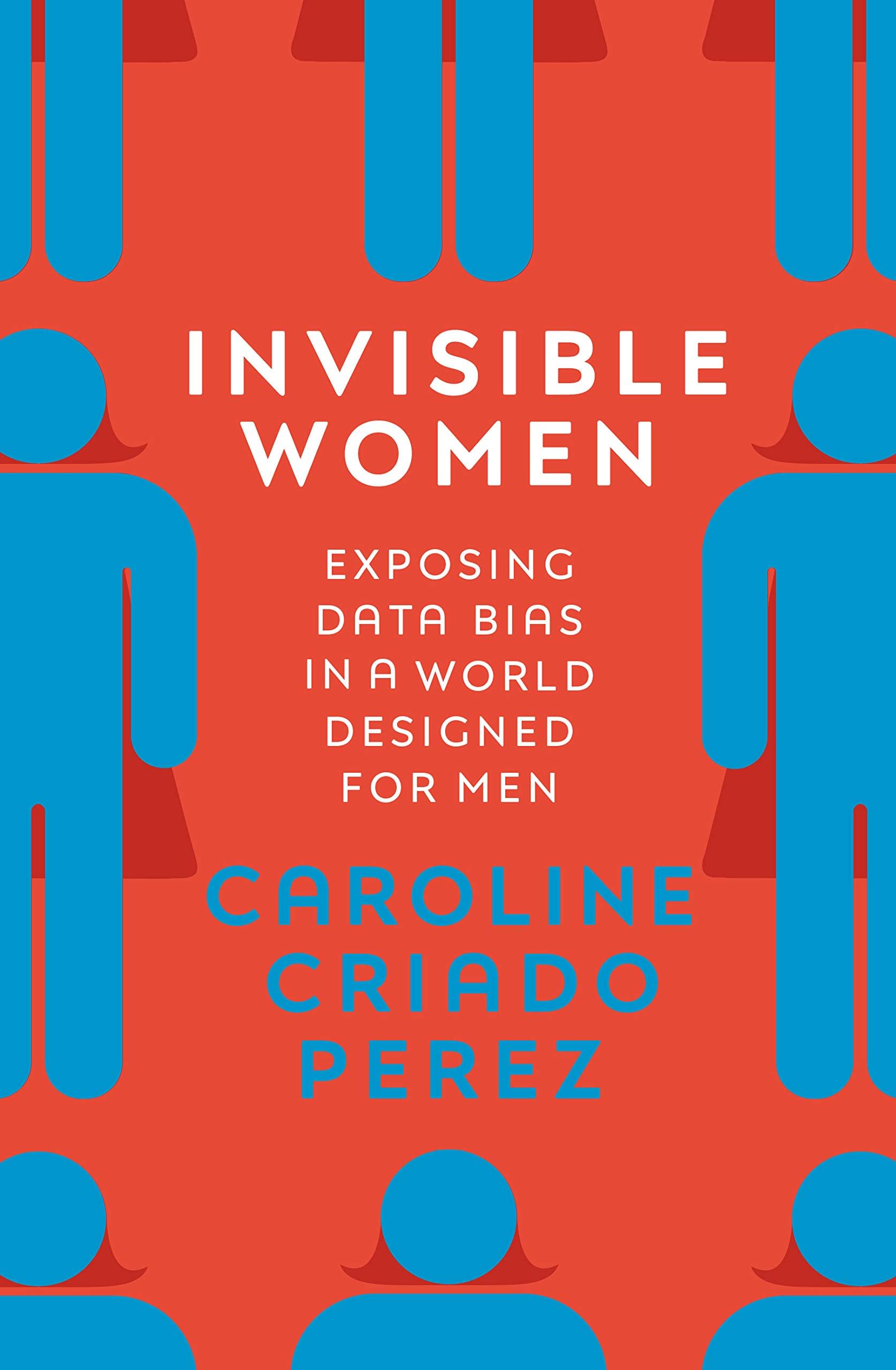
First things first: the designer of this book was clearly on a roll. The font is clear and delightful. The italics, in particular, are so beautiful I had to take a picture of them and send it to my friend so he could appreciate them too. The cover design is subtle and fantastic. When you take the dustjacket off, the overlaid blue male figures disappear, leaving the invisible women behind, which ties in wonderfully with the book’s overarching message. The texture of the dustjacket and hardcover is delightful, with a velvety-smooth overlay that is really pleasing to the touch. The book is heavily referenced throughout with endnotes. These are collected directly after the acknowledgements, a full 69 pages of references. The impact of this collected body of commentary serves to underline the density of information and dedication of the research which went into this book. While I’m not a fan of endnotes, personally, the stylistic choice to collect them all together gives undeniable weight to the book, and makes it difficult to dismiss its conclusions. But that’s enough about the physical construction of this book (for which Chatto and Windus deserves great praise). What about the content itself? Well, I read this book with a combination of mounting horror, frustration, and rage. Criado Perez takes the reader by the hand and gently leads them along a journey of discrimination against women which is endemic in all areas of life. Split into six thematic sections (Daily Life, The Workplace, Design, Going to the Doctor, Public Life, and When it Goes Wrong), this book catalogues a pantheon of circumstances where what is female is considered as abnormal, as less than standard, as Other. Collected together, the ignorance of design to the differing needs of 50% of the population is both fascinating and incredibly infuriating. Criado Perez doesn’t use this book as a stick with which to beat the patriarchy, however. Rather, she delicately unpicks the circumstances which lead to a lack of consideration of the needs of those other than what is considered to be the default. Her examples are wide-ranging, touching on every area of life, and consistently return the same conclusion: women just haven’t been thought about. It’s not that their needs have been considered and dismissed. It’s that the fact that they might have different needs hasn’t even occurred to the people creating these structures. (Generally. There are some notable exceptions. One quote from Tim Schalk really burned my cookies. But it’s not actually the norm.) From Sheryl Sandberg’s explanation at Google that heavily pregnant women can’t walk long distances to Apple Health’s omission of allowing tracking of a menstrual cycle, for many examples in this book, the reason for these omissions is that people didn’t even think of them as a potential need. Cars are crash tested rigorously before making it to market – but the dummies used are 1.7m tall. This is the size of the average man, not the size of the average person, and it leads to shocking statistics like the fact that women – despite being less likely to crash – if they are involved in a crash, are 47% more likely to be seriously injured. Criado Perez points out myriad ways that this unthinking acceptance of male as default – and as applicable to all – unfairly impacts on women, and leads to their being unconsidered in further development. The book has one overarching message, which calls clearly from every page. Do something about this. Don’t accept data as applicable to all. Sex-disaggregate data, and investigate how men and women are differently impacted. In an era which relies on big data more than ever, the gender data gap needs to be acknowledged, counteracted, and filled. And it needs to be done with a specific focus on counteracting the detriment which the gender data gap had caused. Otherwise we end up with situations where a policy designed to create more family-friendly situations actually end up disadvantaging those it intended to help. Criado Perez is not myopic in her discussions either – she skillfully acknowledges the intersections of race, gender identity, disability, and other minority identities can have to create a cumulatively detrimental effect. Invisible Women is a primer on how not to design, a feminist manifesto, a fantastic example of hard research with incredible readability, and a thoroughly engaging experience. It has filled me with rage and frustration – my friends and family have borne the brunt of several rants already – and I’ll be passing it on and recommending it to pretty much everyone I know.
P**S
Finally, the data behind every day inequality!
This book 📕 is very informative and thought provoking. It’s also infuriating if you’re a woman! You will feel both anger and validation through reading this book. There’s lots of facts and figures and data throughout. Would recommend not reading all in one sitting, however, this is a must read!
S**Y
Very interesting
L**A
Recommended to everyone - especially men. We are simply not aware of how the world we live in is impacting society as a whole. This book is based in so many studies and data it is impossible to argue with the reality it presents.
A**R
Esse livro é perfeito. Um livro necessário que coloca luz sobre fatos através de pesquisas que já eram sentidas na pela pelas mulheres. Leitura obrigatória para todo pesquisador e pesquisadora, assim como qualquer pessoa que se interesse por viés, diversidade de gênero e igualdade.
N**A
Very interesting book that highlights the gender data gap that shapes nearly every aspect of women's lives. From medical research and devices, to technology or even to workplaces/living infrastructure and design, it appears that the world is built without keeping in mind women's health and safety needs. A one-size-fits-all approach is not working for half of the world population. Highly recommended!
D**A
Fascinating, illuminating and validating a lot I already 'knew' but didn't have the data to back up. I love to read about data in a conversational format, as though talking to a friend. This book is that. I've bought several copies for friends.
Trustpilot
2 days ago
1 month ago