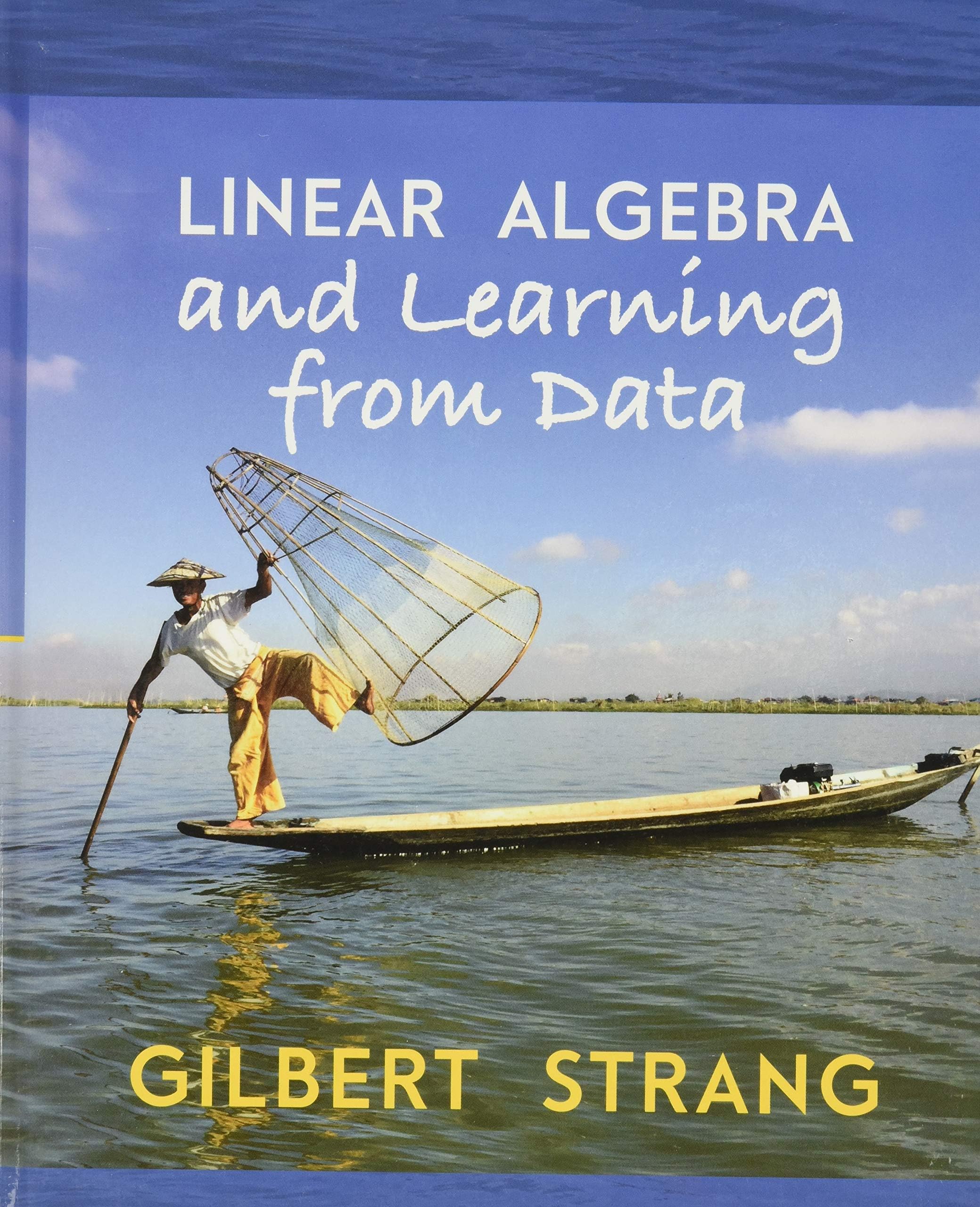

Linear Algebra and Learning from Data [Strang, Gilbert] on desertcart.com. *FREE* shipping on qualifying offers. Linear Algebra and Learning from Data Review: Clear on the Linear Algebra and focused on data science applications - Gilbert Strang, well known MIT professor and author, writes another book on Linear algebra. He put a lot of effort into making the material accessible and not assuming a background in linear algebra (matrices) so aimed at beginners. There is a bit of 'personal commentary' added to the text that is trying to make the public comfortable that wouldn't normally be in a text book but doesn't bother me much here. The added focus is on applications to Machine learning and other data extraction so it focuses on linear algebra that are useful for that purpose and how they are useful. Review: Another Strang masterpiece - Excellent coverage of Principal Component Analysis. Good high-level overview of Fast Fourier Transformation. It is not a complete chapter on Fourier analysis, but enough to understand how it works. Has a collection of applications of linear algebra. Not a good first text book -- use Strang's Linear Algebra for that, but an excellent book for applications.
| Best Sellers Rank | #120,709 in Books ( See Top 100 in Books ) #19 in Computer Vision & Pattern Recognition #169 in Computer Science (Books) #665 in Mathematics (Books) |
| Customer Reviews | 4.6 4.6 out of 5 stars (265) |
| Dimensions | 7.72 x 0.98 x 9.53 inches |
| Edition | First Edition |
| ISBN-10 | 0692196382 |
| ISBN-13 | 978-0692196380 |
| Item Weight | 2.05 pounds |
| Language | English |
| Print length | 446 pages |
| Publication date | January 31, 2019 |
| Publisher | Wellesley-Cambridge Press |
| Reading age | 18 years and up |
R**.
Clear on the Linear Algebra and focused on data science applications
Gilbert Strang, well known MIT professor and author, writes another book on Linear algebra. He put a lot of effort into making the material accessible and not assuming a background in linear algebra (matrices) so aimed at beginners. There is a bit of 'personal commentary' added to the text that is trying to make the public comfortable that wouldn't normally be in a text book but doesn't bother me much here. The added focus is on applications to Machine learning and other data extraction so it focuses on linear algebra that are useful for that purpose and how they are useful.
M**Y
Another Strang masterpiece
Excellent coverage of Principal Component Analysis. Good high-level overview of Fast Fourier Transformation. It is not a complete chapter on Fourier analysis, but enough to understand how it works. Has a collection of applications of linear algebra. Not a good first text book -- use Strang's Linear Algebra for that, but an excellent book for applications.
N**H
A lot of information
This has an incredible amount of information about applications of Linear Algebra all over Computer Science and beyond. It is reasonably well explained, however Mike X Cohen's Linear Algebra book "Theory, Intuition, Code" has much better explanations (although covering far fewer topics). I would recommend using both books together.
G**S
Prof. Strang Puts out Another Winner
Prof. Strang is just a masterful teacher, a teacher's teacher. I have followed him for years via both his online lectures and his books, and neither this book nor the companion online course disappoint. It is all the more admirable that even late in his career he has stayed current in his field (he is quite the guru of applied linear algebra) and seems to always be striving for innovative ways to teach in both his lectures and his books. For those interested in learning both some of the basics of linear algebra and some of the more advanced topics that are pertinent to ML and data analysis, I highly recommend this book.
D**Y
Great introduction to learning methodology
While not a full-on linear algebra book (despite the title), this does serve as a perfect undergraduate-level introduction to the Machine Learning galaxy and its many, many applications and increasingly popular methodology. Computer scientists, mathematicians and engineers - as well as math-savvy economists and businesspeople - could benefit from a class using this text or from self-learning if one is not prepared for a classic like Deep Learning. Upsides include a thorough review of linear algebra and a very up-to-date list of data analytic topics that are at the edge of research and recently implemented techniques, including Google's new ranking system, which it continues the recent trend of texts in covering as a side section late in the book. This is a Gil Strang book, which means problems, problems, problems galore (no answers are given within the text). Chapter VI on optimization methodology is the star of this show, and is a really good stepping stone to the higher-level texts on these topics. Downsides include breadth-not-depth coverage and the need for a little bit of organization. There is far more in here for a single class, but it seems like it was written with the purpose to be all or almost all used for a single semester's worth of coursework. This may work for MIT, but not for a second- or third-tier undergraduate department (at least not without significant trouble). Fortunately, an instructor can simply cut some topics, but the students should at least read up on these for the purposes of interest; they are certainly NOT comprehensive introductions - hence, the "breadth-not-depth" critique above; see e.g. the Compressed Sensing section for a prime example of ... well, sparsity of information. It could also stand for some significant clean-up and organization. Glibert Strang is well-known in math cirles as an extraordinary innovator and teacher of linear algebra. I found this book from him simply delightful, and, though my needs already exceeded it in general, was surprised on how much I learned from it still.
J**.
A rank one correction to the teaching of linear algebra!
Prof Strang has been writing intoductory linear algebra books since the mid nineteen seventies. All of them good. In this book he sharply departs from his own and ever other book in introductory presentation and presents the outer product at the same level of detail as the inner product. This clarifies many applications, by allowing discussion of rank one corrections in applications. I really like this. For me it was late undergraduate or early graduate school that the outer and inner product became peer in the type of applications that I was interested in. While this book has an eye towards “machine learning,” it is very clear that Prof Strang sees all applications as data science. This book is his distillation of that. I wish I’d had this at the beginning of my education. This was a wonderful reintroduction to a view I use everyday.
E**N
Great for a basic introduction or quick review
I wanted to brush up on linear algebra just because it's been so long since I've really gone through all the details. This is a great refresher course for me. And a lot of the conceptual pedagogy that Strang is so well known for really shines here. Maybe it's because I am already familiar with the material, but Strang makes it feel like meeting an old friend for dinner.
M**W
A great assistant for deep learning
This book relates two essential topics linear algebra and deep learning. Prof Strang sees statistics and optimization as two supplementary topics which bridge the main subjects. This book organizes central methods and ideas of data science and provides insight into how linear algebra gives expression to those ideas.
G**M
Well done, very clear and explain in details .
S**E
Any book by Prof Strang, is a book worth owning. If you have an interest in an area of study that Prof Strang has written a textbook about, just buy his book and learn it cold. 'Linear Algebra and Learning from Data' is another ringer.
G**.
Il miglior libro sulle applicazioni dell’Algebra Lineare alla data science
A**I
Uso esse produto em minhas pesquisas acadêmicas.
A**R
Arrived in mint condition. Printing is good too. Content covers basics of linear algebra then moves to application of it. All the lecture material is available at MIT OCW 18.065
Trustpilot
5 days ago
1 month ago