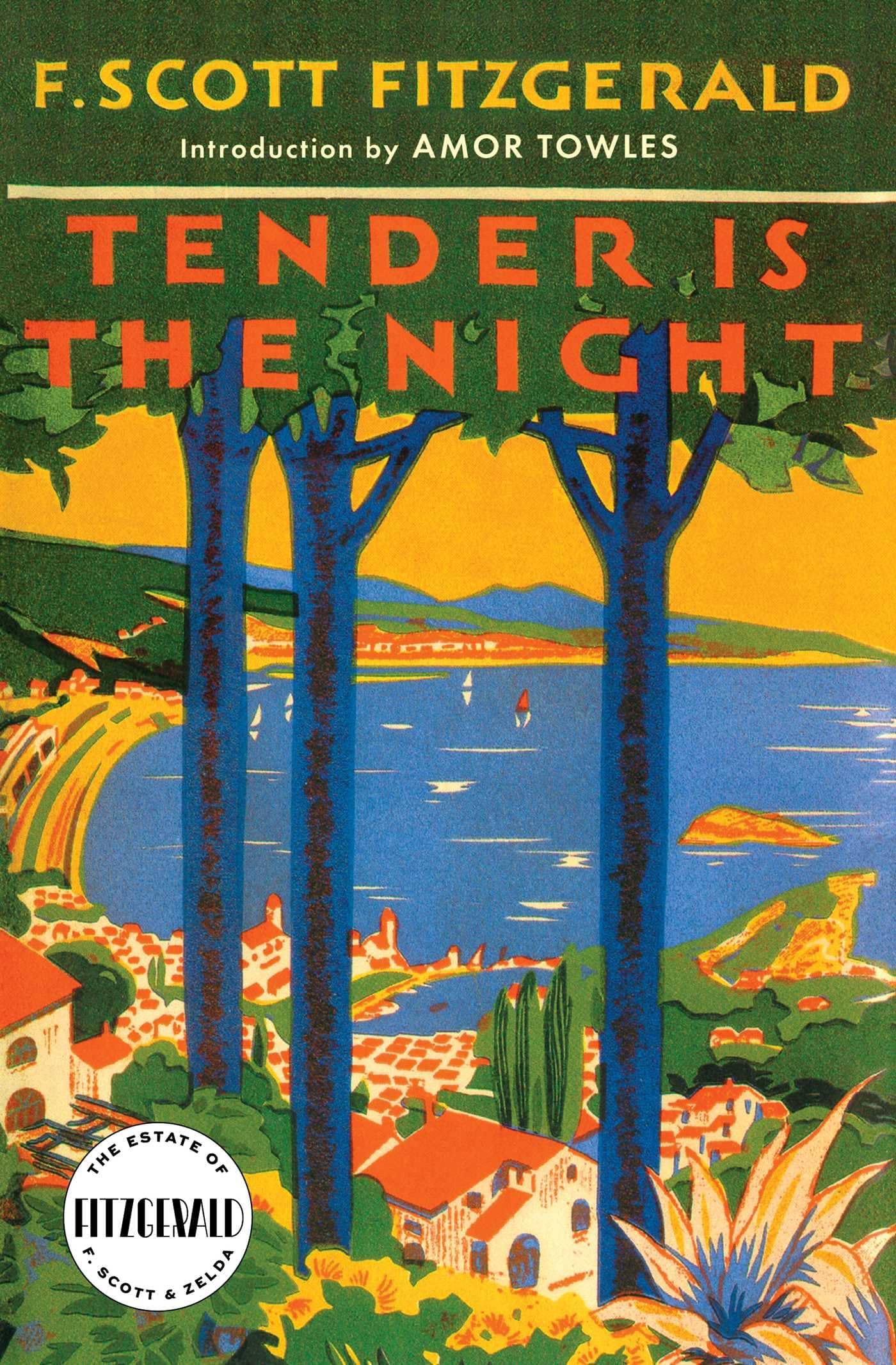
Tender Is the Night (Cover May Vary)
Product ID: 1234838
Buy anything from 5,000+ international stores. One checkout price. No surprise fees. Join 2M+ shoppers on Desertcart.
Desertcart purchases this item on your behalf and handles shipping, customs, and support to KUWAIT.
A modern classic by F. Scott Fitzgerald, with an introduction by #1 New York Times bestselling author Amor Towles and a foreword by Fitzgerald's great-granddaughter Blake Hazard. Set in the south of France in the late 1920s, Tender Is the Night is the tale of a young American actress, Rosemary Hoyt, and her complicated relationship with the alluring couple Dick and Nicole Diver. A brilliant psychiatrist at the time of his marriage, Dick is both husband and doctor to Nicole, whose wealth pushed him into a glamorous lifestyle, and whose growing strength highlights Dick’s decline. Lyrical, expansive, and hauntingly evocative, Tender Is the Night was one of the most talked about books when it was originally published in 1934 and is even more beloved by readers today. Review: A Marriage story - Tender is the night is a true of the troubled Mr and Mrs Diver that seem to have it all. The characters were hard to like but there were moments that you felt for them and needed to know more. Dick and Nicole Diver are the toast of the French Riviera in the 1920s. Both beautiful, rich and charismatic. But behind it all is two very complicated all to real characters struggling to stay connected to life and each other. The writing is good. F Scott Fitzgerald style of writing leaves a lot to the imagination but gets the point across. A very good read but buckle up it is quite an emotional ride Review: Good Depiction of a Troubled Couple in the Roaring 20’s - I really enjoyed the descriptions of all of the locations in Europe that the main characters live in and visit. Fitzgerald does a great job in depicting the life style and attitudes of ex-pats living in Europe during the 1920s. Dick and Nicole Diver start out with lots of hope and success. However, eventually, they grow apart through her mental illness and his ennui and drinking. This version of the book also provides a good introduction and end notes providing great detail into the period and some of the statements that characters in the book make. Well worth a read.
| Best Sellers Rank | #11,948 in Books ( See Top 100 in Books ) #48 in Classic American Literature #339 in Classic Literature & Fiction #836 in Literary Fiction (Books) |
| Customer Reviews | 4.1 out of 5 stars 3,161 Reviews |
N**S
A Marriage story
Tender is the night is a true of the troubled Mr and Mrs Diver that seem to have it all. The characters were hard to like but there were moments that you felt for them and needed to know more. Dick and Nicole Diver are the toast of the French Riviera in the 1920s. Both beautiful, rich and charismatic. But behind it all is two very complicated all to real characters struggling to stay connected to life and each other. The writing is good. F Scott Fitzgerald style of writing leaves a lot to the imagination but gets the point across. A very good read but buckle up it is quite an emotional ride
D**.
Good Depiction of a Troubled Couple in the Roaring 20’s
I really enjoyed the descriptions of all of the locations in Europe that the main characters live in and visit. Fitzgerald does a great job in depicting the life style and attitudes of ex-pats living in Europe during the 1920s. Dick and Nicole Diver start out with lots of hope and success. However, eventually, they grow apart through her mental illness and his ennui and drinking. This version of the book also provides a good introduction and end notes providing great detail into the period and some of the statements that characters in the book make. Well worth a read.
J**R
Why is Fitzgerald so attracted to such loathsome characters?
Now, I have an admission to make. In my own fiction, I tend to get lost in my own little world, fall in love with my language and my parataxis, and subject my reader to little in-jokes that make me laugh. For example, in a recent work of mine, I included a little part about T. S. Eliot's Wasteland. I referenced, what I though to be heavy handedly, the "game of chess" section, and what I hoped to be more oblique, the "death by water" part. This was done because I was trying to get across the theme of decay. Ok, so it did not work. I can accept that fact. Maybe I have to be more aware of the audience, or something along those lines. The point here is that my own idiosyncrasies perhaps do not translate well. I have the same problem reading Fitzgerald that I suppose that people have when reading my own work. Alcoholics living out their own malaise in high society do not interest me. I cannot find the characters that Fitzgerald writes about compelling. I find myself disgusted at their self-indulgent and harmful acts. The knowledge that these characters come from real life in the circles that Fitzgerald lived in pushes me over the edge. He obviously had interest in these sorts of people. It cannot be denied that he the prime chronicler of the Jazz Age. Dick, Nicole and their lot are loathsome characters. I first read this book, two years or so ago, and I have to say that I have no desire to revisit it. There are other more pressing things on the schedule, like washing my hair. Fitzgerald got closer to a sympathetic character when he fleshed out Nick in The Great Gatsby. I think this is because he was portraying someone more like himself. Nick was more of an outsider looking in, or in his case, at the other end of the egg. Fitzgerald is able to create someone who you can sympathize with, because Nick somehow comes across as the most human of the characters that I can remember. Nick possesses a certain sense of longing to belong that seems to be indicative of Fitzgerald himself. He appears as an outsider in this expatriate community, or even the riche community of Gatsby. The question I have is, "Why is Fitzgerald so attracted to such loathsome characters?" He to seems entranced by broken people in circumstances that would seem to be the embodiment of success on some levels. These characters all have a façade that seems smooth and glassy, only you can see the imperfections the closer you get. Dick, Nicole, Rosemary, Abe, Jay, and Nick all have their failings in the realm of fiction. Fitzgerald has his own, and so does Zelda. I have no answers for my own question, and as a reader, I cannot get past this isolation that Fitzgerald uses by focusing on such unsympathetic characters. His writings have long been canonized, and are taught all over, but I have a distance with him that is greater than the one I feel when reading Hemingway.
P**R
Putting together fragments of the lives of those he knows, and himself, plus more, F. Scott Fitzgerald creates a masterpiece.
Tender is the Night was very interesting to me because I read it long after I read a biography of the writer. The book was written after Fitzgerald had been on a long dry spell and desperately needed money both to keep up his lifestyle and primarily to pay for incredibly expensive ongoing mental health hospitalization for his wife Zelda in Switzerland and the US. Fitzgerald takes a mix and match of his own life and those of others he met during the hey-day of American writers in Paris and Europe in the 1920's. Primarily, he uses a rich couple who coddled geniuses, Sarah and Gerald Murphy, as part models for the main couple of his book, Dick and Nicole Diver. While both of the Murphys were rich and started inviting the highly talented to their home by an initially almost private beach, Fitzgerald places the Divers in a close match to the Murphy's home on the French Riviera, has Dick raking the sand like Gerald Murphy did to make it habitable for sunbathing, and initially shows them as taste makers for the Lost Generation. However, Fitzgerald invents many parts of the Divers, such as one party to the relationship only being wealthy, while the other is a psychiatrist, and has the Divers travelling in a style much like the Fitzgeralds did, as they moved from one expensive hotel and rented apartment or home to another. Due to Fitzgerald's own wife's quite serious mental illness, which to me made her as well as Nicole Diver, upon whom her madness is modelled, quite egocentric. Fitzgerald clearly shows the burden of being married to a seriously ill person before medication entered the picture in psychiatry. Everything revolves around the mentally ill person's feelings and weaknesses, with the sane spouse having to always be the strong one with no one to turn to for his own insecurities, such as we all have. The book shows how Dick struggles with this, and how it eventually destroys him. In essence, while the wife is expected to have the destroyed life, much like Zelda Fitzgerald had; in this case the wife comes out on top and essentially betrays the man who has protected her for so many years and brought her to full sanity. Fitzgerald was extremely devoted to his wife, and devoted to her care (especially making sure it was paid for). as he drank himself into a more or less constant stupor as a process. I think this book was an outlet for him to tell what that felt like, as Zelda was talentless bur relentlessly jealous of her husband's talents. In fact, Zelda seemed to me to be much more dislikable than Nicole Diver in the book. The book, which has been hashed over for decades as a major classic, is still well worth reading. Fitzgerald's writing is downright lyrical in its beauty and the narration keeps you turning the pages, even though the book is in no way a thriller or mystery. I did not feel gulty giving a few spoilers in this review because I am probably the only serious reader who really did not know the plot of the book before I read it. It deserves its status as a worldwide classic, and is one of the best written books I have ever read.
S**E
Fitzgerald's best
The writing manages to be mesmerizing and distancing at the same time, the story unfolds slowly but powerfully, the final third is almost unbearable in its tracing of Dick Diver's decline. Among much else, it's about damage done and the tangled steps of healing and growth. Somehow it's about duty and sacrifice. Somewhere there's a political theme as well. Give this painful, inspiring work a try.
P**N
The Novel That Ate-Up the Author
I was writing a review of this book when I lost all that I had written, as Goodreads closed the review page and opened my bookshelf page, instead. I don't have the patience to recreate what I had written and I will compose future reviews in Word to avoid a repeat of this very annoying event. Suffice to say that this book is quite complex, primarily because Fitzgerald started the book in 1925 but did not finish writing until 1934. Think of all that happened to the Fitzgeralds in those 9 years and what happened to the world, including the Great Depression. The story of a young doctor's love for his psychiatric patient, Nicole, the cure of that patient but the destruction of that doctor forms the main story of the novel. Fitzgerald's organization of the novel can be faulted as can his wandering narrative and literary focus, but his writing and phrasing is excellent and his insight into the characters and his sometimes brutal analysis of their motives is quite sharp. The book is a little hard to get into, since it does not start at the chronological beginning, but the development of the story thereafter is strong. The ending is a little hard to take. Fitzgerald seems to understand his doctor's mind not quite as well as he understands the minds of the two women in the story, his wife, Nicole, and his first serious lover,Rosemary.
S**Y
A classic for good reason!
A classic! Enjoyed reading it on a trip through France- where it was written!
D**S
Fitzgerald's Elegy to Youth
F. Scott fans, sorry to disappoint, but I can't regard this book as much more than a semi-autobiographical paean to rich and hollow youth, graced redeemingly here and there by the deft lyrical touch.-But even the trumpeted writing in this book is mostly Princeton Sophomoric- Every single character, not just the primary ones, is as beautiful as he or she is hollow. One gets the feeling, after a while, that one is watching one of those mindless beach films of the early sixties---It may be true that Fitzgerald cried every time he read Keats's Ode to A Nightingale, from which Fitzgerald gets his title for the book, but Dick Diver, so obviously Fitzgerald's alter ego, is, in so many passages casually relating his omnipotence over women, and in one explicitly stating the similitude (p. 258 in my edition) much more a Byron figure than the greater poet. Life in this world seems to end at 29, where Nicole leaves our hero in the last few pages.-The whole to do about Fitzgerald's/Diver's alcoholism as an excuse for the book's banality just won't do.- Fitzgerald made the excuse to his editor that he wrote the whole of Section III while tight as an owl-And so what, Scott? - Hemingway was an alcoholic and suicide. Faulkner died of the DT's in a sanatorium near his home in Mississippi Jack London died at 40 of alcoholism and Tennessee Williams, and Eugene O'Neil, and Hart Crane and Carson McCullers and.....and it's really hard to think of a major American writer of Scott's era that didn't succumb to the perils of drink. This did not stop any from writing mature works that dealt powerfully with the human condition, not just the rich and beautiful. ---The one exception seems to be Ezra Pound, who merely went mad and spent most of his time broadcasting Fascist propaganda for Mussolini during WWII. The book's credo might well be summarised by Abe North, who disappears early in the work, foreshadowing Dick's later demise, asseverating before his own alcoholic death: "When you're older, you'll know what people who love suffer. The agony. It's better to be cold and young than to love." As an alternative to this rather cold and young book, I would recommend either Fitzgerald's The Beautiful and The Damned, written when he WAS young and his lyrical powers, quite frankly, were at their height and allowed him to pull it off. Or, for a truly great lyrical book, probably the best of Fitzgerald's generation, Thomas Wolfe's (not to be confused with Tom Wolfe) Look Homeward Angel...Not a witless bathing beauty from first page to last.. .
N**A
engaging classic
I will not attempt to review a classic . Added whispersync Beautifully narrated - I note many people have narrated this book , however I love the gentleness of this voice
A**A
Scribner always
Another masterpiece by Fitzgerald. I give you one reason to read it, this quote "I don't ask you to love me always like this, but I ask you to remember. Somewhere inside me there'll always be the person I am to-night." - as for the book itself, I suggest you to buy the Scribner edition always, as it was Fitzgerald's editor and it is the most genuine you can trust. This particular one is a beat cheap in terms of paper quality, I mean it's too thin, but I knew that as I bought the cheap version. As for the rest, all good. Ok size of the letters .
A**R
Yanlış Kitap
Elime gelen kitap ile ürün fotoğrafı ve bilgilerine bakarak aldığım kitap hikaye içeriği açısından aynı olmasına rağmen farklı bir yayıncı tarafından basılmış. Elime gelen Wordsworth Yayınlarının klasik baskılarından. Bunu düşünerek almanızı tavsiye ederim. Memnun kalmadım.
C**E
Disappointing!
The product is of very poor quality! They didn’t even bother to use decent paper. I’m really disappointed. I do not recommend it — don’t buy it!
G**T
Schöne Ausgabe
Nur diese und keine andere Ausgabe! Das beste Cover!
Trustpilot
3 weeks ago
4 days ago