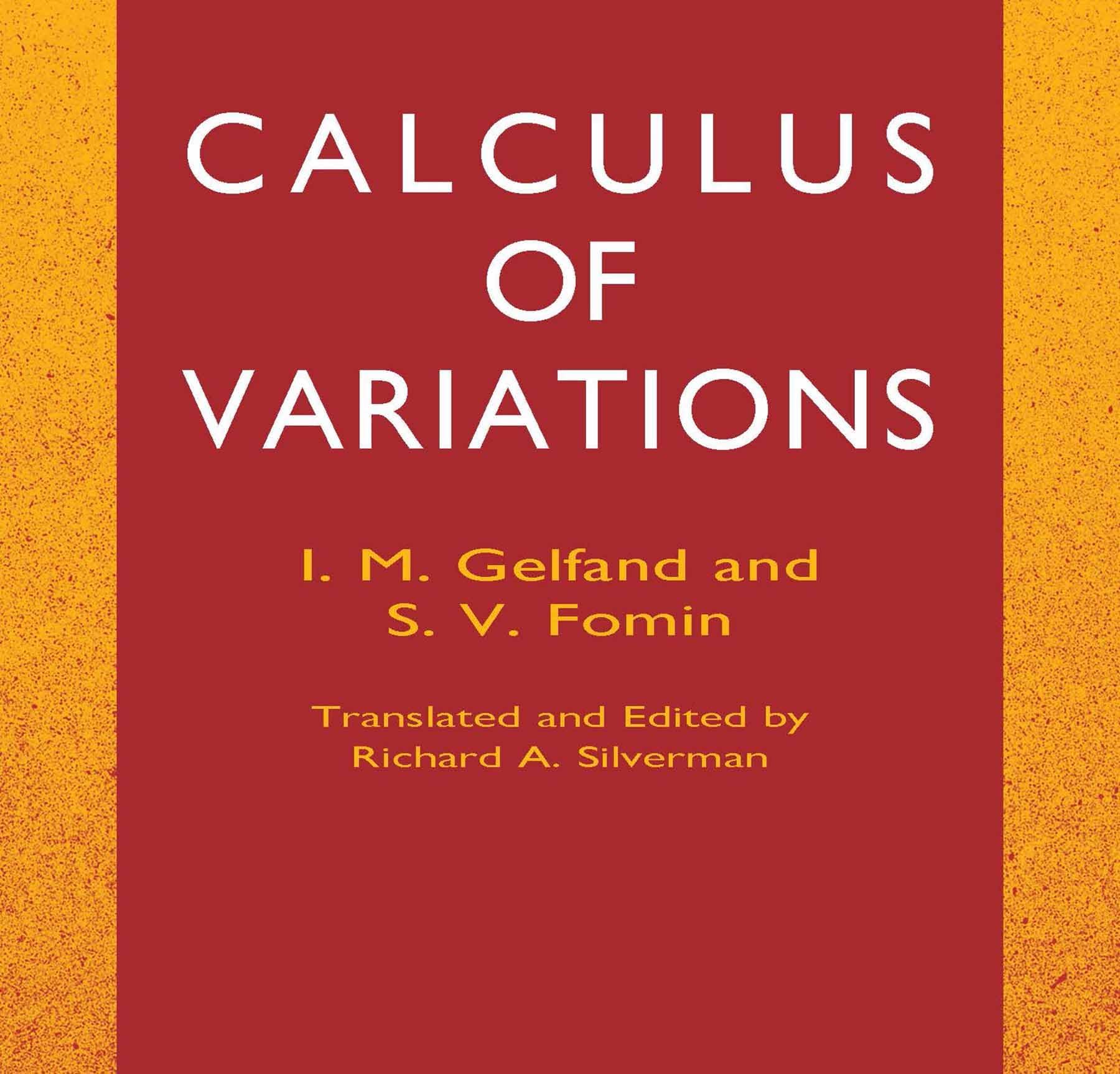
Calculus of Variations (Dover Books on Mathematics)
Product ID: 14033858
Buy anything from 5,000+ international stores. One checkout price. No surprise fees. Join 2M+ shoppers on Desertcart.
Desertcart purchases this item on your behalf and handles shipping, customs, and support to KUWAIT.
Based on a series of lectures given by I. M. Gelfand at Moscow State University, this book actually goes considerably beyond the material presented in the lectures. The aim is to give a treatment of the elements of the calculus of variations in a form both easily understandable and sufficiently modern. Considerable attention is devoted to physical applications of variational methods, e.g., canonical equations, variational principles of mechanics, and conservation laws. The reader who merely wishes to become familiar with the most basic concepts and methods of the calculus of variations need only study the first chapter. Students wishing a more extensive treatment, however, will find the first six chapters comprise a complete university-level course in the subject, including the theory of fields and sufficient conditions for weak and strong extrema. Chapter 7 considers the application of variational methods to the study of systems with infinite degrees of freedom, and Chapter 8 deals with direct methods in the calculus of variations. The problems following each chapter were made specially for this English-language edition, and many of them comment further on corresponding parts of the text. Two appendices and suggestions for supplementary reading round out the text. Substantially revised and corrected by the translator, this inexpensive new edition will be welcomed by advanced undergraduate and graduate students of mathematics and physics. Review: Wonderful book, but could use some modern context. - Gelfand and Fomin wrote a wonderfully clear, rigorous, and concise introduction to the calculus of variations, and it requires little more than a calculus and analysis background (say, 1st or 2nd year math undergraduate) to understand much of the reasoning. Furthermore, the end-of-chapter problems are generally pretty straightforward to set up, and they often follow in-chapter examples, although the resulting algebra can be beastly. A word of advice for someone new to the calculus of variations: keep in mind that since this book is an older text, it lacks some modern context. For example, the variational derivative of a functional is just the Frechet derivative applied to the infinite-dimensional vector space of admissible variations. They use a norm on a Sobolev space without defining it as such. They make no mention of the Hamiltonian as the convex conjugate functional of the Lagrangian. If you're just looking to solve variational problems, you might be fine with this. On the other hand, if you're looking for more general insight, I think it would benefit you to first learn some basic functional analysis (e.g. Kreyszig, Luenberger) and then make it an exercise to match the concepts from this book to a more modern jargon. Review: A Rigorous Introduction - This book takes a more rigorous approach to variational calculus than the books by Elsgolc or Weinstock. If you have some background in real analysis, this book will be much more readable. It is well written and to the point, so expect to study the pages slowly and intentionally. In such a small book there is plenty to be learned and at the price it is hard to turn down.

| Best Sellers Rank | #223,193 in Books ( See Top 100 in Books ) #68 in Mathematical Physics (Books) #125 in Calculus (Books) #426 in Applied Mathematics (Books) |
| Customer Reviews | 4.5 out of 5 stars 219 Reviews |
B**J
Wonderful book, but could use some modern context.
Gelfand and Fomin wrote a wonderfully clear, rigorous, and concise introduction to the calculus of variations, and it requires little more than a calculus and analysis background (say, 1st or 2nd year math undergraduate) to understand much of the reasoning. Furthermore, the end-of-chapter problems are generally pretty straightforward to set up, and they often follow in-chapter examples, although the resulting algebra can be beastly. A word of advice for someone new to the calculus of variations: keep in mind that since this book is an older text, it lacks some modern context. For example, the variational derivative of a functional is just the Frechet derivative applied to the infinite-dimensional vector space of admissible variations. They use a norm on a Sobolev space without defining it as such. They make no mention of the Hamiltonian as the convex conjugate functional of the Lagrangian. If you're just looking to solve variational problems, you might be fine with this. On the other hand, if you're looking for more general insight, I think it would benefit you to first learn some basic functional analysis (e.g. Kreyszig, Luenberger) and then make it an exercise to match the concepts from this book to a more modern jargon.
C**N
A Rigorous Introduction
This book takes a more rigorous approach to variational calculus than the books by Elsgolc or Weinstock. If you have some background in real analysis, this book will be much more readable. It is well written and to the point, so expect to study the pages slowly and intentionally. In such a small book there is plenty to be learned and at the price it is hard to turn down.
J**O
Another Excellent Book!
I'm reading this book as a refresher along with Weinstock's book on Calc of Variations, which I applied in an Advanced Classical Mech course using Goldstein's textbook many years ago. It's nice to once again review the beauty of the mathematics and it's applications.
C**S
Fantastic Textbook
Concise and clearly written. Perfect for an introduction to the subject. Amazing value as well.
D**N
Great book
It’s worth the price. Some prior knowledge on calculus and algebra is needed prior to studying this book.
J**L
Very good book on Calculus of Variations CofV
Very good book on Calculus of Variations CofV Complements, Robert Wienstock's book on CofV.
R**Y
calc 1
it is certainly math
J**S
I believe it's a Russian text: they're priceless.
To eventually enhance my, presently, depth of knowledge/ skill of this subject.
N**A
Riferimento fondamentale
Il testo tratta i fondamenti del Calcolo delle Variazioni (CV) ed è scritto da due pezzi grossi della matematica russa, che, come noto, è rigorosa senza perdersi in un formalismo superfluo senza per questo essere ingenua e guardando sempre alle applicazioni (soprattutto fisiche). Infatti, nel caso di questo libro, vi è addirittura un capitolo in cui il CV si fonde con la Meccanica Analitica (principio di minima azione, trasformazioni canoniche, trasformata di Legendre, equazione di Hamilton-Jacobi, eccetera), inoltre, molto importante è la presenza di due capitoli sulle condizioni sufficienti di estremo (argomento molto delicato e spesso ignorato nelle trattazioni di base del CV, qui trattato in maniera estremamente rigorosa), tuttavia, in tale testo il CV è trattato in maniera piuttosto avanzata, pertanto lo sconsiglio a chi si accinge allo studio del CV per la prima volta, a costoro suggerisco prima di consultare i capitoli introduttivi sul CV presenti in alcuni testi di Meccanica Analitica o nelle appendici di testi di Complementi di Analisi Matematica o di Metodi Matematici della Fisica, oppure di cominciare col testo di Elsgolts https: //www.amazon.it/Equazioni-differenziali-calcolo-delle-variazioni/dp/886473225X/ref=sr_1_2?ie=UTF8&qid=1516815159&sr=8-2&keywords=elsgolts un po' più agevole di questo. In ogni caso questo libro rimane un riferimento fondamentale per chiunque si occupi di CV in maniera avanzata. Indicato soprattutto per fisici.
A**C
Worth the effort and enjoyable to read to discover new facts!
* Introduction I have chosen this book to further explore the topics around `Calculus of Variations'. Previously, I read and reviewed another book on this mathematical topic named `The Introduction to the Calculus of Variation's' that is also published by Dover. Just to make it clear this following book is not written by the author of the first book. This second volume is very well bound for a paperback, and its texts and graphics are both in black and white. Also of note is that the font sizes are adequate for those of us who may require glasses to read. The contents of this book are based on a Moscow state university series of courses, but with the original author's permissions, these have been built upon and explored more deeply by the author who is also its translator into English. Dover, the publisher, has a tendency to reprint older, perfectly usable Math books at budget prices. This book has been read from May to July 2014. * A-level, H.N.D, Undergraduate, Graduate? The book is designed for advanced undergraduate (3rd year level Hons) and graduate level studies. * What is Calculus of Variations used for? The basic reasons for the study of this topic is to calculate finite -difference approximations to functions using linear methods with in areas arising in topics such as Analysis, Mechanics, Geometry that must apply technique's using continuously differential functions that are within [a, b]. These can be accommodated several variables members in these approximations. Such calculations, such as to derive the length of a function. Or a where a derivative is zero, so finding a local maximum or minimum for example. These equations are different in that they can possess several variables. Unlike usual Mechanics having physical equivalents of up to the forth derivative, these can possess equations with many finite n - derivations. * Concisely, what topics are covered? The general equation that drives these calculations, and the whole book, is a generally applicable `Euler's equation'. These can apply `Taylor series' to generate the whole membership of a custom function series to be solved. This short and rather wonderful equation is reused and built upon several times to explore a whole raft of technique's; some using symbolic notation upon matrices, many others applying symbolic techniques using partial differential equations in the usual level of mathematical short - hand to keep the book shorter than it would otherwise be. It's the method that is being explored and is more important and not the specific equation. To explore the partial differential equations -that can be non-linear- the Euler equation is expanded to Hamilton - Jacobi equation representing canonical equation equivalents representing the characteristic system. This is further explored symbolically to apply to say for an example, 3-D (x, y, z, t) fields by using first derivative equivalents to map a finite number of particles to find where its reaches zero. As before, the classical mechanics equations exploring conservative systems in equilibrium with n - finite number of particles and kinetic and potential energies with observation of Lagrangian rules. Often present with multiple partial integrals. This level of mechanics I felt it became very helpfully explained, but not delving too deeply into another topic when exploring this component of variation topics. * Summary I hope my humble summing up is not just a tissue of my butchered misunderstandings! But I have really enjoyed this book and have a better comprehension of these deeper calculus techniques that are written so much within concise mathematical symbolic notation. Its not at a super deep level, but its helpful along the ways to gain new comprehensions.
M**R
Useful book for introductory level
One of the best books that I have used on this subject. In fact, I use this book in my course as the main reference. I advice this book along with Elsgol's book on the subject for those who want to learn this subject (even as a self reading course). This book has very good Mathematical rigour and very simple to follow.
S**D
A must for physicists but also to those interest by functional optimization for other applications like image processing
Thanks to amazon.fr for quick dispatching of the Dover Edition (very accessible price!) of this very valuable book. An excellent introduction to the calculus of variations with application to various problems of physics. The scope of application of those techniques has tremendously grown since the original edition of this book. For example, the calculus of variation is extremely useful for R&D activities in image processing. I would warmly recommend this book for those who would like to have a quick but sound introduction to the subject (first few chapters of the book).
C**E
good
Good
Trustpilot
1 month ago
1 day ago