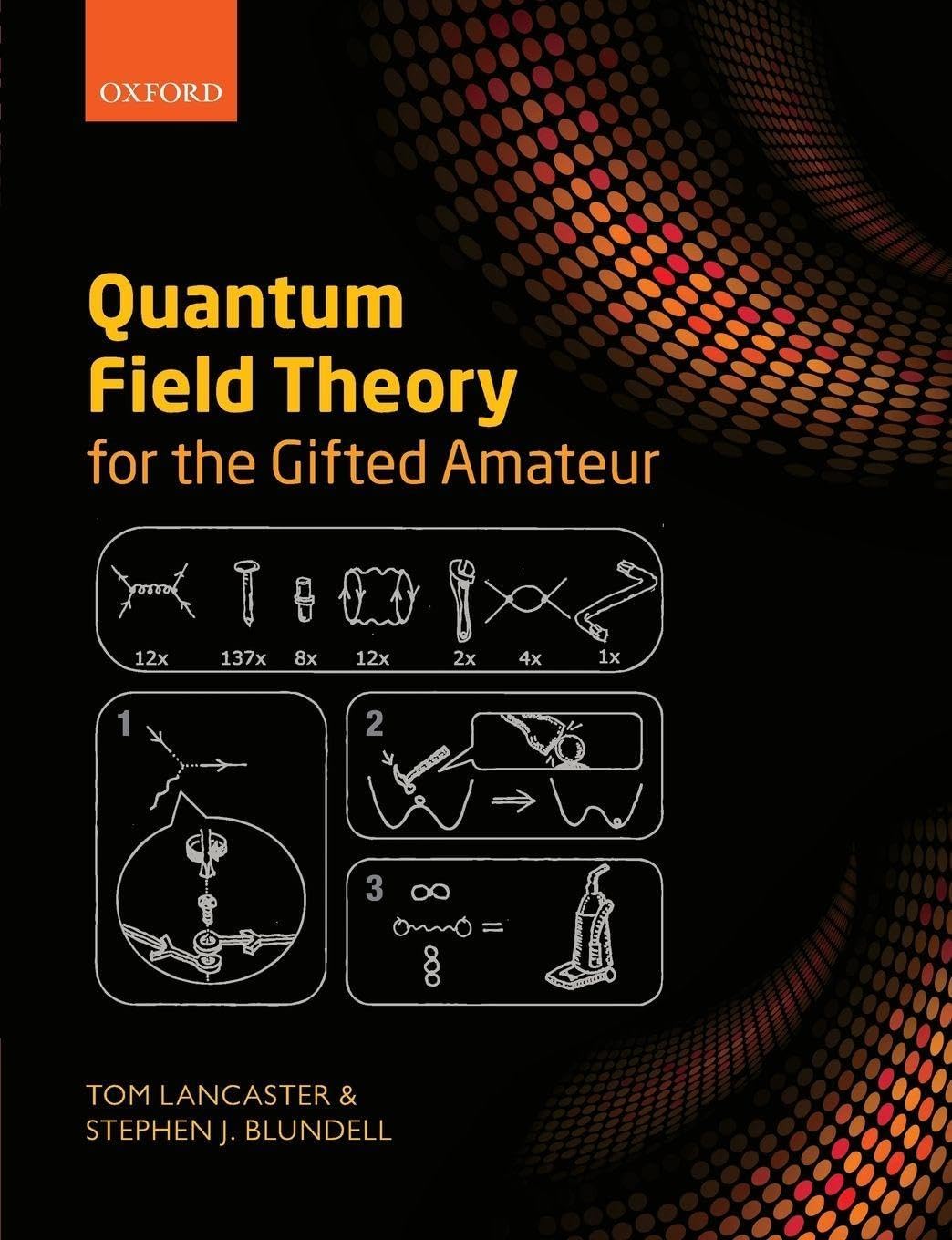
Quantum Field Theory for the Gifted Amateur
Product ID: 1566951
Buy anything from 5,000+ international stores. One checkout price. No surprise fees. Join 2M+ shoppers on Desertcart.
Desertcart purchases this item on your behalf and handles shipping, customs, and support to KUWAIT.
Quantum field theory is arguably the most far-reaching and beautiful physical theory ever constructed, with aspects more stringently tested and verified to greater precision than any other theory in physics. Unfortunately, the subject has gained a notorious reputation for difficulty, with forbidding looking mathematics and a peculiar diagrammatic language described in an array of unforgiving, weighty textbooks aimed firmly at aspiring professionals. However, quantum field theory is too important, too beautiful, and too engaging to be restricted to the professionals. This book on quantum field theory is designed to be different. It is written by experimental physicists and aims to provide the interested amateur with a bridge from undergraduate physics to quantum field theory. The imagined reader is a gifted amateur, possessing a curious and adaptable mind, looking to be told an entertaining and intellectually stimulating story, but who will not feel patronised if a few mathematical niceties are spelled out in detail. Using numerous worked examples, diagrams, and careful physically motivated explanations, this book will smooth the path towards understanding the radically different and revolutionary view of the physical world that quantum field theory provides, and which all physicists should have the opportunity to experience. To request a copy of the Solutions Manual, visit http://global.oup.com/uk/academic/physics/admin/solutions. Review: pedagogically instructive bridge and self-study guide - I enjoyed this textbook quite a bit. If utilizing this text for self-study, be sure and visit the author's academic website where a list of errata can be found (most typos are minor and can be cleaned up with a bit of dimensional analysis: for instance, the -1/2 for lambda should be +1/2 on bottom of page 408. This highlights an issue regarding background: dimensional analysis can be incredibly helpful. For instance, you would not forget the (2*pi)^4 in the denominator of equation #24 (page 6) if you were simply to keep your eye on dimensions. Onward: (1) Mathematics prerequisite: Mary Boas, Mathematical Methods In The Physical Sciences (chapters two and eleven). Boas is necessary background. View page 285 of Lancaster and Blundell, three integrals at bottom of page--you either know them, or not. If not, review that material ! View appendix B of Lancaster and Blundell, a review of complex analysis. There are seven examples there. If those examples are not completely understandable, the material needs to be learned. Note: Anthony Zee's textbook, QFT In A Nutshell, will not review complex variables. Thus, it is already clear that this textbook is pitched at a lower plane than Zee's insightful textbook. (2) Complex variables, dimensional analysis, integration-by-parts, "resolution of the identity" these tools (and more) are your lifeblood. You surely want to recognize the difference between Lagrangians and Hamiltonians. It is difficult to recommend here a mechanics text. I will say this: my course in junior-level mechanics was inadequate when it came to either Lagrangians or Hamiltonians. I hope undergraduate instruction has since changed in that regard. In any event, recognize the difference between when derivatives are more useful as a tool, as opposed to when Integrals are more useful (That begs the question: Why did it take ever so long for the Feynman path integral techniques to become part and parcel of the establishment ? Read Kaiser.). (3) Let me survey the pedagogic attributes of this textbook: Margin notes amplify textual material, summaries at end-of-chapter, diagrams and figures (cartoons) along the way, many examples to ruminate upon, intermediate steps in the mathematical derivations supplied, and last (but not least) excellent problems for student involvement (hints for their solution, too. For instance, problem #35.2, verify the Gell-Mann-Low equations. Some exercises are relatively easy, for instance, problem #30.2,"suggest a form for (4+1)-dimensional Chern-Simons term". It is difficult to overstate this: (4) Do the exercises ! When I say an exercise is "relatively easy," I imply this: If you study what Lancaster and Blundell have written, if you study their examples thoroughly, if you perform intermediate calculations on your own, then those end-of- chapter exercises are within grasp ! I am unfamiliar with a textbook quite as elementary as is this one (and, I own almost the entire gamut of texts-- from 1959 to 2017-- I will say the pedagogy of Zee "of letting you discover the Feynman diagrams for yourself " is admirable (Zee, page 44, 2010); yet his text is for a different subset of learners. An exercise herein: "We'll work through a famous proof of Goldstone's Theorem--the states linked to the ground state via the Noether current are massless Goldstone modes." (see page 246, #26.3 parts a through g). Compare to Anthony Zee (page 228), although I very much like how Peskin and Schroeder approach the Goldstone Theorem (page 351). (5) Take a linguistic tour, reading what Lancaster and Blundell have to say: "commutation operators contain all the information about the states." (page 35) and "the formerly negative-energy-states are interpreted as positive-energy antiparticles with momenta in the opposite direction to the corresponding particle." (page 63), and, "to get around the infinity encountered at the end of the last section, we define the act of Normal Ordering." (page 105), and "it may be helpful to think of the freedom of the choice of gauge as a choice of language." (page 129). Reading: " a QFT which satisfies a fairly minimal set of assumptions--lorentz invariant, local, Hermitian and Normal Ordered--possesses the symmetry PCT." (page 139). Also, "propagators, with their 'from here to there definition', also have the appealing property that they can be drawn in a cartoon form showing a particle travelling from y to x. This isn't quite as trivial as it sounds." (page 150). Finally: "In this way of looking at the world, our theories of Nature are low-energy, effective field theories, which will eventually break down at high enough energies." (page 294). Each line quoted above is enhanced with plentiful detail within each chapter that you find it ! (6) Spin arrives late (chapter nine, page 321). Dirac equation arrives late. That strategy makes sense. We read from Steven Weinberg: "Dirac's original motivation for this equation as a sort of relativistic Schrodinger equation does not stand up to inspection." (Quantum Theory Of Fields, volume one, page 565). What Weinberg has to say is reinforced in more elementary terms here. Reiterating: Lancaster and Blundell pitch themselves at a more elementary vantage. (7) This review could go on forever ! For instance, the pedagogic approach to renormalization is multi-pronged, multi-chaptered. Instead of continuing, I will simply reiterate my view that this textbook is an excellent bridge for further excursions into quantum field theory. It is difficult to be objective: Anthony Zee's QFT In A Nutshell is hard to beat, but it is not truly an introduction (perhaps, though, if you are already brilliant). For those students who aspire to get there (brilliance, that is) Lancaster and Blundell provide an opportunity to approach the goal. (8) My favorite textbooks: Steven Weinberg for understanding (also, Anthony Duncan), Peskin and Schroeder for computation. However, for an elementary textbook, Lancaster and Blundell hit closest to the mark. You will want to utilize Shankar, Principles of Quantum Mechanics, for collaborative reading (for instance, regards coherent states). Before study of the book, view appendix B (complex analysis) and example #1.2 (page 13). Do they make sense ? If so, this text may be what you are looking for. If not, learn the material in the appendix, then return to these pages. This textbook is difficult to surpass, especially for a truly elementary and pedagogic textbook. Review: Uninformative title. Very informative textbook. - Fantastic book on QFT! Covers the basics very well. There are a lot of chapters (50) but they are all short (~10 pages each). I like the short chapters as it makes it easy to set reading goals (ex: 2 chapters a day) without having to figure out where to stop reading and yet still have a coherent reading schedule. I 100% recommend this book for those who want to learn the basics of QFT but are not aiming to be quantum field theorists. Of course those that are aiming to be quantum field theorists will also learn a lot from this book and I'd recommend reading this over the summer before taking your first QFT course, but you will obviously want to use this textbook as a stepping stone to the more advanced QFT textbooks out there. This book will give you a strong conceptual understanding of QFT and the book goes over basic/standard problems in QFT. A QFT course that uses Peskin and Schroeder or the like will then help you fill in the details and do more advanced problems, but you'll have a solid grasp after reading QFT for the Gifted Amateur. Now, the title itself is pretty lame, in my opinion. The "for the Gifted Amateur" part is uninformative and potentially misleading and, if nothing else, just corny. Should you buy this book? Are you a "gifted amateur" (ill-defined term)? Well.... If this is you, then the text book is perfect for you: 0) You know close to nothing about QFT. 1) You've had a course on classical mechanics that covered the Lagrangian and the Hamiltonian formalism. 2) You've had a course on quantum mechanics, preferably graduate level. Basically, you should ideally be at the level of Shankar/Sakurai quantum mechanics. 3) You know undergraduate electromagnetism (Griffiths is fine). You should ideally be exposed to the electromagnetic field tensor F_{uv}, but this isn't hard to learn on your own. Knowing graduate level electromagnetism is even better, but an overkill for this textbook. 4) You should know the basics of tensor notation. (The first two chapters of Sean Carroll's general relativity book should do the trick.) So you should know what things like g_{uv}a^{u}b^{v} mean and not get scared by stuff like that. 5) You are comfortable with basic Fourier transforms. Knowledge of Laplace transforms would be helpful if you want to solve some of the more involved exercises, but isn't really a prerequisite. 6) You know basic complex analysis. Just the typical undergraduate course on complex analysis will suffice. So Cauchy's theorem, residue theorem, and contour integration. You don't need to be an expert by any means, but knowing the basics will let you follow some steps in some of the equations involving integrals or poles. In my opinion, the ideal reader would meet these qualifications and would benefit greatly from reading this textbook and should not have terrible difficulties in the reading process. There are probably more prerequisites that would be helpful, but these are probably the most important. Any other prerequisites can be self-taught if the reader runs into a chapter or exercise that has some basic concepts he/she does not understand. To repeat: This book is NOT a "I want to learn QFT but I'm not very good at math and I didn't like physics when I was in school but I love knowledge and I am a gifted amateur!" It's not a book for the masses in the sense that you love reading books and learning stuff. This is a legit physics textbook. The standard QFT textbooks are usually dense, really advanced and focus a lot on the small details, or some combination thereof. This book bridges the gap between the level of not knowing any QFT and the level of the standard QFT textbooks.
| Best Sellers Rank | #217,550 in Books ( See Top 100 in Books ) #162 in Quantum Theory (Books) #581 in Science & Mathematics |
| Customer Reviews | 4.6 out of 5 stars 423 Reviews |
G**Y
pedagogically instructive bridge and self-study guide
I enjoyed this textbook quite a bit. If utilizing this text for self-study, be sure and visit the author's academic website where a list of errata can be found (most typos are minor and can be cleaned up with a bit of dimensional analysis: for instance, the -1/2 for lambda should be +1/2 on bottom of page 408. This highlights an issue regarding background: dimensional analysis can be incredibly helpful. For instance, you would not forget the (2*pi)^4 in the denominator of equation #24 (page 6) if you were simply to keep your eye on dimensions. Onward: (1) Mathematics prerequisite: Mary Boas, Mathematical Methods In The Physical Sciences (chapters two and eleven). Boas is necessary background. View page 285 of Lancaster and Blundell, three integrals at bottom of page--you either know them, or not. If not, review that material ! View appendix B of Lancaster and Blundell, a review of complex analysis. There are seven examples there. If those examples are not completely understandable, the material needs to be learned. Note: Anthony Zee's textbook, QFT In A Nutshell, will not review complex variables. Thus, it is already clear that this textbook is pitched at a lower plane than Zee's insightful textbook. (2) Complex variables, dimensional analysis, integration-by-parts, "resolution of the identity" these tools (and more) are your lifeblood. You surely want to recognize the difference between Lagrangians and Hamiltonians. It is difficult to recommend here a mechanics text. I will say this: my course in junior-level mechanics was inadequate when it came to either Lagrangians or Hamiltonians. I hope undergraduate instruction has since changed in that regard. In any event, recognize the difference between when derivatives are more useful as a tool, as opposed to when Integrals are more useful (That begs the question: Why did it take ever so long for the Feynman path integral techniques to become part and parcel of the establishment ? Read Kaiser.). (3) Let me survey the pedagogic attributes of this textbook: Margin notes amplify textual material, summaries at end-of-chapter, diagrams and figures (cartoons) along the way, many examples to ruminate upon, intermediate steps in the mathematical derivations supplied, and last (but not least) excellent problems for student involvement (hints for their solution, too. For instance, problem #35.2, verify the Gell-Mann-Low equations. Some exercises are relatively easy, for instance, problem #30.2,"suggest a form for (4+1)-dimensional Chern-Simons term". It is difficult to overstate this: (4) Do the exercises ! When I say an exercise is "relatively easy," I imply this: If you study what Lancaster and Blundell have written, if you study their examples thoroughly, if you perform intermediate calculations on your own, then those end-of- chapter exercises are within grasp ! I am unfamiliar with a textbook quite as elementary as is this one (and, I own almost the entire gamut of texts-- from 1959 to 2017-- I will say the pedagogy of Zee "of letting you discover the Feynman diagrams for yourself " is admirable (Zee, page 44, 2010); yet his text is for a different subset of learners. An exercise herein: "We'll work through a famous proof of Goldstone's Theorem--the states linked to the ground state via the Noether current are massless Goldstone modes." (see page 246, #26.3 parts a through g). Compare to Anthony Zee (page 228), although I very much like how Peskin and Schroeder approach the Goldstone Theorem (page 351). (5) Take a linguistic tour, reading what Lancaster and Blundell have to say: "commutation operators contain all the information about the states." (page 35) and "the formerly negative-energy-states are interpreted as positive-energy antiparticles with momenta in the opposite direction to the corresponding particle." (page 63), and, "to get around the infinity encountered at the end of the last section, we define the act of Normal Ordering." (page 105), and "it may be helpful to think of the freedom of the choice of gauge as a choice of language." (page 129). Reading: " a QFT which satisfies a fairly minimal set of assumptions--lorentz invariant, local, Hermitian and Normal Ordered--possesses the symmetry PCT." (page 139). Also, "propagators, with their 'from here to there definition', also have the appealing property that they can be drawn in a cartoon form showing a particle travelling from y to x. This isn't quite as trivial as it sounds." (page 150). Finally: "In this way of looking at the world, our theories of Nature are low-energy, effective field theories, which will eventually break down at high enough energies." (page 294). Each line quoted above is enhanced with plentiful detail within each chapter that you find it ! (6) Spin arrives late (chapter nine, page 321). Dirac equation arrives late. That strategy makes sense. We read from Steven Weinberg: "Dirac's original motivation for this equation as a sort of relativistic Schrodinger equation does not stand up to inspection." (Quantum Theory Of Fields, volume one, page 565). What Weinberg has to say is reinforced in more elementary terms here. Reiterating: Lancaster and Blundell pitch themselves at a more elementary vantage. (7) This review could go on forever ! For instance, the pedagogic approach to renormalization is multi-pronged, multi-chaptered. Instead of continuing, I will simply reiterate my view that this textbook is an excellent bridge for further excursions into quantum field theory. It is difficult to be objective: Anthony Zee's QFT In A Nutshell is hard to beat, but it is not truly an introduction (perhaps, though, if you are already brilliant). For those students who aspire to get there (brilliance, that is) Lancaster and Blundell provide an opportunity to approach the goal. (8) My favorite textbooks: Steven Weinberg for understanding (also, Anthony Duncan), Peskin and Schroeder for computation. However, for an elementary textbook, Lancaster and Blundell hit closest to the mark. You will want to utilize Shankar, Principles of Quantum Mechanics, for collaborative reading (for instance, regards coherent states). Before study of the book, view appendix B (complex analysis) and example #1.2 (page 13). Do they make sense ? If so, this text may be what you are looking for. If not, learn the material in the appendix, then return to these pages. This textbook is difficult to surpass, especially for a truly elementary and pedagogic textbook.
B**A
Uninformative title. Very informative textbook.
Fantastic book on QFT! Covers the basics very well. There are a lot of chapters (50) but they are all short (~10 pages each). I like the short chapters as it makes it easy to set reading goals (ex: 2 chapters a day) without having to figure out where to stop reading and yet still have a coherent reading schedule. I 100% recommend this book for those who want to learn the basics of QFT but are not aiming to be quantum field theorists. Of course those that are aiming to be quantum field theorists will also learn a lot from this book and I'd recommend reading this over the summer before taking your first QFT course, but you will obviously want to use this textbook as a stepping stone to the more advanced QFT textbooks out there. This book will give you a strong conceptual understanding of QFT and the book goes over basic/standard problems in QFT. A QFT course that uses Peskin and Schroeder or the like will then help you fill in the details and do more advanced problems, but you'll have a solid grasp after reading QFT for the Gifted Amateur. Now, the title itself is pretty lame, in my opinion. The "for the Gifted Amateur" part is uninformative and potentially misleading and, if nothing else, just corny. Should you buy this book? Are you a "gifted amateur" (ill-defined term)? Well.... If this is you, then the text book is perfect for you: 0) You know close to nothing about QFT. 1) You've had a course on classical mechanics that covered the Lagrangian and the Hamiltonian formalism. 2) You've had a course on quantum mechanics, preferably graduate level. Basically, you should ideally be at the level of Shankar/Sakurai quantum mechanics. 3) You know undergraduate electromagnetism (Griffiths is fine). You should ideally be exposed to the electromagnetic field tensor F_{uv}, but this isn't hard to learn on your own. Knowing graduate level electromagnetism is even better, but an overkill for this textbook. 4) You should know the basics of tensor notation. (The first two chapters of Sean Carroll's general relativity book should do the trick.) So you should know what things like g_{uv}a^{u}b^{v} mean and not get scared by stuff like that. 5) You are comfortable with basic Fourier transforms. Knowledge of Laplace transforms would be helpful if you want to solve some of the more involved exercises, but isn't really a prerequisite. 6) You know basic complex analysis. Just the typical undergraduate course on complex analysis will suffice. So Cauchy's theorem, residue theorem, and contour integration. You don't need to be an expert by any means, but knowing the basics will let you follow some steps in some of the equations involving integrals or poles. In my opinion, the ideal reader would meet these qualifications and would benefit greatly from reading this textbook and should not have terrible difficulties in the reading process. There are probably more prerequisites that would be helpful, but these are probably the most important. Any other prerequisites can be self-taught if the reader runs into a chapter or exercise that has some basic concepts he/she does not understand. To repeat: This book is NOT a "I want to learn QFT but I'm not very good at math and I didn't like physics when I was in school but I love knowledge and I am a gifted amateur!" It's not a book for the masses in the sense that you love reading books and learning stuff. This is a legit physics textbook. The standard QFT textbooks are usually dense, really advanced and focus a lot on the small details, or some combination thereof. This book bridges the gap between the level of not knowing any QFT and the level of the standard QFT textbooks.
K**N
Great Intro to QFT
Updated after several months. This is an outstanding first book for QFT. There are several more advanced topics such as the LSZ reduction formula that would have been great to have, but for a first go this is the best I have found. I found it much more comprehensible than another intro book "A Student Friendly Introduction to QFT". If you get this book and work through it during the summer before your first QFT course, you should be way ahead. Original Review: The flow of the book is excellent. I would suggest that the "gifted amateur" is probably someone who has taken a "Modern Physics" course at the sophomore/junior college level. Otherwise a review of quantum mechanics at either that level or the level of Griffiths excellent quantum book should be undertaken first. For the most part the book flows very well with a well-paced development of field theory, why we need one, and creation and annihilation operators. The authors are condensed matter experimentalists, which means that the book does not assume that you are going to do particle physics theory soon. There are many examples drawn from condensed matter that are excellent. Feynman diagrams are well-developed, and relativistic field theory is as well. The one topic that I would have liked to see is the LSZ reduction, but perhaps it is not necessary at this level. Overall, this is an excellent self-study or supplementary book for a QFT course. I highly recommend it, with the one caveat below. So, why only 3 stars? I have had the book for two months, used it only at my desk, and pages are starting to fall out! In the past books from Oxford press have been of high quality, both content and printing; so, I am very disappointed. Unfortunately, I have passed the "window of opportunity" to return the book at Amazon. I have included a photo of the book that is starting to fall apart. Note added: I complained to the publisher about the binding problem, and they sent me a hard cover edition, which seems to hold up well so far. The problem appears to be with the paperback binding. Given that, I have upped the stars to 5.
G**R
EXTRAODINARY !
I am a retired mathematician and surely I do have the prerequisites fror reding that book as a novel as other authors already wrote ; this book is absolutely fantastic ; this is not to say that there can be no improvement but first of all , I got to underline how outstanding is the writing , the presentation the humor; I cannot stop reading , come back , trying to solve exercises which are in general interesting , adapted ,and the only way to know that you have understood ; I could write pages about my admiration ; the title is a kind of joke but if you are like me and try to understand what's the cathedrals of moderne times are , please read this book, reread , take it with you just in case you get bored somewhere ; this book takes you uphill ; in the worst situations , this book lets you escape from sad thoughts Wonderfull ! Ah , and I forgot : if only maths courses could be tought that way at least in part !!!!The fact that physicists of that rank complain about recrimanations of mathématcians for the lack of rigor is something that SHOULD DISAPPEAR in the years to come ; Mathematics should be made SIMPLE BUT NOT A BIT SIMPLER . These critics seem to me to come from Middle age ! BY learning QFTGA you will also leran a LOT OF VERY GOOD MATHEMATICS and probably make you feel better in learning maths seriously Some critical remarks ; 1) How can you write to the authors, this should be added 2) All of a sudden appear relativity theory ; OK that's mandatory ; some explanations are given ; OK and then comes the problem of spacelike events with ana interesting paragraph about the problem of concilating clasical Quantum mechanics with relativity ; this leads to considérations WHICH ARE INTUITIVE but still unclear to me about commutativity of observables for spacelike events but the worst is to come ; relaitive to that question there is an exercise ............ Well well well ; while it is clear that for spacelike events x and y you can interchange them this is no problem it does NOT clearly imply that the expression for the commutator of the 2 Observables is 0 ; unless you reverse time which of course is also allowed in that case ; wether this is the right explanation is yet unclear to me and this is based on a physical argument not a mathematical one ; by the letter I do not intend to say that you cannot perform the changes as mentioned in the formulaes it just wish to indicate that the physical argument seems to be the only way to get the required conclusion; this is troublesome somehow ; other books spek about special axioms like the wonderfull 'Tourist guide for mathematicians ' from G Folland or "Einstein gravity in a nutshell" of A Zee ( this book derves a special critic ; I saw nowhere something of that kind) where the question is alluded to but for a PROOF , one has still to wait or take it for granted which I dislike...
R**Y
It is really a good book, but has this one flaw
Sorry, but this book assumes you can solve Green's functions,. It assumes you know Fourier transforms,Laplace transforms and can do residue theory. Since this gives the propagator. It is really a good book, but has this one flaw. I do admit it is the first book I have ever seen that gives the correct definition of a functional derivative. This book cannot teach you how to solve green's functions. Most OFT books just avoid this altogether, just asking you to plug in the result they give you to prove that the green's function is a solution. I teach on a one to one basis, due to an injury I received, so I get a really good understanding what the student understands and does not. Look at Example 16.2, you have seen the first part in electrodynamics but what about when the k^2 is added. On page 157, Ex. 17.3 he exchanges x for y and p for q, yet offers no explanation for why he can do this. My students had a real problem with this one, it seemed like pulling a rabbit out of a hat, to them. Remember that teachers usually have years of experience and that is what it takes to really understand this. Leonard Susskind from Stanford was asked how long it takes to really understand OFT, his answer, "Three years." Why not just write a 2000 page book explaining all the ideas that go into OFT and give you everything, including the solutions to all the problems, for the self-learner. Then you can go back and learn from other books. What is wrong with that idea? You could work along with the book and not spend day after day figuring out what is going on, if you ever get it. I take this book to be one that will not be used in a University to teach QFT, I would not use it. This book goes under the guise that it is for someone to get up to speed with, in order to learn on their own. Sorry, but the solutions would also be helpful, If you are learning on your own, how do you know if you did the problem right. I take this book at it's title and to me that makes it for someone to learn enough to go on to a harder book to learn from. Had I have written this book, I would have included a solution set and a study manual to go with it, especially for certain parts of the book. Again, I take this book to be one in order to get up to speed to be able to read a book like Peskin and Schroeder or Srednicki's book. My review is an attempt to try to improve the next book, that attempt's what this one did. If you are not having any problems understanding this book, then either you are really smart or have already studied the subject. If either is the case, go for one of the books I mentioned above.
D**A
Swallow before taking Peskin&Schroeder Intro to QFT
Finally, truly an undegraduate-level textbook for QFT! 95% of it is super clear and it is true what another reviewer wrote that you can almost read it like a novel. I tip my hat to the two authors. You can start studying this book after only digesting Griffiths' QM and Electrodynamics with addition of some undegraduate-level theoretical mechanics and statistical mechanics. You can complement this book with another two undiscovered gems: 1) D'Auria & Trigiante "From Special Relativity to Feynman Diagrams: A Course of Theoretical Particle Physics for Beginners" another excellent undergraduate textbook which gives all the prerequisites for QFT (Lie groups, relativistic electrodynamics, Lagrangina&Hamiltonian mechanics of particles and continuum) and and excellent intro to the canonical quantization approach to QFT.[This book is said to be written for electrical engineers working in CERN] 2) Radovanovic "Problem book in QFT", the only book of problems and solutions in QFT for both undegraduate and beginning graduate students. Work out all the problems! After finishing the above three books, you can casually read Zee's "QFT in a Nutshell" and then you are really well prepared for a real graduate-level course from Peskin&Schroeder "Intro to QFT" or Altland&Simons "Condensed Matter Field Theory." P.S. To the above list, I would also add "Feynman Diagram Techniques in Condensed Matter Physics" by R. A. Jishi. Excellent introduction to the non-relativistic QFT (canonical quantization) and the bonus is that the author offers online SOLUTIONS TO ALL THE PROBLEMS in the book! Perfect for self-study! The level is for senior undergaduates in physics (or beginning graduates in EE), anyway much simpler book than Altland&Simons, actually it's prerequisite for Altland&Simons. Hat off to Prof. Jishi.
J**K
They really do mean "gifted"...
Amateur is a word that should never be used in the same title as QFT. It implies that you can approach the subject with limited background knowledge. That is not the case here, though I can see a need to give it a title that clearly differentiates it from a school textbook. So I want to first address who this book would be best for. A physics or engineering major who has made it through his or her second year of math should have the necessary background, though see below for what exactly that means. What I have found is that if you've taken application-oriented courses on linear algebra and differential equations (With titles like "Applied differential equations" or "Linear algebra for engineers") and third-semester calculus (multivariable) that should cover the absolute requirements. Everything more advanced than that, and the book will clearly tell you what processes you will use, and you should look these up on your own. The authors appear to intend the reader to be someone like that: a student with a solid core background in math and the ability to direct further studies in math as needed. Any knowledge of complex analysis, calculus of variations, modern geometry, and modern algebra will be immensely beneficial. In terms of the physics background, having completed a course in modern physics is enough. You should be very comfortable with special relativity and quantum mechanics, and have an understanding of the basic concepts (though not necessarily the math) of general relativity. QFT is not a trivial subject, it is no exaggeration to say that in any other context this would be PhD student-level stuff. The book is difficult but the authors should be commended for making it as close to first principles as it is possible to be. You will learn things, probably just as much math as physics.
A**N
I thank the authors for providing such an excellent text on Quantum Field Theory
I am about one third through the text. Since I am already familiar with the subject I am jumping around the text. I will update my review later if needed. I thank the authors for providing such an excellent text on Quantum Field Theory. The authors distinguish themselves in this effort in several ways. They continually provide pedagogically sound introductions to the often nebulous concepts of QFT, the prose is well done with the concise examples blended in seamlessly (make sure to read the examples as they appear) and they make effective use of sidebar notes. The text has 50 separate sections. The authors lay out one or two related concepts at time. I find this fine structure is very satisfying. The book stands out in these respects to any other QFT text I have read (in my humble opinion). I think the title undersells the books value. I do think that a gifted amateur may come to understand some profound ideas of modern physics by reading this text. I don't believe this is true of other QFT texts (and it is usually not the goal of such texts). I also should say that I would expect that most of the advanced math will be inaccessible to the amateur. You should go in knowing that. Fortunately the authors have provided the words as well as the math. The problem with the title is that it might prevent an instructor from using it as a course text or as a supplementary text. I hope I can find time to return later and comment on specific sections.
G**A
Brilliant content. Careful with edition.
First order came damaged. When asking a return, Amazon sent a printed on demand copy. Now I have two books and not happy with none of them. Content is brilliant, best QFT introduction. After this, you can jump to Feynman and Weinberg.
T**F
Très bonne introduction à la QFT
Très très bonne introduction à la théorie des champs quantiques. Pour une étude par soi-même ou pour préparer/complémenter la lecture du Weinberg ou encore du Peskin c'est le livre qu'il vous faut. Les chapitres sont courts et écrits avec des touches d'humour 'pince-sans-rire' à l'anglaise qui font oublier la difficulté du sujet. De même les exercices sont bien dosés niveau difficulté, et bien que démunis d'un solutionnaire, ils sont suffisamment explicites ou contiennent assez d'indices que pour ne pas rester bloquer dessus.
R**R
Ein sehr gutes anregendes Buch - wenn auch nicht gerade für den "Amateur" ...
Ich habe zwar vor Jahrzehnten Physik studiert (mit Schwerpunkt theoret. Physik) und war auch einige Zeit in der theoret. Astrophysik tätig. Ich arbeite aber seit nunmehr fast 30 Jahren in der IT. Das meiste an Mathematik war/ist gründlich verschüttet. Auf meine alten Tage wollte ich mich mal wieder in Form einer anregenden Nachtlektüre mit Quantenfeldtheorie befassen. Daher der Kauf des Buches. Ich sah mich dabei durchaus als "gifted amateur" ... Schließlich hatte ich mich irgendwann schon mal mit Quantenelektrodynamik befasst und auch elementare Einführungen in zweite Quantisierung, Streumatrizen und Quantenfeldtheorie hinter mich gebracht ... Na ja - das ist lange her und deshalb war ich schon ein wenig gespannt, ob ich überhaupt noch etwas verstehen würde. Was war also meine Erfahrung beim Eintauchen in das Buch, von dem ich nach nunmehr 1,5 Monaten "Nachtlektüre" inzwischen 2/3 hinter mir habe ? Vorweg: Das Buch ist super ! Aber: Es ist offenkundig von Autoren geschrieben, die tief in der Materie drin stecken und die das auch nicht verbergen. Und genau für Leute, die sich mit der Thematik des Buches schon mal auseinandergesetzt haben (!), entfaltet das Buch seine inspirierende Kraft wohl am meisten. Meine Erfahrung war die, dass ich mir schon während der ersten Kapitel erstmal wieder ein hinreichendes Grundniveau verschaffen musste, um überhaupt weiter zu kommen : Rings um mein Bett (Nachtlektüre) wurden die Stapel an Mathematikbüchern und Büchern zur theoretischen Physik (Theoret. Mechanik/Variationsprinzipien, QM (klassisch, relativist.), Elektrodynamik, ...) aus Studienzeiten immer größer. Sehr zum Leidwesen meiner Frau. Ich musste mir im "Schnelldurchgang" verschüttetes Wissen zu relativ avancierten Themen (mehrdim. Vektoranalysis, Funktionentheorie, Delta-Funktionale, Greensfunktionen und -propagatoren in der Elektrodynamik und QM, Fock-Darstellung der QM etc. ) freigraben. Das war anstrengend; faktisch habe ich mir an 2 Wochenenden zusätzlich die Mühe gemacht, einige wichtige Dinge skriptartig zusammenzuschreiben - und dann bestimmte Kapitel im Buch neu zu lesen. Da fiel dann so mancher Groschen im Nachgang .... Voraussetzungen für die Lektüre sind aus meiner Sicht: Mathematik auf dem Niveau des abgeschlossenen 4-ten Semesters (in einem Studiengang für allgemeine oder theoret. Physik), zudem Kenntnisse in theoretischer Mechanik, Elektrodynamik, spez. Relativitätstheorie, Quantenmechanik (klassisch, relativistisch). Erst auf dem Niveau ist das Buch dann als "Nachtlektüre" überhaupt verdaubar. Zudem empfehle ich unbedingt, parallel ein weiteres einführendes Lehrbuch zu lesen - etwa den Band von E. Rebhan "Theoretische Physik: Relativistische Quantenmechanik, Quantenfeldtheorie und Elementarteilchentheorie". Ich habe den Vergleich der verschiedenen Darstellungen als sehr hilfreich und nützlich empfunden. Das Buch enthält viele Skizzen, die man in dt. Theorie-Büchern leider allzu oft vermisst. Den für angelsächsische Physikbücher typischen Plauderton empfinde ich als sehr angenehm; er entschädigt für die mathematischen Mühen bei der Lektüre. Über die vielen, vielen Randnotizen kann man sich sicher streiten; die eine oder andere gehört vielleicht in den Haupttext. Bei manchen "Notizen" hatte ich zudem den Eindruck, dass den Autoren erst im Nachhinein aufgefallen ist, dass sie im Text zu viel voraussetzen. Aber was soll's: Als Leser befasst man sich zwangsläufig mit den Anmerkungen und nimmt daraus neue Erkenntnisse mit. Das gilt auch für einige historische Anmerkungen. Am Anfang des Buches hatte ich ein wenig Mühe damit, dass scheinbar unvermittelt neue Themen aufgemacht werden. Die Logik der Gedankenführung erschließt sich dem "Amateur" manchmal erst im Nachhinein - ich ertappte mich dabei, wie ich bei zunehmender Lektüre immer wieder nach vorne blätterte. Nachdem ich nun 2/3 des Buches hinter mir habe, fand ich das Vorgehen im Nachhinein geradezu als pädagogisch: Das Buch stellt auf den ersten 200 Seiten im Grunde verschiedene Pfeiler eines Theoriengebäudes zusammen, von denen man mit zunehmender Lektüre immer mehr erkennt, wie sie zusammenspielen. Ein Beispiel: In Kap. 7 wird kurz und knapp auf die Lagrangedichte wechselwirkender skalarer Felder (Phi^4-Theorie) eingegangen - als ein Beispiel für "how to write down a theory". In Kap. 19 entfaltet der kurze frühere Abschnitt plötzlich eine ungeheure Wucht, wenn an ihm beispielhaft die Reihenentwicklung der S-Matrix und zugehörige Feynman-Graphen diskutiert werden. In Kap. 32/33 werden dann am gleichen Beispiel Renormalisierungsaspekte der QFT beigesteuert. Also: Das Buch bedeutet Arbeit - man muss sich auf es einlassen, sich mit relativ anspruchsvoller Mathematik befassen und manches Kapitel zweimal lesen. Aber je weiter man sich reingräbt, umso bereichernder wird es. Es ist aus meiner Sicht kein klassisches Lehrbuch; schon gar nicht ein typisch deutsches. Es ist nicht staub-trocken; aber es ist auf keinen Fall ein populärwissenschaftliches Buch. Es ist vielmehr eine Zusammenschau erarbeiteten und reichhaltigen Fachwissens; es greift viele verschiedene Kernelemente des Theoriengebäudes der Quantenfeldtheorie auf und verzahnt sie zunehmend miteinander. Dabei wird anhand von vielen (komplexen) Beispielen ein Blick auf Probleme und Lösungsansätze geworfen. Auf die Wurzel der ganzen Argumentation - nämlich dass Lagrangedichten und Variationsprinzipien Ausgangspunkt der Theoriebildung sind - wir dabei immer wieder zurückgegriffen. Das vergisst man nach der Lektüre nicht mehr; ich sehe das als ein Markenzeichen des Buches an. Dieser grundlegende Aspekt ging in meinem Studium und auch später im Wirrwarr von Differentialgleichungen und Operatorumformungen oft verloren. Dass die Klein-Gordon-Gleichung oder die Maxwell-Gleichungen des freien elektromagnetischen Feldes eigentlich Euler-Lagrange-Gleichungen zu Variationsprinzipien für bestimmte Lagrangedichten darstellen, war mir vor der Lektüre des Buches jedenfalls nicht mehr bewusst. Ich würde das Buch auf dem jetzigen Stand der Lektüre am ehesten als in Buchform ausgearbeitetes Skript eines Oberseminars zur QFT einstufen - für ausgebildete und aktive Physiker, die ihr Wissen rekapitulieren und auf anregende (!) Weise vertiefen wollen. (Dass diese Einschätzung nicht allzu falsch ist, zeigt eine Anmerkung im Vorwort, in der als möglicher Titel auch "Fifty shades of QFT" diskutiert wird.) Leute, die professionell in der Physik arbeiten wollen, sollten sich sicher auch an der einen oder anderen Übungsaufgabe versuchen. (Ich selbst bin dafür zu alt und zu faul.) Der aktuelle Unterttitel darf jedenfalls nicht darüber hinwegtäuschen: Vom Leser wird viel verlangt; er muss ein solides Grundwissen in theoretischer Physik und zugehöriger Mathematik mitbringen. Aber auf dieser Basis: Lesen und genießen - am besten zweimal.
A**R
Excellent book
Good book for beginers.
X**!
O melhor livro de teoria quântica de campos!
Quantum Field Theory for the Gifted Amateur", de Tom Lancaster e Stephen J. Blundell, é uma obra-prima no ensino moderno da teoria quântica de campos. Com clareza notável e uma abordagem pedagógica acessível, o livro consegue realizar o difícil equilíbrio entre rigor teórico e intuição física. Em vez de lançar o leitor diretamente em técnicas abstratas e formalismos pesados, os autores optam por construir gradualmente o entendimento, começando por fundamentos da mecânica quântica e introduzindo os elementos essenciais da QFT de forma motivada e cuidadosamente estruturada. O diferencial da obra está na linguagem amigável, sem ser simplista, e na organização que respeita a curva de aprendizado do leitor autodidata ou estudante de graduação avançado. Os tópicos clássicos — como quantização de campos, diagramas de Feynman e teoria de perturbação — são apresentados com uma combinação eficaz de explicações conceituais e demonstrações matemáticas bem fundamentadas. A presença de problemas ao fim dos capítulos também contribui para fixar o conteúdo de maneira prática. Além disso, o livro se destaca ao manter uma linha narrativa contínua, evitando os saltos abruptos comuns em textos mais técnicos, e ao explicar claramente as motivações por trás de cada conceito. É ideal para quem quer aprender teoria quântica de campos com profundidade, mas sem o formalismo excessivo de textos como os de Peskin & Schroeder ou Weinberg. Em suma, Quantum Field Theory for the Gifted Amateur é uma leitura altamente recomendada para estudantes que desejam uma introdução sólida e acessível à teoria quântica de campos, oferecendo uma ponte excelente entre a intuição física e a formalização matemática.
Trustpilot
1 day ago
3 days ago