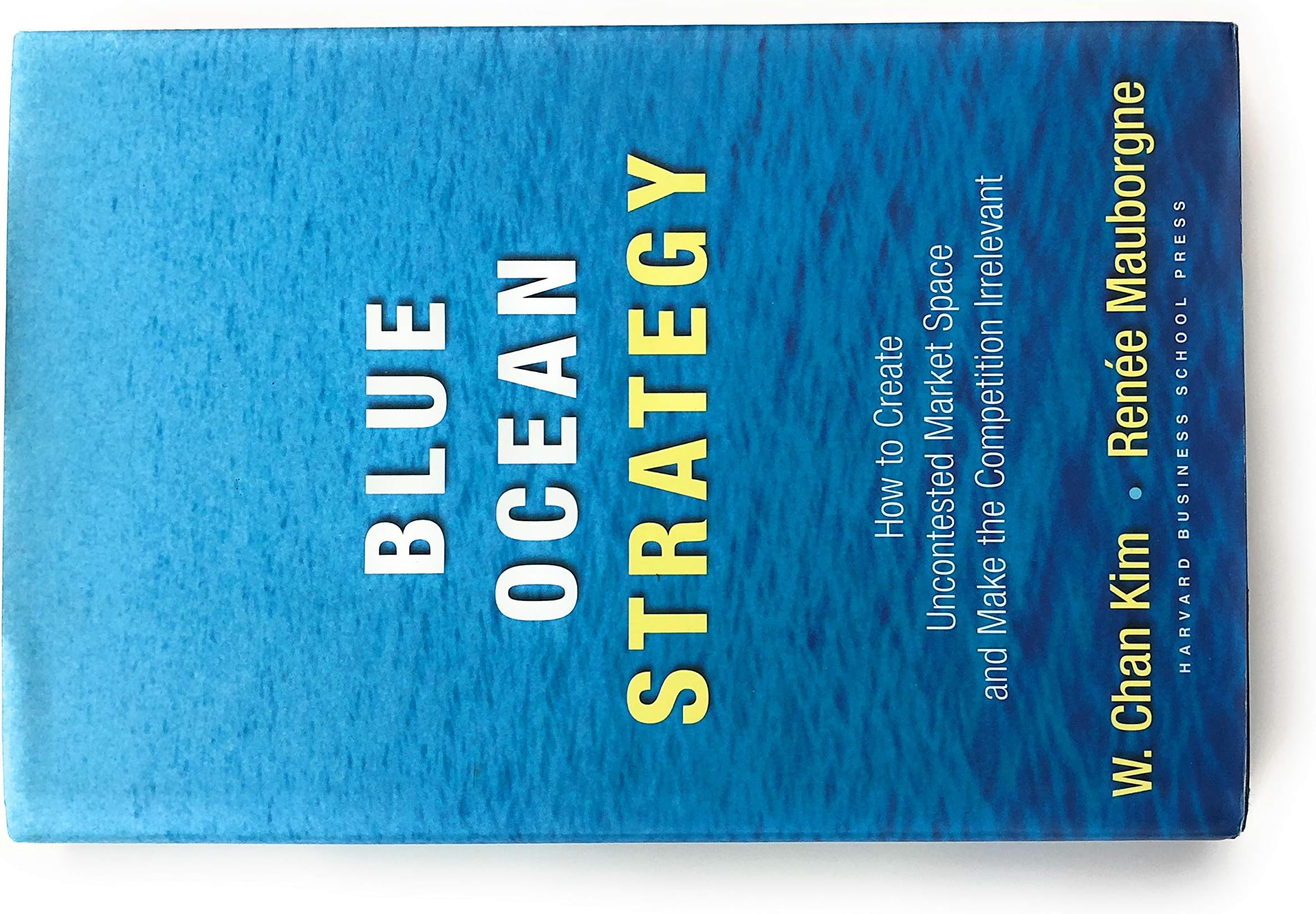


Blue Ocean Strategy: How to Create Uncontested Market Space and Make Competition Irrelevant Hardcover – February 3, 2005
Product ID: 1601332
Desertcart purchases this item on your behalf and handles shipping, customs, and support to KUWAIT.
Full description not available
T**L
Blue Ocean
BLUE OCEAN STRATEGY: Authors - W. Chan Kim and Renee Mauborgne, distinguished Fellows of INSEAD, "the business school for the world, which brings together people, cultures and ideas from around the world to change lives and to transform organizations" [...] Major article contributors to name a few, ie., the Harvard Business Review, Financial Times, Wall Street Journal and the New York Times, etc. Both founders of the Value Innovation Network (VIN) and Value Innovation Action Tank (VIAT) in Singapore. Summary - How do you create an uncontested market space and make the competition irrelevant? The content of this book is based on the authors believe that high growth and profits can be generated to produce new demand in uncontested and untapped market space, or "Blue Ocean" versus "Red Ocean" strategy, which the competitive rules are known and the industries market space boundaries are defined. Blue Ocean's proposed strategy is to differentiate between product/service and lower cost. This book provides career professionals with creative, insightful innovative ideas through consideration of utility placed on value, price and a cost affective strategy approach to gain uncontested market space. The impact of their strategies will enable a company to position themselves within new market space to sustain profit, growth and maneuver successfully through the worldwide sensitivities, competition and uncertainties affected by the factors and variables of a global economy. The authors provide proven cases, models strategies and examples which substantiate their approach. What five things gleaned from this book regarding the importance of Blue Ocean Strategies are: 1. Marketing leaders would be wise to consider the opportunities of redefining and reconstructing buyer value elements and innovation to create new forms of strategy leading to changes and discovery of recombination(s) and find new solutions to subsystem activities, to serve and reinforce an existing strategic position. 2. Companies would do well to capture the mass of target buyers from the outset and expand the size of the market by offering radically superior value benefits at price points accessible to them. 3. The focus of Blue Ocean Strategy does not restrict output at a high price but rather on creating new aggregate demand through a leap in buyer value at an accessible price. This creates a strong incentive, not only to reduce costs to the lowest possible level at the start but also to keep it that way over time to discourage potential free-riding imitators. 4. Firms with monopolistic positions often do not focus on efficiency and cost reduction and hence consume more scarce resources, consumer demand drops and prices artificially increase. The monopolistic practice, by consuming more of the society's resources, incurs dead weight loss for the society at large and achieved at the expense of consumers and society at large. 5. Learning to develop a Blue Ocean Strategy approach of non-rival and non-excludable goods, such as knowledge, ideas and entrepreneur ingenuity cannot be reproduced and have potential to increase growth. Concluding that Blue Ocean Strategy is based on a non-combative approach to a win-win break through in value achieved by innovation to create new forms of strategy leading to changes and discovery of recombination(s) and finding new solutions to subsystem activities, to serve and reinforce existing strategic position. Buyers win and society at large benefits from improved efficiency.
H**E
How to find, analyze, and develop new markets
I got to listen to Renée Mauborgne speak about "Blue Ocean Strategy." She was a very entertaining speaker and she made a number of interesting points. I tracked down the book and read it. I am glad I did. This book is the result of years of research into the history of business. One of the key questions the authors focus on is: "What makes a business profitable?" They came to the conclusion that companies which develop new markets can basically print money for the first five to ten years.A "Blue Ocean" represents an uncontested market, a product or service that only one company is selling. The authors show that historically this has been the most profitable situation to be in, as opposed to a market with lots of competitors, or a "Red Ocean." The authors found that most of the tools for developing strategies in business are focused on "Red Oceans." The authors found that most "Red Ocean" strategies take the current industry's structural conditions as a given. A "Blue Ocean Strategy" sees market boundaries and industry structures as flexible. This book was written to help people find new markets, analyze if the new market could be profitable, and then develops strategies for fully exploiting the new market.One of the key tools for finding new markets is what the authors call a "Strategy Canvas." The idea is to pick a set of key factors that current markets focus on, then on a scale from low to high put a point for where a market is for each factor, and then draw a line for a market. By looking at where there are no lines you may get some ideas for new markets.Once a new market is identified the authors help analyze if there is potential for making money. They have a set of ideas on how to look beyond the existing demand, more importantly they provide some tools and processes for the analysis just how big a new market might be.And once the decision is made to move into a new market, the authors have ideas on how to organize the business. They made the point that there is often a lot of reluctance to make changes and provide some ideas on how to get employees on board.In many ways developing a new market, or a "Blue Ocean," is a lot of work. And in the past it has been very risky. By using the ideas from "Blue Ocean Strategy" businesses will have a better chance of finding and developing profitable new markets. It will be interesting to see if there is a new emphasis by businesses to more systematically look for new markets, and where that leads us.This is going to be a classic. It is very readable, and worth rereading. The key insights and principles in the book are well explained, and supported by lots of examples. People will be reading it for the next twenty or more years. If you enjoy books about business, read this book. If you are looking for ways to expand or develop your business, read this book.
J**P
Very good book
Really enjoyed this
A**S
Mind blowing
A simple framework capable of direct how to think about new business opportunities. The authors put a straightforward strategy in how to evaluate the market and how to position the desired product in a way it enjoys little concurrency and sail free from competitors for a good time
O**T
Five starts
One of my favourite entrepreneurship books. Radically changed my approach to startups and innovation. I still think about the blue ocean mindset many years on from reading this title
W**R
Excellent !
Ce livre m'a ouvert les yeux sur la façon d'aborder le business. La recherche de perspectives de développement au delà de la compétition classique est très intéressante. Je pense relire ce livre plusieurs fois car il faut assimiler beaucoup de concept. Si vous recherchez un livre de business high level, c'est le bon. Ce livre est recommandé dans Shark Tank notamment et bien d'autres entrepreneurs qui ont rencontré beaucoup de succès dans leur carrière.
W**H
Das beste Strategiebuch seit der Jahrtausendwende
Das beste Strategiebuch seit der Jahrtausendwende. Kim und Maubourgne zeigen sehr anschaulich den Weg aus der alten Denke (den Wettbewerb besiegen) hin zur neuen Denke auf (unbearbeitetes Marktpotenzial zu erobern). Die Beispiele und die Methoden sind sehr instruktiv und helfen, die neue Denke auch im eigenen Unternehmen umzusetzen.Mark Walther, Walther Management GmbH
Trustpilot
4 days ago
2 months ago