Buy anything from 5,000+ international stores. One checkout price. No surprise fees. Join 2M+ shoppers on Desertcart.
Desertcart purchases this item on your behalf and handles shipping, customs, and support to KUWAIT.
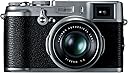
📷 Elevate your craft with the Fujifilm X100 — where vintage charm meets cutting-edge precision.
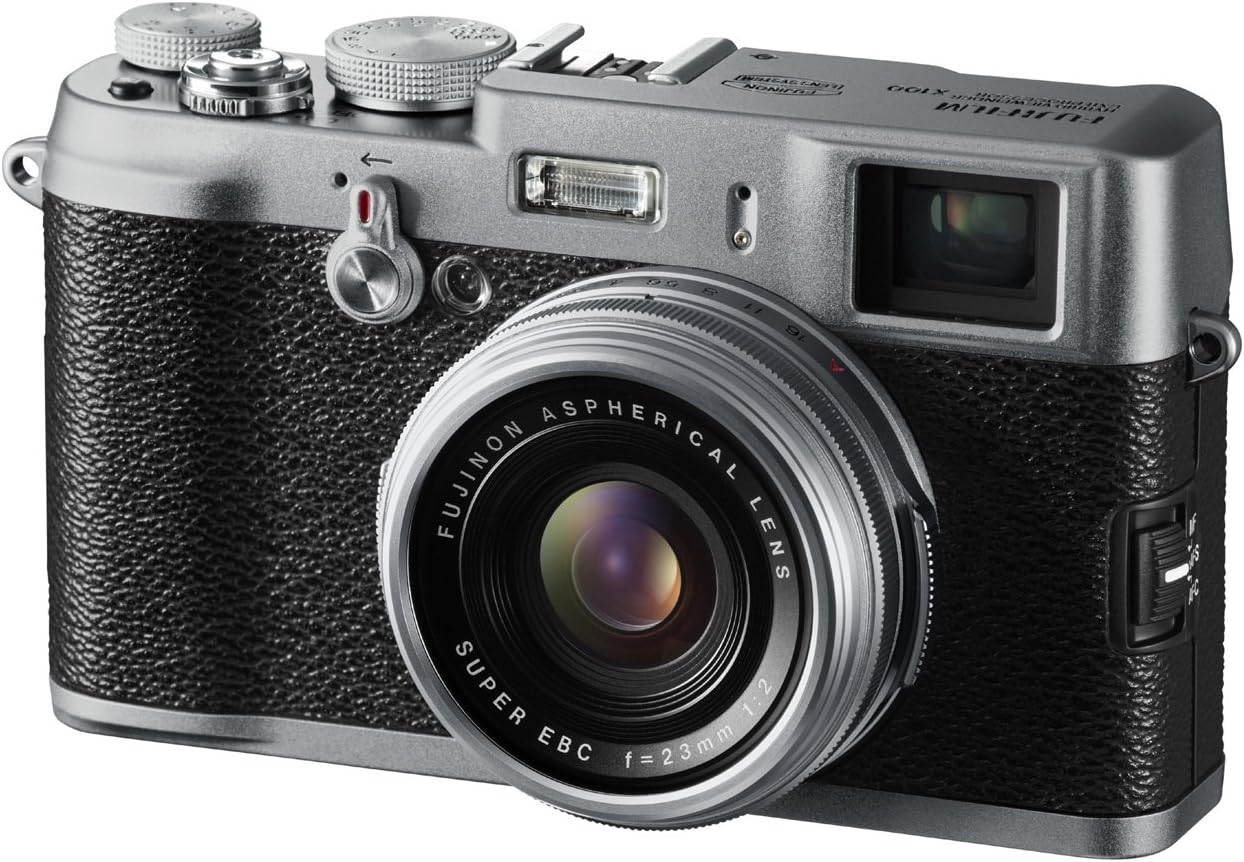
The Fujifilm X100 is a premium compact camera featuring a 12.3MP APS-C CMOS sensor paired with a fixed 23mm f/2 Fujinon lens. It uniquely combines an optical and electronic hybrid viewfinder, enabling versatile shooting styles. With a silent leaf shutter and built-in 3-stop ND filter, it excels in low-light and discreet photography. The 2.8-inch 460K-dot LCD and 720p HD video capture round out a sophisticated tool designed for discerning photographers who value image quality, portability, and classic design.
| ASIN | B0043RS864 |
| Age Range Description | Adult |
| Aperture modes | F2.0 |
| Are Batteries Included | Yes |
| Aspect Ratio | 1.78:1 |
| Auto Focus Technology | Continuous, Contrast Detection, Live View, Multi-area, Single |
| Autofocus | Yes |
| Autofocus Points | 49 |
| Best Sellers Rank | #213,807 in Electronics ( See Top 100 in Electronics ) #1,949 in Digital Point & Shoot Cameras |
| Bit Depth | 14 Bit |
| Brand | Fujifilm |
| Built-In Media | Battery, Battery Charger, Instruction Manual, Lens Cap, Shoulder Strap, USB Cable |
| Camera Flash | Hotshoe |
| Camera Lens | Fujinon 23mm F2 single focal lens |
| Color | Silver |
| Compatible Devices | Fujifilm X |
| Compatible Mountings | Fujifilm X |
| Connectivity Technology | HDMI, USB |
| Continuous Shooting | 5 |
| Customer Reviews | 3.7 out of 5 stars 213 Reviews |
| Digital Zoom | 4.00 |
| Digital-Still | Yes |
| Display Fixture Type | Fixed |
| Display Maximum Resolution | 460000 |
| Display Resolution Maximum | 460,000 |
| Display Type | LCD |
| Dots Per Screen | 460000 |
| Dynamic Stops | 10 Stops |
| Effective Still Resolution | 12.3 MP |
| Expanded ISO Minimum | 200 |
| Exposure Control | Aperture Priority |
| File Format | JPEG (Exif 2.3), RAW, RAW+JPEG, MOV |
| Flash Memory Bus Interface Type | UHS-I |
| Flash Memory Installed Size | 20 |
| Flash Memory Speed Class | C10 |
| Flash Memory Type | SD/SDHC/SDXC |
| Flash Memory Video Speed Class | 6 |
| Flash Modes | Auto, Auto/Red-Eye Reduction, Flash On w/ Red-Eye Reduction, Forced On, Off, Slow Sync, Slow Sync/Red-Eye Reduction |
| Flash Sync Speed | 1/200 or 1/250 |
| Focal Length Description | 23 Mm |
| Focus Features | Hybrid |
| Focus Mode | Manual Focus (MF), Single-Servo AF (AF-S) |
| Focus Type | Autofocus & Manual |
| Form Factor | Large sensor compact |
| Generation | 1 |
| Global Trade Identification Number | 00074101008357 |
| HDMI Type | Mini connector |
| Hardware Interface | HDMI, USB |
| Has Color Screen | Yes |
| Image Capture Type | Stills & Video |
| Image Stabilization | Digital, Hybrid, Optical |
| Image stabilization | Digital, Hybrid, Optical |
| Item Weight | 445 Grams |
| JPEG Quality Level | Basic, Fine, Normal |
| Lens Construction | 8 elements in 6 groups |
| Lens Correction Type | Fixed |
| Lens Type | fixed |
| Manufacturer | Fujifilm |
| Manufacturer Part Number | X100 |
| Maximum Aperture | 2 f |
| Maximum Focal Length | 35 Millimeters |
| Maximum Image Size | 12 MP |
| Maximum Shutter Speed | 1/4000 Seconds |
| Memory Storage Capacity | 20 MB |
| Metering Methods | Multi, Average, Spot |
| Minimum Focal Length | 35 Millimeters |
| Minimum Shutter Speed | 30 seconds |
| Model Name | Fujifilm X100 |
| Model Number | X100 |
| Model Series | X100 |
| Movie Mode | Yes |
| Night vision | No |
| Optical Zoom | 4 x |
| Photo Sensor Resolution | 12.3 MP |
| Photo Sensor Size | APS-C (23.6 x 15.8 mm) |
| Photo Sensor Technology | CMOS |
| Real Angle Of View | 56.8 Degrees |
| Recording Capacity | 13 Minutes |
| Remote Included | No |
| Screen Size | 2.8 Inches |
| Self Timer | 10 Seconds |
| Sensor Type | CMOS |
| Series Number | 100 |
| Shooting Modes | Scene |
| Skill Level | Amateur |
| Special Feature | Color TFT-LCD with 460k pixels; 100% coverage |
| Specific Uses For Product | Photography, Videography |
| Supported File Format | JPEG (Exif 2.3), RAW, RAW+JPEG, MOV |
| Supported Image Format | JPEG (Exif 2.3), RAW, RAW+JPEG, MOV |
| Total Still Resolution | 12.3 MP |
| Total USB 2.0 Ports | 1 |
| Total USB Ports | 1 |
| Total Video Out Ports | 1 |
| UPC | 074101008357 |
| Unit Count | 1.0 Count |
| Video Output | HDMI |
| Video Resolution | HD 720p |
| Viewfinder | Electronic, Optical |
| Viewfinder Magnification | 0.5x |
| White Balance Settings | Auto, Custom |
| Wireless Technology | Yes |
| Write Speed | 5 fps |
| Zoom | Optical Zoom, Digital Zoom |
L**O
A review of the X100 by a Nikon dSLR and m4/3 owner
I am writing this review from the perspective of someone who owns a Nikon full-frame dSLR (Nikon D700+MB-D10), two Nikon crop dSLR (Nikon D7000+MB-D11 and Nikon D3100) and an m4/3 camera (Panasonic GH2). I receive the Fujifilm X100 about 5 days ago and since then, I have been slowly learning the features and capabilities of this camera. I will be steadily adding to this review in the coming days but I thought I'd share here my initial impressions of the X100 to help those wondering whether to get this camera make their decision. Though I tried my hand at using small cameras that can shot RAW and provide full manual controls on aperture, shutter speed, ISO and White Balance (the Panasonic LX-3 and the Canon S90 being among these), I was never happy with the marginal photos that I could take with these cameras. This is mainly due to the small-sized camera sensor. Yet part of my dis-satisfaction with these cameras is also due to the shooting position where one extends one's arms to view and compose with the rear LCD screen rather than the viewfinder to the eye position when using a dSLR. After trying my hand with these cameras, I sold them but knew that my next small and light camera must have a large sensor and a proper viewfinder. My initial attempt to finally address this issue on poor image quality and sub-optimal shooting stance yet have a small and compact camera was my purchase of the Nikon D3100 which I paired with a Nikkor 35mm f/1.8G DX lens. Equipped with a good-sized sensor, a real optical view finder (OVF) and a very capable lens, this setup provided me with a compact, light, inexpensive and very capable camera setup. I was very happy with the setup and it provided me some relief from using the D700+MB-D10 or D7000+MB-D11 combo. Though I did install and use my other Nikkor lenses on the D3100, it was the Nikkor 35mm f/1.8G DX that was mounted on the D3100 easily 50% of the time. For the other times, it was mainly the Nikkor 24mm f/1.4G at 40% of the time and the Nikkor 17-55mm f/2.8 or the Tokina 11-16mm f/2.8 for the remaining 10%. I would have used the Nikkor 24mm f/1.4G far more often with the D3100 than the Nikkor 35mm f/1.8G DX but the large size and heavy weight of the Nikkor 24mm f/1.4G lens does not make for a light and well-balanced combo with the D3100. So as much as I would have preferred matching the D3100 with a 24mm focal length prime lens, the lighter weight and smaller size of the 35mm f/1.8G DX made it the default lens for the D3100. I also acquired a Panasonic GH2. Though equipped with a smaller m4/3 sensor, the GH2 acquits itself very well for video work and the 14-140mm lens provided good results when shooting outdoors or in good lighting conditions. But for still-photography, the GH2 with the 14-140mm lens is simply awful. For a while, I had the impression that the GH2 was very bad for still photos until I decided to buy an adapter and mounted my Nikkor prime lenses on the GH2. Wow .. what a difference mounting good lenses made on the quality of photos the GH2 can take. I found myself using the GH2 more and more often for still-photos even though I had to manually focus my Nikkor lenses. The GH2 was my first exposure to an electronic viewfinder (EVF) and despite its real limitations when working in sub-optimally lighted conditions, I appreciated the ability of the EVF of the GH2 to display information that an OVF could not display. I decided to add a Panasonic 20mm f/1.7 and 14mm f/2.5 lens and was happy with the resulting setup which was even more compact and lighter than my Nikon D3100 and 35mm f/1.8G DX lens. While the image quality of the Nikon D3100 was still better than the GH2, the smaller lighter size of the GH2 and its excellent video capabilities made it my choice for many situations. Then came the Fujifilm X100. Combining the small compact size of the GH2 and its compact prime lenses plus incorporating the advantages of both the optical viewfinder of the D3100 and the electronic viewfinder of the GH2, I became seriously interested in the X100. The fact that the lens was not interchangeable was not an issue for me as the X100 lens is a 23mm f/2.0 - the perfect focal length as far as I was concerned. The 35mm equivalent of 35mm would have been my favorite focal length with the D3100 and the GH2 but neither Nikon nor Panasonic makes a compact and light prime lens that has a fast 35mm in 35mm equivalent (Olympus makes a m4/3 17mm but it is just f/2.8). That the X100 lens was also a fast f/2.0 lens was definitely an ace in favor of the X100. While cleaning the sensor of my D700, I realized another reason why the non-interchangeable lens nature of the X100 was a non-issue. With a non-removable lens, the X100 will likely not need any sensor cleaning at all, I happily realized. Yes! Viewed sideways, the X100 was considerably smaller and thinner than the D3100 with the 35mm f/1.8GDX lens and still substantially thinner than the GH2 with the 20mm f/1.7 lens. The X100 wins against the two others on this point. Based on my initial test, the image quality of the X100 is excellent and can easily hold its own against the Nikkor D3100 with the 35mm f/1.8G DX lens. This is quite an achievement as the Nikon-Nikkor combo is superb. While the X100 is a bit soft when shot wide-open at f/2.0 compared with the Nikkor D3100 shooting the 35mm f/1.8G DX at f/2.0, I like the way the X100 renders the image which is very pleasing and of a different character than the clinical images I could take with the Nikon D3100 and the 35mm f/1.8G DX lens. Testing both at f/2.8, f/4.0, f/5.6 and f/8.0 yielded even better results with the X100 while the Nikkor D3100 with the 35mm f/1.8G DX stayed very good as well (it was really good wide-open to begin with anyway). In terms of image quality, I would rank these two at about equal. What for me tilts the balance in favor of the X100 is the focal length of its lens - 23mm vs the 35mm of the Nikkor. So while the image quality for both are neck-to-neck, I much prefer the X100 because of its lens' focal length. The GH2 ranks lower than the X100 and D3100 in image quality and with the X100 being thinner and having both OVF and EVF and with my preferred focal length lens, the X100 is now my first choice for a small and light compact camera. CONTINUATION - April 12, 2011 In many respects, while there are similarities among the D3100, GH2 and the Fujifilm X100, each is unique and each serves a specific purpose better than the other. The primary advantage of the D3100 is that it packs a lot of capabilities and flexibility for its size. These advantages however are lost when one installs a zoom lens on the D3100 as the resulting bulk and weight no longer qualifies it as a light and compact camera. Until such time that Nikon releases several compact and light prime AF-S lenses that will auto-focus on the D3100, the D3100 steps out of the light-and-compact auto-focusing camera competition when equipped with other than the Nikkor 35mm f/1.8G DX. For video work, the GH2 remains the best tool for the job, with the D3100 and the X100 a far second and third. In addition to a far superior video capabilities, the GH2 has a electronic zoom that essentially gives the user a 2nd lens when using the pancake prime lens. Very impressively, this electronic zoom (or "ETC" in Panasonic parlance) can be used without any significant or visible degradation in the captured video and provides the GH2 a flexibility that other manufacturers would do well to emulate. The availability of several good light and very compact interchangeable pancake prime lenses adds further to the attraction of the GH2 as a video camera - as well as a still photography camera. This makes the GH2 a better tool for those who want to capture still photos and videos at the same time. The only disadvantage that I see to the GH2 is its low-light performance which is best described as adequate but not exceptional. This is partly due to its smaller sensor and higher pixel density. While using fast primes such as the 20mm f/1.7 can often delay the onset of having have to use higher ISO, the GH2 would truly be exceptional if it had better low-light performance and will likely be the toughest hombre to beat among the three. The Fujifilm X100 as a still camera is excellent for a select group of photographers who are not limited by the fixed-lens as its performance as a still camera is nothing short of excellent. In terms of low-light performance, the Fujifilm X100 outclasses the D3100 when shooting at ISO 3200 and even more so at ISO 6400 where the X100 still yields very good images. Combine with the f/2.0 lens, the X100 users will likely have minimal need of bringing an external flash. For a narrower select group of photographers who are not hobbled by the fixed lens, the Fujifilm X100 is one of the most exciting camera in the market. CONTINUATION April 15, 2011 Fujifilm's decision to equip the X100 with a fixed non-interchangeable lens has allowed it to make the camera and lens smaller, and to add several features unique to the X100. This setup dispense with the need to use a focal plane shutter so unlike a dSLR where the shutter is found in the body, the shutter of the X100 is found in its lens. The combination of a quiet leaf shutter on the lens and the absence of a mirror-slapping noise means that it is possible for me to shoot the X100 very discretely even in a quiet room. Even continuous shooting with the X100 generates little noise. The shutter sound of the X100 shooting continuously is unobtrusive unlike the loud staccato clatter of the dSLR. Another feature the fixed lens arrangement allowed is for Fujifilm to install a built-in 3-stops neutral density filter in the X100. I wished this was button activated but its fairly easy to access it from the menu. Once activated, I have a choice of either using a slower shutter speed or to shoot with the aperture wide-open. The X100 can simulate several colored, B&W and sepia films. The colored setting are named after the Fuji Films. The standard setting is Provia. For landscape (and sometimes even for people), I like using the Velvia for its rich saturated look. Though one can choose the Vivid on the Nikon D3100, I find the Velvia look on the X100 more pleasing, specially when viewed on the computer. The Astia is intended for use with soft-tone palette and yields a less-saturated look. So I took several solo and group shots in the diffused light in the late afternoon with everyone wearing light pastel and earthy colors. The Astia setting yielded a dreamy old film look which I find very pleasing. The shutter is adjusted using a dedicated top knob beside the shutter release button while the aperture is adjusted using the aperture ring on the lens. The controls work very well though the adjustment is always in increments of one stop. This is one area where the dSLR may provide greater flexibility in that it allows the easy adjustment in increment of 1/3 of 1/2 stop. It is possible to adjust the aperture and shutter speed of the X100 in 1/3 increments but it takes a whole lot longer to do this with the X100. It is by far faster to just adjust the exposure compensation when one is shooting in aperture priority mode. Because of the greater effort, I simply adopted and made my exposure adjustment (shutter speed and aperture) in one-stop increment adjustments. CONTINUATION April 17, 2011 As someone who cleans his camera after every use upon getting home, one of the things I appreciate about the X100 was that it was designed for photographers who have a nose. =) As a right-eyed focusing photographer, I can avoid the noise hitting and smearing the rear LCD screen of the X100 whenever I bring it to the eye to look through the viewfinder. Instead of my nose hitting the rear LCD screen whenever I do this, I am doubly pleased that this no longer happens and that cleaning the camera before putting it away is a bit easier and faster at the end of the day. While video is limited to 720p, it is nonetheless quite good. The advantage of the X100 having an electronic viewfinder (EVF) becomes evident when one uses it for video. With the EVF, one can take video while keeping the X100 to one's eye and this makes for a more natural and steady shooting position just like with still photography. This is similar to the Panasonic GH2 which also has an EVF but in contrast to the Nikon D3100 where the arms would be outstretched in a point and shoot position while using the rear LCD screen take the video. The Fujifilm X100 can autofocus on video and its pretty fast. The Panasonic GH2 autofocuses on video faster still but the X100 is much faster than the Nikon D3100 on video. Some have complained about power-up lag. First off, the type of SD card you use will make a substantial impact on power-up. A slow SD card can slow down the X100 from power-up to ready-to-use state. Using a fast SD card will help. Assuming that one is using an SD card, power up lag will depend on which viewfinder you are using. If you are using the electronic viewfinder, power lag is about 2 seconds. If you are using the optical viewfinder, the power lag is just a little bit above 1 second. In both instances, unless you have the viewfinder to your eyes and ready to shoot, the power lag does not make much of a difference as you still need to bring the camera up to your eyes upon power up, then need some time to compose, check exposure then shoot. While a dSLR like the D70 is almost instantaneous and is faster, it really will not make much of a difference for 99% of the time. UPDATE: June 12, 2011 After taking hundreds of photos with this camera, I fully appreciate the solid and sturdy feel this camera imparts whenever one uses it. As such, it imparts a certain sense of confidence and satisfaction in being able to take good photos in a measured and deliberate manner. Never designed for sports speed shooting nor for the urgency of events or wedding photographers, the X100 is best used when one can take his time to frame and compose before taking the photo. I can also categorically say that in terms of image quality, the X100 camera can hold its own against some of the best APS-C-sized sensored dSLRs in the market such as the Nikon D7000 for the type of shooting that the X100 was designed for. The black and white setting of the X100 can be quite intoxicating. The 3 "film" settings of the X100 (Astia, Provia and Velvia) is superb. What has also become clear is the value of the silent shutter of the X100. Several times, I have had to take photos inside a very quiet church. The few shots I took with the Nikon FX D700 sounded like gunshots inside a very quiet church and even the considerably softer and quieter Nikon DX D7000 still sounded loud. I could not continue without causing a major disturbance. The X100 came to the rescue and allowed me to continue taking photos quietly and unobtrusively. What has also become of great help is the ability to see the aperture, shutter and exposure compensation settings of the X100 in one glance without needing to view these through the viewfinder. This has been helpful when shooting from the hip again to avoid disturbing the very quiet and solemn atmosphere in a church. Going on to regular shooting, the electronic viewfinder (EVF) of the X100 allows me to shoot a photo and to review it immediately in the same EVF without need to put down the camera to view the image I just took through the rear LCD screen. I do not know of any camera that can do this ... not even the GH2 which also has an EVF. The EVF makes eye-on-camera video shooting very easy. While limited to 720p with very limited control on the settings, the X100 nonetheless can take very good video even in low light due to its clean images at high ISO. On the other hand, using the optical viewfinder (OVF) of this rangefinder-type camera, I can see a greater area than what the lens cover and this gives me the advantage of better and greater situational awareness that allows me to better compose or anticipate the different elements that I would like to converge in my photos. With the dSLR, I have to keep both eyes open to do this but it is neither easy nor convenient. The OVF of the X100 make it a cinch to do this. I should however mention 2 negatives both of which do not go directly into the performance of the X100. The first is the plastic adapter that comes with the battery charger. The battery charger is designed for another battery and an adapter is needed to charge the battery used with the X100. Though this adapter is also supplied with the charger, it is easily dislodged and as a result, could easily be lost making recharging a real challenge. The second negative is how Fuji has chosen not to design the lens so it can take on a filter (49mm) and also failed to include a hood with the camera. One needs to buy an expensive adapter that would allow the mounting of a filter on the X100. Considering that the lens is fixed, scratching the lens can quickly ruin anybody's day. Still on this, Fuji has also chosen not to include a hood with the lens. Like the filter adapter, this is again an expensive accessory. The hood is essential when shooting outdoors in bright sunlit conditions as well as indoors in harsh lighting conditions. Fuji may make a handsome profit when an X100 owner buys these but it leaves a bad taste in the mouth when one has to pay so much for something that should not cost much for Fuji to make and which it should have included with the camera as these are essential items. While at it, there are a couple of nitpicks that one can make against the X100 (e.g., difficulty and tediousness of taking multiple shots using a timer) so some of the complaints made against the X100 firmware is justified. Fuji has already released a firmware upgrade and is expected to release a 2nd sometime soon. This gives me confidence that many of the nitpicks will eventually be addressed. And as these minor irritants does not detract from the X100 being a good camera for what is was designed for, I have decided to keep the 5-stars rating for this camera. Finally, I can understand the frustration expressed by some who have reviewed the X100 when they treat and use the X100 as a substitute for their dSLRs. Having read this review this far, you will perhaps better understand their missives against the X100. The X100 has been designed for use in a specific niche and it excels within this specialized area. Outside this area, there are far better camera models out there that would surpass the X100 in size, weight, price, performance, flexibility, or the various combination of these. A better understanding of the capabilities and design of the X100 will help in avoiding the pitfalls that some have fallen into when they use the X100 as a dSLR substitute. I own an X100 but use my dSLR when I need a dSLR.
E**E
Quick Review
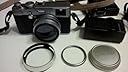
Just opened up the box like 30 minutes ago. First impression, very easy to use. Makes me happy when I hold it in my hands. It's slightly smaller and lighter than the Nikon FE. Design wise, it's sweet. I am pretty happy with low light pics up to 2500 iso at F2. Tried to manual focus, but, when using the focus ring, nothing happens at first. Switched on the EVF, then you can see the manual focusing working. Forgot it's not a SLR, so you have to use EVF when manual focusing. Also, manual focusing is a pain on the X100. You turn and turn the dial, and the focus field changes either very slowly or very abruptly. The manual focusing is not mechanical like on a SLR lens body but is electronic. I wouldn't the camera in manual focus mode unless I have to. Shutter speed is on a dial and is self pretty explanatory. I think my Nikon D90 has more speeds though. Aperture dial is on the lens. It's easy to turn as long as you are using the knurled protruding portion. ISO is pre-programmed on the function button. Just press the function button and use the arrow button to go up or down on the menu screen or in the EVF. One dislike is the positioning of the battery and SD card door. It's right next to the hole where you screw in the tripod head release plate. So, each time I need to access that door, I need to remove the release plate. Another dislike is I tried to plug in a mini USB to try to access the card without accessing the battery door. I couldn't plug the minu USB cord in. The input connection is slightly smaller. Stupid USB port is proprietary. Maybe there is an ultra mini USB connection standard that I don't know about? I have the Fuji MX700. It's an ancient model from like 1996 if I remember correctly. I haven't used it in quite awhile, but I remember the menu and general GUI to be very similar to the Fuji X100. My camera came with the latest 1.11 firmware installed. 12/29/2011 Update: I've purchased a few accessories for the X100. First, I received Gariz half case. Second, I received a 49mm B+W circular polarizer filter as well as Rainbow Imaging's filter adapter and hood. The Gariz case has a bottom plate that works as an adapter. It screws into the X100's bottom and has another tripod screw-in about 1" away from the battery door. So, now I can access the battery door without removing the quick release plate. And, I find the X100's color to be a bit flat. The circular polarizer solves this problem. Images with the filter on are a tad cooler but colors are much more lively and details are a bit more distinct. Been using the X100 with Manfrotto 484 tripod head w/ release plate, 680B monopod and 678 monopod folding base. The monopod with folding base is great for long exposure shots especially with the X100 since it is not nearly as heavy as a DSLR. Portability is awesome compared to DSLR plus full tripod.
R**N
This is a camera you may want to keep FOREVER
I wasn't going to write a review on this X100 as it has been reviewed so many times already so what can I really add? I just don't understand some of the 1, 2, 3 star reviews here. Yes as said a million times here the X100 is rather quirky. But at the end of the day, when you stop PLAYING with your camera twiddling dials, this Fuji will give you pictures that will simply blow you away they are so good. I am not a pro photographer but a big time lover of photography and I admit to being a bit of a gear head. I presently own a Pentax K-5, Just sold my Nikon D-7000, have a Nex5N and...well I'll stop there. I mention those cameras because out of all of them at the end of the day...NOTHING comes close to my X100 in final output..as to IQ, "color accuracy," !!!! HIGH ISO performance...just picture after picture where I say WOW. This X100 stands alone for high ISO low noise it's simply incredible! ISO 2000 has lower noise than my D7000 and K5 had at ISO 1250. One reason I am writing this review is I get more IN focus pics from this X100 than the D7000 or K-5. Yes the X100 is not going to be your camera for really fast action like sports I admit that. But for portraits, landscapes..things that don't move 100 miles an hour..this X100 is in it's own league. For the most part skin tones are INCREDIBLY accurate and beautiful on this camera. It's so dead on it's almost scary. My Pentax K-5 has to be tweaked after every picture YET it's one of the highest rated DSLRS out there but it can't compete with the X100 on color.NOT EVEN CLOSE! Again as to focus do people realize this "x100 has a VERY useful DISTANCE SCALE?" If you look at it you almost have to get IN focus pictures. In other words, if your subject is about 5 feet away, but the scale reads about 15 feet you already know the x100 is focusing PAST your subject. This little tool alone will save you from out of focus shots. My wife was trying to put my x100 safely away while on our kitchen table into a VERY small camera bag I had just bought for it. Long story short my first x100 missed the camera bag fell 3 feet onto a hard tile floor BOUNCED..landed like a brick. Only damage was a slightly dented lens cap. The camera was still perfect!! Again with my wife (she's dangerous with cameras :) ) she borrowed it to shoot some stuff in our backyard. She got startled by a bee and dropped the poor Fuji right on it's lens onto the grass..big thump. Again...after a cold sweat..I checked it out it's still perfect.WOW! Point being this thing is built like a tank it's so high quality. Knowing it had two major falls it bothered me. I gave it to another family member as a gift and it's still perfect. I bought a second one..well it's perfect and I'll be keeping my wife away from this one. :) I'm off track, my point was it's build quality puts in in a class of it's own just amazing QUALITY and craftsmanship. One con that has been discussed is the manual focus..yeah it's not really that great..well it's bad. But I just don't use manual focus much and frankly I like the auto-focus because all my shots come out....well FOCUSED and sharp..maybe I'm a lucky one here? As to the menu I hear people bashing...I don't get it, it's so easy to navigate..what's the problem??? The long story short if you can live with a few quirks this camera can BLOW YOU AWAY with it's pictures. At the end of the day when all you want are GREAT pictures..this Fuji is the camera to get!!! Yes it's got a fixed lens..it can also zoom.?,you use your feet, walk forward..BRILLIANT! I am never going to sell my x100 it's a lifetime keeper at least for me..SUPER recommended!
F**U
Fuji should have recalled X100 for sticky aperture issue.
I bought this fujifilm x100 new from Amazon.com and it just had sticky aperture issue after three weeks of minor use. Also mine had color balance problem but that is another story. After I searched online, I found numerous reports about the SAME sticky aperture issue. So far Fujifilm never says a word about this issue. Fujifilm charges $660 for repairing the aperture/lens after limited warranty expires. This is too bad!!! Fujifilm should have recalled all X100 and repair them for free (even outside warranty). Since Fujifilm is not doing anything, we should boycott all future fujifilm digital products(such as X-Pro-1) and file a class action against Fujifilm. Shame on FUJI!!! BTW, besides all these troubles, x100 takes excellent pictures when it is not broken.
G**P
So close...
I really wanted to love this camera. Instead I'm left a little disappointed. First the good: the quality of the sensor is top-notch. Images at 1600 look fantastic and 3200 is very good. That, combined with the sharp, wide, fast lens should make it a great indoor shooter. The top controls and aperture ring are great. Exactly what I was expecting. But the x100 is let down by its focus. The auto focus in low light simply isn't good. Now, it's not awful, but it's not as good as other cameras (i.e. budget SLRs) in this price range. I know it's phase detection vs contrast issue. But I don't care by what method the thing focuses, I just want it to be faster and more accurate. However, the auto focus, even though it's not great, is leaps and bounds better than the manual focus. Simply put, the x100's manual focus is pathetic. I can't imagine it ever being useful. It's slow. Even with the 1.1 firmware it's super slow. I understand it's fly by wire, but that doesn't explain it's glacial speed. I could go on and on about the terrible manual focus - it's that bad. Also, I really don't care that much about the hybrid viewfinder. I leave it on optical the vast majority of the time. I dislike EVFs. Supposedly that x100s EVF is better than most, but I wouldn't know. The only time it'd be useful is for manual focus and we all know how I feel about that. You pretty much have to use the EVF and manual focus for macro. Personally, I think I'd just take a step back and hope I have enough detail to crop in post. The parallax issues are more of an issue than I thought they'd be. I'd never used a camera with an offset viewfinder before. Before I received my x100, I thought people online were needlessly complaining. It's definitely something to be aware of if you're shooting within a two or three feet. What you're focusing on may not be what you're truly focusing on. And your image will definitely shift from what you had framed. I don't think this is an issue with the x100 per se, just offset viewfinders in general. Minor complaints: The write speed is a little pokey. Even with a fast, 45 MB/s UHS-1 card be prepared to wait a good 5 seconds or more for the burst buffer to clear. The black, textured plastic isn't nearly as sumptuous as I thought it would be. It's just hard black plastic. If this camera had been $800, even with all the flaws I would have given it four stars. But for $1200 I expect a manual focus that is usable. For the x200, if Fuji fixes the manual focus, preferably a direct mechanical dial, and switches to phase detection for the auto focus, it would definitely be a five star camera.
C**Y
If You Buy It, Download and Use Ken Rockwell's Users Guide
I just purchased this camera last week, and it arrived a couple of days ago. I've hardly used it yet, but I love it. It's one of those objects that is so perfectly sized and designed that it's fun just to pick it up and take a look through the viewfinder. And as a bonus, it does indeed take excellent photos. Like most products like this from the Pacific Rim countries, the owner's manual is considerably less than logically laid out and useful. Some reviewers have termed the camera's menu terminology quirky, and it is a little, but no big deal. If you purchase the X100, or if you already have, I strongly, strongly recommend you visit Ken Rockwell's web site at [...] and click your way to his X100 users guide. He leads you completely through the setup and shooting menus, at each stop explaining the options and the one that he prefers. I differed with him on only one of his choices, and by the time I had gone through this process, the camera was ready to go, and I came away with a pretty good understanding of its controls and functions. Since writing this review, I've had a chance to use the camera, and am just as pleased with it as I had expected. In that regard, it's interesting to me that, while this camera markets naturally to what I would consider a fairly narrow spectrum...professional to advanced ametuers who choose the X100 as a "fun" camera to carry in given situations as an alternative to a pro-line DSLR...it sure is tough to get hold of one. Before ordering the camera from Amazon, I had previously tried to buy one on a trip to New York when my wife had damged her Coolpix in a non-serious stumble. My first thought was to pick up an X100 and give her my own point-and-shoot. Guess what? As near as I could ever find, the only Fujifilm for sale in Manhattan was in a camera store in the Murray Hill neighborhood, where the shop keeper absolutely refused to sell it other than in a kit, with a card, an extra battery, auxilliary lenses and a selection of other schlock stuff I didn't want or need. Hopefully, he still has it! The attractive things about the cmera, to me at least, are that it takes excellent photos, but you can make it as easy or as complex to use as you see fit. I find that I actually like the fixed focal length lens. When I want to take a picture, I just lift the camera, compose, and shoot it. It's easy enough in Photoshop to crop it to nicely frame the center of interest. No sweat. I'd say that if you are looking at the X100 as your only camera, you might want to consider something with more features, such as the new Nikon 1, which I just bought for my aforementioned wife, who loves it. But if you fall in that category of somebody looking for a nifty and retro looking, but high performing, camera to carry around with you when visiting, say, an exciting city, this is it. Go for it!
N**T
You Broke My Heart, Fuji!
Beautiful compact body. Large APS-C sized sensor with outstanding low-light performance and class-leading DxOMark score. Fast f2.0 lens from top-tier lens manufacturer. Innovative optical/electronic view finder. Favorable initial reviews from trusted sources like Luminous Landscape. Could this be the perfect carry-everywhere camera? I could not resist any longer and was fortunate enough to get one from the first batch of Amazon orders. WOOO HOOO!!!!! The camera arrived last week and since it arrived I have been taking pictures with it every day in all the situations where I wouldn't normally bring my GH1 or D3S . Inside and outside. Bright light and low light. People and things. Pictures of friends and family at home, out-and-about, on nature walks, in restaurants, at school. Pictures of food served in restaurants. Pictures of my children's classmates in the classroom and on the playground. Pictures of flowers and bugs and plants. And each picture I took dragged me kicking and screaming and ultimately crying to the unavoidable conclusion that this camera is fatally and tragically flawed. Like the hero of a Greek tragedy, the Fujifilm X100 has the most promising of attributes, each with a fatal flaw, and the outcome is photographic tragedy. This camera has delivered more out-of-focus shots than I have ever experienced in my three decades of photography. Of more than five hundred pictures that I've taken with the X100 in the past week, less than 50 are in focus and only a handful are keepers. With firmware 1.01, the X100 can only reliably take good pictures of stationary well-lit subjects, like static scenes or posed people. Let's start with the innovative optical viewfinder (OVF). It has a white rectangle in the middle that turns green when the camera acquires focus. But the OVF doesn't tell you what part of the scene is in focus and it most definitely is not that white rectangle in the middle. (This is partially mitigated by the 2011/06/24 firmware update.) My only consistent success with the OVF is with static scenes entirely contained in the chosen depth of field, like pictures of a wall. If you want to know what part of the scene is in focus, you must use the electronic viewfinder (EVF). But the EVF has a perceptable lag so you can't use it to time your shutter. And even worse, when you initiate auto-focus, the EVF is momentarily frozen and by the time it unfreezes and you can see your subjects to be in focus and properly framed, your subjects may have moved on, so when you release the shutter you end up with another out-of-focus shot. My only consistent success with the EVF is with static or posed subjects, like the ones that appeared in the Luminous Landscape and Steve Huff reviews. Don't believe me? Check the X100 image samples on dpreview -- there are only two pictures with non-static subjects (DSCF0345, two girls on a rocking horse, DSCF0422 couple hugging), and they're both out-of-focus. I didn't count DSCF0426 (woman in front of mosaic) even though the woman was out-of-focus because the mosaic was the subject. Second consider the fast f2.0 Fuji lens that I have coveted since the X100 was announced at Photokina 2010. It lacks optical image stabilization (OIS). So if you're shooting handheld, you have to keep the shutter above 1/60 or better still 1/125 to avoid handheld motion blur. Its soft at f2.0. So if you want a sharp image, you're going to have to stop down to f2.8 or better yet f4.0. And now you're looking a camera that's not so great at low light anymore unless you stick it on a tripod and what's the point of a compact camera that must be mounted on a tripod? Third the auto-focus. It only works well for subjects that are well front-lit. As the light decreases or moves behind the subject, the X100 quickly gets to the point where it can't auto-focus at all even with the very intrusive AF assist light. "No problem," I thought, "I'll switch to manual focus and use this beautiful focus ring on the front of the camera". But that focus ring is only tenuously connected to the camera's focus point, and the connection is 100% electronic. You can turn the focus ring 10 times in the same direction and still the focus will only have changed a tiny bit. Even something so basic as using the ring to move the focus to the closest focus point (4") or the farthest focus point (infinity) is 100% unpredictable and 100% annoying. So if you want to acquire accurate focus, you have to use the auto-focus with the EVF, a wide f-stop, and the scene better be well front-lit or the auto-focus will hunt hunt hunt and never acquire focus. Fourth the camera's controls. The X100 has dedicated controls for aperture, shutter speed, and exposure compensation. As expected, you change those settings whenever you want and they take effect immediately (provided you don't switch between automatic and manual modes). The X100 also has a dedicated ring for manual focus and dedicated buttons for metering, auto-focus point position, changing OVF/EVF/LCD, macro mode, flash, white balance, shooting mode (aka "drive"), menu, and a custom function button that can be set to the ND filter or ISO (among others). Unfortunately you cannot use any of those controls or change any of those settings while the camera is recording an image. With a premium 30MB/s Sandisk Extreme SDHC card, the X100 takes between 7 and 10 seconds to record a single RAW+JPG image and 30 seconds to record a burst. During that time, you can't switch between the OVF/EVF/LCD, change the metering mode, move the auto-focus point, manually set the focus, turn the ND filter on or off, change the ISO, or turn the flash on or off. Nor can you switch between auto-aperture and manual aperture, or between auto-shutter and manual shutter while the camera is saving an image. That's right, after every picture the X100 controls are frozen for 7-30 seconds, including the manual focus ring. It's so difficult to believe, so out of the range of thinkable thought, that few reviewers have noticed it. It's annoying if you're shooting a static scene, but the scene isn't changing so you can just wait until the red light stops blinking and then change your settings. But if you're recording a dynamic scene, it's intolerable. That's the synopsis of Greek tragedy that is the Fuji Finepix X100. All the desirable attributes of a camera in a camera that can only consistently take good pictures of well front-lit static or scripted scenes. Over the past week, I grew to appreciate my Nikon D3s even more by way of contrast with the X100. I realized that my D3s is big and heavy but it is the ultimate clutch camera. No matter what the photographic situation, I am sure to walk away with some outstanding shots from the D3s. The Fuji X100 is the exact opposite - in most photographic situations, I am likely to walk away with no good shots at all. The Fuji X100 is the ultimate choke camera. There are some other problems with the camera that I would gladly overlook if the camera could take more in focus pictures. But I'll include them anyway in case you wouldn't be able to overlook them. The camera is uncomfortable to shoot one-handed. It's significantly heavier than a LX3 or GH1 w/ 20mm f1.7 . It doesn't have a grip and the front is covered with slippery plastic material so that when shooting one-handed you have to support it from the bottom with your pinkie, which quickly becomes uncomfortable. Even my monster D3s with the 24-70mm f2.8 zoom is more comfortable to shoot one-handed than the X100. There's one customizable "function" button but no dedicated button for ISO, the ND filter, for burst mode, or to take a movie. I set it to the ND filter, which means I have to trust to the (mostly good) auto ISO setting. The 720p24 movies that the X100 takes are good, although they are often out-of-focus and the camera is very slow to reacquire focus. If I had to take a movie, I'd pick my GH1 and TM700 far ahead of my LX3, D3s, or X100. Next on the list (and far down) I would probably pick the D3s with manual focusing even though I dislike manual focusing - at least I could choose an appropriate lens for the situation and there's always hope that the movie would be in focus and if not I could only blame myself. The LX3 movies are always in focus but the colors are faded and grainy even in bright light so I would more likely take a chance on the X100 than enduring the LX3 movies. The X100 can capture more detail in a static well-lit scene than the Nikon D3s does with a similar number of pixels. The colors in the RAW files are chalky and the greens in the RAW files are very brown. Not sure how this affects the JPEG conversion since my favorite RAW program (DxO) doesn't yet support the Fuji X100. The menus aren't any better or worse than the menus from Panasonic, Canon, or Nikon. The lack of "menu resume" is annoying. The on-camera flash is excellent. Somehow Fuji has programmed the on-camera flash to emit just the right amount of flash to improve the picture. It's the only camera I have with a built-in flash where direct flash pictures can often look better than non-flash pictures. To save batteries, I turn off image review, turn on "OVF power save mode", and reduce the LCD intensity, so I haven't yet had a problem with battery life. I appreciate that Fuji decided to use one of their standard batteries and chargers instead of making a new battery size for every camera like Panasonic does to my great annoyance. Ultimately, the Fuji Finepix X100 is a very limited use camera. It can't replace an LX3, GH1, D7000, or D3s. In perfect conditions it is capable of taking better images than any of those cameras, but in real world use it is unlikely to do so. You broke my heart, Fuji. **Update 2011/06/24** On June 24, 2011, Fujifilm provided a firmware update 1.10 that claims to fix an astounding twenty two defects in the camera. Most of the repaired defects were related to inconsistencies in the user interface. The 1.10 firmware also adds a "Corrected AF Frame" feature that appears to improve the operation of the OVF. According to the updated X100 user manual (p.87), "A second focus frame for focus distances of about 80cm will be added to the display in the optical viewfinder. The focus frame for the current focus distance is displayed in green when the shutter button is pressed halfway." I no longer have an X100 to test, but it sounds like the corrected AF frame gives a better idea of what the camera is focusing on when using the OVF.
D**C
A serious camera for a serious hobbyist or pro.
It's been a couple of months since i got the Fuji X100. I usually use a nikon D300s DSLR and i was looking to drop some pounds from the camera body i use without losing the image quality. First things first, this camera DOES NOT replace a DSLR and shouldn't be compared to it. If you shoot sport, running kids or pets this camera is not for you and you don't need to read any further. If you're looking to have a superb image quality for your portraits, street photos, travel photography, landscapes, and low light photography; than this may be what you've been looking for. Pros: discreet, super light, solid built, A very silent shutter sound, great optics (the f/2 Fujinon is superb), elegant, not cheap but affordable, excellent image quality (same sensor size as the CMOS sensor on non-full frame SLR!!!!) A pleasure to work with (the shutter speed button , the aperture slider, ....) A SUPERB Electrical View Finder (EVF)that is the FIRST OF ITS KIND IN THE WORLD, you can alternate between the EVF and an elegant Optical one (OVF) in one touch. While using the EVF you shoot EXACTLY what you see via the view finder, a luxury that even any multithousand dollars LEICA doesn't have. A BIG PLUS Cons: Battery life is horrible (you need to get at least one extra genuine Fuji battery and please don't waste your money of the cheap alternatives), The manual ring focus is not practical (hopefully to be fixed in upcoming firmware updates) The Continuous AF is crappy (not best choice for very fast continuously moving subjects) The Macro mode focus is a hit and miss yet overall acceptable since the hits are often what I get, and once you get the focus what a reward. Not the most intuitive software (though the updated firm did a lot and hopefully more to come) NO interchangeable lenses (for me personally it's not a negative thing, i don't care to carry lenses in my travels and the 35 mm equivalent is almost of a universal use, add to it the superb performance even at very low light thanks to the f/2 of the Fujinon) NO ZOOM option, again not an issue for me personally. So the last two points aren't even an issue for me and in fact it's an exercise for me to improve my photography. So overall, an EXCELLENT camera, but it's not for you if you're looking for just a point and shoot cam, or a zoom camera that does the work for you. This is for you if -like me- you want to leave your heavy bag of lenses and SLR when you need (long walks, travel...) and you still want to get a superb PRO image quality, superb bokeh, and the fun of making photos.
J**N
Notice
L'appareil photo correspond tout à fait à ce qui était attendu, cependant il serait bon que les notices vendues en France soient en français. Nous avons reçu la notice en anglais. Cordialement,
M**F
très bon produit
Appareil compact de très belle fabrication, look à la "Leica" bluffant, viseur optique très clair, objectif lumineux et de haute qualité. Agréable et efficace !
A**2
Good quality
A bit confused with the settings at first but after researching a bit more, the pictures came out great.
Trustpilot
2 months ago
1 month ago