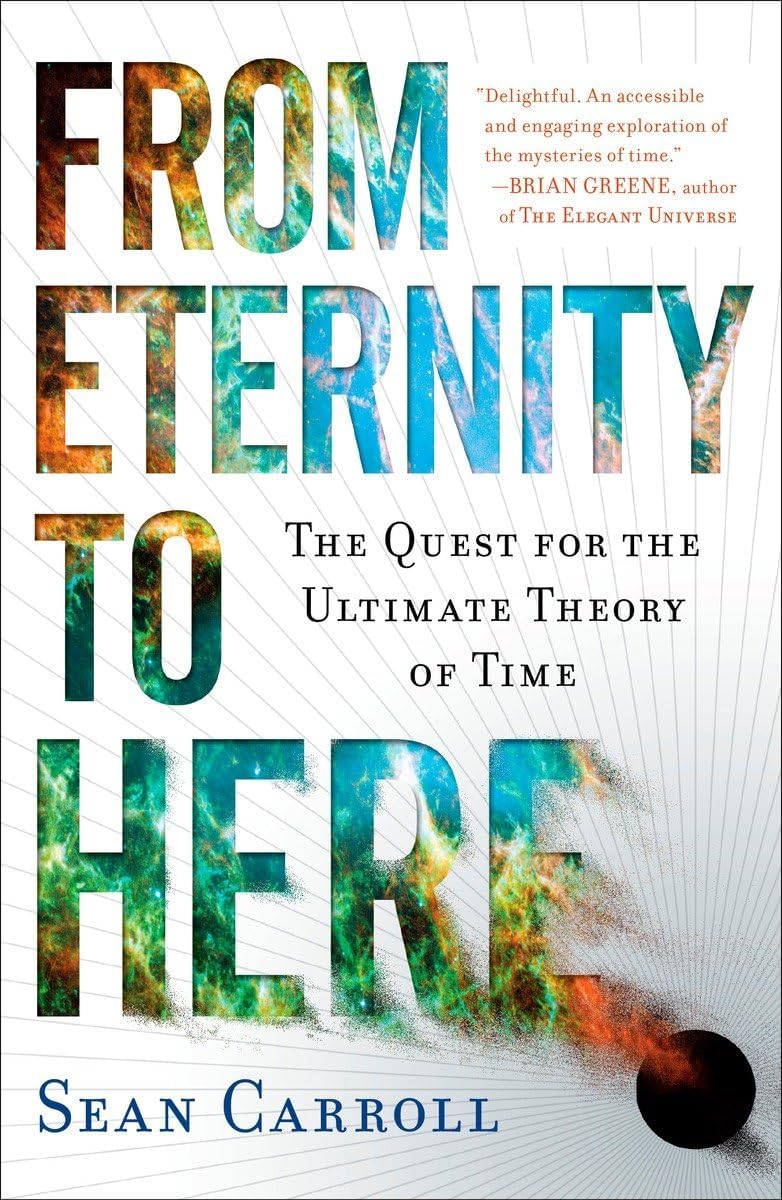
From Eternity to Here: The Quest for the Ultimate Theory of Time
Product ID: 1698724
Buy anything from 5,000+ international stores. One checkout price. No surprise fees. Join 2M+ shoppers on Desertcart.
Desertcart purchases this item on your behalf and handles shipping, customs, and support to KUWAIT.
Buy From Eternity to Here: The Quest for the Ultimate Theory of Time on desertcart.com ✓ FREE SHIPPING on qualified orders Review: An excellent, engrossing, very easily understandable introduction to the science of cosmology - If you're interested in the answers to the questions like "How did the universe come into existence? Why? Is it ever going to end?", then this is the book for you. Be warned: everything in this marvellous book is science, the falsifiable one supported by physics and mathematics as we know them (don't worry; they're not required). In spite of that, Carroll has an easygoing way to explain what I thought was beyond my capabilities. Entropy; information (conservation of); locality (possible violation of); holographic principle and so on, things that I only knew about, now I UNDERSTAND. Everything is utterly logical, understandable and captivating in the same time. There is very little formal math, and for the (very) few formulas, if you can count, and figure out which of two numbers is greater, then you're OK; that's all you need to get through (and you're not required to memorize them, by the way). There are four parts: 1. Time, experience, and the universe 2. Time in Einstein's universe 3. Entropy and time's arrow 4. From the kitchen to the multiverse and in the end you will find that , just as the author quotes, "compared to cosmology, metaphysics is pedestrian and unimaginative". I would add science fiction to metaphysics; I read a lot of it, but nothing compares to the fireworks in the pages of this book. I find useful when reviewers recommend other books; works much better than desertcart's automated service. From what I also read, if you like this book, you will be interested in Bruce Schumm's "Deep Down Things" (particle physics; stepping stone for any other particle physics book), in Alan Guth's "The Inflationary Universe" (one of the chapters (14) in "From Eternity To Here" connects to it), Lisa Randall's "Warped Passages", Brian Greene's "The Elegant Universe", Michio Kaku's "Hyperspace: ...". For best results, I think this book (From Eternity...) is easiest to understand, followed by Bruce Schumm's (a bit more math!... but what a wonderful book, too) and then it's up to you. Ah, by the way: the answers to the questions in my first phrase? I'll quote from the book's epilogue: we're at the stage where "we can state the problem very clearly but have only a few vague ideas of what the answer might be". Believe me; few non-physicists can "state the problem", and forget about any vague (scientific) ideas without this book. A hint: The Big Bang is not an answer; only one small piece of the puzzle. Review: Very interesting and likely to prompt further study - This book is an overview of the time symmetry of most physics and the reality we live in where time seems to evolve in 1 direction. Sean Carroll is a world renowned physicist and so the approach is one that is defined from the implications of our physical laws themselves rather than from a philosophical perspective based on our subjective interpretation of time. Most of the book focuses on time from the perspective of thermodynamics and the second law in particular- entropy is expected to increase through time, though relativistic time and its similarity to space is discussed, as are modern theories of the origin of the universe to try to avoid assuming the problem away theories. Let me try to talk briefly on the topics the author explores. The arrow of time is not specifically a part of classical physics (newtonian physics and electromagnetism) and this is confusing as to us, time clearly only moves forward not back. The relativistic aspects of closed spacelike curves and wormholes are addressed briefly as ideas in relativity that approach time's direction, but this isnt focused on in depthly. The author approaches the direction of time as a correspondence between entropy's strict march higher and our experience with the irreversibility of time. The ideas justifying an increase in entropy are well discussed and exponential increase in states if configuration spaces are discussed. This is with the backdrop of a static universe. Poincare's recurrence theorems in dynamical systems is brought up to describe things like the eventual recurrence of low entropy states over time and Boltzmann's retorts which amount to assuming away issues are then included. The book then discusses the change from static universe in which time has no beginning nor end to one which has a beginning and how this avoids recurrence by selecting preferred intial boundary conditions of low entropy, and then the author gets into how this too is unsatisfying as it assumes the problem away again. Quantum ideas are presented, the asymmetry of the collapse of the wave function is brought up but not taken anywhere. On a side note, I still have no clarity on how a spacelike closed curve can exist in a world with quantum mechanics (excluding a multiverse scenario) as I would think that implies there is no probability which can change an event in spacetime's trajectory and the author doesnt discuss that at all. Quantum gravity is discussed at a high level and is presented as the theory which eventually will illuminate the subject though the huge fuzziness of the subject isnt really very encouraging. The book concludes with some modern theories and directions in physics which might give consistent frameworks for worlds with strictly increasing entropy which evolve into our visible universe though is careful to admit that this is all really speculation. This is a complicated book. One can probably gloss over a lot of the content and get something out of it, but most of the contents of this book are based off a lot of deep thinking by academic minds over centuries. I for one definately have not come through this book having any stronger feeling about the nature of time, though I now have a better understanding of entropy and information theory. I also think the most clear writing on relativistic time is described in this book which takes only a small portion of the space. This is not a light read, if you make it such you probably will miss a lot of what the author is trying to communicate, im sure I missed a lot of the subtelties though i was trying to concentrate while reading. I did not come out anymore clearly on- why do we remember the past? The author often makes statements about having addressed it as a result of entropy, but I really dont find a rigorous argument in this book that convinces. The state of entropy and its direction impacts the distribution of events in a probabilistic world, it doesnt imply determinism which the arrow of time has a deterministic past from our eyes. The relative entropy of the universe now and 100 years ago being higher is not a reason why we have a memory of the past and literature from the past. The specific reason why we have a flitration of measurable sets to us that is bounded by time is not convincingly shown to be a result of increasing entropy. If it was, then I wish the author spent more time on the arguments. This book is mainly about physics and how time fits in and what time's implications are on physics and then the interpretation of that physics. It is a subject for which there will likely never be a final say, this is a bold introduction to a lot of modern ideas, but dont read it lightly as its value is in the depth of the ideas presented.
| Best Sellers Rank | #113,979 in Books ( See Top 100 in Books ) #10 in Physics of Time (Books) #63 in Cosmology (Books) #86 in Quantum Theory (Books) |
| Customer Reviews | 4.4 4.4 out of 5 stars (790) |
| Dimensions | 5.46 x 1.02 x 8.24 inches |
| Edition | Reprint |
| ISBN-10 | 0452296544 |
| ISBN-13 | 978-0452296541 |
| Item Weight | 2.31 pounds |
| Language | English |
| Print length | 464 pages |
| Publication date | October 26, 2010 |
| Publisher | Dutton |
R**R
An excellent, engrossing, very easily understandable introduction to the science of cosmology
If you're interested in the answers to the questions like "How did the universe come into existence? Why? Is it ever going to end?", then this is the book for you. Be warned: everything in this marvellous book is science, the falsifiable one supported by physics and mathematics as we know them (don't worry; they're not required). In spite of that, Carroll has an easygoing way to explain what I thought was beyond my capabilities. Entropy; information (conservation of); locality (possible violation of); holographic principle and so on, things that I only knew about, now I UNDERSTAND. Everything is utterly logical, understandable and captivating in the same time. There is very little formal math, and for the (very) few formulas, if you can count, and figure out which of two numbers is greater, then you're OK; that's all you need to get through (and you're not required to memorize them, by the way). There are four parts: 1. Time, experience, and the universe 2. Time in Einstein's universe 3. Entropy and time's arrow 4. From the kitchen to the multiverse and in the end you will find that , just as the author quotes, "compared to cosmology, metaphysics is pedestrian and unimaginative". I would add science fiction to metaphysics; I read a lot of it, but nothing compares to the fireworks in the pages of this book. I find useful when reviewers recommend other books; works much better than Amazon's automated service. From what I also read, if you like this book, you will be interested in Bruce Schumm's "Deep Down Things" (particle physics; stepping stone for any other particle physics book), in Alan Guth's "The Inflationary Universe" (one of the chapters (14) in "From Eternity To Here" connects to it), Lisa Randall's "Warped Passages", Brian Greene's "The Elegant Universe", Michio Kaku's "Hyperspace: ...". For best results, I think this book (From Eternity...) is easiest to understand, followed by Bruce Schumm's (a bit more math!... but what a wonderful book, too) and then it's up to you. Ah, by the way: the answers to the questions in my first phrase? I'll quote from the book's epilogue: we're at the stage where "we can state the problem very clearly but have only a few vague ideas of what the answer might be". Believe me; few non-physicists can "state the problem", and forget about any vague (scientific) ideas without this book. A hint: The Big Bang is not an answer; only one small piece of the puzzle.
A**N
Very interesting and likely to prompt further study
This book is an overview of the time symmetry of most physics and the reality we live in where time seems to evolve in 1 direction. Sean Carroll is a world renowned physicist and so the approach is one that is defined from the implications of our physical laws themselves rather than from a philosophical perspective based on our subjective interpretation of time. Most of the book focuses on time from the perspective of thermodynamics and the second law in particular- entropy is expected to increase through time, though relativistic time and its similarity to space is discussed, as are modern theories of the origin of the universe to try to avoid assuming the problem away theories. Let me try to talk briefly on the topics the author explores. The arrow of time is not specifically a part of classical physics (newtonian physics and electromagnetism) and this is confusing as to us, time clearly only moves forward not back. The relativistic aspects of closed spacelike curves and wormholes are addressed briefly as ideas in relativity that approach time's direction, but this isnt focused on in depthly. The author approaches the direction of time as a correspondence between entropy's strict march higher and our experience with the irreversibility of time. The ideas justifying an increase in entropy are well discussed and exponential increase in states if configuration spaces are discussed. This is with the backdrop of a static universe. Poincare's recurrence theorems in dynamical systems is brought up to describe things like the eventual recurrence of low entropy states over time and Boltzmann's retorts which amount to assuming away issues are then included. The book then discusses the change from static universe in which time has no beginning nor end to one which has a beginning and how this avoids recurrence by selecting preferred intial boundary conditions of low entropy, and then the author gets into how this too is unsatisfying as it assumes the problem away again. Quantum ideas are presented, the asymmetry of the collapse of the wave function is brought up but not taken anywhere. On a side note, I still have no clarity on how a spacelike closed curve can exist in a world with quantum mechanics (excluding a multiverse scenario) as I would think that implies there is no probability which can change an event in spacetime's trajectory and the author doesnt discuss that at all. Quantum gravity is discussed at a high level and is presented as the theory which eventually will illuminate the subject though the huge fuzziness of the subject isnt really very encouraging. The book concludes with some modern theories and directions in physics which might give consistent frameworks for worlds with strictly increasing entropy which evolve into our visible universe though is careful to admit that this is all really speculation. This is a complicated book. One can probably gloss over a lot of the content and get something out of it, but most of the contents of this book are based off a lot of deep thinking by academic minds over centuries. I for one definately have not come through this book having any stronger feeling about the nature of time, though I now have a better understanding of entropy and information theory. I also think the most clear writing on relativistic time is described in this book which takes only a small portion of the space. This is not a light read, if you make it such you probably will miss a lot of what the author is trying to communicate, im sure I missed a lot of the subtelties though i was trying to concentrate while reading. I did not come out anymore clearly on- why do we remember the past? The author often makes statements about having addressed it as a result of entropy, but I really dont find a rigorous argument in this book that convinces. The state of entropy and its direction impacts the distribution of events in a probabilistic world, it doesnt imply determinism which the arrow of time has a deterministic past from our eyes. The relative entropy of the universe now and 100 years ago being higher is not a reason why we have a memory of the past and literature from the past. The specific reason why we have a flitration of measurable sets to us that is bounded by time is not convincingly shown to be a result of increasing entropy. If it was, then I wish the author spent more time on the arguments. This book is mainly about physics and how time fits in and what time's implications are on physics and then the interpretation of that physics. It is a subject for which there will likely never be a final say, this is a bold introduction to a lot of modern ideas, but dont read it lightly as its value is in the depth of the ideas presented.
E**O
I've read it on epub format. But it's a book worth buying. I wanted it on my shelve for eternity.
Z**E
Book itself OK, but the font - I have a perfect sight, tested this year, this is insane. I need a loop. Its basically unreadable for me. Photo attached is appendix part (really relevant) bit the main font is not much bigger. For what, for 10 pages more if font increases?
C**E
Il miglior libro che io abbia mai letto sul problema del tempo( e ne ho letti diversi!). Si basa sopratutto sulla legge dell'entropia, spiegandone molto bene il concetto e i diversi significati.Da leggere, per chi è appassionato dei problemi più grandi e profondi del cosmo e della vita.
M**E
This book is a great start if you are trying to understand the cosmology of time. I must agree that one read is not enough to understand the concepts discussed in this book. However, the author is successful in explaining rather complicated scientific concepts in layman's terms.
S**)
A very detailed discussion of the nature and origins of time. Hugely complex thought experiments that come ten-to-the-dozen. A book that will have to be read at least three times. Fortunately it is well written, although there are diagrams that aren't clearly understood. Works well with the two primers: 1) The Quantum Universe: Everything that can happen does happen. 2) Quantum: A guide for the perplexed. There are no significant mathematical hurdles to navigate (unlike field theory) but if you fatigue with the thought experiments and logic, Sean Carroll has a lovely dry sense of humour that rescues the situation. It isn't a read anywhere book. Although available in my Public Library, it needs a quiet reading room. It induces narcolepsy. Enjoy!
Trustpilot
4 days ago
2 weeks ago