Buy anything from 5,000+ international stores. One checkout price. No surprise fees. Join 2M+ shoppers on Desertcart.
Desertcart purchases this item on your behalf and handles shipping, customs, and support to KUWAIT.
🚀 Elevate your home network to pro-level speed and security — don’t get left buffering!
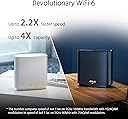
The ASUS ZenWiFi AX6600 Tri-Band Mesh WiFi 6 System (2-pack) delivers ultra-fast 6600 Mbps speeds and expansive coverage up to 5500 sq.ft, ideal for large homes with multiple rooms. Featuring next-gen WiFi 6 technology with OFDMA and MU-MIMO, it supports simultaneous device connections with stable, efficient performance. Setup is a breeze via the ASUS Router app, and lifetime Trend Micro security ensures your network stays protected. Compatible with AiMesh for flexible expansion, this system is designed for professionals seeking reliable, high-performance whole-home WiFi.


| ASIN | B083Q45V1V |
| Antenna Location | Business, Home |
| Antenna Type | Internal |
| Best Sellers Rank | #5,091 in Electronics ( See Top 100 in Electronics ) #28 in Whole Home & Mesh Wi-Fi Systems |
| Brand | ASUS |
| Built-In Media | ZenWiFi AX White Mesh Router(2) |
| Color | White |
| Compatible Devices | Gaming Console, Personal Computer, Smart Television, Smartphone, Tablet |
| Connectivity Protocol | wi-fi |
| Connectivity Range | 5500 Square Feet |
| Connectivity Technology | Wi-Fi |
| Control Method | App |
| Controller Type | vera |
| Coverage | 5500 square foot |
| Customer Reviews | 4.0 out of 5 stars 3,406 Reviews |
| Data Transfer Rate | 6600 Megabits Per Second |
| Frequency | 5 GHz |
| Frequency Band Class | Tri-Band |
| Global Trade Identification Number | 00192876579015 |
| Is Modem Compatible | No |
| Item Dimensions L x W x H | 6.3"L x 2.95"W x 6.36"H |
| Item Type Name | ASUS ZenWiFi AX Whole-Home Tri-band Mesh WiFi 6 System (XT8) - 2 pack, Coverage up to 5,500 sq.ft or 6+rooms, 6.6Gbps, WiFi, 3 SSIDs, life-time free network security and parental controls, 2.5G port |
| Item Weight | 6 Pounds |
| LAN Port Bandwidth | 2.5 Gigabit |
| Manufacturer | Asus |
| Maximum Upstream Data Transfer Rate | 3300 Megabits Per Second |
| Mfr Part Number | ZenWiFi AX 2PK White |
| Model Name | ZenWiFi AX 2PK White |
| Model Number | ZenWiFi AX 2PK White |
| Number of Antennas | 6 |
| Number of Ports | 4 |
| Operating System | Apple iOS, Linux, Mac OS, Microsoft Windows |
| Other Special Features of the Product | Alexa Compatible, Internet Security |
| RAM Memory Installed | 512 MB |
| Security Protocol | WPA2-Enterprise, WPA2-PSK, WPS |
| Smart Home Compatibility | Smart Home Compatible |
| Special Feature | Alexa Compatible, Internet Security |
| UPC | 091128522963 192876579015 |
| Unit Count | 2.0 Count |
| Voltage | 110 Volts (AC) |
| Warranty Description | 3 years warranty ARR |
| Wi-Fi Generation | Wi-Fi 6 |
| Wireless Communication Standard | 802.11ax |
| Wireless Compability | 802.11ax |
M**N
Works great with some issues
Update: 3-28-2020. Still having issues with the primary router always connecting with the 5 g network, particularly when it is in the ax mode. Supposedly this system is backward compatible with other adapters but by switching it off the ax mode and then back on a few minutes later then it seems work ok. Shouldn't have to do this Asus. Try to fix it, I can't be the only one who has this issue. Devices generally will connect to the node without any issues. Update: 3-8-2020 I'm finding that some of devices will not connect to the 5 G network when the system is in ax mode. Even if I'm but 5 ft. away. Switch the ax mode off and it will connect both the 2.4 and 5 networks. Go figure. Occasionally I have to switch the ax mode back on to get some other device to connect properly. I often take the device into another room some 15ft or more away and it will connect with the 5G without any issues.??? Update: 3-2-2020 My Blue Cave node was inconsistent on wifi but excellent with the ethernet so I tried a RT-AC68A as a node and it works great. Both the ethernet and the wifi provide excellent speeds in the basement some 25 feet away. I don't plan on sending it back since I'm very happy with it so far. Have had to make a few adjustments here and there because not all digital devices are "equal". If you don't mind paying up for a system it is pretty hard to beat for setup and performance. One thing to add: when I set up the node I used an ethernet cable from the main router lan to the AC68A wan. For some reason it would not locate it wirelessly. Update: 2-24-2020 Went into the wireless in the menu and enabled WIFI Agile Multiband for both the 2.4 and 5g networks. (I disabled the smart connect right out of the box.) It will ask you to change the Protected management Frames also. Did so not knowing what the outcome might be but these changes seemed to help with the issue of the mesh switching between the nodes and the primary router. Also, my phones would not hook up to the primary router sitting 5 ft. away but since the afore mentioned changes that issue is gone and the speeds have been excellent. I added a star to my orignal review since the system is working much better. I sure as hell would like a manual to look at rather than just a quick setup document. If someone out there has some ideas or additional adjustments that can be made I'm all ears. FIRST REVIEW: This is an early impression of my experience so far. 2-pak setup was very easy and straight forward. Had to reset once but couldn't find the reset button until I looked on the very bottom of the router. By the way the wps button is there also. I'm paying for 200 mgb and will get 200 to 260 with my desktop 7 ft away. My motorola z3 play generally gets 140 to 170 depending on where I am. I was getting 160 to 200 in the basement 25 ft. away on a desktop. The all those scores are on wifi. I setup an additional Blue Cave node in the basement (which was another story) and connected to two different desktops with ethernet cables. At times they are ripping along at 230 to 260 or may drop off to 80 to 90 for no apparent reason. I disconnected the cables reconnected and the speeds went up again???? (This issue has vanished after making the above mentioned changes). The app will sometimes show the blue cave is offline yet it is working. I have some similar questions as a few others have had about bothersome issues that have arisen. Will address these later. I finally disabled the ax mode for 2.4 and 5g and it seemed to put some of these issues to rest for awhile. I have had ASUS routers for years and love them along with the menu. These two have me considering going back to my older routers because they were more reliable. I'm not a computer guru but I can handle most of the basic computer issues and projects. We don't buy the hardware to continually reboot, reconnect, and try work arounds to make the systems work. Update: 9-22-2020 Additional thoughts on the zenwifi routers. I've found that I need to keep it in the non-AX mode so all of my cameras, wall plugs, etc will remain connected all of the time. ALSO, THE RESET AND WPS BUTTONS ARE ON THE BOTTOM OF THE ROUTER. Nothing in the instructions that I could see regarding their location so if you are looking for them check the bottom. The wifi range is excellent; the speed is excellent; and the app works very well setting the routers up. I'm paying for 200mbs but I get 260+ download with wifi in the same room and 200+ downstairs in the basement. One additional point: Since the recent updates adding my Blue Cave router to the mesh was much easier than when I first started using the zenwifi XT8 mesh system.
S**Y
Effortless setup, massive improvement
Night and day coming from a Ubiquiti AP in terms of setup and performance. I've only been using this setup for a day, so longer term performance is still TBD, but everything has been excellent so far. Worth noting that my use cases and infrastructure might be simpler than many folks but even then, some of the negative reviews are a bit baffling given my experience. Pros: - Stupid-simple setup. The entire network with both devices was up and running within ~15 minutes of opening the box. I'm probably more technically inclined than others, but a child could figure this out. As simple as connecting the router to your modem, turning it on, and then walking through the in-app setup. The mesh node was about as plug-and-play as it gets, at least when using ethernet backhaul. It was recognized and configured almost immediately as a secondary node in the network. - Mobile app. Used for initial setup and management. Could probably be done through the web-ui but I don't really see a reason to do that on initial setup. Save time and just download/use the app. - Web UI. The router management web UI is more robust and a bit easier to navigate than the mobile app. Will likely use this going forward for more detailed configuration and monitoring. - Performance. Both speed and coverage are incredible. I pay for 1000/20 and consistently got ~930/~25 with the speed test in the Asus app. 5Ghz WiFi speed tests (fast dot com) on newer devices averaged ~750/~25. 2.4Ghz varied but was consistently fast and reliable. Full signal on various devices throughout the house and outside on both bands. - Wired backhaul. Worth mentioning specifically because I saw some reviews that complained about this not working very well or at all when a switch was in between the two units. It worked immediately and works well for me. There's also multiple physical connections between the node, the wall and the switch itself and there still aren't any problems. if you run into problems, its probably worth double-checking your cabling (CAT 5E+), hardware (switch compatibility/1G+ ports), and Asus config Cons: - Asus UI/UX. Very minor issues just getting used to and understanding how to navigate the UI both on the mobile app and on the web. It seems simple enough now though after poking around. Not worth docking the rating. - 2.4 Ghz. Noticed in some instances where the speeds were sporadically low on 2.4 Ghz, but I generally don't use that and it isn't consistent enough to dock a star. Most of the connected devices on the network default to or have to use the 2.4 band, so it could just be some basic congestion. As of this writing, I'm getting 150/22 on my laptop while situated near the secondary node, which is more than acceptable. I'll look deeper into the settings and report back if there are problems. - SSID management. Fairly negligible but worth mentioning like others have. The default configuration uses a single SSID for both 5 and 2.4 Ghz bands which I immediately turned off. I assume most folks would want the delineation of the two like me. The other knock here is that it will broadcast the alternate 5 Ghz channel used for wireless backhaul. I don't intend to ever use the wireless backhaul, but, unless I'm missing something, Asus seems to force it to be left on as a fallback in case the wired connection ever drops. I'm fine leaving it on as a fallback but I'll at least see if I can hide the SSID without causing problems with the network, since it should never be used by regular clients. TBD: - Long-term performance. Very satisfied at the moment but I'm sure most would agree that a huge percentage of the value is how these things hold up over time. I'll report back as needed. - Advanced features. I haven't spent enough time with the router management software to really understand the pros and cons here quite yet. - IOT connection stability. Saw some reviews that dinged connection drops for connected devices. No issues to report yet. I used the same SSID and passwords as before. Everything connected seamlessly and appears to be working. I'll keep an eye on this as well. - Wireless backhaul. I have not tested wireless backhaul and I don't really intend to. In fact, I don't really see the utility of using wireless backhaul if you can avoid it. For the XT8, it relies on an alternate channel on the 5Ghz band. This is obviously going to be slower than ethernet from the jump but the 5Ghz band is much more "fragile" and can quickly become very limited by physical distance and obstructions between the two nodes, even if the actual channel is dedicated strictly for backhaul instead of regular traffic. Misc. Notes: Physical setup: - Cable connection from the street comes into the basement, which is where the modem and the main router are situated. - The house is fully wired via ethernet. A 10-port gigabit switch also sits in the basement with the modem and router, which feeds the wall ports in various rooms throughout the home. - Only a handful of the wall ports are actually used consistently. One for the entertainment center, one for a PC and one for an AP on the second floor of the home. - Various connected and personal devices throughout the house. Smart speakers, smart TVs, Nest thermostats, a camera, dog collar, wireless printer. Personal devices include cellphones, laptops, and tablets. Previous hardware: - Netgear Nighthawk 6700 running DD-WRT, located in basement. Older model but the reputation precedes itself. Worked fairly well on stock firmware for a little while. Decided to switch to DD-WRT after cord-cutting and increased bandwidth needs for remote work and more IOT devices. DD-WRT improved things for a little while. I toyed with various setups but ultimately wanted the router to feed all connectivity in the house, so it remained in the basement. - Ubiquiti AP on 2nd floor for better coverage. The house is a recent reno but is originally ~200 years old. Whether the older construction materials of the innards of the house or just physical distance of having the router in the basement, it was difficult to get solid coverage throughout even with relatively modest square footage. The single AP worked well for a little while but UI/UX for Ubiquiti products is clunky at best and annoyingly difficult to configure. Performance degraded slowly over time and required lots of hand-holding just to remain stable. It also seemed impossible to get a true "mesh"-like network without having to purchase a second AP and completely turning off wifi on the main router. This didn't seem appealing given the dissatisfaction with the Ubiquiti ecosystem as a whole. Current hardware: - Main AX6600 router in basement, replacing the Netgear 6700. Modem feeds the WAN port, single LAN port feeds the main switch for ethernet wall ports. - Secondary AX6600 on 2nd floor as secondary AP Mesh Node, replacing Ubiquiti AP. Strictly uses ethernet backhaul via wall port
M**K
MAJOR ISSUES (May 2024 update) after 1.5 years of owning both AX and MX (mini) 5 node setup
XT8 purchased: September 17, 2022 (1 item) - 2 units AX Mini purchased: May 22, 2023 (1 item) - 3 units 3,800 sq ft Main modem and router - 2nd floor Main office - basement (beneath 1st floor) Distance: 30 ft between XT8, 10-15 ft between AX Mini's When I first bought the XT8 AX6600 pair, they worked great for the first year. Strong signal, very minimal downtime, good asus interface on both browser and via app. After the first year, started having connection issues. After the first year, there was a small increase in occasional bottle necking, but I attributed it to the possibility of the XT8's and the MX (mini versions) having wifi overlapping. Still would work for weeks, even months, between any noticeable issues. After updating them at the start of May 2024, though, v. 3.0.0.4.388_24621-g9054e31 for the XT8 and v. 3.0.0.4.386_49599-g8352df7 for the AX Mini's, the performance of both units SEVERELY went downhill. The update was security related. Everyday, every hour - sometimes between 4-5 hour spans, but still every day, all nodes would disconnect from the mesh (from each other) and then try to reconnect themselves. Downtime is about 5-10 seconds, but when it happens, it's VERY noticeable, annoying, and f**king stupid. I'd either be working from home, on a call, browsing, streaming, or playing games - especially when in a competitive game - and disconnects would happen randomly at any point in the day and night. If I pay for something that's $300, plus the $200 cost of the mini's, I expect them to last AT LEAST 3 YEARS, preferably 5 years, before any major issues or any need to upgrade. My opinion of ASUS routers and (at least) these routers has gone down the drain and I do not and WOULD NOT recommend them to anyone at this point, despite them being WiFi 6 and fairly powerful routers. ASUS Ai-Mesh is nice... when it works. I tried running the XT8's solo and the AX Mini's solo - same connection issues. Also confirmed that it's not a modem problem, as I ran tests for a couple days via hard-line only from the modem, having it act as the router; no connection issues, couldn't see any problems like with the routers. My daily traffic is about 30 GB. Pic related to when disconnect starts to happen. When it does, it's either you restart and reconnect the whole system, or you wait it out until the issue resolves itself - whatever it is. I've tried: - resetting the whole network from default - swapping main routers between both XT8 and AX Mini - run with AND without Adaptive QoS (prioritization of apps on network) - run with AND without backhauling Same result, still happens. I blame the May 2024 update - these blow now.
S**I
Ready to sell the Eero
Update: I bought an AX92U to see if I can get some speed upgrade to the slower spots of the house, especially the office which hides behind 2 corners. It went from 80 mbps to 120mbps. I tried wired backhaul, but not helping much, until I turn 5GHz-2 as dedicated backhaul off and unhide the SSID with name and password. Whah! The office is now over 400mbps both up/down and everywhere inside the house! More update: Found it not compatible with different AiMesh router. Tried to use the ethernet to connect the AX92U to free up the 5Ghz-2 band. But as soon as I plugged the network cable into the 92U, it lost connection, unplugged the 92U, and the internet was very slow. Checked the app, it said the uplink type is 2.4GHz! Reboot, reset all routers, turn on/off dedicated backhaul, nothing helped. So basically the two 5Ghz bands disappeared! Luckily, my backordered AX11000 showed up, so my internet is up and running while I return the ZenWifi. I am WFH, so a good internet is very important and not going to bother to figure out what went wrong. However, I do suspect the hardware may had problem since they were bought from the warehouse as like new. Note that I have a very sophisticated smart home setup with over 50 devices connected from doorbell to fountain pump, and many smart TVs, I so I am happy to get 400mb out of 1Gb internet on any PC or iPad with no streaming going, or 120mb with 1 or 2 streaming video on. But I am still researching on possible improment using 12 stream AX router. I had Eero for about a year or so, although it had been working fine, but I had to use 5 of them to cover a two story home with yards, it doesn’t go through walls well enough. Also being a gadget guy all my life, I think it is time to upgrade to an AX mesh network to validate if it really can cover more grounds with higher speed. Been on Amazon since day one writing/reading reviews, I can say there is no perfect product in the world, so I rarely buy stuffs based on reviews, instead, buy them for the looks or functions they provide. In this case the Asus XT8 got me for its speed and price, not for the bulky look. Setup - easy enough, just need an IOS or Android phone or pad with bluetooth, download the app and follow the instruction. Make sure the two routers are fully linked before running the app, or you will see 2 mesh devices and setup will fail. Once setup is completed, move the node router to where you think it should cover the other half of the area. This involves a little guesswork, but surprisingly easy for me, since the signal is strong even where I left the node at the farthest corner downstairs. You can tell if the link between the two routers are strong if the led is solid white. If yellow or red, then move it around. Connection speed - For my 1gb internet connection, ipad was getting 200/250 up/down on the Eero, now it is 350/400. Even in the backyard, I could get 170/200, with just 2 routers. Coverage - I had not found a dead spot yet. Inside or outside. Although speed may vary, the lowest one been the office at the very corner of the house, on the PC that is 13 years old. Compatibility - with same SSID setting and let the router handle the bandwidth, all smart home devices are working. About the only device not working was the 13 year-old PC the no longer has a updated NIC driver, I solved it using an USB 11ac dongle with updated driver. I still need to figure out how to hang the main router upstairs on the wall, but other than that, I am happy withe the ASUS XT8, the simple setup and management using phone app, and strong signal for internet with just 2 nodes. It is something worth looking at for WFH now and the future.
V**S
Great router as a stand alone, but mesh networking does not work well
I own both the Asus AX6000 RT-AX89X and the Asus ZenWiFi AX6600. I originally bought the RT-AX89X hoping that it would cover my entire home. It came pretty close, but there were some areas without great coverage. I don't fault the router for that, I have a challenging house to cover as it is 3300 sq ft, L-shaped with outdoor cameras in different places. On top of that, I'm unable to locate the router as centrally as I might like. So I got the Zenwifi to add on as a mesh network. Asus advertises that these and most of their higher end products can work together to create a mesh system. I set it all up and at first it all seemed to go well, however I noticed that both my wife and my phones would sometimes be connected to wifi but not have any internet. When trying to go to a website, it would just hang like the website was not responding, but then I'd check the wifi settings and it would show the message "connected with no internet". This happened on laptops as well sometimes, but we noticed much, much more often on our phones. The problem could always be immediately solved by switching from 5G to 2.4 or vice versa. It could also be solved by turning off wifi and then back on. Over time I started to realize that this tended to almost always happen when moving from an area that was close to the main router to another area that was close to the Zenwifi, meaning that it was an issue switching between the two. I went through the settings over a period of weeks, changing different things to see if I could fix it. Nothing I tried worked. I contacted Asus tech support and they had me change a bunch of settings, but the problem still wasn't solved. They elevated it to their 2nd level tech support, and said they would contact me. I replied to the 2nd level support's email and sent them files they requested generated by the router, and explained the entire problem in detail again. They wanted to call me but I told them I really don't have the time to take a random call from them in the future that will probably last an hour or two. I work full time and have 2 young children, it's hard to find time for stuff like that. I asked that they send any troubleshooting steps they suggest via email so I can try them when I get a chance. They still called me. And then followed up by email asking me all the same questions that I've already answered again. After a little more of this back and forth, I realized they weren't going to be able to help me so I decided to not use the mesh feature, just run two separate wireless networks. I went into the router settings and couldn't immediately figure out how to do this, so I figured I would online chat with support as this is probably pretty easy to set up. I had to explain an abbreviated version of my issues all over again and told the support rep that I just wanted to have separate wireless networks. Told him I had factory reset both devices but couldn't figure out how to not have them run mesh, as that is the only option it gives you when you log in and bring up the set up screens. He told me it wasn't possible. This seemed kind of crazy to me for routers that are this expensive, with this level of features to not be able to just run independently off the same internet connection. He offered again to escalate it. I asked if he could have them send any suggestions for setting up separate wireless networks by email, again explaining that it's super unlikely they are going to call at a time when I am home and able to spend the time needed on the phone with them. Again, they called my phone, and again they sent an email asking me all the basic info that I had explained multiple times already. At this point I had figured it out myself. I just had to set up the main router with the log in for my fiber internet, then plug the Zenwifi into my computer with the main router disconnected and use the setup screens to make it an access point. Then I could connect the Zenwifi downstream from the main router. I could only access the main router from my desktop or laptop, but in the android app I could switch back and forth between both. And in that app, I could find the direct address for the Zenwifi to type into the browser bar and get access separately. It really wasn't a crazy difficult process and if someone like myself who is only somewhat familiar with networking could figure it out, I don't know why their tech support thought it was impossible. Now that it is set up with separate networks it does work great, although I would have prefered the more seamless experience of a mesh network that Asus advertises. The router interface is very powerful with tons and tons of options. The speeds are very fast and I'm not having issues even though I have somewhere between 50-100 devices connected at any given time (I have lots of home automation stuff and also an in-law apartment with it's own devices). As stand alone equipment I would give these devices 5 stars, they really are great by themselves. For mesh networking, I would give them 1 star as they really don't work well for this. If you decide to go with Asus, their tech support is friendly, but pretty clueless and not very helpful, so I wouldn't expect much in that regard.
K**M
Better than a Nighthawk IMO
Straight up was an upgrade from the Nighthawk RAX78. The RAX would not allow me to use DNS servers of my choice. I'm not sure if that was the reason why my webpages wouldn't load and after getting this product, I don't care. I placed a unit upstairs and down, backhauled by ethernet (cable is always more solid than WiFi imo) and everyone's signal throughout the house is full bars. No more lags or pages or Google TV apps that don't load. A little background: I had a Nighthawk RAX75 that was decent and was happy with and one day, it just started randomly rebooting, or the ethernet ports would randomly reset. Called Netgear support, and although the people were nice, it was kind of a hassle due the outsourcing of the support (it's interesting waiting on the phone and you can hear roosters in the background, kinda unexpected) and being asked to pay for support for a product that was still under warranty (this is a recurring theme with Netgear). I assume the firmware updates broke it, but I'll never know. Support was kind enough to send me a RAX78 and I had nothing but problems since I got it. Signal throughout my house was not as solid, but it was ok, but the worst of it was that no one could ever connect to webpages on the first try. You'd have to reload or retry multiple times. We dealt with this for almost a year. It was painful (first world problems amirite). Open HBO Max, yeah, GL. It would rarely load (mostly never). Had to cast from my phone. Open Amazon video? LOL. "Error connecting" screen that would eventually connect after 2 or 3 mins. Voice search? Pfft, not gonna happen bud. Considered purchasing an ORBI which, based on reviews, is a solid product, then I realized, "oh, this is a Netgear product" and based on my previous customer experience, it was a non-starter for me. This product was a close second to the ORBI (based on some reviews, but I'm sure that's dated by now) for considerably lower $$$. Set it up fairly quickly using the app (the firmware update was solid, zero issues), but for a better, more thorough setup, I used my web browser. Decent amount of customization if you want it w/out having to be an engineer. Now everyone's webpages, apps, and throughput is SO MUCH BETTER and so much faster. Just a more confident experience. Full bars throughout the house. I wish I'd done it sooner, but 4 C notes is a lot for me to drop (especially with inflation) but an Orbi was even more. I didn't wanna risk a dud (unlikely) or having to deal with Netgear customer service. I would definitely recommend this product to anyone who can get together the money. If you're strapped like me, I understand the hesitation, but it's worth it so far. I'm writing this review, day one, but the difference to me was so apparent, I felt it important to share my experience.
C**R
Why did I wait this long?
Picked a set of these up to replace my initially-amazing-but-ultimately-hot-mess Netgear XR500 router (which itself replaced my brilliant workhorse but too-slow-for-my-needs Netgear R7000) after eyeballing them for nearly a year. Setting the XT8 units up was surprisingly simple, even though the instructions lacked a bit of detail. Plugged them both in, chose one of them to plug into my modem, downloaded the Netgear app, chose the appropriate model in said app, and away I went. Only potentially confusing point was where it insisted on asking me about IP assignment method...I selected DHCP, which should have been the default anyway. It also asked me if I wanted a unified network name across the 2.4 and 5Ghz bands...I kept them separate with their own unique names to stay consistent with my original setup. This is a nice option that some modern routers inexplicably do not offer, the lack of which can cause some older 2.4-only devices to have trouble connecting. Within a few minutes the units were linked and the two networks were visible. I initially couldn't browse the internet, but a quick modem reboot solved that...not an unexpected step at all. After that, everything was a breeze. I had kept my network names and passwords the same as before, and every device in my house had no trouble whatsoever immediately communicating with the XT8s, and I hadn't even yet moved the satellite XT8 out of the same room as the main router XT8. I then moved the satellite XT8 to my basement, a place where my wifi speeds were only around 50Mbps of an available 400Mbps on either wifi band with my previous router. I was worried that due to the distance/walls/floors between the satellite and the main router, I'd see a similar drop-off if I let the units communicate wireless using the wireless backhaul (vs. running ethernet cable between them). I'd also had terrible luck with range extenders in this room. But with the XT8s? Nope. I ran Speedtest and got speeds of over 100Mbps on the 2.4Ghz channel, and over 350Mbps on the 5Ghz channel. Impressive. I thought about plugging my PS5 into one of the XT8's ethernet ports, but the performance on wifi is so good, with such low latency, that I've had no reason to do so (the PS5 is a Wi-Fi 6 capable device, as is the XT8, so no surprise there really). As for devices that are upstairs and close to the main router XT8, unsurprisingly they're seeing almost every bit of my ISP total bandwidth. I am pretty flabbergasted at the performance thus far. When I received them, I was on the verge of returning them on the spot after further research made me doubt their capabilities, especially with regards to firmware update issues. I updated the firmware and had no problems. I'm glad I gave these a shot. I haven't even had reason to need to try their QoS functionality. I know that routers can take time to reveal their warts. My XR500 was a case study in such frustration. I'll certainly be leery of major firmware updates to these and will likely wait for inevitable followup patches to major releases before applying. But so far these XT8s have been a revelation. I've had them up for a week now without a single drop or incident since initial setup. I'll update this review as time goes by. Pros: -Fast fast faaaaaaaaaaast, even when the satellite XT8 is placed in a seemingly poor location -Unobtrusive, subdued physical design -FAST -Easy setup -Seriously...SO FAST... Cons: -App could be a little more intuitive -Packed-in documentation could be better -Satellite takes a few minutes to sync-up when plugged in -Supposed issues with firmware updates, but I've had none thus far and will be cautious UPDATE 2/3/2023: No issues thus far. I have heard issues regarding certain firmware updates, so I never update the firmware until I've read up on user experiences with them, and even then there's not much reason to unless they address something truly necessary. These have been absolutely awesome. UPDATE 2/9/2024: They just keep chugging along.
P**N
ASUS vs NetGear
If you're considering a home mesh network system, you've probably looked at ASUS and NetGear and similar mesh systems. With this system, I’m replacing a (very expensive) NetGear Orbi mesh system (router + 5 satellites). The ASUS system in my home (6,600 sq ft) is a router and 4 satellites with the same or better coverage (whole home, plus attached 3-car garage and everywhere in the front and back yard, 80+ attached devices). Not only are the individual units less expensive than the Orbi, but you need less of them - many homes would be completely covered by two units. The Orbi was a great system for coverage and speed - in fact one of fastest systems I've used. It's Achilles' Heel and downfall was/is stability - not only inherent stability but INstability introduced by NetGear itself. Virtually every firmware update caused the system to develop disconnects, power outages would render it inoperable on restart, and the latest firmware update has caused users to be locked out of their router, unresolved for months with no sense of urgency by NetGear, and no fix in sight. My Android phone would lose its Internet connection regularly, and require activation of the Guest Network to even get access. Tired of the constant system repair and tweaking with Orbi, I switched to ASUS and am delighted. The pros and cons compared to NetGear's Orbi: Pros - ASUS stability. Rock solid from the beginning, no dropouts or blank zones, anywhere. - Any unit can function as a router (similar to LinkSys). Orbi requires a dedicated and specific router, so if your router goes out you will need to purchase a router PLUS satellite(s): it doesn’t come any other way. - Individual units are cheaper than equivalent Orbi units. Everything is included with your one-time purchase, including lifetime internal network security through Trend Micro. With NetGear, you’ll need to purchase a pricey annual subscription to maintain your network protection with NetGear Armor. - Ergonomics - lighter weight and approximately 2/3 the size of an Orbi unit, and more ergonomically shaped (with the weight and the tapered, smooth exterior of an Orbi satellite, you risk dropping it - about $400 of delicate electronics - every time you move it). - A front LED indicates status - white indicating that the router/satellite is on and operational. When the Orbi is on and functional, all lights are out - the same as if the unit was off, which was always to my thinking a bizarre design. You can tell just by looking whether an ASUS satellite/router is working or not. - Speed. As in consistent speed at the far ends of the mesh - very similar to Orbi but consistently faster, at or just over a Gigabit on my Internet speeds everywhere, as opposed to just slightly over with Orbi in some locations. More than enough for any online device or task, and individual satellites can be positioned further from the router in the mesh with ASUS. - Fully configurable software for attached devices. Devices can be individually throttled or protected, or really any aspect of a network can be configured with the software or online through the router. - Better unit design - each unit has an actual on/off switch, as opposed to Orbi which requires you to actually unplug the unit to turn it off. Minor, but indicating some engineering thought went into ASUS vs construction shortcuts with Orbi. - Once you do have it set up, it’s set and forget. The automatic features of the ASUS system will take care of everything, unless you really DO want to go into your network and configure everything individually, which you can do (as above). - Like Orbi, the ASUS mesh has a backup of all your settings and configuration, however to restore it is a matter of minutes, unlike Orbi where even with a backup you will spend as much or more time recovering it as you did setting it up. Which you will need to do, as above, probably more than once. Cons - Less intuitive software app than Orbi, and more complex setup. Individual satellites need to be within a meter or so of the router to initially set up, and some sections of the software are clearly "pending," without much explanation of what they do. And satellite setup can take some time for each satellite, so setting up your network, depending on size and your experience, can take an hour or two. That’s it. Hands-down, ASUS is the choice for a simple or complex home mesh network, whether you are experienced or a novice. Highly recommended.
L**D
WiFi everywhere
The best mesh system I’ve used so far.
W**L
It’s amazingly fast
Consistently fast 600+ mbps. Never lost connection anywhere in the condo. 3 lans on the side, good enough for anything that needs to be plugged in. Otherwise wireless is just as easy and reliable. You have the option to bind ip to any device to like so the ip never changes even if have to reboot the router. You can choose different ssid for the 2 5Ghz network, or keep the same name. Totally up to you. This router is the most secure out of all the ones I’ve used in the past. I bought a single, since I don’t have a big space. If I need an upgrade on figure, configuring a node for the extra space is easy enough.
Y**Z
Absolutamente increible!!! 1000% recomendado!
Ya habia probado varios aparatos para poder sostener e "incrementar" la velocidad de mi WIFI en toda la casa, estos aparatos en verdad impresionan, en cualquier punto de mi casa de 2 pisos, la señal llega y alcanza casi lo mismo que cuando estas a lado del modem, mi caso tengo 500 MB, hemos logrado en horarios nocturnos alcanzar 800 MB de velocidad en el segundo piso, es increible el aparato en general extraordinario, durante el dia siempre por arriba de los 300 MB, consideren claramente que tengan un plan de internet que les brinde esta capacidad, hoy dia ya no es tan caro. :)
K**N
speedy but big…
It’s much bigger than what I had imagined it to be. Was hoping for even better wall penetration though it’s already good.
C**L
Asus ZenWiFi AX
connected two new nodes without problems. seller really helped with the delivery. thank you for everything
Trustpilot
5 days ago
1 month ago