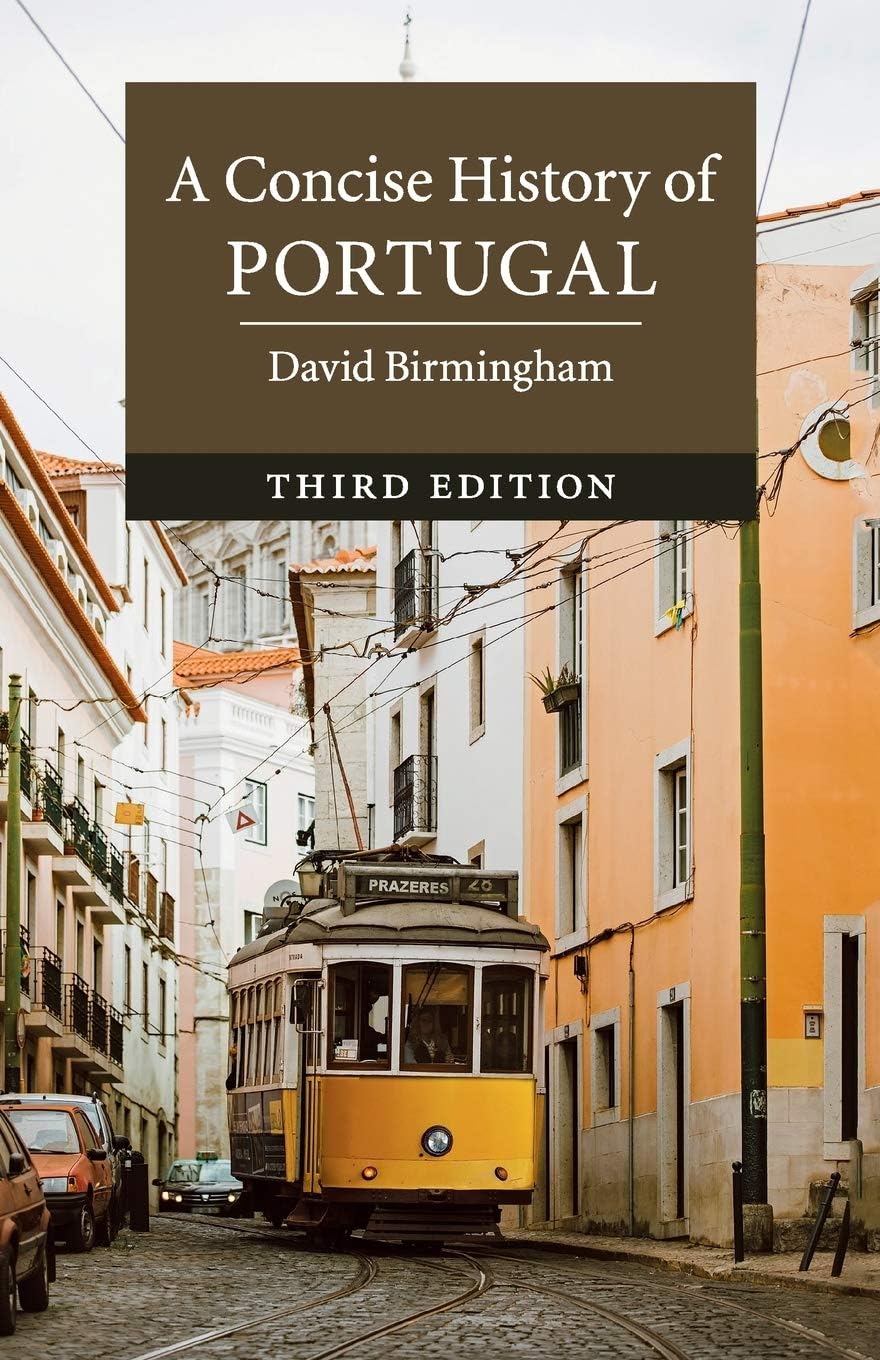
A Concise History of Portugal (Cambridge Concise Histories)
Product ID: 203396703
Buy anything from 5,000+ international stores. One checkout price. No surprise fees. Join 2M+ shoppers on Desertcart.
Desertcart purchases this item on your behalf and handles shipping, customs, and support to KUWAIT.
Buy A Concise History of Portugal (Cambridge Concise Histories) by Birmingham, David (ISBN: 9781108439558) from desertcart's Book Store. Free UK delivery on eligible orders. Review: Wonderful book - Wonderfully informative book that has been written in a way that takes the reader on a great voyage through time Review: It's rather boring - I had great hopes for this but, for my purposes, it's too long and involved. To be honest, it goes on and on and on. Lots of stuff about the economic woes: the Portuguese tried textiles, then they didn't, then they did again, then they didn't. King this, Marquis that and so on. Good heavens! I struggled though 30% of it and then gave up.
| Best Sellers Rank | 529,219 in Books ( See Top 100 in Books ) 53,798 in History (Books) |
| Customer reviews | 4.1 4.1 out of 5 stars (115) |
| Dimensions | 13.97 x 1.47 x 21.59 cm |
| Edition | 3rd |
| ISBN-10 | 1108439551 |
| ISBN-13 | 978-1108439558 |
| Item weight | 360 g |
| Language | English |
| Part of series | Cambridge Concise Histories |
| Print length | 254 pages |
| Publication date | 31 Mar. 2018 |
| Publisher | Cambridge University Press |
S**E
Wonderful book
Wonderfully informative book that has been written in a way that takes the reader on a great voyage through time
J**N
It's rather boring
I had great hopes for this but, for my purposes, it's too long and involved. To be honest, it goes on and on and on. Lots of stuff about the economic woes: the Portuguese tried textiles, then they didn't, then they did again, then they didn't. King this, Marquis that and so on. Good heavens! I struggled though 30% of it and then gave up.
C**N
Good overview of Portuguese History
A well researched book, well written and easy to ready. Would recommend this if you want an overview of Portuguese history.
W**K
Very reliable seller
Very good and quick service.
M**S
Great book, very well explaining the history of Portugal. I have learnt a lot about this amazing country, but I feel that the book could have been longer and better explain certain historical events or have 2 or 3 extra chapters covering certain periods more in-depth. Aside that small remark, if you want to learn more about Portugal and its turbulent past, go and buy it.
I**Y
The 2018 release of the third edition of David Birmingham's Concise History of Portugal is well-timed for me, as I'd been curious to try Cambridge's Concise Histories series and had also been wanting an accessible overview history of the country and its empire before ploughing into something more detailed or involved (such as A. R. Disney's two volume set 'A History of Portugal and the Portuguese Empire', for example). It's generally fit for purpose, though arguably too heavy on economic matters. This is perhaps understandable given that attempting to cover two millennia of history in a little over two hundred pages for a country that, while small, established an empire spanning four continents, is a necessarily reductive exercise. Birmingham is also something of a Lusophone African specialist, so there is a focus - one might even say a disproportionate one - on Angola and Mozambique compared to Goa, Macau, and East Timor. He often discusses political forces and the development of and interactions between the different classes and groups - such as the poor literacy of rural peasantry and their incentives to emigrate, the state antagonism towards the clergy, or the semi-colonial wealthy class of British capitalists, but always approached from an economic angle. One could be left with the impression that everything in the nation's history was the natural consequence of economic forces, so it would be nice to round it out a little more. The entry in this series for the comparable nation and empire of the Netherlands, for example, is twice as long, so more content could reasonably be added even in a 'concise' history. Birmingham is not unaware of such criticism of earlier editions however, and does recommend Angela Delaforce's 'Art and Patronage in Eighteenth-Century Portugal' which he says 'makes good some of the serious deficiencies in cultural history which readers noted in the present concise study'. He also recommends Marion Kaplan's 'The Portuguese' as a companion piece for this reason. As a function of this limited focus we are left without basic information one would think useful - such as an outline of the differences between the roles of President and Prime Minister. Or the way he talks of the name Fátima and could really do a better job of introducing what is meant by it; namely, that it is a town associated with alleged apparitions of the Virgin Mary, leading to a cult-like offshoot of Christianity. This may be the audience's first encounter with the name so he could have written about it more clearly. Nevertheless, it's nice to be given an introductory glimpse of aspects one wouldn't necessarily be familiar with from other history reading, such as the catastrophic Lisbon earthquake of 1755, the period of union with the Spanish crown and subsequent striving for independence, the points of difference between the authoritarian Salazar dictatorship and its fascist contemporaries, or the stunning extent of British economic dominance within their long-term strategic alliance. To nitpick further, there are moments where one wonders if a firm editor would have caused the wording to be reconsidered. For example: "The fundamentalists even rejected the constitutionalism of the exiled Manuel II and proposed a Miguelite absolutist as candidate for the vacant throne. The anti-semitism of the 1920s into Portuguese politics." Am I being dense, or is that a fragmentary sentence that needs more words and context to make sense? "He was Salazar's most tenacious political rival and had the Catholic-led politicians failed to sustain the conservative consensus Norton de Matos would probably have been the focus for a masonic-led coalition of military and civilian interests." I'm dubious about blatantly speculative statements such as this in history books. What does it add? By what sources is it supported? Is this really the best possible standard of academic rigour? "Barroso came to world attention when Portugal hosted a meeting on the Azores Islands in the mid-Atlantic at which George Bush and Tony Blair agreed to invade Iraq, thereby precipitating a catastrophic disintegration in the Middle East." Why did this sentence continue after the word 'Iraq'? The 'disintegration' observation tells us nothing of Portuguese history and is too simplistic to tell us anything of Middle Eastern or world history. It suggests a lack of editorial discipline. And would it not have been better to specify George W. Bush rather than George Bush for the benefit of clarity? Then, in the very next sentence: "In Europe Barroso became a compromise candidate for the presidency when France vetoed an Irishman and Britain retaliated by barring any French nominee." Why did Britain have cause to 'retaliate' here? Who was this candidate? A Northern Irishman and hence a British citizen, or a Republican Irishman and therefore not a British Citizen, in which case what was Britain's relationship with him? This may not be an important point but it lacks clarity, and if it isn't clear it should be re-written or not included. The notes provide a number of sources for further reading, though most of these are decades old and one wonders what other options are available incorporating more recent scholarship. All in all, this is not the book it could be but it gets the job done.
W**B
There are so few excellent histories of Portugal. This is one.
B**N
This book does not start Portuguese history until 1640 although there is one chapter summarizing Portuguese history up to that point. I was very interested in learning more about Portuguese history in the 1400 and 1500s so somewhat disappointed. Also, very focused on economics and not so much on events.
M**S
I bought this book before a trip to Portugal. It is authoritative and well researched, but there is nothing here that captures the imagination.
Trustpilot
1 day ago
5 days ago