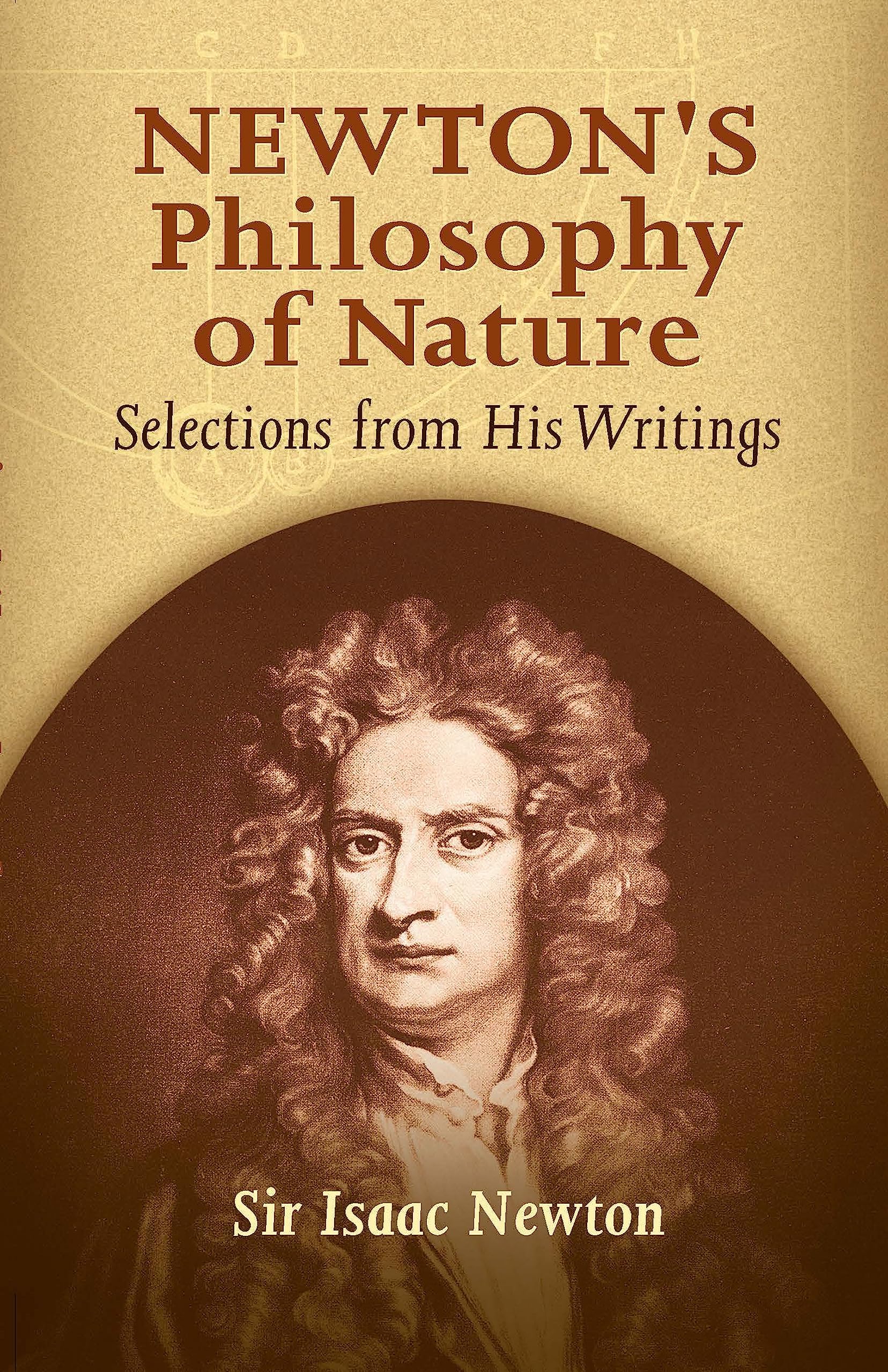
Newton's Philosophy of Nature: Selections from His Writings
Product ID: 2264073
Buy anything from 5,000+ international stores. One checkout price. No surprise fees. Join 2M+ shoppers on Desertcart.
Desertcart purchases this item on your behalf and handles shipping, customs, and support to KUWAIT.
Buy Newton's Philosophy of Nature: Selections from His Writings on desertcart.com ✓ FREE SHIPPING on qualified orders Review: ''Theology, indeed, rarely distorts science; but science, in the hands of modernists, is always corrupting sound theology'' - ''Theology, indeed, rarely distorts science; but science, in the hands of modernists like Newton, is always corrupting sound theology.'' (This from introduction) 'Science corrupts theology' What! '''Modernistic or liberal theology, ever anxious to accommodate itself to the latest fashion in ideas, is at the present moment in some disrepute, since it is not intellectual acceptance but moral rejection of our world that seems of pressing religious concern to our most sensitive theologians and prophets.'' Religion appears 'immoral' to most. Why wickedness? Why suffering? Why injustice? ''But our Western religions, which from the beginning have had to live with Greek thought, have never long been able to maintain a faith in serious conflict with the best available knowledge. Even shorter have been the intervals when the temporary expedient of assigning knowledge and faith to separate and mutually exclusive realms has remained successful. What Philo Judaeus, the Alexandrian doctors, and St. Augustine did with consummate skill, what Maimonides and St. Thomas did for a different science with no less skill, if less enduring success, Newton and his theological followers attempted once more in the eighteenth century.'' Keen insight. Augustine combined Plato and Christ. Catholicism then more platonic than Christian; Trinity, immortal soul, hellfire, are Greek, not scriptural. Aquinas mixed Aristotle and Catholicism. When Pascal/Galileo/Newton overthrew Aristotle, Catholicism never recovered. ''If their efforts in rational, or natural, religion were unfortunate rather than blessed with success, any theologian—whether he rejects the whole enterprise of natural theology or resolves to take his place in the long line of his predecessors who have likewise sought to adjust religious insight to modern knowledge—can learn much from a careful study of this particular episode in the history of religious thought.'' (101). Well said. Newtonian science was used to create 'natural law', which superseded (improved) scriptural commandments. Religious faith weakened, due to wrong foundation. Why? ''After two centuries of battles fought in the name of warring theologies and church polities, most men were only too glad to welcome this new natural philosophy as a secular alternative to religious quarrels of which they had grown tired. Many wanted to forget theology and get down to business, especially that middle class which in Western Europe had been growing so rapidly in economic strength and was now making ready to take over political power as well, in the great revolutions of the end of the century.'' 'Get down to business'! '''What the middle class needed was a new set of ideas to provide the intellectual leverage for dislodging the lingering feudal landlords and breaking the hold of the older social controls of industry, now grown restrictive. For them, “Newtonian science” furnished a “Nature” fully as effective as the earlier “will of God.” It had, in fact, at last demonstrated what the will of God really was; and what it demonstrated was that the Divine Will had decreed a mechanism that worked automatically without further interference.'' Think Comte, Hegel, Marx. ''No wonder that the social philosophies that endeavored to extend scientific methods to human affairs pointed to a similar autonomous order as the highest wisdom for conducting the life of man. Thus the Newtonian philosophy of nature was made into what a later jargon calls “the ideology of the bourgeois revolution.” Introduction: What Isaac Newton started. I. The Method of Natural Philosophy II. Fundamental Principles of Natural Philosophy III. God and Natural Philosophy IV. Questions on Natural Philosophy V. Questions from the Optics Notes Selected Bibliography Newton's letter to a friend . . . ''This most beautiful system of the sun, planets, and comets could only proceed from the counsel and dominion of an intelligent and powerful Being. . . . And lest the systems of the fixed stars should, by their gravity, fall on each other, he hath placed those systems at immense distances from one another.'' (42) Fascinating insight! This before the staggering light-years were known! Then commenting on God . . . ''We have ideas of his attributes, but what the real substance of anything is we know not.'' Human knowledge of the person of god is non-existent. By comparison, what about the knowledge of human bodies? ''In bodies we see only their figures and colors, we hear only the sounds, we touch only their outward surfaces, we smell only the smells and taste the savors, but their inward substances are not to be known either by our senses or by any reflex act of our minds; much less, then, have we any idea of the substance of God.'' (44) We don't even know what our own body is made of! Nevertheless, the Creator must be a person, not . . . ''Blind metaphysical necessity, which is certainly the same always and everywhere, could produce no variety of things. All that diversity of natural things which we find suited to different times and places could arise from nothing but the ideas and will of a Being necessarily existing.'' (44) Marvelous reasoning! Another deep insight . . . ''But how the matter should divide itself into two sorts, and that part of it which is fit to compose a shining body should fall down into one mass and make a sun and the rest which is fit to compose an opaque body should coalesce, not into one great body, like the shining matter, but into many little ones; or if the sun at first were an opaque body like the planets or the planets lucid bodies like the sun, how he alone should be changed into a shining body whilst all they continue opaque, or all they be changed into opaque ones whilst he remains unchanged, I do not think explicable by mere natural causes, but am forced to ascribe it to the counsel and contrivance of a voluntary Agent.'' (47) Of course, we now understand the nuclear reaction causing 'lucid' (shining) stars. This has not reduced Newton's amazing insight. The incredible fine tuning of - gravity, electromagnetic and nuclear forces - that allows for stars, is more miraculous than even Newton could have imagined! Newton now reasons that the wild orbits of comets confirm that - 'blind fate could never make all the planets move one and the same way in orbs concentric.' ''Now by the help of these principles all material things seem to have been composed of the hard and solid particles above mentioned, variously associated in the first Creation by the counsel of an intelligent Agent. For it became him who created them to set them in order. And if he did so, it is unphilosophical to seek for any other origin of the world or to pretend that it might arise out of a chaos by the mere laws of nature, though being once formed it may continue by those laws for many ages. For while comets move in very eccentric orbs in all manner of positions, blind fate could never make all the planets move one and the same way in orbs concentric,'' (175) Review: Take your time - Take your time. Savor each word. You are lucky. You have Google. In the old days it took years to understand this work. The words of the man himself.
| Best Sellers Rank | #116,651 in Books ( See Top 100 in Books ) #152 in Cosmology (Books) #358 in History & Philosophy of Science (Books) #2,886 in Philosophy (Books) |
| Customer Reviews | 4.5 out of 5 stars 29 Reviews |
C**R
''Theology, indeed, rarely distorts science; but science, in the hands of modernists, is always corrupting sound theology''
''Theology, indeed, rarely distorts science; but science, in the hands of modernists like Newton, is always corrupting sound theology.'' (This from introduction) 'Science corrupts theology' What! '''Modernistic or liberal theology, ever anxious to accommodate itself to the latest fashion in ideas, is at the present moment in some disrepute, since it is not intellectual acceptance but moral rejection of our world that seems of pressing religious concern to our most sensitive theologians and prophets.'' Religion appears 'immoral' to most. Why wickedness? Why suffering? Why injustice? ''But our Western religions, which from the beginning have had to live with Greek thought, have never long been able to maintain a faith in serious conflict with the best available knowledge. Even shorter have been the intervals when the temporary expedient of assigning knowledge and faith to separate and mutually exclusive realms has remained successful. What Philo Judaeus, the Alexandrian doctors, and St. Augustine did with consummate skill, what Maimonides and St. Thomas did for a different science with no less skill, if less enduring success, Newton and his theological followers attempted once more in the eighteenth century.'' Keen insight. Augustine combined Plato and Christ. Catholicism then more platonic than Christian; Trinity, immortal soul, hellfire, are Greek, not scriptural. Aquinas mixed Aristotle and Catholicism. When Pascal/Galileo/Newton overthrew Aristotle, Catholicism never recovered. ''If their efforts in rational, or natural, religion were unfortunate rather than blessed with success, any theologian—whether he rejects the whole enterprise of natural theology or resolves to take his place in the long line of his predecessors who have likewise sought to adjust religious insight to modern knowledge—can learn much from a careful study of this particular episode in the history of religious thought.'' (101). Well said. Newtonian science was used to create 'natural law', which superseded (improved) scriptural commandments. Religious faith weakened, due to wrong foundation. Why? ''After two centuries of battles fought in the name of warring theologies and church polities, most men were only too glad to welcome this new natural philosophy as a secular alternative to religious quarrels of which they had grown tired. Many wanted to forget theology and get down to business, especially that middle class which in Western Europe had been growing so rapidly in economic strength and was now making ready to take over political power as well, in the great revolutions of the end of the century.'' 'Get down to business'! '''What the middle class needed was a new set of ideas to provide the intellectual leverage for dislodging the lingering feudal landlords and breaking the hold of the older social controls of industry, now grown restrictive. For them, “Newtonian science” furnished a “Nature” fully as effective as the earlier “will of God.” It had, in fact, at last demonstrated what the will of God really was; and what it demonstrated was that the Divine Will had decreed a mechanism that worked automatically without further interference.'' Think Comte, Hegel, Marx. ''No wonder that the social philosophies that endeavored to extend scientific methods to human affairs pointed to a similar autonomous order as the highest wisdom for conducting the life of man. Thus the Newtonian philosophy of nature was made into what a later jargon calls “the ideology of the bourgeois revolution.” Introduction: What Isaac Newton started. I. The Method of Natural Philosophy II. Fundamental Principles of Natural Philosophy III. God and Natural Philosophy IV. Questions on Natural Philosophy V. Questions from the Optics Notes Selected Bibliography Newton's letter to a friend . . . ''This most beautiful system of the sun, planets, and comets could only proceed from the counsel and dominion of an intelligent and powerful Being. . . . And lest the systems of the fixed stars should, by their gravity, fall on each other, he hath placed those systems at immense distances from one another.'' (42) Fascinating insight! This before the staggering light-years were known! Then commenting on God . . . ''We have ideas of his attributes, but what the real substance of anything is we know not.'' Human knowledge of the person of god is non-existent. By comparison, what about the knowledge of human bodies? ''In bodies we see only their figures and colors, we hear only the sounds, we touch only their outward surfaces, we smell only the smells and taste the savors, but their inward substances are not to be known either by our senses or by any reflex act of our minds; much less, then, have we any idea of the substance of God.'' (44) We don't even know what our own body is made of! Nevertheless, the Creator must be a person, not . . . ''Blind metaphysical necessity, which is certainly the same always and everywhere, could produce no variety of things. All that diversity of natural things which we find suited to different times and places could arise from nothing but the ideas and will of a Being necessarily existing.'' (44) Marvelous reasoning! Another deep insight . . . ''But how the matter should divide itself into two sorts, and that part of it which is fit to compose a shining body should fall down into one mass and make a sun and the rest which is fit to compose an opaque body should coalesce, not into one great body, like the shining matter, but into many little ones; or if the sun at first were an opaque body like the planets or the planets lucid bodies like the sun, how he alone should be changed into a shining body whilst all they continue opaque, or all they be changed into opaque ones whilst he remains unchanged, I do not think explicable by mere natural causes, but am forced to ascribe it to the counsel and contrivance of a voluntary Agent.'' (47) Of course, we now understand the nuclear reaction causing 'lucid' (shining) stars. This has not reduced Newton's amazing insight. The incredible fine tuning of - gravity, electromagnetic and nuclear forces - that allows for stars, is more miraculous than even Newton could have imagined! Newton now reasons that the wild orbits of comets confirm that - 'blind fate could never make all the planets move one and the same way in orbs concentric.' ''Now by the help of these principles all material things seem to have been composed of the hard and solid particles above mentioned, variously associated in the first Creation by the counsel of an intelligent Agent. For it became him who created them to set them in order. And if he did so, it is unphilosophical to seek for any other origin of the world or to pretend that it might arise out of a chaos by the mere laws of nature, though being once formed it may continue by those laws for many ages. For while comets move in very eccentric orbs in all manner of positions, blind fate could never make all the planets move one and the same way in orbs concentric,'' (175)
R**E
Take your time
Take your time. Savor each word. You are lucky. You have Google. In the old days it took years to understand this work. The words of the man himself.
J**N
The Newton you weren't told about in school.
A must-read for any science student or enthusiast. Among his writtings on gravity, light, the absoluteness and relativity of infinity and centripetal force, Newton brings to our attention the Almighty God who created it all. Newton clearly states in chapter three of Philosophy of Nature that the harmony of our solar system is the effect of choice of the Author of life, rather than blind chance. The year after chemist Robert Boyle passed away, Dr. Richard Bentley was chosen to present the first of the Boyle Lectures. Four of the segments of chapter three are Newtons replies to letters written by Dr. Bentley. In addition to affirming the Biblical global flood, the absurdity of common descent of man, and the apparent fine-tuning of the heavens, Newton closes this chapter with a beautiful testimony declaring the goodness and high worth of God while showing our need for a saviour.
S**A
Newton's stupendous intellect is very evident. His views on ...
Newton's stupendous intellect is very evident. His views on God are noteworthy, and stem from his deep understanding of nature.
R**I
This is great that someone took the time to put this together
It is hard to imagine a mind as great as Newton. This book has some nice selections of writings. Sometimes I am too stupid to understand them though!
J**S
Modern English version
This does not seem to be a totally comprehensive review as it does not take any account of his voluminous alchemical writings, for example, and perhaps another introduction to this edition would be appropriate, along with supplementary diagrams to his explainations. Nevertheless, it is does transcribe Newton's rather free 16C spelling without spoiling his racy English and translates where he slips into his equally good Latin.
R**A
Five Stars. Excellent book.
Another valuable book to own, next to 'The Age of Reason'.
S**E
Five Stars
Great product and quick delivery.
Trustpilot
2 weeks ago
3 weeks ago