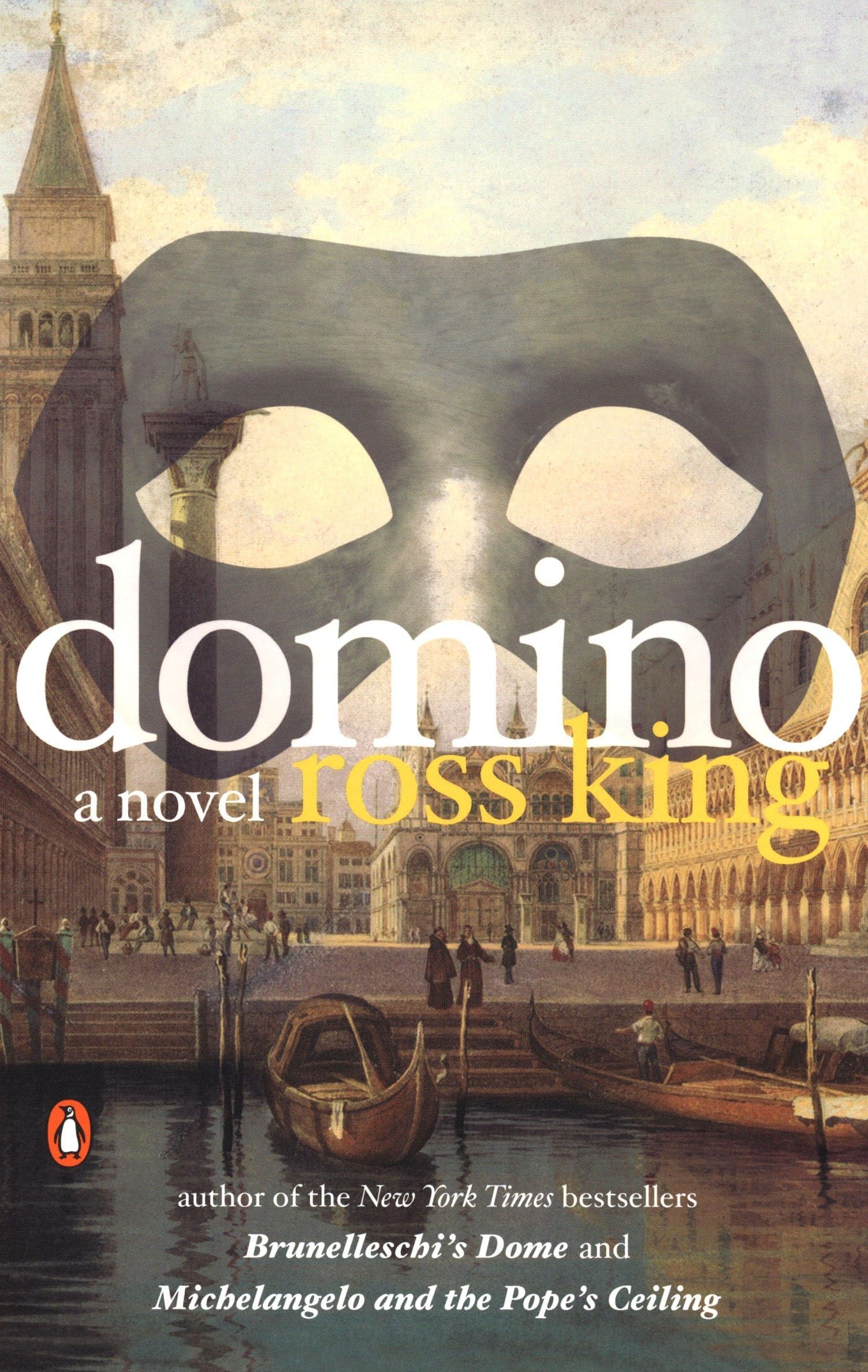
Domino
Product ID: 24962638
Desertcart purchases this item on your behalf and handles shipping, customs, and support to KUWAIT.
Domino [King, Ross] on desertcart.com. *FREE* shipping on qualifying offers. Domino Review: Wonderful book for a literati taste - This is not the usual blockbuster, for the usual readers. It is full of splendid sentences and vivid descriptions, an old-world marvel that nobody writes these days. It is slow, it is gorgeously written with humor and great sensibility. Review: Couldn't finish it - I'd read "The Judgment of Paris" a work of non-fiction set in mid 19th visual arts scene of Paris, by Ross King and unreservedly loved it. Yet Domino was so tortured in its language, presumably an attempt to recreate the cadence of 18th English, I couldn't complete it. I had no empathy or interest in its characters either.
| Best Sellers Rank | #3,313,181 in Books ( See Top 100 in Books ) #1,236 in Renaissance Literary Criticism (Books) #31,165 in Contemporary Literature & Fiction #76,003 in Literary Fiction (Books) |
| Customer Reviews | 3.7 3.7 out of 5 stars (20) |
| Dimensions | 5.12 x 0.98 x 7.99 inches |
| Edition | Reprint |
| Grade level | 12 and up |
| ISBN-10 | 0142003360 |
| ISBN-13 | 978-0142003367 |
| Item Weight | 12.8 ounces |
| Language | English |
| Print length | 448 pages |
| Publication date | December 30, 2003 |
| Publisher | Penguin Publishing Group |
| Reading age | 18 years and up |
C**E
Wonderful book for a literati taste
This is not the usual blockbuster, for the usual readers. It is full of splendid sentences and vivid descriptions, an old-world marvel that nobody writes these days. It is slow, it is gorgeously written with humor and great sensibility.
V**O
Couldn't finish it
I'd read "The Judgment of Paris" a work of non-fiction set in mid 19th visual arts scene of Paris, by Ross King and unreservedly loved it. Yet Domino was so tortured in its language, presumably an attempt to recreate the cadence of 18th English, I couldn't complete it. I had no empathy or interest in its characters either.
M**A
Excellent reading, history , politics, economy, everything to make the time and setting of the novel complete. Easy and enjoyabl
Excellent history background. Love Ross style and cultural baggage in all his books (i've purchased 6 all from Amazon)easy and enjoyable reading loaded with facts
L**T
Painterly masquerade
Narrator George Cautley is an old man at the opening of this lush, dense story of 18th century London, King's first novel (written before his bestsellers, "Ex-Libris" and "Brunelleschi's Dome"). At a masquerade ball Cautley captures a young man's attention with the portrait miniature of a beautiful woman known as Lady Beauclair. Cautley offers to tell the boy his - and her - story, a tale of innocence and masquerade, deception, jealousy and corruption, that ends, Cautley says, with his becoming a murderer. Cautley's narrative is actually two life histories, 50 years apart. His tale begins with his arrival in London in 1770 at age 17, and the second, Lady Beauclair's story of the operatic castrato Tristano, takes place 50 years earlier and is told to Cautley as Beauclair sits for her portrait. Yes, this becomes confusing, but the reader's disorientation is part of the fun, dovetailing playfully with King's themes of elusive identity, perception and deceptive appearance. Cautley comes to London seeking his fortune as a portrait painter. The orphaned son of a country parson, he is earnest, naïve, clumsy, ambitious, and a bit of a prig. A potent combination. Taken by his rich friend Toppie to one of the masquerades so popular at the time, Cautley is relieved of what little money he has by a set of genial card sharps who gladly lend him more. His resulting insurmountable debt turns out to be his best luck, as the lender is none other than the man Cautley has been trying to meet, the famous portrait painter Sir Endymion Starker. Later at the same party Cautley becomes disoriented by the numerous passageways, and is rescued by a glamorous costumed lady who bears a startling resemblance to a portrait he has just been admiring on the wall. Lady Beauclair invites Cautley to paint her portrait and hear the life story of the old man in the garden whose curious plight has caught Cautley's eye. Beauclair's lodgings are in a decrepit, even dangerous part of town, but her rooms are elegant and her portrait costume most provocative. As her dress slips down her shoulder and the light from a single candle dances over her artfully painted face, she relates the sad, passionate story of the impoverished Italian boy who became one of the greatest singers in Italy in the 1720s. Cautley, entranced by Beauclair's aspect, ("the face that, as its vizard was removed, tallied in every point with my youthful standard of beauty") intimidated by her boldness, and in awe of her mystery, disregards some of the more doubtful elements of her allure. Meanwhile, Cautley discharges his gambling debt to Starker, the great painter, by becoming his temporary apprentice. Starker has two studios - his big fashionable public address, where the rich come to have their portraits painted - and his secret, shabby bolt-hole where he keeps an angry mistress and paints his "true" art. Beauclair takes Tristano toward his fate in the London opera houses, Cautley succumbs to a corrosive jealousy, and Starker reveals himself (in Cautley's judging eyes) to be a hypocrite in matters of love as well as art. Every straightforward drama and intrigue is draped and shadowed with mystery, illusion and doubt. Identities are obscured by costumes and masks, and motives are similarly cloaked. Much of the narrative takes place at the elaborate masquerades popular at the time (and 50 years earlier), where lords dressed like buxom serving maids or lusty soldiers and ladies wore the raiments of goddesses or shepherdesses. And those with real secrets wore dominos, the simple robe which hides form, figure and face. King's writing is painterly. Paragraphs hurtle through teeming crowds and elaborate costumes and extravagant decadence as he immerses the reader in the period. There's fascinating detail on the lives of the castrati, the rigid demarcations of class, and attitudes toward art, music and morality, public and private. Hypocrisy and deception abound. Though beautifully written, with an intriguing, suspenseful plot and vivid historical detail, the novel has a few minor plot flaws (why, for instance, would a prominent and wealthy painter bother fleecing an impoverished country bumpkin?) and a larger character flaw. Cautley, the naïf who becomes corrupted by his doubts, is not that likable to begin with and he diminishes through experience. Lady Beauclair is fascinating but ultimately unknowable and Tristano, barely glimpsed in the flesh, is more pawn than power. In other words, there are no heroes in King's elusive and colorful world. But it's a fascinating, evocative world and King's prose is pure pleasure.
S**N
Odd and unsatisfactory
Halfway through Domino I was seriously beginning to wonder whether the author was visually impaired, not a native speaker of English, or both. Even allowing for the strain of writing in a pastiche of eighteenth-century English, the language is just odd - is there any native English-speaker who doesn't feel the word "waggle" to be inherently silly? It is used here in passages of high drama. And the "evocative descriptions of the sights, sounds, smells and society of eighteenth-century London" which are promised on the back cover, and do indeed fill the book, persistently give the impression that the author had never seen the things he is describing - very odd in a novel about a painter! It's not only the descriptions of historical details that are out of kilter (surely anyone who has ever looked at Hogarth's pictures of London low-life would have noticed that the women don't wear buttoned blouses? - or that it would be impossible for them to "unbutton the tops of their petticoats" in the street to attract custom?) - everyday things are misdescribed in odd ways; as when the face of a character who chokes goes "the colour of Rhenish wine" - pale yellow - despite wearing thick heavy make-up. The behaviour and manners of the characters is quite improbable for the period. A threadbare would-be painter could not possibly mix in society with a rich lord as a social equal, and could certainly not address or refer to him by a nickname. Nor would a fashionable portraitist demand that a stranger visiting him would dress up in the clothes of a wealthy lady client so he could go on painting her portrait - a life-size lay figure for that purpose was a basic piece of an artists equipment. And so on, and so forth. This might not matter if the characters and the story were interesting, but they aren't. I would call this book a failure on every level.
B**E
Canadian Literature
A few years ago a few friends and I saw a movie that said there was no Canadian Literature. As the only American in the group they bombarded me with books - of all of them good, but two stood out. This was one of those two books. It's got history, suspence, wild adventure, sex, disgust- all the good makings of high drama and . . . literature.
P**W
I read this book for the first time around 15 years ago when it was sent to me for review. I loved it then as it reminded me of my all time favourite book 'Perfume' by Patrick Suskind. A few months ago, seized by nostalgia I reordered this, and 'Ex Libris' . Both are five star reads, world into which one can escape and feel, smell and almost touch the characters and surroundings. I just wish Mr King would write more fiction.
Trustpilot
1 month ago
2 weeks ago