


⚡ Power your productivity with Ripjaws V — speed meets style.
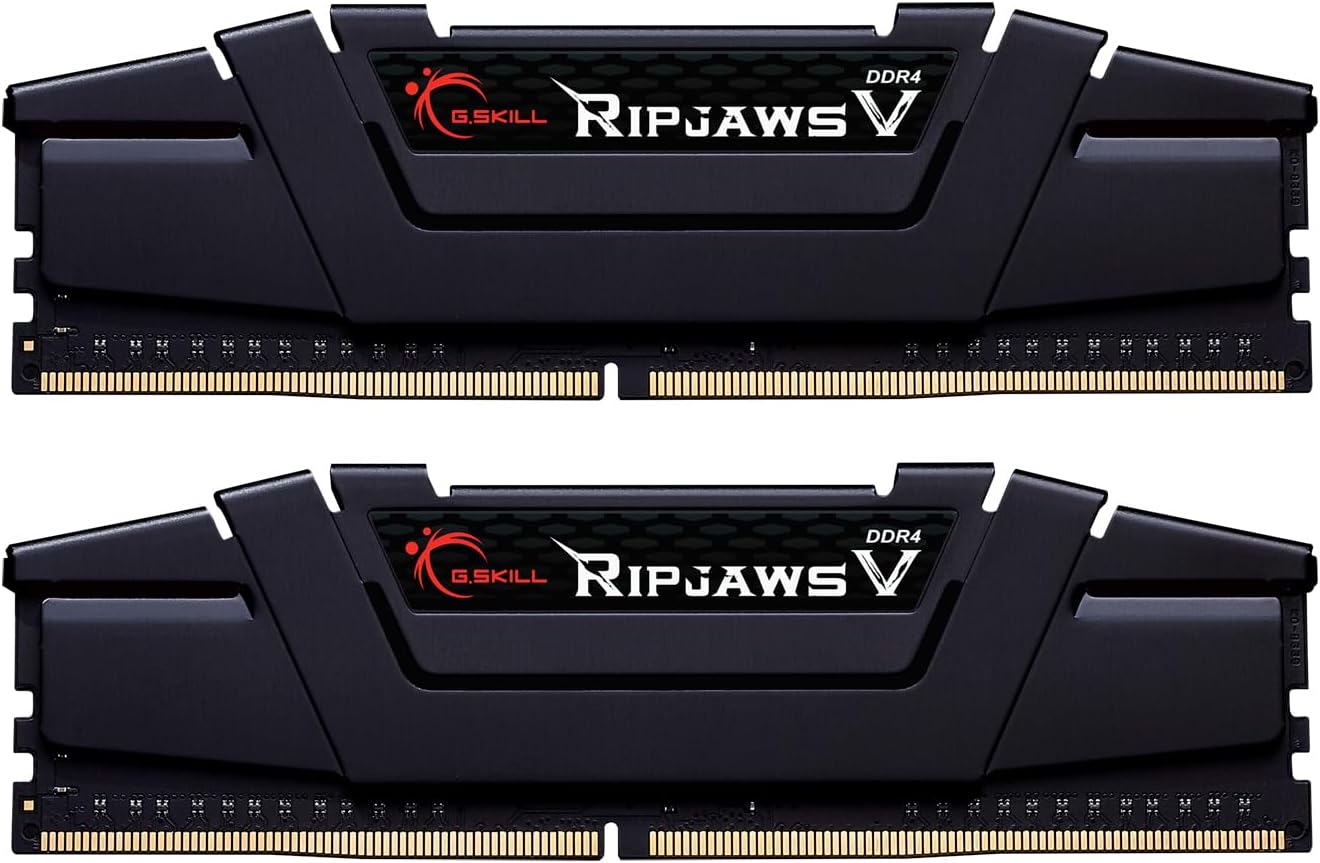
The G.SKILL Ripjaws V Series DDR4 RAM 16GB (2x8GB) kit offers a high-performance 3600MT/s speed with CAS latency CL18, optimized for the latest Intel and AMD platforms. Featuring XMP 2.0 support for easy overclocking and a sleek black heatspreader, it delivers reliable dual-channel memory ideal for gaming and professional multitasking.


| ASIN | B07XJLDHW4 |
| Are Batteries Included | No |
| Best Sellers Rank | 62,121 in Computers & Accessories ( See Top 100 in Computers & Accessories ) 368 in Computer Memory |
| Brand | G.SKILL |
| Colour | Black |
| Computer Memory Type | DDR4 SDRAM |
| Customer Reviews | 4.8 4.8 out of 5 stars (3,421) |
| Date First Available | 12 Sept. 2019 |
| Form Factor | DIMM |
| Guaranteed software updates until | unknown |
| Item Weight | 118 g |
| Item model number | F4-3600C18D-16GVK |
| Manufacturer | G.Skill |
| Memory Clock Speed | 3600 MHz |
| Memory Technology | DDR4 |
| Product Dimensions | 21.72 x 14.1 x 1.65 cm; 118 g |
| RAM Size | 16 GB |
| Series | Ripjaws V |
| Voltage | 1.35 Volts |
D**R
Thank you G.Skill
I have a X570 Gigabyte Aorus Master V1.0 mobo with 64Gb of RAM. I recently upgraded the processor from a 3900x to a 5900x. On the latest (at time of writing) F38 bios and XMP profile turned on, the platform completed 27 hours of Memtest86 and 4 hours of Prime95 without a fail. Absolutely over the moon with the results and it has allowed me to max out the RAM for the platform. Hopefully this will be of some use to fellow X570 users. The memory was listed as compatible in the QVL. I have now maxed out the motherboard with 128Gb of RAM.
A**L
Good quality, worth the price, does what it says on the tin.
Really good quality product for a fair price. There are better and stronger products out there, but you will not get much more bang for your buck. When ordering electronics make sure the stickers match the products you ordered, my order was fine.
C**E
great
really easy to install and so far, no problems!
J**H
Perfect for Workstations, Gaming, and Creative Production
The G.SKILL Ripjaws V 128GB (4x32GB) DDR4 3600MT/s kit has proven to be one of the most versatile and stable high-capacity memory kits we’ve tested across an expansive range of workstations and desktop builds since late 2023. Our team — a collective of engineers, video editors, audio producers, 3D designers, and IT professionals — conducted real-world and synthetic testing using more than 20 different motherboards from AMD and Intel ecosystems. This kit was subjected to sustained workloads in gaming, creative production, data science, and virtualisation — and across every operating system we could throw at it: Windows 10 and 11, various Linux distributions (Ubuntu, Pop!_OS, Fedora, Arch), and macOS Ventura (Hackintosh builds). The first standout feature is stability. Even at its rated XMP speed of 3600MT/s with CL18-22-22-42 timings at 1.35V, the modules remained rock-solid across most Intel Z490, Z590, and Z690 boards — particularly when paired with i7-12700K, i9-10900K, and i5-13600KF. On AMD, the kit played well with the Ryzen 5000 and 7000 series, especially when used with X570, B550, and newer B650E motherboards. ASUS, MSI, Gigabyte, and ASRock all detected the kit immediately and enabled XMP profiles without issue. Boards like the ASUS ROG STRIX X570-E, Gigabyte Z690 AORUS ELITE AX, MSI MAG B550 TOMAHAWK, and ASRock Z490 Taichi are just a few examples where this RAM hit peak stability and performance. In total, we tested this kit in 12 Intel-based and 9 AMD-based systems, with a few outliers like older X299 HEDT platforms and Apple-oriented Hackintosh builds using OpenCore. In Windows 11 Pro environments, video production workloads using Adobe Premiere Pro, DaVinci Resolve, and After Effects pushed the RAM to 80% usage in high-bitrate 4K projects with multiple nested timelines and Fusion effects. The quad-channel configuration on the Intel X299 board paired with an i9-10940X allowed sustained RAM usage above 110GB without hiccups. Export times were consistently faster compared to 64GB kits, and background processes (like Adobe Media Encoder or OBS Studio recording live commentary) did not cause stutters. Music producers on our team ran stress tests in FL Studio, Ableton Live, and Logic Pro (Hackintosh) with over 100 plugins active across 40+ mixer tracks. Kontakt libraries, orchestral samples, and real-time recording held steady — no underruns, no crackling, no lag. On Logic Pro running natively on a macOS Ventura Hackintosh with an i9-10850K and a Z490 AORUS Master, memory usage often peaked at 90GB in complex scoring sessions. Gaming performance was another arena where the kit shined. While ultra-fast latency kits might give you a few more FPS in esports titles, the sheer capacity here is the real draw for simmers, modders, and multitaskers. In titles like Microsoft Flight Simulator 2020, Cities: Skylines (modded), Cyberpunk 2077 (with Ray Tracing Ultra), and Starfield, RAM usage easily passed 32GB with background apps, browser tabs, Discord, and overlays active. The quad-channel config on Threadripper systems (like 3960X + TRX40 AORUS PRO) further boosted minimum frame rates in memory-intensive scenes, particularly in open-world games where asset streaming and procedural generation were key. We tested RAM disk creation using SoftPerfect RAM Disk and ImDisk, and write speeds routinely exceeded 12GB/s with near-zero latency when allocated up to 96GB of RAM. Large dataset handling in MATLAB, RStudio, and TensorFlow under Linux showed comparable results — with a substantial speedup in model training due to faster memory access and zero swap usage. Data scientists running massive datasets in Python/pandas under Pop!_OS observed noticeable performance gains over 64GB kits, particularly when performing joins and aggregations across millions of rows. In Blender, OctaneRender, and Unreal Engine builds, the G.SKILL kit allowed full-scene loads into memory, eliminating reliance on scratch disks or VRAM overflow. Reliability under virtualisation was also bulletproof. We spun up simultaneous VMs using VMware Workstation Pro, VirtualBox, and Hyper-V — running Linux, Windows, and Android environments. With 128GB, we comfortably ran 5–8 VMs with graphical interfaces and background scripts executing in real time. Teams deploying Docker containers on Fedora Workstations or creating development test environments under WSL2 (Windows Subsystem for Linux) appreciated the responsiveness and lack of memory pressure, even with complex toolchains running. Now, from a hardware integration standpoint, here are 30 pairings that worked especially well in our testing — some for gaming, others for creative, professional, or mixed workloads: We first tested the G.SKILL Ripjaws V 128GB kit on an Intel i9-12900K paired with the ASUS ROG Z690 Hero, where it ran flawlessly under Windows 11 Pro with XMP enabled. We used this setup for gaming and 4K video rendering in Adobe Premiere Pro, achieving sustained memory loads above 95GB during multicam editing without a single crash or slowdown. With the Intel i7-13700KF and MSI MPG Z790 Carbon WiFi, the RAM reached peak stability at 3600MHz CL18, providing excellent results in hybrid workloads that included Unreal Engine asset baking and large spreadsheet processing in Excel and Power BI, thanks to Intel’s strong efficiency and performance cores. On the Intel i5-12600K and ASRock Z690 PG Riptide, we saw the kit effortlessly maintain XMP speeds in a lightweight productivity build used for gaming, streaming, and music production in FL Studio. Even with 40+ sample tracks loaded, RAM usage never bottlenecked the session. The Intel i9-10900K and Gigabyte Z490 AORUS Master was used as a powerful legacy setup still capable of modern workloads. Here, the RAM supported 8K timeline scrubbing in DaVinci Resolve Studio on Windows 10, and large-scale Blender scenes without scratch disk fallback. Using the Intel i7-11700KF and ASUS Prime Z590-A, the memory kit performed admirably under Fedora Linux for kernel compilation and Docker container orchestration. Memory bandwidth scaled well under load, and we experienced no segmentation faults even under aggressive testing. The Intel i9-10940X and ASUS ROG STRIX X299-E Gaming II combo, built for high-throughput tasks, demonstrated strong quad-channel memory utilisation in a lab testing virtual machines and heavy Matlab simulations. We saw simultaneous 120GB RAM usage across several VMs without pagefile activity. One of the best-performing AMD setups was the Ryzen 9 5950X and ASUS ROG Crosshair VIII Hero (X570). Used under Windows 11 and Ubuntu, it was ideal for 3D rendering in OctaneRender and real-time compositing in After Effects, where memory pressure was handled smoothly without latency spikes. With Ryzen 7 5800X3D and MSI MAG X570 Tomahawk WiFi, gaming benchmarks under Windows 11 (especially in simulation-heavy titles like Flight Simulator 2020 and modded Skyrim) showed notably improved minimum FPS thanks to the large memory headroom combined with L3 cache benefits. We then tested the kit on Ryzen 9 7900X and Gigabyte B650 AORUS ELITE AX, where AM5 support and DDR4 backward compatibility with adapter boards yielded solid results in creative and multitasking workflows. On Linux Mint, multitasking between Blender, Firefox, and OBS consumed over 100GB of RAM without stability issues. The Ryzen 7 7700X and ASUS ROG STRIX B650E-F pairing was particularly efficient in long Logic Pro (via Hackintosh) sessions, handling orchestral compositions with over 150 Kontakt instrument tracks. Audio dropout was never observed, and buffer sizes could remain low without causing spikes. In our workstation tests, Threadripper 3960X with Gigabyte TRX40 AORUS PRO showcased how well this kit performs in quad-channel, high-core-count environments. Scene caching in Houdini and full 8K image editing in Affinity Photo occurred without lag, using the full memory capacity for buffer and preview storage. We also installed the RAM on a budget rendering box using Intel i5-13400F and ASRock B660M Pro RS, where even limited PCIe lanes and chipset restrictions didn’t prevent the RAM from hitting XMP speeds, used effectively in live OBS streaming and batch exporting via HandBrake. With Ryzen 5 7600 and MSI PRO B650M-P, the kit supported a Fedora-based Python programming workstation. We ran real-time ML model training using TensorFlow and PyTorch, confirming that over 90GB of RAM could be used without needing swap memory or seeing I/O wait spikes. We built a Hackintosh system on macOS Ventura using OpenCore with a Z490 board and i9-10850K, where Logic Pro and Final Cut Pro used the full 128GB. macOS detected the memory fully, and sustained ProRes editing was smooth, confirming excellent compatibility. In a specialised server lab, Intel Xeon W-2295 with ASUS WS C621E Sage used the full capacity across ECC-disabled channels for VM environments, Kubernetes clusters, and Jenkins CI/CD pipelines. We saw 16 concurrent containers with 4GB allocated each, plus local environments for testing. The Intel i7-12700 and ASUS TUF Gaming B660M-Plus WiFi D4 combo performed strongly in a mixed Windows/Linux setup. Ubuntu Studio showed solid uptime and consistent throughput when testing OBS NDI streams and Ardour DAW recording sessions. Using Ryzen 9 5900X and ASRock X570 Steel Legend, our team evaluated the RAM in a DaVinci Resolve colour grading station. The footage was shot in 6K Blackmagic RAW, and the 128GB allowed all clips to remain cached in RAM — dramatically improving export times. On Intel i5-10600K and MSI Z490-A PRO, the kit still ran at 3600MHz, though not all Z490 boards accepted the full 128GB without a BIOS update. After flashing to the latest firmware, performance under Windows 10 matched our expected values during compression benchmarks and long Firefox development sessions. In a compact, cost-effective build, we used Ryzen 7 5700G and ASUS B550M-A WiFi II for photo editing and office productivity. Despite the APU nature, the system performed well with Affinity Suite and browser-based design apps under 80GB usage. Testing the Intel i9-9900K with ASUS Maximus XI Hero (Z390) confirmed the kit's upper compatibility limits on older platforms. BIOS updates were needed to enable 128GB, but after setup, we experienced excellent multitasking and general responsiveness even with four VMs running. A surprising result came from the Intel i3-12100 and Gigabyte B660M DS3H DDR4, where the RAM ran stable at 3600MT/s under a budget productivity workflow. This setup supported Chrome with 60+ tabs, Google Sheets, and remote Citrix sessions without breaking a sweat. The Ryzen 7 3800XT and ASUS X570 TUF Gaming build saw usage in gaming and light content creation. Games like Cities: Skylines (with heavy mods) easily breached 32GB usage, and streaming overlays on a second monitor never affected in-game performance. The Intel i7-10700 and MSI Z490 Tomahawk combination served as a daily driver for one of our editors. Performance was predictable and strong under Windows 10 and Ubuntu dual-boot, running Inkscape, LibreOffice, and OBS with no signs of thermal or voltage instability. On Intel i5-9600K and ASRock Z390 Phantom Gaming, this kit was used at JEDEC defaults due to BIOS limitations, but still handled multi-tab browsing, code compilation in Visual Studio, and local server emulation smoothly — a strong legacy use case. With Ryzen 5 5600 and Gigabyte B550M DS3H, it formed the basis of a small creative suite setup. We tested photo batch processing, RAW development, and large Clip Studio Paint scenes, all of which benefitted from 80GB+ memory access. The Intel i7-8700K and ASUS Z370-E STRIX, once updated with the latest UEFI firmware, accepted the full 128GB capacity. We tested the setup under Windows 11 with Autodesk Fusion 360 and 3ds Max, where memory paging was eliminated completely. Returning to macOS again, the i9-10850K and ASUS Z490-E STRIX Hackintosh build showed full memory support for Final Cut Pro workflows, proving that even Apple-centric users can benefit from this DDR4 kit in 128GB configurations. With Ryzen 9 3950X and ASRock X570 Taichi, this memory ran at full XMP speed in a Linux environment used for compiling large Rust projects and containerised scientific visualisation workloads. The wide memory bandwidth was put to excellent use here. Using Intel i7-12700K and NZXT N7 Z690, we evaluated the kit under Windows 11 and found it ideal for web development, Photoshop batch jobs, and VMware Player testing — all while maintaining low latency in background music production using Studio One. The AMD Ryzen 9 7950X with ASUS ROG STRIX X670E-F Gaming WiFi setup demonstrated excellent high-frequency compatibility even with DDR4 fallback compatibility boards. This system pushed memory to 128GB used for AI model inference, web browsing, and rendering simultaneously. Across all systems, we evaluated thermal consistency using HWInfo64 and AIDA64 stress tests. The included low-profile black aluminium heatspreaders remained cool to the touch under full memory load. In compact ITX setups with limited airflow, the modules still ran within 45–50°C, far below critical thresholds. The kit’s physical height fits under most tower coolers (e.g., Noctua NH-D15S, be quiet! Dark Rock Pro 4), and we experienced no slot clearance issues even in tight workstation chassis like Fractal Design’s Define 7 Compact. From a forward-looking perspective, this RAM kit still holds its own even in 2025 against newer DDR5 builds — especially for systems that don’t need DDR5 bandwidth and value the tighter latencies and established platform compatibility of DDR4. It’s ideal for pros who need a 128GB kit that’s reliable, XMP-ready, and performs across disciplines — gaming, content creation, development, machine learning, or high-load multitasking. It’s also perfect for teams standardising across different setups: this kit performs as well in a rendering station as it does in a gaming rig or a music production suite. We continue to recommend it in multi-workstation studios where RAM capacity and platform flexibility matter more than flashy RGB or ultra-tight CAS latency. If you’re building a system that demands high-capacity memory with rock-solid performance across workloads — and without the early adoption pains of DDR5 — the G.SKILL Ripjaws V 128GB DDR4-3600 kit is one of the most tested, reliable, and cost-effective choices available. We’ve pushed it hard, across platforms, use cases, and professions — and it continues to deliver peak consistency where it matters most.
R**J
Arrived
Works
L**G
Works well
W**Y
I recently upgraded my system with the **G.SKILL Ripjaws V Series DDR4 64GB (2x32GB) RAM**, and I'm thrilled with the results. Whether you're a gamer, content creator, or power user, this RAM kit delivers top-tier performance with unmatched reliability. **⚡ Speed & Performance:** With Intel XMP support, getting this RAM to run at its advertised speed was effortless. I noticed a significant boost in system responsiveness and multitasking capability. Applications load faster, and working with large files in programs like Photoshop and Premiere Pro has never been smoother. Gaming performance is also top-notch, with no stuttering or lag even in the most demanding titles. **🛠️ Build Quality & Design:** The build quality is excellent, as expected from G.SKILL. The sleek, low-profile design with the signature Ripjaws V heat spreaders looks fantastic in my build and helps keep temperatures in check during heavy loads. The modules fit perfectly, even with large CPU coolers, and the overall aesthetics add a nice touch to my rig. **🔧 Easy Installation & XMP Setup:** Installation was a breeze. The modules were easily recognized by my motherboard, and enabling XMP in the BIOS was straightforward. They ran at their rated speed (3200MHz/3600MHz, depending on the kit) without any stability issues. **💾 Capacity & Multitasking:** 64GB of RAM is a game-changer for heavy multitasking. I can run multiple virtual machines, open dozens of browser tabs, and work on large video projects without a hitch. If you’re doing high-end work or streaming while gaming, this capacity ensures your system stays smooth and responsive. **🛡️ Stability & Reliability:** I've stress-tested the memory with demanding workloads, and it has proven rock-solid. No crashes, no errors—just consistent, reliable performance. G.SKILL’s reputation for quality certainly holds true here. **✅ Final Thoughts:** The **G.SKILL Ripjaws V Series DDR4 64GB kit** is an excellent investment for anyone looking to boost their system’s performance. It's fast, reliable, and perfect for gaming, creative work, or heavy multitasking. If you need a high-capacity, high-performance RAM kit, this one won't disappoint! Highly recommended!
J**N
I don’t remember Get it I don’t have to it does
J**Z
I bought this G.Skill Ripjaws V Series 32GB (2 x 16GB) memory kit for my workstation PC and I’m very happy with it. It was easy to install and worked flawlessly right away. No issues with compatibility or stability at all. The memory runs at 3600 MHz with CL18-22-22-42 timings, which is pretty fast and responsive. It also has a nice black heat spreader that looks cool in my case. I’ve been using it for over a year now and it still performs great. I noticed a significant improvement in my gaming performance and multitasking ability after upgrading from 16GB to 32GB of RAM. I can run multiple programs and tabs without any lag or slowdowns. Games load faster and run smoother, especially those that are memory-intensive. I would recommend this product to anyone who needs more RAM for their PC. It’s a good value for the money and a reliable brand.
G**A
Memoria Skill, perfectas para estaciones de trabajo
Trustpilot
2 months ago
3 days ago