
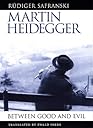
Martin Heidegger: Between Good and Evil
Product ID: 278137657
Desertcart purchases this item on your behalf and handles shipping, customs, and support to KUWAIT.
Buy Martin Heidegger: Between Good and Evil Reprint by Safranski, Rudiger (ISBN: 9780674387102) from desertcart's Book Store. Everyday low prices and free delivery on eligible orders. Review: Dealing with Heidegger's own 'Dasein' ... - I'm glad I read this book after reading Heidegger's Being and Time and not the other way round, because I would have had a rather `biased' view of Heidegger before reading his magnum opus. Rudiger Safranski, though not a withering critic of Heidegger nor a fawning disciple, presents the man with all his brilliance and weaknesses, and those human and political weaknesses during the 1930s and 1940s were serious. But Safranski's book not only looks at the human being that Heidegger was, with his friendships and his enemies, but also deals with the development of Heidegger's philosophical thinking, not in isolation but within a stream of twentieth-century German thinking, politics and culture. It's an absorbing read. Heidegger's philosophy developed after he broke with his early stage of being protected and promoted by the Catholic Church, which, in Being and Time, published in 1927 when Heidegger would have been 38 years old, seems to suggest a having taken leave of God for an undisclosed `Being', and a having substituted human beings made `in the image of God' for an open-ended and not quite obvious `Dasein'. In fact, there is the sense of a Nihilism infecting Heidegger's philosophy, while at the same time having deep and original insights into the human malaise as evidenced by an industrial and technological society `blinding' people into not seeing the `showing themselves' of objects and others around them. As Safranski points out from time to time, Heidegger's very focus on the Big Questions of `ontology' seemed to blunt his own self-understanding in an `ontic' sense, i.e. the human being in relation to others both personally and politically. Two people with whom Heidegger had complex relations - Hannah Arendt and Karl Jaspers - considered themselves (perhaps rightly) as his two closest friends, and yet he had ways of making it difficult for them at various stages in their lives to accept his ways and manner. The Jewish question, particularly in the era of National Socialism in Germany, makes Safranski devote a chapter to asking the question: `Is Heidegger Anti-Semitic?', and the answer is not immediately clear. However, while Heidegger's philosophy and politics became enmeshed in his mind during this period, there is indication that he was already withdrawing from some of the Nazi thinking and practice even during the war years. Both Jaspers and Arendt found ways of reconnecting to Heidegger after the war, but not without struggling through certain strains, more deeply by Arendt, with whom Heidegger had had an affair in her youth. Safranski's book is a triumph in that it deals with Heidegger's (not easy) philosophical views in an articulate and revealing manner, as well as placing him in his wider philosophical and cultural context, and without losing sight of the man that Heidegger was - brilliant philosopher, immature politician, friend, husband and lover. The original title of the book in German was Ein Meister aus Deutschland: Heidegger und seine Zeit, but the English translation (by Ewald Osers) somehow captures the essence of the person that Heidegger was: Martin Heidegger: Between Good and Evil. That latter phrase in the English title sums up how I feel about this great and interesting man, and, while I feel cautious about Heidegger on some fronts, I still want to read him and learn from him, while retaining the right to criticise him when I believe that is appropriate. Review: Beautifully written clarifies, contextualises and develops - I find with my limited brain I have to take this more slowly than I'd like - there are times I realise that I'm reading words and stopped comprehending. That's about my limitations though. One of the most complicated and radical thinkers is laid out here. There are some technical philosophical terms banded around. To some extent that is inevitable as Heidegger is trying to undo those technical philosophical constructions. It brings clarity to the ostensible contradiction between authenticity and membership of the Nazi party.
| Best Sellers Rank | 725,571 in Books ( See Top 100 in Books ) 355 in Historical Biographies 1701-1900 623 in German Historical Biographies 933 in Academic Philosophy |
| Customer reviews | 4.8 4.8 out of 5 stars (34) |
| Dimensions | 16.19 x 3.3 x 23.5 cm |
| Edition | Reprint |
| ISBN-10 | 0674387104 |
| ISBN-13 | 978-0674387102 |
| Item weight | 726 g |
| Language | English |
| Print length | 496 pages |
| Publication date | 14 Oct. 1999 |
| Publisher | Harvard University Press |
D**U
Dealing with Heidegger's own 'Dasein' ...
I'm glad I read this book after reading Heidegger's Being and Time and not the other way round, because I would have had a rather `biased' view of Heidegger before reading his magnum opus. Rudiger Safranski, though not a withering critic of Heidegger nor a fawning disciple, presents the man with all his brilliance and weaknesses, and those human and political weaknesses during the 1930s and 1940s were serious. But Safranski's book not only looks at the human being that Heidegger was, with his friendships and his enemies, but also deals with the development of Heidegger's philosophical thinking, not in isolation but within a stream of twentieth-century German thinking, politics and culture. It's an absorbing read. Heidegger's philosophy developed after he broke with his early stage of being protected and promoted by the Catholic Church, which, in Being and Time, published in 1927 when Heidegger would have been 38 years old, seems to suggest a having taken leave of God for an undisclosed `Being', and a having substituted human beings made `in the image of God' for an open-ended and not quite obvious `Dasein'. In fact, there is the sense of a Nihilism infecting Heidegger's philosophy, while at the same time having deep and original insights into the human malaise as evidenced by an industrial and technological society `blinding' people into not seeing the `showing themselves' of objects and others around them. As Safranski points out from time to time, Heidegger's very focus on the Big Questions of `ontology' seemed to blunt his own self-understanding in an `ontic' sense, i.e. the human being in relation to others both personally and politically. Two people with whom Heidegger had complex relations - Hannah Arendt and Karl Jaspers - considered themselves (perhaps rightly) as his two closest friends, and yet he had ways of making it difficult for them at various stages in their lives to accept his ways and manner. The Jewish question, particularly in the era of National Socialism in Germany, makes Safranski devote a chapter to asking the question: `Is Heidegger Anti-Semitic?', and the answer is not immediately clear. However, while Heidegger's philosophy and politics became enmeshed in his mind during this period, there is indication that he was already withdrawing from some of the Nazi thinking and practice even during the war years. Both Jaspers and Arendt found ways of reconnecting to Heidegger after the war, but not without struggling through certain strains, more deeply by Arendt, with whom Heidegger had had an affair in her youth. Safranski's book is a triumph in that it deals with Heidegger's (not easy) philosophical views in an articulate and revealing manner, as well as placing him in his wider philosophical and cultural context, and without losing sight of the man that Heidegger was - brilliant philosopher, immature politician, friend, husband and lover. The original title of the book in German was Ein Meister aus Deutschland: Heidegger und seine Zeit, but the English translation (by Ewald Osers) somehow captures the essence of the person that Heidegger was: Martin Heidegger: Between Good and Evil. That latter phrase in the English title sums up how I feel about this great and interesting man, and, while I feel cautious about Heidegger on some fronts, I still want to read him and learn from him, while retaining the right to criticise him when I believe that is appropriate.
D**E
Beautifully written clarifies, contextualises and develops
I find with my limited brain I have to take this more slowly than I'd like - there are times I realise that I'm reading words and stopped comprehending. That's about my limitations though. One of the most complicated and radical thinkers is laid out here. There are some technical philosophical terms banded around. To some extent that is inevitable as Heidegger is trying to undo those technical philosophical constructions. It brings clarity to the ostensible contradiction between authenticity and membership of the Nazi party.
S**N
great biography
Quite possible the best biography of a philosoper ever. The chapter on Being and Time is excellent. A must buy.
J**P
The other big book
This is the most important book for my life. It reads like a novel. I thought the German title was 'Ein Meister aus Deutschland'; it is a serious tragic tale full of magic, anguish, hidden gods, mystic power, and human misunderstanding. Since Heidegger's philosophy was so difficult even to himself, a biography can make brief stabs into the terrain of the philosophy with vague hints. And this, mixed with descriptions of a life lived near to that philosophy and its object. The object of Heidegger's philosophy is existence, and also thought itself. If novels are successful at presenting an existence, then this biography is similarly successful. And the thought it presents, which takes us INTO existence is first rate. I myself returned to Heidegger's books for a decade under the stimulus of this mere biography.
A**Q
Judging the thinker & his thoughts
This is a biography as well as an exposition of Heidegger's ideas. As an exposition of the philosopher's ideas, it is admirably clear and lucid. But using the same objective dispassionate prose on Heidegger's life the biographical passages read in places like reportage. Biographical details are at times scarce. Only in chapters about Heidegger's last years does Safranski allow anecdotes such as the one about Heidegger discussing football with the interviewer instead of philosophy, anecdotes which allow the reader a glimpse into the philosopher as human being. Otherwise it is only after 300+ pages that I discover Heidegger had two sons and they never reappear in the narrative. And the author does not tell the reader much about Heidegger the man during the crucial Third Reich years. This book examines in detail Heidegger's thought within its intellectual and political contexts. This part of the book is very strong. The author gives a detailed portrait of H's rural, artisan, religious background and his anti-modern anti-technology anti-cosmopolitan sentiment that informs his philosophy of roots, and how this, by a slight shift of focus, became justification of Nazi ideology. The extent to which Heidegger was seduced by Nazism is laid bare by the presentation of facts including excepts from his letters. The author does not judge but let the reader draw his or her own conclusions. Heidegger emerges from this book a much diminished person and it is up to the reader to decide whether his philosophy is strong enough to withstand ideological adjustments by the philosopher himself during the Nazi years or political appropriation by others, then as now, especially now (2017) with the rise of nationalism everywhere, through the concepts of Volk, Heimat, blood & soil etc.
J**N
I ordered this book in hardcover (publisher:Harvard University Press, Cambridge, MA) because of its lasting value. It was in excellent condition, and was shipped promptly. This book is also available in soft cover (paperback). Martin Heidegger (1889-1976) was a genius in philosophy (born in Germany as was another emblematic genius, Albert Einstein) and his thinking will last through the ages. He has had a profound impact on psychology and psychiatry (see his Zollikon Seminars, authored by Martin Heidegger and edited by a very famous Swiss German psychiatrist, Medard Boss), as well as upon other fields of inquiry. Heidegger's Collected Works approach 100 volumes. He was extremely bright, and all of his manuscripts were handwritten because he did not want a typewriter or personal computer to come between his mind and the written word. His hand was part of who he was, and his thinking would flow from his mind, heart, spirit through his hand onto the manuscript page. His Magnum Opus is Sein und Zeit (translated by Macquarrie and Robinson as Being and Time - the best translation available in English) completed in 1926 and dedicated to his mentor, Edmund Husserl (the father of phenomenological philosophy and a Jew). This biography is a wonderful introduction to Martin Heidegger, the human being and the philosophical genius. Professor Heidegger himself always downplayed the significance of his biographical narrative. He preferred that others would focus on his thinking in and of itself. However, there is something magnetic about human genius and we can all benefit from knowing the human being who was so gifted with genius (and wisdom). He loved his native land and very much regretted Germany's tragic immersion in World War I, the Nazi scourge on humanity, and World War II. He loved his native tongue, but also loved the language of Ancient Greece. His "conversational partners" spanned the centuries. Genius has a way of finding other genius. This biographer has done a masterful job of telling one story of the life and works of Martin Heidegger. Other stories of this genius also need to be told.
N**N
As a person who about 25 years ago came across Heidegger’s name as a titan of 20th. century philosophy and ever since has been on a quixotic quest to understand what he really meant , this amazing book brought my saga of understanding “Saint Martin of Messkirch” to a satisfying conclusion : Professor Safranski makes an impressive effort to clarify one of the most obscure philosophers of our time , if not THE most obscure one . He elucidates Heidegger’s complex thought and writings without trivializing them . There lies of course a challenge to the layman and those unfamiliar with the obscurantist sage’s cryptic terminology, yet again the whole idea of Heideggerian ontology is still within grasp thanks to Safranski’s scholarly explanation . I learned a lot from this book, and it introduced me to German thinkers contemporary of Heidegger, who were critical of his thought in various domains of human sciences which was very interesting. Also interesting was the coverage of the love/hate relationship between the trio of Jaspers-Heidegger-Arendt, and how Heidegger's flirtations with his Nazi "revolution" almost ruined that unique friendship of great minds. At the end my own personal verdict on Heidegger after reading this book and a few others is that he wanted to entice us to return to the original amazement of perception which was also the original point of philosophy . The way he described his approach appeared more poetic than philosophical , yet like Hölderlin , Heidegger’s favorite poet , he never ceased to arouse the mind and start a new way of thinking.
A**I
Honestly, my purchase was primarily based on the fact that the author and I share the same surname. What I received was a biography that did three things for me (an ordinary guy with ordinary intelligence). 1. Made clear Heidegger’s impact on philosophy and how his thought compared and contrasted to other leading thinkers of the day. 2. Provided an objective analysis of Heidegger’s involvement with Hitler’s National Socialist Party. 3. An engaging presentation of the relational ups and down Heidegger had with Hannah Arendt (a Jew) and others. Especially poignant were the episodes shared about Heidegger’s last years of life. Safranski is highly readable and engaging!
D**Z
This book's richness is quite impossible to adequately convey. Safranski not only conjures up the circumstances surrounding Heidegger and his work, but also touches on the zeitgeist surrounding that which surrounded Heidegger. One of the most exciting things I've read in recent years is the portion of the book explicating the 'life philosophy' movement of the late-19th c./early 20th c. and how this played out among the professional and academic class. Fascinating book, and I find myself still able to continue to mine nuggets through the many re-readings of it I have done this past year. By the way, I initially purchased a soft cover copy at Borders and, when I discovered I had accidentally left it behind in a coffee shop somewhere, I had to re-purchase the book again (this time via Amazon, and a hard-back copy now, since it has become a 'lifetime book' for me - one to which I return, over and over again.) Beautifully written and well-translated, this book is Safranski's major achievement, his genuine tour de force. Yes, I profited from his Nietzsche book as well, but that book does not convey the care and - one is tempted to use the word 'love' - that he put into this Heidegger biography. An unqualified masterpiece!
J**A
If you want to tackle Heidegger, this is a great place to start. (Along with Simon Critchley's podcast series). Terrific book. Well written. Fair and even-handed. And just super interesting all around. Highly recommended!
Trustpilot
3 weeks ago
2 weeks ago