We remain fully operational. Our teams are working around the clock to ensure your deliveries continue safely.

DOWNLOAD THE APP


Copyright © 2025 Desertcart Holdings Limited
DOWNLOAD THE APP
Buy anything from 5,000+ international stores. One checkout price. No surprise fees. Join 2M+ shoppers on Desertcart.
Desertcart purchases this item on your behalf and handles shipping, customs, and support to KUWAIT.
Review: Good series - Nephew likes reading them Review: Tehanu - Tehanu returns us to the world of Earthsea, to the time after the The Farthest Shore and The Tombs of Atuan. Tenar has grown older, had a family, and is now a widower when she received an urgentl from Sparrowhawk's former mentor Ogion, the mage that took her in when she first came to the area. As she journeys to her cottage we are introduced to the little girl Therru, marked by horrible tragedy and evil. While at Ogion's cottage, Sparrowhawk returns to Tenar, but he returns scarred and damaged, missing part of himself. Tenar, Sparrowhawk, and little Therru make a life journey together to put the pieces of themselves back together and bring the work back to a better place. This book was a fantastic read. it gave me what I've always wanted at the end of a series....just one more book. A book to show me how they ended up, what their family was like, and who would continue on after them. Tenar and Ged (also called Sparrowhawk), reunited after many years, are still the same characters I had grown to love in the earlier books. Only this time they are wiser, and will need to use all of their wisdom to help little Therru. Therru drew my sympathy from the start, and I admired her spirit and her tenacity to overcome her difficulties. This was a great addition to the Earthsea Cycle. 4/5
| Best Sellers Rank | #1,381,419 in Books ( See Top 100 in Books ) #62 in Teen & Young Adult Fiction about Self Esteem & Reliance #77 in Teen & Young Adult Classic Literature #149 in Teen & Young Adult Epic Fantasy |
| Customer Reviews | 4.5 out of 5 stars 3,966 Reviews |
T**S
Good series
Nephew likes reading them
N**D
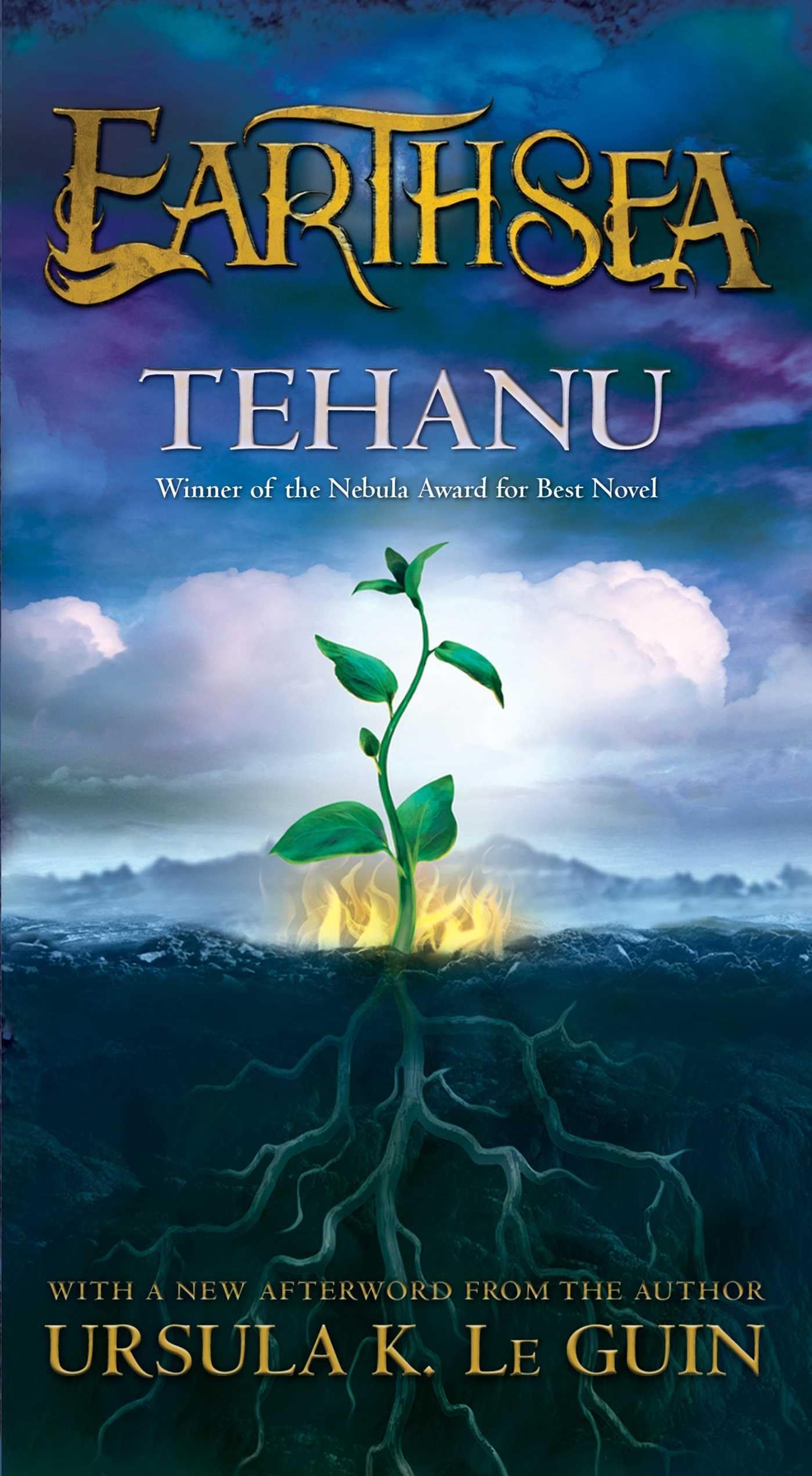
Tehanu
Tehanu returns us to the world of Earthsea, to the time after the The Farthest Shore and The Tombs of Atuan. Tenar has grown older, had a family, and is now a widower when she received an urgentl from Sparrowhawk's former mentor Ogion, the mage that took her in when she first came to the area. As she journeys to her cottage we are introduced to the little girl Therru, marked by horrible tragedy and evil. While at Ogion's cottage, Sparrowhawk returns to Tenar, but he returns scarred and damaged, missing part of himself. Tenar, Sparrowhawk, and little Therru make a life journey together to put the pieces of themselves back together and bring the work back to a better place. This book was a fantastic read. it gave me what I've always wanted at the end of a series....just one more book. A book to show me how they ended up, what their family was like, and who would continue on after them. Tenar and Ged (also called Sparrowhawk), reunited after many years, are still the same characters I had grown to love in the earlier books. Only this time they are wiser, and will need to use all of their wisdom to help little Therru. Therru drew my sympathy from the start, and I admired her spirit and her tenacity to overcome her difficulties. This was a great addition to the Earthsea Cycle. 4/5
T**T
Ursula gets better with every book !
Incredible. Beautiful. Compelling. I understand why this series is considered one of the greatest fantasy novel series of all time.
E**R
Paths of the powerless (some spoilers if you have not read through book 3)
I read the Earthsea trilogy when I was a teen in the 90's. I heard rumors then of a 4th book, Tehanu, and wanted badly to read it, but never saw it in stores. The internet didn't exist yet, so I did not pursue it further, believing I would read it someday. I finished reading it today, as a woman in my mid-30's. It's a book I am glad I didn't try to grasp when I was younger. Like Le Guin mentions in the afterword, she said she needed nearly 18 years to gain the experience to write the book, and I think I needed my 20 years to read it and be ready to hear what it had to say. I understand the book has been criticized by some for being overly 'feminist', and she addressed that in the afterword deftly, and without shrinking or apologizing for what she wrote, and I love her all the more for it. I don't want to spoil anything, but I feel the heart of this book is in Tenar's character development through maiden and then mother, and her relationship to crones as she looks forward to the next stage of her life. Her relationships to power are explored--both the power she possesses innately, and the powers that have influenced her externally. She cares for a girl who has been disfigured and disused beyond the point of healing, such that only a transformation would allow her to thrive. Ged spent the last of his power at the end of 'The Farthest Shore', and must find a renewed purpose to continue living, as his power is no longer the core of his identity, and he is no longer effectual in the ways in which he has been accustomed his whole life. This book explores further the role of death in the life cycle, and the pressures of pain and injustice that push each of these lives deep into the earth, from which they must all burst forth and transform renewed as seedlings must reach for the sunlight. Reading a high fantasy book with a woman past her flower (invisible as they often are) as the main protagonist has affected me profoundly. I wish desperately that I could still thank Ursula K. Le Guin for what her writing and vision have mean to to my life, but I am too late to catch her before her final departure. I felt as though, reading this, that in the telling she had whispered a piece of her true name in my ear, and left behind a home in Earthsea, and her books and sage insight, and the cycle continues unbroken.
E**2
Glimmering prose
Ms. Me Guin holds absolute dominion over storytelling. With flawed yet beautiful characters she explores the role of gender in society but, never loses track of the magical world she has built!
B**D
The plot is engaging and wrapped up nicely at the end, satisfyingly, and with room for more stories.
I am considering this one a 3.5 star rating. I enjoyed Tehanu more so than The Farthest Shore, but not quite as much as A Wizard of Earthsea or The Tombs of Atuan. Speaking of The Tombs of Atuan, I was very pleased to be reacquainted with Tenar, some 25 years after we left her in that book. I was pleased to see that she found a simple life on Gont, away from the terror and blind fanaticism that was her experience on Atuan. In this, Tehanu is a different story. It is slower paced than the books preceding it, but I found that it didn't suffer for this. Quite the opposite. Tenar (as well as Therru, Ogion, Ged, and a few other side characters on the island) is interesting to read about whether she is escaping pitch black labyrinthine depths, or whether she is planting peach trees and sewing a new red dress. Now, that isn't to say that Tehanu is without conflict; on the contrary the plot is engaging and wrapped up nicely at the end, satisfyingly, and with room for more stories (I'm especially looking forward to the Other Wind). And in true Le Guin fashion she raises many worthwhile topics of conversation in these pages.; especially the focus on a woman's 'place' in Earthsea. Things are changing in the islands of Earthsea, and as far as I can see, for the better. Her prose is as efficient as ever, and every once in a while she hits you with one of those short little passages that is so intricately beautiful that you can't help but stop and read it again. There are a couple of those throughout.
S**G
An exploration of feminism and identity
"Tehanu" steps back from the series' focus on epic journeys and instead focuses on Tenar and her place in the world. I like the exploration of identity and autonomy. Ged has lost his magic, so he has to shape a new identity for himself, and Tenar's life is changing. There is the idea of a person being shaped by the events around them and playing a role rather than being their own person. Tenar says, "I chose to mold myself like clay... I made myself a vessel. I know the shape. But not the clay. Life danced me. I know the dances. But I don't know who the dancer is." She is saying that even when she was given choices, she was only choosing a role for herself and that she didn't know who she was as a person. I like that discussion because it eloquently lays out a question that many people have: who am I? Where does the individual begin and the social conditioning end? I disagree with the overall answer, though, because I don't think that there is a transcendent self separate from the person immanent in the world. As Chuck Palahniuk said, "Nothing of me is original. I am the combined effort of everyone I've ever known." In Tenar's analogy, the clay gains its meaning only as a vessel; the dancer is defined by the dances. The question shouldn't be trying to figure out who the dancer "really is" (as if there were some meaningful answer to that question) but rather to figure out the right dances to do. We shouldn't ponder on the nature of clay; we should make things with it. The book has a focus on social structures. I remember reading some second-wave feminist writings by Catherine MacKinnon where she describes women as superior for reasons relating to their connection to the earth and bearing children and having periods and breastfeeding (if I recall correctly). Le Guin reflects, in her afterword, about a conversation. One character, Moss, says, "Who knows where a woman begins or ends?... I have roots... I go back into the dark!... Who'll ask the dark its name?" and the protagonist, Tenar, responds, "I will... I lived long enough in the dark." Moss' statement seems very much like MacKinnon's writing, and Tenar's response, very much in the theme of her explorations in the book, is an expression of dissatisfaction with the simple mysticism of second wave feminism. She feels as though other peoples' explorations of identity aren't helping her own search, and a reflection of the power structures and systemic injustices that she has experienced are more relevant to her than discussions of intrinsic identity.
K**R
Sad, wonderful, nurturing, magical..
It has finished unexpectedly as it began, led through plenty of miserable moments, as well as deeply bright, tender moments full of love. Aged has lost his power but gained something much greater than that.. heartbreaking and heartwarming at the same time and deeply comforting
Trustpilot
4 days ago
1 week ago